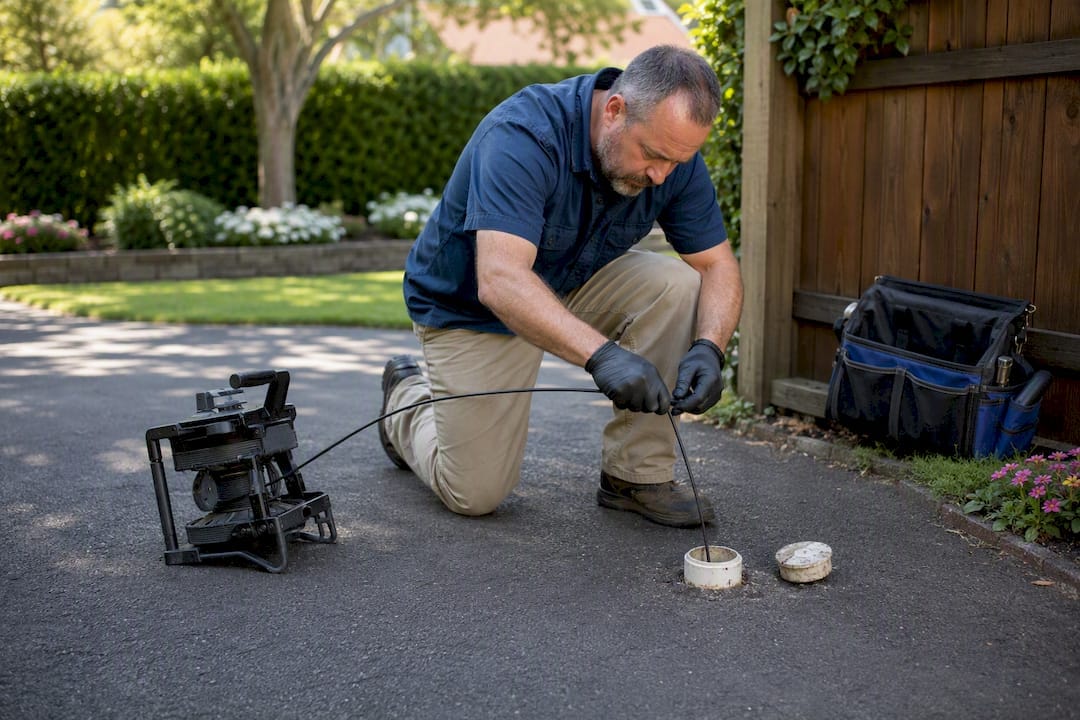
Expect a residential sewer scope cost somewhere between $100 and $700, with most straightforward jobs landing near $250. The number that actually matters isn’t the range, it’s access. If the house already has a working cleanout, you’re near the bottom of that range. If the inspector has to pull a toilet or install a new cleanout to get the camera in, you’re paying more, sometimes a lot more.
Compare that to what you’re protecting yourself from. A collapsed clay lateral or a belly full of roots can run $4,000 to $25,000 to repair, depending on whether it’s a spot repair or a full trenchless replacement. A $250 scope that catches that problem before closing is one of the cheaper insurance policies in a real estate transaction.
- Bundled with a home inspection: commonly falls within a moderate range depending on location and inspector
- Standalone sewer scope: typically costs a moderate amount varying by access complexity
- Access requires new cleanout install: $700–$1,500+
Key Takeaways
Sewer scope cost depends primarily on cleanout access, not line length or camera type, so ask about access before comparing any two quotes.
| Point | Details |
|---|---|
| Typical price range | Expect $100–$300 with an existing cleanout, $250–$700 standalone, and $700+ if a new cleanout is needed. |
| Access is the biggest factor | Toilet-removal and new-cleanout jobs cost more because of labor, not because the scope itself changes. |
| Add-ons add up fast | Locating, video reporting, jetting, and follow-up scopes can each add $40 to $800 depending on scope. |
| Report quality matters | A complete report includes full video, documented pipe material, and notes on any unreached sections. |
| Upchurch Inspection option | Upchurchinspection provides documented, standards-based sewer scopes across the Mid-South with upfront access-fee discussion. |
Table of Contents
- What Drives Sewer Camera Inspection Cost and Pricing Models
- What Factors Push Sewer Line Inspection Cost Higher?
- What Should a Sewer Scope Report Actually Include?
- Should You Rent a Camera and Try DIY Instead?
- Questions to Ask Before Booking a Sewer Line Video Inspection
- Why Homeowners Trust Upchurch Inspection for Sewer Scopes
- What Experience Actually Teaches About Sewer Scope Pricing
- How to Book a Sewer Scope With Upchurch Inspection
- Sources
What Drives Sewer Camera Inspection Cost and Pricing Models
Pricing isn’t uniform because providers structure it differently, and homeowners get confused comparing a flat quote from one company to a per-foot bid from another. Most residential inspectors quote a flat fee for a standard single-family lateral, typically 50 to 100 feet from the house to the street or septic tank. That flat number covers a “normal” job: existing cleanout, no unusual obstructions, a single continuous run.
Longer runs, commercial laterals, or multi-building properties sometimes get billed per linear foot, typically a range of moderate rates per foot instead of a flat rate. A 200-foot commercial run priced at $2 per foot lands around $400 before any add-ons, which is why apartment complexes and commercial properties see different math than a three-bedroom ranch.
Regional labor rates move the needle too. A scope in a rural West Tennessee county with lower overhead and less traffic often prices below the same job quoted in a dense metro market. That’s not price gouging, it’s the same reason an oil change costs more in one zip code than another. Sources disagree on averages partly because of this regional spread, and partly because some datasets blend simple scopes with complex-access jobs, pulling the average toward $996 even though most straightforward jobs cost far less.
- Flat rate: Standard for single-family homes with existing access
- Per-foot rate: Common on long or commercial lines
- Hourly labor: Occasionally used when access problems eat into the appointment
What Factors Push Sewer Line Inspection Cost Higher?
Access is the number one variable, and it’s not close. Here’s how the tiers typically break down:
- Existing cleanout present — the camera goes in through a dedicated access point, no demolition needed. This is your $100–$300 territory.
- Toilet removal required — no cleanout near the house, so the inspector pulls a toilet to feed the camera through the drain. Add roughly $50 to $175 to the base price.
- New cleanout installation — no usable access point exists anywhere on the line. This means cutting into the pipe and installing hardware, which can add $500 to $1,500 or more depending on where the cut has to happen.
Beyond access, line length and pipe material matter. Older homes with Orangeburg pipe (a tar-paper composite common through the 1970s) or cast iron often need slower, more careful camera runs than PVC, since the material itself is more prone to collapse or blockage that stalls the camera. Camera technology plays a role too. A basic push camera handles most residential jobs fine, but pan-and-tilt or HD cameras that can rotate and inspect lateral connections cost more to operate and usually show up as a line-item upcharge, not a swap on price. Add-ons stack from there: locating/sonde service runs $40 to $150, video recording and a written report often add $50 to $150, hydro-jetting to clear a line before scoping runs $250 to $800, and a follow-up verification scope after repairs typically costs $100 to $250.
Pro Tip: If you already know the line has roots or grease buildup, ask about a jetting-plus-scope package upfront. Paying for cleaning and inspection together is almost always cheaper than paying for a scope that shows nothing because the camera couldn’t get past a blockage.
What Should a Sewer Scope Report Actually Include?
A sewer scope isn’t just someone snaking a camera down a pipe and telling you it “looked okay.” Industry standard operating procedures from InterNACHI call for specific documentation, and if your report doesn’t have it, you didn’t get a complete inspection.
At minimum, expect:
- Full digital video footage of the run, not just verbal notes
- Identified pipe material (PVC, cast iron, clay, Orangeburg)
- Clear documentation of how much of the line was actually inspected
- Written notes on any section the camera couldn’t reach, and why
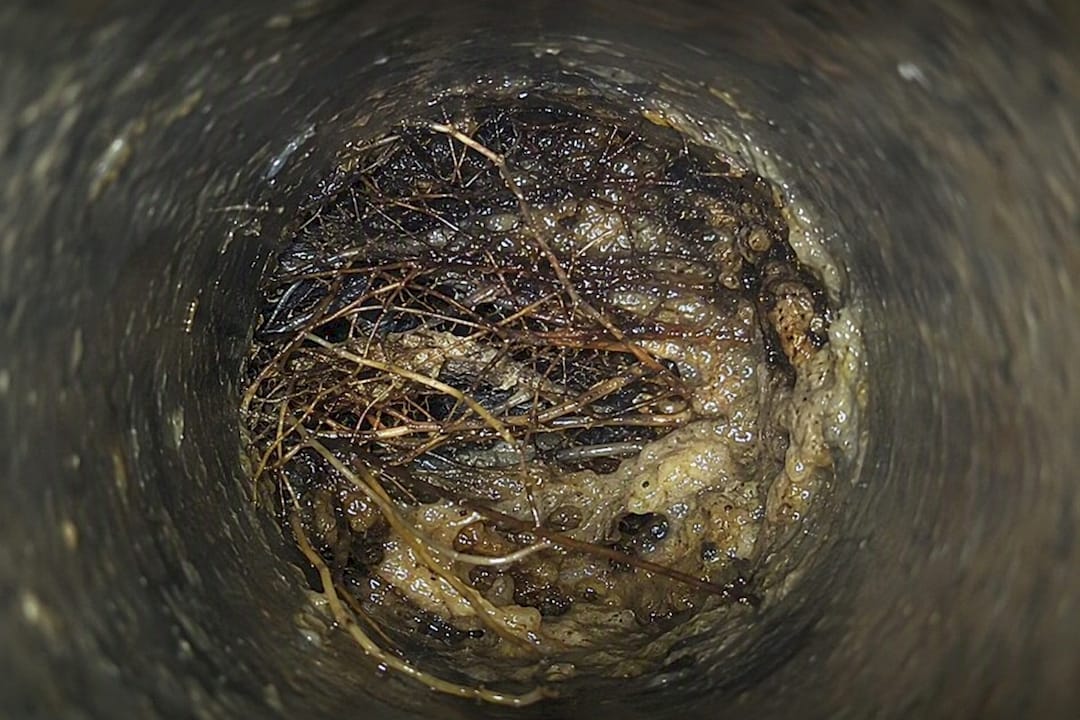
A sewer scope is a snapshot in time. If the video stops short of the municipal tap or septic tank without an explanation, the inspection isn’t finished. That gap should be documented, not glossed over.
Red flags to watch for in a report: video that just ends with no comment, no mention of pipe material anywhere, or a summary that says “no issues” with nothing to back it up. If the inspector didn’t reach the main connection, ask why and whether a re-run is warranted once any blockage clears.
Should You Rent a Camera and Try DIY Instead?
Homeowner-grade sewer cameras are more available now than they used to be, and the price makes DIY tempting for some situations. Rental units from equipment centers typically run $50 to $150 per day, and consumer-grade cameras for purchase start around $200 and climb past $1,000 for models with better reach and self-leveling heads.
The limitations show up fast, though. Cheap cameras often can’t push far enough to reach the street connection, footage quality makes defects hard to judge, and there’s no standardized report if you later need documentation for a real estate transaction or insurance claim.
- DIY makes sense for: routine maintenance checks on a line you already know is in decent shape
- Call a professional for: home purchases, older homes with unknown pipe material, or any situation where you’ll need a written report
Questions to Ask Before Booking a Sewer Line Video Inspection
A quote that looks cheap on the phone can turn into a bigger invoice once the inspector shows up and finds no cleanout. Ask these questions before you book:
- How will you access the line, and what happens if there’s no cleanout on site?
- Do I get the raw video file, or just a written summary?
- Is locating/sonde service included, or is that a separate add-on?
- What’s the cost for a follow-up scope after repairs are made?
- What’s your cancellation policy, and do you charge for after-hours or emergency calls?
Pro Tip: Get this in writing, even if it’s just a confirmation email. Verbal quotes have a way of growing once the crew is standing in your driveway. Providers themselves recommend getting multiple quotes whenever a house has no visible cleanout, since access-driven price swings between two “similar” bids can run into the thousands.
Why Homeowners Trust Upchurch Inspection for Sewer Scopes
Upchurchinspection performs inspections across Tennessee, Arkansas, Mississippi, Missouri, and Kentucky, and sewer scopes get the same documentation discipline as our structural and mechanical work.
- Inspectors trained beyond state minimum licensing requirements
- Full video footage delivered with the report, not just a summary paragraph
- Documented pipe material and clear notes on any section the camera didn’t reach
- Locating/sonde service available on request when you need an exact dig point before repairs
- Access fees discussed upfront, before the appointment, not discovered on the invoice
You can see what a full scope covers on our sewer scope inspection page, and review common defects our cameras catch before your own appointment.
What Experience Actually Teaches About Sewer Scope Pricing
The conventional advice out there treats sewer scope pricing like a simple menu item: pick a number, book the job, done. That’s not how it works in practice, and pretending otherwise sets homeowners up to feel blindsided when a quote grows after the crew arrives.
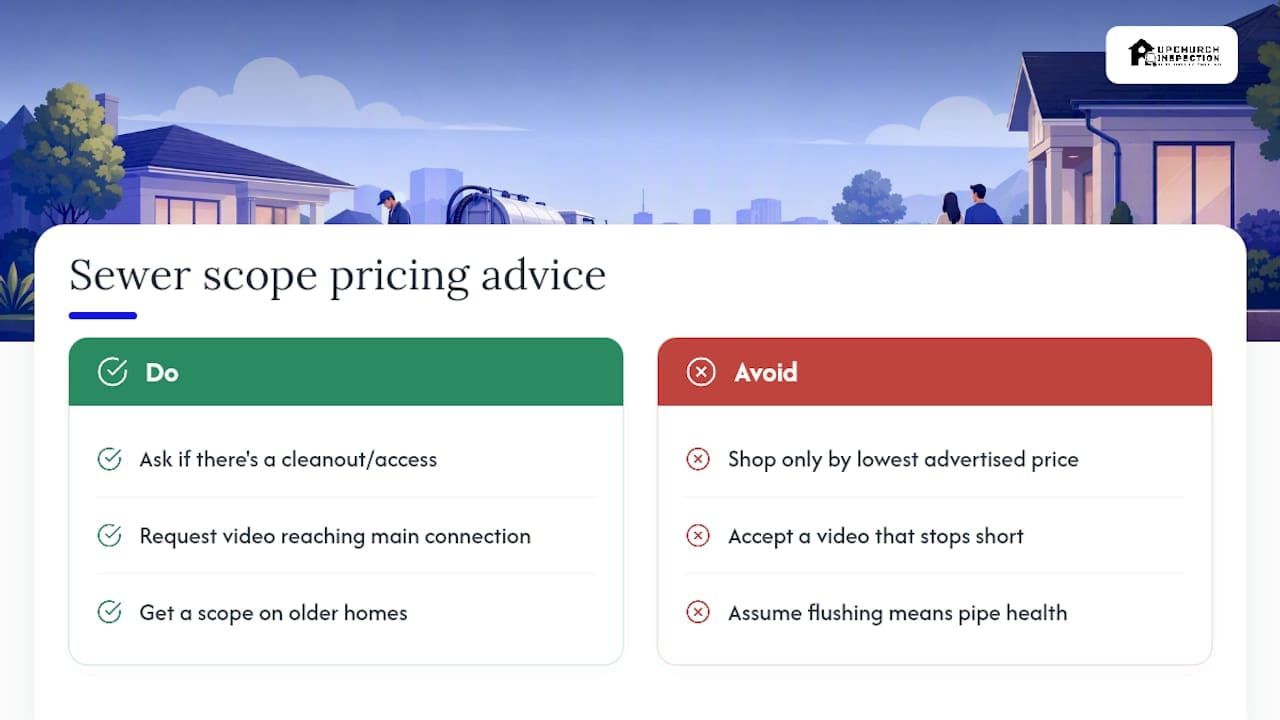
The real judgment call isn’t “is $300 fair,” it’s “does this house have a cleanout, and does the quote account for that.” A homeowner who asks about access before booking will almost always end up with a more accurate number than one who just calls around comparing flat prices. That single question does more to prevent surprise fees than any amount of shopping for the lowest advertised rate.
I’d also push back on treating the scope as optional on older homes just because the toilets flush fine. Clay and Orangeburg pipe can look and behave normally for years right up until a root intrusion or a partial collapse turns into a five-figure repair. The report matters as much as the scope itself. If the video stops short of the main connection with no explanation, that’s not a clean bill of health, it’s an incomplete answer.
— Holly
How to Book a Sewer Scope With Upchurch Inspection
If you’re weighing a home purchase or you just want a maintenance check on an older line, the fastest path is booking a scope alongside a full inspection rather than chasing separate estimates from separate companies. Upchurchinspection handles both in one visit across the Mid-South, which means one crew, one report, and no guessing about whether two companies’ findings line up.
Before your appointment, locate your cleanout if you know where it is, and clear access to crawlspaces or utility areas where the line runs. That alone prevents most of the surprise access fees discussed above. When you call or request a quote, mention the home’s age, known pipe material if you have it, and whether you need the scope bundled with a broader inspection.
Start with our property inspection services page to see what’s included and request your estimate.