
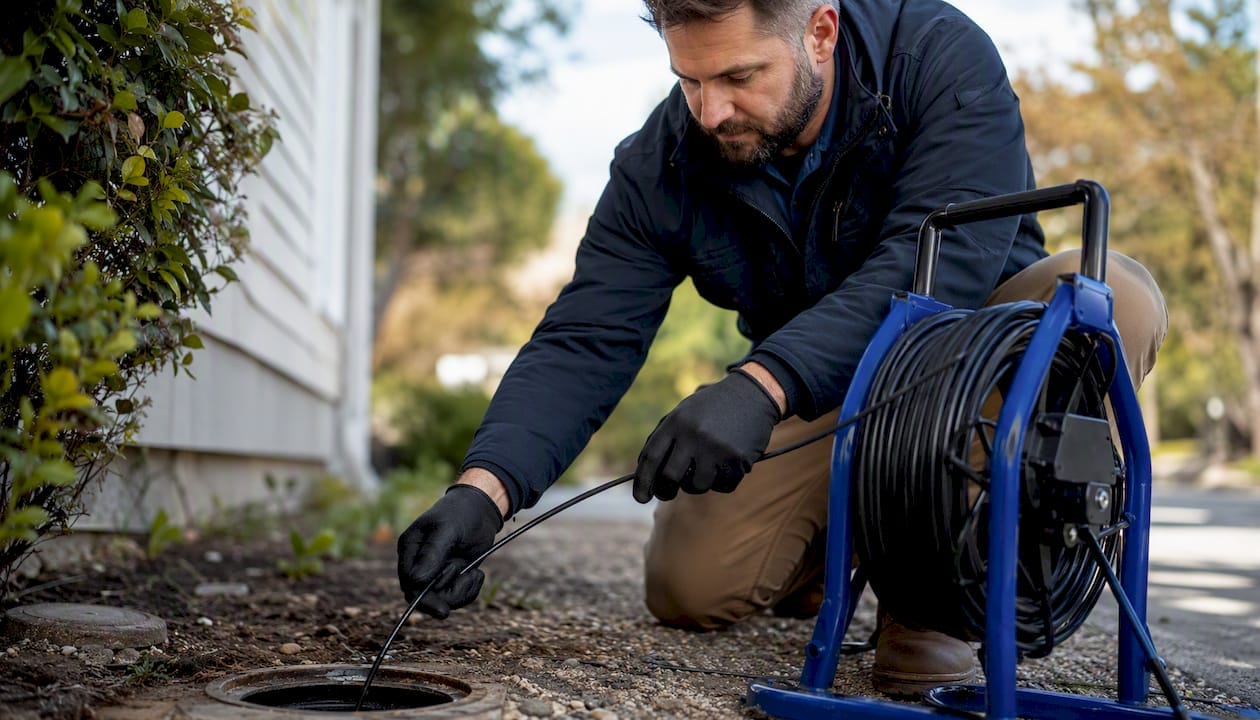
A sewer scope inspection is one of the most cost-effective risk checks you can run on a property. For a typical fee within the cost range charged by many inspectors, a camera run through the building’s lateral line can surface defects that may incur very expensive repair or replacement costs — costs that land entirely on you the moment you close. If you are buying a home, order a scope during your due-diligence period. Request the video file, time-stamped still images, pipe material identification, and a written condition summary with defect locations noted by linear footage from the cleanout. That documentation is what drives accurate repair quotes and, when problems appear, gives you objective leverage with the seller.
- Order the scope during due diligence, not after closing.
- Request the raw video file plus a written report with defect locations in linear footage.
- Use PACP-style condition notes (or ask the inspector to rate severity) so you can compare contractor quotes on equal footing.
- If major defects appear, get at least two contractor quotes before deciding whether to negotiate a credit, require pre-closing repairs, or walk away.
Pro Tip: Ask for the video file to be included with your report, not just a summary. Contractors who see actual footage give you far more accurate estimates than those working from a verbal description.
Table of Contents
- How does a sewer scope differ from a standard home inspection?
- How a sewer scope inspection is performed on site
- What inspectors commonly find on a sewer scope
- Why sewer scope inspections matter: financial, health, and resale risks
- When should you schedule a sewer scope?
- What does a sewer scope cost, and how long does it take?
- What to do when the scope finds problems
- Pipe materials and why some carry higher risk
- Key Takeaways
- What the camera actually tells you — and what it doesn’t
- Upchurchinspection delivers the documentation buyers actually need
- Useful sources and further reading
How does a sewer scope differ from a standard home inspection?
A standard home inspection covers visible plumbing: fixtures, supply lines, drain function, water heater condition, and accessible pipe sections. What it cannot see are underground lateral defects — root intrusion, bellied sections, cracked joints, or a partially collapsed pipe buried three feet below grade. InterNACHI confirms that home inspectors check visible plumbing but have no way to evaluate the buried lateral without a separate camera scope.
A sewer scope is a distinct service. A CCTV camera mounted on a flexible cable is inserted into the building’s sewer lateral, typically at a cleanout access point, and pushed toward the municipal connection. The operator monitors live video and records the entire run. The deliverables from a properly conducted scope include:
- A continuous video file of the full lateral run
- Time-stamped still images captured at each defect location
- Pipe material identification (clay, cast iron, PVC, Orangeburg, etc.)
- Defect locations noted by linear footage from the cleanout
- A written condition summary with recommended next steps
That combination of media and written documentation is what separates a useful scope report from a verbal opinion. Without it, you have no basis for contractor quotes and no negotiating evidence.
How a sewer scope inspection is performed on site
The process is straightforward, though access conditions vary. Here is what happens during a typical residential scope:
- Locate the cleanout. The operator finds the building’s sewer cleanout, usually a capped pipe near the foundation exterior or in a crawlspace. If no accessible cleanout exists, a test plug may need to be removed from a floor drain or toilet, or a small excavation may be required.
- Deploy the camera. The flexible cable with a camera head is fed into the lateral. The operator monitors live video on a screen, noting pipe material, joint condition, and any visible defects as the camera travels toward the municipal connection.
- Document as you go. The operator records continuous video and captures stills at every defect, noting the distance from the cleanout in linear footage. That footage measurement is critical — it tells a contractor exactly where to dig or line.
- Produce the report. After the camera run, the inspector compiles the video, stills, and written notes into a report. A complete report identifies pipe material, defect type, severity, and location.
A residential sewer scope typically takes 30–60 minutes on site. Scheduling it early in your due-diligence window leaves time to get contractor quotes and negotiate before your contingency deadline.
Most buyers can schedule a scope within one to two business days of going under contract. The report turnaround is usually same-day or next-day. Waiting until the last day of due diligence is a common mistake — if the camera finds a belly or root mass, you need time to get quotes.
What inspectors commonly find on a sewer scope
Camera footage surfaces a predictable set of failure modes. Understanding what each one means helps you read a report without panic — and without underreacting.
- Root intrusion. Tree and shrub roots enter through joint gaps and grow into the pipe. Light root intrusion can sometimes be cleared by hydro-jetting and managed with periodic maintenance. Dense root masses that have deformed the pipe or caused joint separation usually require repair or replacement. Check common sewer line defects for field examples of how this looks on camera.
- Bellied or sagging sections. A belly forms when the pipe settles and loses its downward slope, creating a low point where waste pools. Standing water in a belly accelerates corrosion and causes recurring clogs. Bellies rarely respond to cleaning alone; the pipe usually needs to be re-graded or replaced in that section.
- Offset joints and joint separation. Ground movement, soil settlement, or tree roots can shift pipe sections out of alignment. Even a small offset creates a ledge that catches solids and allows groundwater infiltration. Severe offsets can eventually cause structural failure of the line.
- Cracks, corrosion, and collapsed pipe. A localized crack in an otherwise sound pipe may support a spot repair or trenchless lining. Systemic corrosion or multiple collapse points across the run typically indicate the entire lateral needs replacement.
- Grease, scale, and obstructions. Heavy grease buildup and mineral scale narrow the effective pipe diameter and slow drainage. These are often maintenance issues rather than structural ones, but scale in old cast iron can be severe enough to affect service life estimates.
The difference between a maintenance issue and a capital repair is not always obvious from a single still image. Continuous video, with the camera moving through the pipe, is what lets an experienced inspector distinguish a surface deposit from a structural failure.
Why sewer scope inspections matter: financial, health, and resale risks
The financial case is direct. According to ReportWalk, latent sewer problems can range from $10,000 to $30,000 in repair, replacement, and surface restoration costs. A $150–$400 scope fee is a small fraction of that exposure. Once you close, the lateral from your foundation to the municipal connection is your responsibility in most jurisdictions — the municipality owns the main, but the building lateral is the homeowner’s problem.
Insurance does not fill this gap. GEICO’s coverage guidance confirms that standard homeowner policies typically exclude sewer line repair and replacement. Sewer/water backup riders, which cost roughly $40–$80 per year, generally cover damage caused by a backup — not the cost to repair or replace the failed pipe itself. That distinction matters when a collapsed lateral causes a sewage backup in a finished basement.
Beyond cost, there are health and property risks. A cracked or separated lateral can allow sewage to leach into the soil near the foundation, creating odor, moisture intrusion, and potential contamination. A collapsed pipe that causes a backup inside the home creates an immediate health hazard and can damage flooring, framing, and finished surfaces.
For buyers, video evidence often converts into negotiated credits or pre-closing repairs rather than surprise emergency replacements after closing. Sellers respond differently to objective camera footage than to a verbal claim that “the sewer might have issues.” The video is the argument.
Statistic callout: A sewer scope costing $150–$400 can surface repair or replacement needs in the $10,000–$30,000 range — a return on diagnostic investment that few other inspection add-ons can match.
When should you schedule a sewer scope?
Timing and property characteristics both determine urgency. Some situations make a scope close to mandatory.
For buyers:
- Order during the due-diligence period, early enough to get contractor quotes before your contingency deadline.
- Any home built before 1970 warrants a scope — Nuflow’s research confirms that pre-1970 systems commonly used clay, cast iron, or Orangeburg pipe, all of which are prone to root intrusion, corrosion, and collapse.
- Properties with large mature trees near the lateral run are higher risk regardless of age.
- Homes with a history of slow drains, backups, or prior yard excavations near the sewer line.
- Properties converting from septic to municipal sewer, or with any prior septic system on site.
For homeowners:
- Routine maintenance scoping every 5–10 years is reasonable for most homes; shorten that interval if you have large trees, recurring slow drains, or a home built before 1980.
- Before any major landscaping or excavation near the lateral.
- After a sewage backup, to confirm the cause and assess pipe condition before assuming a cleaning solved the problem.
Newer homes are not immune. Poor installation, construction damage, or ground settling can cause significant lateral problems even on a recent build. When a scope is strongly recommended covers the full range of property types and conditions that raise the risk profile.
What does a sewer scope cost, and how long does it take?
Camera inspections in most U.S. markets run roughly $125–$500, with most residential scopes falling in the $150–$400 range depending on region, access complexity, and report turnaround time. The on-site work typically takes 30–60 minutes. Report delivery is usually same-day or next-day.
Several factors push the fee higher:
- Long lateral runs to the municipal connection
- No accessible cleanout (requires excavation or alternate access)
- Multiple cleanouts or a complex building layout
- Obstructions that require partial clearing before the camera can pass
- Expedited report turnaround
Permit costs are a separate line item when repairs follow. HomeCostLab’s replacement cost guide notes that permit fees commonly run $75–$400, and some municipalities require a municipal inspection before backfill on sewer repairs.
Cost note: HomeGuide’s data puts camera inspection fees at $125–$500. Contractors who quote repair work without running a camera are effectively guessing at scope, depth, and material — which means their estimate can shift dramatically once they actually open the ground.
What to do when the scope finds problems
Finding defects on camera is not automatically a crisis. The right response depends on what the camera found, where it is, and what the pipe material is.
Repair options by defect type:
- Cleaning and hydro-jetting: Appropriate for grease, scale, and light root intrusion without structural damage. Not a permanent fix for root intrusion if the entry points remain.
- Spot repair: Works for a single localized crack or offset in an otherwise sound pipe. Requires excavation at the defect location.
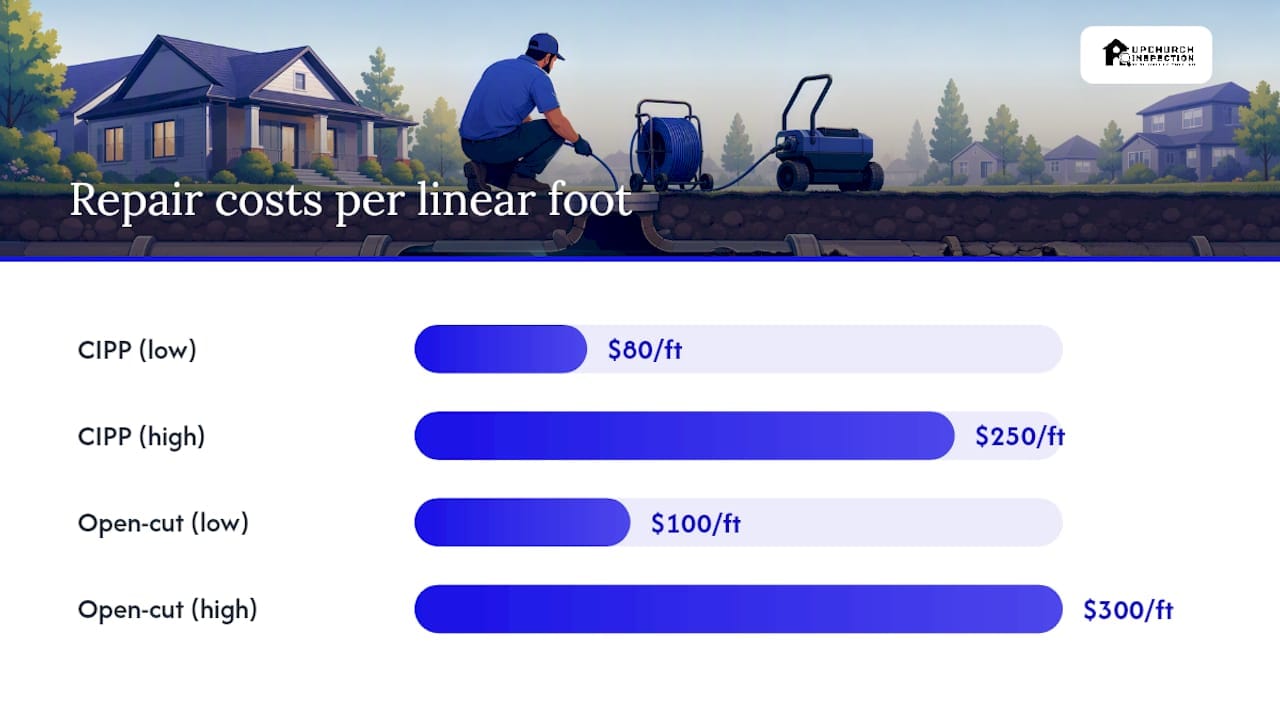
- CIPP trenchless lining: A cured-in-place liner is inserted and inflated inside the existing pipe, creating a new pipe within the old one. AlertPlumber’s cost data puts trenchless CIPP lining at roughly $80–$250 per linear foot. Requires that the host pipe retain enough shape and wall integrity to support the liner.
- Open-cut excavation and replacement: Full replacement of the lateral, typically at $100–$300 per linear foot plus surface restoration. Required when the pipe is collapsed, severely deformed, or made of Orangeburg.
For buyers negotiating after a scope:
- Get the video file and written report with defect locations in linear footage.
- Obtain at least two contractor quotes based on the scoped findings, not verbal descriptions.
- Request that quotes include permits, surface restoration, and a final camera inspection after repairs.
- Present the video and quotes to the seller and ask for a credit, price reduction, or pre-closing repair with permit and final inspection documentation.
- If the seller agrees to repair, require a licensed contractor, a permit, and the post-repair camera footage before closing.
Understanding how inspection reports interact with real estate negotiations helps buyers frame these requests clearly and avoid leaving money on the table.
Pipe materials and why some carry higher risk
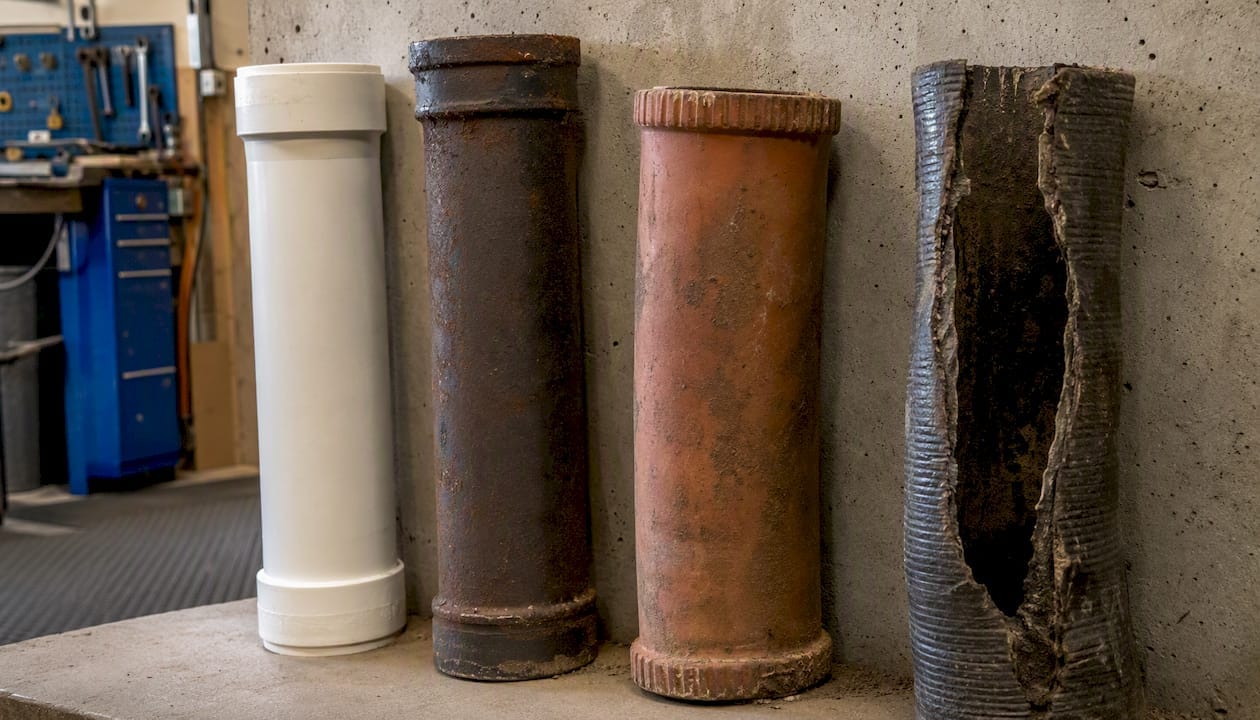
The pipe material identified in a scope report shapes every downstream decision about repair feasibility, cost, and urgency.
| Material | Typical Era | Primary Failure Mode | Trenchless Lining Feasible? |
|---|---|---|---|
| PVC | 1980s–present | Root intrusion at joints; generally durable | Usually yes |
| Cast iron | Pre-1980s | Internal scaling, corrosion, joint failure | Often yes, if not collapsed |
| Clay tile | Pre-1970s | Root intrusion, joint offsets, brittle fracture | Sometimes, if shape is retained |
| Orangeburg | 1940s–1970s | Delamination, collapse, pipe deformation | Rarely — usually requires replacement |
Nuflow’s research on pre-1970 sewer systems notes that internal scaling in old cast iron can reduce effective pipe diameter by 30–50%, which affects both flow capacity and the feasibility of inserting a liner. Clay tile joints fail at offsets and allow root intrusion readily; the pipe itself may be structurally intact while the joints are completely compromised.
Orangeburg — a bituminized fiber pipe used from the 1940s through the early 1970s — is the highest-risk material on this list. It absorbs moisture, softens, and deforms over time. By the time a camera reaches it, Orangeburg pipe often looks oval or collapsed rather than round. Trenchless lining requires a host pipe that holds its shape; Orangeburg rarely qualifies.
Older and historic homes present additional complications. Sewer Repair Authority’s guidance on historic properties notes that legacy materials, burial depths, and local preservation rules can change repair feasibility and may require PACP condition scoring to support permitting decisions. In Memphis and West Tennessee, sewer line problems in older neighborhoods often involve a combination of clay tile, cast iron, and root pressure from mature trees — a pattern that makes pre-purchase scoping especially important.
Key Takeaways
A $150–$400 sewer scope inspection is the most cost-effective way to avoid inheriting a $10,000–$30,000 sewer repair after closing.
| Point | Details |
|---|---|
| Order during due diligence | Schedule the scope early enough to get contractor quotes before your contingency deadline expires. |
| Insist on video and footage notes | A report without the raw video file and linear footage measurements cannot support accurate repair quotes. |
| Insurance won’t cover pipe replacement | Standard homeowner policies exclude lateral repairs; backup riders cover damage, not the failed pipe itself. |
| Repair method depends on camera findings | Trenchless lining, spot repair, and open-cut replacement each require scoped evidence to price accurately. |
| Upchurchinspection delivers documented scopes | Upchurchinspection provides timed video, still images, material ID, and a written condition summary for use in negotiations and contractor bids. |
What the camera actually tells you — and what it doesn’t
The most common mistake buyers make after receiving a scope report is treating every finding as either a dealbreaker or a non-issue. Neither extreme is usually right.
A root mass at 40 feet from the cleanout, in an otherwise sound clay tile pipe with intact joints, is a different situation from root intrusion at multiple points across a 90-foot run with visible joint separation. The first might be manageable with periodic maintenance and a future spot repair. The second is a systemic failure pattern that points toward full replacement. The video tells you which one you are looking at — a written summary without footage cannot.
Reports that omit linear footage measurements are a real problem. If a report says “root intrusion observed” without noting the distance from the cleanout, a contractor cannot locate the defect without running their own camera. Push back on any report that lacks measurable defect locations. Similarly, still images without timestamps or footage markers are difficult to use as negotiating evidence because the seller’s contractor can claim the image is ambiguous.
When the camera finds something that appears to interact with the foundation — a lateral running directly under a footing, or evidence of soil movement near the pipe — that is a signal to bring in a structural engineer before proceeding. A plumber can tell you what the pipe needs; an engineer tells you whether the repair method is compatible with the foundation above it. Those are two different questions, and conflating them leads to expensive surprises during construction.
Upchurchinspection delivers the documentation buyers actually need
Skipping a sewer scope because it is not required is the kind of decision that looks fine until it isn’t. Upchurchinspection’s sewer scope service gives buyers and homeowners what the inspection actually needs to be useful: timed video of the full lateral run, still images at every defect, pipe material identification, defect locations by linear footage, and a clear written condition summary. That is the package a contractor needs to give you an accurate quote, and the package a seller takes seriously in a negotiation.
We work across Tennessee, Arkansas, Mississippi, Missouri, and Kentucky, with direct familiarity with the clay tile and cast iron systems common in older Memphis and West Tennessee neighborhoods. Independent documentation from a licensed inspector carries more weight in a transaction than a contractor’s verbal assessment — and it protects you after closing if disputes arise.
To schedule a professional sewer scope inspection, confirm cleanout access before your appointment and plan for a same-day or next-day report. If you want to understand what good documentation looks like before you receive your report, the buyer’s guide to reading inspection reports walks through exactly what to look for.
Useful sources and further reading
The claims in this article draw on the following primary sources. Each covers a distinct aspect of sewer scope inspections, repair costs, and insurance coverage.
- InterNACHI — Standards of practice for home inspectors, including what visible plumbing checks do and do not cover. Reference for understanding why a scope is separate from a standard inspection.
- ReportWalk Blog: Sewer Scope Inspection Guide — Covers inspection process, typical cost range ($150–$400), and how video evidence supports buyer negotiations.
- Nuflow: Sewer Repair for Homes Built Before 1970 — Research-backed guidance on pre-1970 pipe materials, failure modes, and the 30–50% diameter reduction common in scaled cast iron.
- AlertPlumber: Sewer Line Repair Cost — Cost breakdown for trenchless CIPP lining ($80–$250/ft) and open-cut excavation ($100–$300/ft), with notes on why camera findings drive accurate quotes.
- HomeCostLab: Sewer Line Replacement Cost Guide — Permit fees ($75–$400), municipal inspection requirements, and full replacement cost factors.
- HomeGuide: Sewer Line Repair Cost — Camera inspection fee range ($125–$500) and repair cost context for U.S. markets.
- GEICO: Sewer Line Replacement and Insurance Coverage — Clarifies that standard homeowner policies exclude lateral repair; backup riders cover damage, not pipe replacement.
- Sewer Repair Authority: Older and Historic Homes — Material, access, and regulatory considerations for historic properties, including PACP condition scoring for permitting.
- The Importance of a Sewer Scope When Buying a Home — Real estate association perspective on why scoping has become a standard buyer due-diligence step in many markets.