
TL;DR:
- Knob and tube wiring is not inherently illegal or dangerous but depends on the condition and modifications.
- Inspection by a licensed electrician is essential for safety assessment and to ensure insurability before home transactions.
- Proper evaluation includes examining insulation, contact with thermal insulation, and any amateur alterations that increase fire or shock risks.
Knob and tube wiring is not automatically illegal, and it is not automatically dangerous. Whether it poses a real hazard depends on three things: the condition of the insulation, whether the wiring is in contact with thermal insulation, and whether it has been modified by someone who did not know what they were doing. If you have discovered it in a home you own or are buying, the right first move is a licensed inspection or electrical evaluation, not panic.
Before you read further, here is what matters most:
- Get a licensed inspector or electrician to assess active vs. abandoned circuits and insulation condition.
- Contact your insurance carrier before closing on any home with active K&T circuits.
- Do not add blown-in or batt insulation over K&T wiring until an electrician has cleared it.
- Do not assume the wiring is fine just because the lights work.
Pro Tip: If you are a buyer, make your offer contingent on a specialized electrical inspection, not just a general home inspection. A general inspection will flag K&T, but a licensed electrician can trace circuits and assess condition in ways a visual inspection cannot.
Table of Contents
- What is knob and tube wiring, exactly?
- How to recognize K&T wiring in your home
- What actually makes K&T wiring dangerous today
- What a licensed inspector checks for on a K&T system
- NEC Article 394, state rules, and what insurers actually do
- Realistic options for managing K&T wiring
- What does it cost to address K&T wiring?
- How buyers and sellers should handle K&T in a transaction
- When is keeping K&T acceptable, and when should it be replaced?
- Key Takeaways
- A field note from the Mid-South
- Schedule an electrical evaluation with Upchurchinspection
- Authoritative sources and further reading
What is knob and tube wiring, exactly?
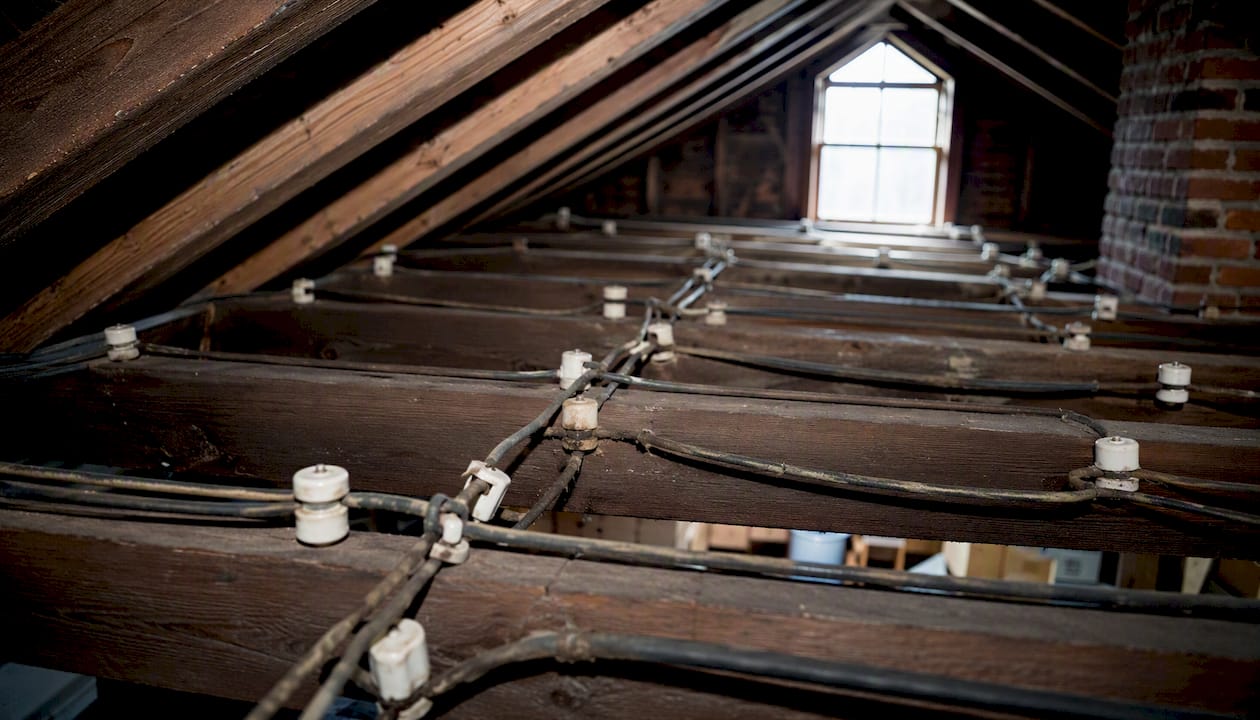
Knob and tube (K&T) wiring is an early electrical distribution method that ran separate hot and neutral conductors through a building using porcelain knobs and ceramic tubes to support and protect the wires where they passed through framing. The insulation was rubber covered with a cloth braid or loom. There was no ground wire. That is not an oversight — grounding was not part of residential electrical design at the time.
It was the standard installation method from roughly the late 1800s through the early 1940s, which means any home built before World War II may still have some of it in place. The original design relied on open-air spacing between conductors to dissipate heat. That physics matters enormously today: the moment you bury K&T in attic insulation, you eliminate the cooling mechanism the system was designed around, and the conductor insulation begins to degrade from heat buildup. Dynamic Electric notes that K&T typically used 14 AWG copper conductors historically rated for 15-amp circuits, a capacity that modern kitchen appliances, HVAC equipment, and EV chargers routinely exceed.
How to recognize K&T wiring in your home
The visual signature is distinctive once you know what you are looking for. The conductors run separately, spaced several inches apart, rather than bundled in a cable. You will see small white or cream-colored porcelain spools (the knobs) nailed to framing members, with the wire looped around them. Where the wire passes through a joist or stud, it runs through a ceramic tube. The insulation on older runs often looks like a dark cloth braid, sometimes cracked, brittle, or missing in sections.
Common locations to check:
- Attic floor joists and rafters, especially near older light fixtures
- Crawlspaces and basement ceiling framing
- Behind plaster-and-lath walls near original switch boxes
- Junction areas near the main panel or subpanels in older homes
- Disconnected runs left in place after partial rewires
If you find what looks like K&T, photograph it before touching anything. Get close-ups of the knobs, tubes, any visible splices or junctions, and any point where insulation material is in contact with the wiring. Those photos are useful to both an inspector and an electrician. Do not disturb suspected live wiring to get a better look. Document and step back.
What actually makes K&T wiring dangerous today
The biggest risks are not the original design. They are deterioration, contact with thermal insulation, and decades of improper modifications by people who were not electricians. Inspectapedia’s field guidance makes this point clearly: K&T is not inherently illegal, but it is frequently compromised by material degradation and hidden amateur work.
Lack of a ground wire is a real limitation. Without a ground, there is no path for fault current to safely return to the panel, which increases shock risk and makes the system incompatible with modern three-prong devices without additional protection. But grounding is not the only concern, and it is often not even the most urgent one.
Insulation deterioration is where the fire risk lives. Cloth and rubber insulation from the 1920s and 1930s was not designed to last 80 or 100 years. Heat cycling, rodent activity, attic foot traffic, and water exposure all accelerate breakdown. When the insulation cracks or falls away, bare conductors can arc against wood framing. The NASCSP weatherization guidance flags insulation contact as a primary safety concern and recommends electrical surveys before any retrofit insulation work.
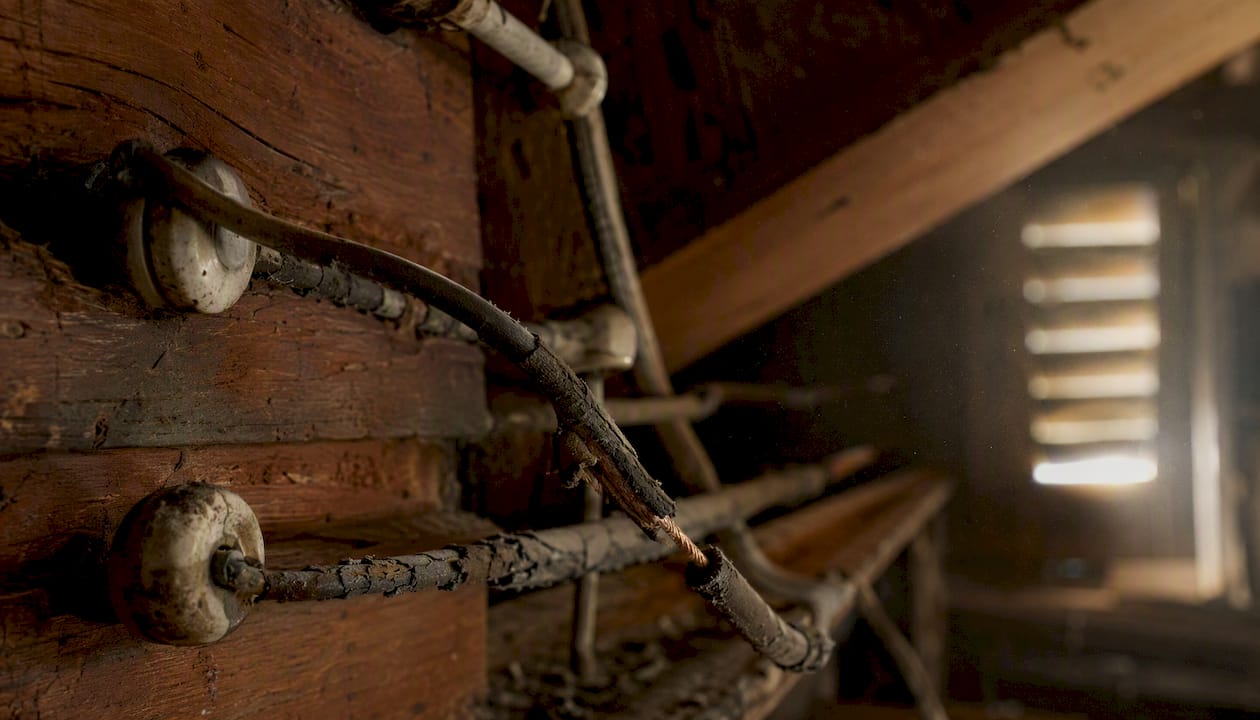
Thermal insulation contact is a code violation under NEC Section 394.12 and has been since 1987. K&T needs free air circulation to shed heat. Blown-in cellulose or fiberglass batt packed around active K&T conductors traps that heat, degrades the insulation faster, and creates fire conditions over time.
Pro Tip: The hidden red flags that matter most are taped splices outside a junction box, mismatched fuse sizes, wiring that transitions from K&T to modern Romex without a proper junction box, and evidence of over-fusing (a 20-amp fuse on a 14 AWG circuit). These are signs of unpermitted amateur work, and they raise the risk profile significantly.
What a licensed inspector checks for on a K&T system
The inspector’s primary goal is to determine whether K&T circuits are active, in good condition, and not in contact with insulation. A general home inspection will identify K&T and note its presence, but a focused electrical safety inspection goes further.
Visual and physical checklist:
- Scope and extent: how much of the home’s wiring is K&T vs. updated circuits
- Insulation condition: cracking, brittleness, missing sections, cloth braid integrity
- Splices and junctions: are they in proper boxes, or taped in open air?
- Over-fusing: do overcurrent protection ratings match conductor ampacity?
- Fixture transitions: how does K&T connect to modern fixtures and devices?
- Thermal insulation contact: is blown-in or batt insulation in contact with active runs?
- Signs of overheating: discoloration at knobs, scorching near fixtures or boxes
- Rodent or physical damage: gnawed insulation, disturbed runs
- Inaccessible concealed wiring: areas where condition cannot be confirmed visually
Inspection methodology, step by step:
- Visual survey of accessible attic, crawlspace, and basement framing
- Circuit tracing to identify active vs. abandoned or decommissioned runs
- Verification that overcurrent protection matches conductor ampacity per NEC tables
- Thermal imaging scan of panels, fixtures, and suspect areas when warranted
- Documentation with photographs, circuit labels, and written findings
- Recommendations for electrician follow-up, remediation scope, or further evaluation
Thermal imaging is worth requesting when K&T is present. It can detect heat signatures at overloaded connections, deteriorating splices, and insulation contact points that are not visible to the naked eye. A photo-rich inspection report with circuit-level findings gives both your insurer and your electrician a clear starting point.
NEC Article 394, state rules, and what insurers actually do
The National Electrical Code addresses knob-and-tube wiring in Article 394, including restrictions on where concealed K&T wiring may be used and its contact with thermal insulation. The NEC is not a federal law or federal building code. It is a model electrical code published by the National Fire Protection Association, and its requirements become legally enforceable when they are adopted by a state or local authority having jurisdiction, often with amendments.
Tennessee is the relevant example for homes in this market. The Tennessee State Fire Marshal’s Office currently lists the 2017 edition of the National Electrical Code as the state-adopted electrical code, subject to specific Tennessee amendments. Local jurisdiction, the age of the installation, the type of work being performed, and applicable permitting requirements can also affect how an existing electrical condition is evaluated or what must be done when the system is altered. In practical terms, saying “the NEC permits existing K&T” does not mean every existing K&T installation is automatically acceptable as found. Its condition, insulation contact, modifications, applicable adopted code, and the requirements of the authority having jurisdiction still matter.
The practical insurance reality: InterNACHI notes that many carriers will refuse to write a new homeowners policy, require a full electrical inspection, or mandate rewiring before coverage is issued on a home with active K&T. Even when an electrician certifies the system as safe, some underwriters still surcharge or restrict policies. Contact your agent before closing, not after.
What to provide an underwriter when K&T is present:
- A licensed electrician’s written certification of system condition
- Inspection photographs showing insulation condition and no thermal insulation contact
- A clear scope of which circuits are active and which have been decommissioned
- Documentation of any GFCI protection installed on ungrounded receptacles
Realistic options for managing K&T wiring
There are four practical paths, and the right one depends on the system’s condition, your insurer’s requirements, and your plans for the property. The repair category framework from Electrical Repair Authority covers these options clearly.
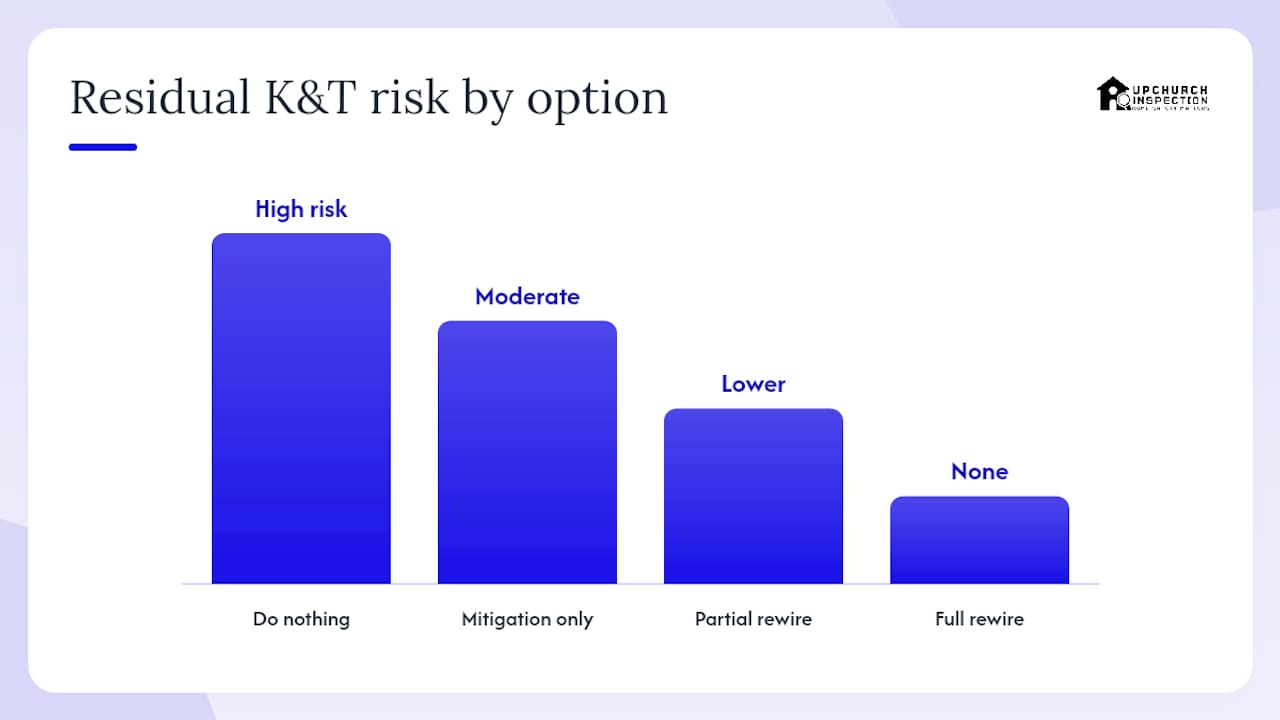
Do nothing with restrictions: Acceptable only when circuits are confirmed active, in good condition, not in contact with insulation, and an insurer will write coverage. This path limits future remodels and load additions.
Mitigation only: Remove or reposition thermal insulation away from active K&T runs. Add GFCI protection on ungrounded receptacles per NEC 406.4(D), with required labeling (“No Equipment Ground”). This improves safety without rewiring but does not resolve the ground issue or aging insulation.
Partial rewire: Replace targeted circuits, typically kitchens, bathrooms, and high-load areas first. This addresses the highest-risk circuits, may satisfy some insurers, and is less disruptive than a full rewire. It works well when K&T is limited in scope.
Full rewire: Replace all wiring throughout the home with modern grounded cable. This is the recommended path when insulation is deteriorated, modifications are extensive, or the insurer requires it. It resolves all K&T concerns permanently and improves resale value.
Quick comparison:
- Do nothing: Low cost, high ongoing risk, likely insurability problems
- Mitigation: Moderate cost, addresses insulation contact, does not resolve aging conductors
- Partial rewire: Moderate to significant cost, targeted improvement, may require follow-up
- Full rewire: Highest cost, eliminates all K&T risk, best long-term outcome for older home electrical systems
What does it cost to address K&T wiring?
Cost depends primarily on access, scope, and how much finished surface needs to be opened and restored. There is no single number that applies to all homes.
| Remediation Type | Relative Cost | Typical Scope |
|---|---|---|
| Mitigation only | Low to moderate | Insulation removal/repositioning, GFCI devices, labeling |
| In-kind repair | Low to moderate | Replacing deteriorated sections, proper junction boxes, permits |
| Partial rewire | Moderate to significant | Targeted circuits (kitchen, bath, high-load), panel work, permits |
| Full rewire | Significant | All circuits, panel upgrade if needed, drywall repair, permits |
Factors that drive the final price:
- Accessibility: open framing in an unfinished basement costs far less to rewire than plaster-and-lath walls
- Extent of K&T: a home where K&T covers only two circuits is a different project than one where it covers the whole house
- Panel condition: if the panel also needs upgrading, that adds to the scope
- Permit and inspection fees: required for any permitted electrical work, vary by jurisdiction
- Finish restoration: drywall patching, painting, and trim work after a full rewire
A quick mitigation project may take a day or two. A partial rewire of a kitchen and two bathrooms typically runs several days to a week. A full rewire of a two-story home can take two to three weeks or longer, depending on crew size and access. Schedule the permit inspection before closing walls.
How buyers and sellers should handle K&T in a transaction
The recommended workflow is straightforward: disclose, inspect, negotiate, then confirm insurability before closing.
Buyer’s checklist:
- Request a specialized electrical inspection or licensed electrician evaluation, not just a general inspection
- Contact at least two insurance carriers before removing your inspection contingency
- Get written remediation estimates from licensed electricians before negotiating credits
- Use contingency language that specifies electrician certification or remediation completion
- Review pre-1950 home inspection concerns alongside the electrical findings
Seller’s checklist:
- Order a pre-listing inspection to identify K&T scope and condition before buyers do
- Consider targeted remediation of the highest-risk circuits to improve marketability
- Prepare documentation: electrician reports, permits pulled, scope of active vs. decommissioned circuits
- Disclose K&T presence in the seller’s disclosure; non-disclosure creates liability
Negotiation guidance: Asking for a price credit rather than requiring the seller to rewire is often cleaner. It lets the buyer choose their own electrician and control the scope. Require licensed contractor estimates to support any credit request. For significant rewiring scopes, an escrow holdback for deferred work can keep the transaction moving while ensuring the work gets done.
When to walk away: if the system shows extensive deterioration, the insurer will not write coverage without full rewiring, and the seller will not negotiate on price or repairs, the numbers rarely work in the buyer’s favor.
When is keeping K&T acceptable, and when should it be replaced?
Active circuits in good condition, with no insulation contact, no improper splices, and a willing insurer: that is the scenario where K&T can stay in place with monitoring. Abandoned circuits that have been properly decommissioned and documented are not a safety concern at all.
Replacement becomes the right call when any of these conditions are present:
- Visible insulation deterioration (cracking, missing sections, brittleness)
- Thermal insulation in contact with active conductors
- Evidence of improper splices, over-fusing, or unpermitted modifications
- Insurer refusal or surcharge that makes the property uninsurable at a reasonable premium
- Plans for remodeling, adding HVAC, or installing EV charging that will increase electrical load
For long-term planning, consider this: any significant addition to the home’s electrical load, whether a new HVAC system, a kitchen remodel, or an EV charger, will likely require a panel evaluation and may trigger a rewire requirement from the permit office. Getting ahead of that with a full rewire now avoids a second round of disruption later.
Key Takeaways
Knob and tube wiring is manageable when it is undisturbed and in good condition, but deterioration, insulation contact, and amateur modifications are the real risk drivers that demand professional evaluation.
| Point | Details |
|---|---|
| Condition drives risk | Deteriorated insulation, insulation contact, and improper modifications matter more than age alone. |
| NEC Article 394 | Existing K&T is permitted under NEC if non-deteriorated and not in contact with thermal insulation; new installations are prohibited. |
| Insurance is the practical hurdle | Many carriers restrict or refuse coverage on active K&T; confirm insurability before closing on any transaction. |
| Remediation options vary | Mitigation, partial rewire, and full rewire each address different risk levels and cost profiles. |
| Upchurchinspection | Provides licensed electrical evaluations and thermal imaging inspections with photo-rich reports for homeowners, buyers, and agents across Tennessee, Arkansas, Mississippi, Missouri, and Kentucky. |
A field note from the Mid-South
K&T wiring is survivable when it has been left alone and the house has stayed dry. When it has been worked on by three different owners over 70 years, that is a different story.
In Memphis and West Tennessee, we see K&T regularly in homes built before 1950, and the condition varies widely. The wiring itself is often intact. What is not intact is everything that happened to it afterward: a 1970s addition spliced in with wire nuts and electrical tape outside any box, a bathroom circuit that someone ran off an existing K&T branch with undersized wire, or an attic that got blown-in insulation without anyone checking what was up there first. Those are the situations that create real fire risk, and they are common enough that we treat any pre-1950 home with K&T as a system that needs a full circuit-level evaluation, not just a visual pass.
Local insurers in this market have become more cautious about K&T over the past several years. We have seen buyers lose coverage commitments after closing because the carrier’s underwriter reviewed the inspection report and flagged active K&T that the buyer did not fully understand at the time of purchase. Getting an electrician’s certification and a clear scope of active circuits before you close is not optional anymore. It is the step that keeps the transaction from unraveling.
For anyone buying a historic home in this region, the Knoxville historic home audit and our notes on what we commonly find in older Memphis homes are worth reading alongside this article.
Schedule an electrical evaluation with Upchurchinspection
Knob and tube wiring questions are exactly the kind of thing a general home inspection surfaces but cannot fully resolve on its own. Upchurchinspection provides focused electrical evaluations and thermal imaging inspections specifically designed for older homes where K&T is present, with detailed photo-rich reports that give your insurer and electrician a clear picture of what is active, what is deteriorated, and what needs attention.
Services relevant to K&T situations include pre-purchase inspections, specialized electrical reviews, thermal imaging, and re-inspections after remediation work is complete. Reports include circuit-level findings, photographs, and written recommendations. If you need an electrician referral in the Mid-South, we can point you in the right direction.
Serving Tennessee, Arkansas, Mississippi, Missouri, and Kentucky. Book your inspection or review your specialized inspection options to find the right service for your situation.
Authoritative sources and further reading
These are the primary references behind this article. Give them to your electrician or insurer if they ask for documentation.
- Knob-and-Tube Wiring – InterNACHI®
- Tennessee State Fire Marshal’s Office — Currently Adopted Codes
- NASCSP — Electrical issues and knob-and-tube guidance
- Knob and Tube Wiring Repair: Safety, Code, and Options | Electrical Repair Authority
- Knob & Tube Electrical Wiring Safety — Inspectapedia
- Ask the Electrician: Knob and Tube Wiring — Dynamic Electric
- Knob-and-tube wiring — Wikipedia