
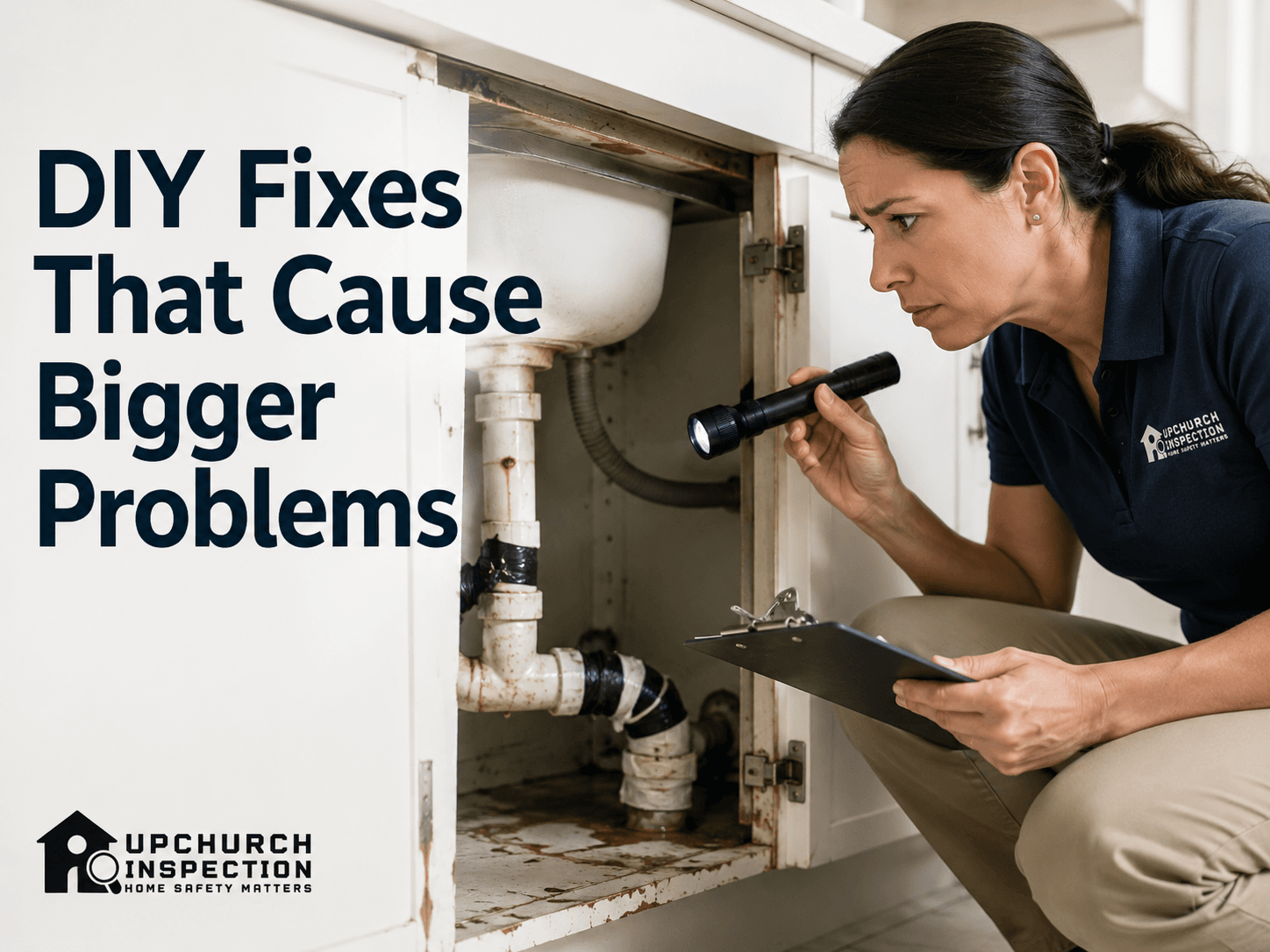
Do-it-yourself repairs are everywhere. Some are thoughtful, well-executed, and genuinely helpful. Others quietly create the very problems buyers discover later—sometimes years after the work was done.
At Upchurch Inspection, DIY work is one of the most common underlying contributors to inspection findings across Memphis, Jackson, Little Rock, Jonesboro, Cape Girardeau, and Middle Tennessee. Not because homeowners meant to cut corners, but because houses don’t forgive partial understanding the way projects like furniture or landscaping might.
What looks like a fix in the moment can become a stress point over time, especially in the regions we serve.
DIY Work Often Solves Symptoms, Not Systems
Most problematic DIY fixes start with good intentions. A small issue shows up. The homeowner addresses what they can see. The immediate problem improves.
The trouble is that houses operate as systems.
A moisture stain leads to interior sealing instead of exterior drainage correction. A draft leads to insulation added without addressing air leakage paths. A sagging floor gets shimmed without understanding load transfer. The symptom improves, but the cause remains active.
In West Tennessee and Central Arkansas, where moisture and soil movement are constant influences, this pattern shows up frequently. DIY solutions may buy time but often increase downstream impact.
Drainage Shortcuts Are a Common Culprit
Some of the most expensive long-term issues inspectors see start as DIY drainage “fixes.”
Improvised downspout extensions, buried pipes without slope, splash blocks placed without understanding water flow—these solutions often redirect water temporarily without moving it far enough away from the structure.
In flat areas like Jonesboro or parts of Memphis, water doesn’t forgive poor routing. It pools, saturates soil, and slowly stresses foundations and crawl spaces. What felt like a practical solution becomes a contributor to long-term moisture behavior.
Inspectors often recognize these patterns not because the fix failed immediately, but because the house behaves predictably afterward.
Electrical DIY Is Often Functional—but Unsafe Over Time
Electrical DIY work frequently “works,” which makes it especially risky.
Improvised junctions, overloaded circuits, missing strain relief, mismatched breakers, or extended runs added without recalculating load often operate fine for years. Until they don’t.
In older homes around Memphis and Jackson, inspectors regularly see modern electrical demand layered onto systems that were never designed for it. DIY additions rarely account for cumulative load or heat buildup, especially in attics and crawl spaces.
The absence of immediate failure doesn’t mean the system is handling stress correctly.
Plumbing Fixes That Create Hidden Damage
DIY plumbing repairs often stop leaks without addressing pressure, support, or material compatibility.
Common examples inspectors see include:
- Mixed piping materials without proper transitions
- Unsupported runs that stress joints over time
- Repairs that restrict flow or alter pressure dynamics
- Temporary sealing methods used long-term
In Middle Tennessee and Southeast Missouri, where freeze-thaw cycles matter, these fixes are especially prone to delayed failure. The plumbing may function well until seasonal stress reveals the weakness.
By then, the damage often extends beyond the original issue.
Crawl Space DIY Is a Frequent Source of Compounding Problems
Crawl spaces invite DIY intervention because they’re out of sight and often misunderstood.
Plastic sheeting added without sealing or drainage planning. Fans installed without understanding pressure balance. Insulation applied without addressing moisture sources.
In Central Arkansas and West Tennessee, inspectors routinely see crawl space DIY attempts that improved comfort briefly while increasing long-term moisture retention. Mold, wood decay, and air quality issues often follow.
These fixes weren’t careless. They were incomplete.
Cosmetic DIY Can Mask Structural Signals
Some DIY work doesn’t cause problems—it hides them.
Patching cracks without understanding movement. Leveling floors locally. Installing new finishes over uneven substrates. These projects make a house feel better while reducing visible cues inspectors rely on for context.
That doesn’t mean the work was dishonest. It means future owners inherit a house with fewer signals and the same underlying behavior.
Inspectors pay close attention to cosmetic DIY for this reason—not to criticize workmanship, but to understand what may no longer be visible.
Regional Conditions Amplify DIY Consequences
DIY fixes behave differently depending on environment.
In Memphis and Jackson, expansive soils magnify drainage mistakes. In Little Rock and Nashville, renovation-driven DIY often layers modern finishes over older infrastructure. In Cape Girardeau, weather exposure accelerates small exterior shortcuts. In Jonesboro, flat terrain limits margin for error in water management.
Inspectors with regional experience recognize which DIY fixes are common—and which ones tend to escalate over time.
Why DIY Isn’t Automatically a Red Flag
Not all DIY work is bad. Some homeowners are skilled, methodical, and careful. The issue isn’t who did the work—it’s whether the work respected how the system actually functions.
Inspectors don’t assume DIY equals poor quality. They look for:
- Consistency with proper design principles
- Evidence that causes were addressed
- Compatibility with surrounding systems
- Signs of stress developing elsewhere
Those factors matter more than labels.
What Buyers Should Take Away
Instead of asking, “Was this DIY?” buyers should ask:
- Did this repair change how the system behaves?
- Does it align with regional conditions?
- Are there secondary effects elsewhere?
- Would this solution hold up under seasonal stress?
Those questions turn DIY from a concern into usable information.
The Practical Reality
DIY fixes rarely cause immediate failure. They cause delayed consequences.
Houses don’t care whether a repair was done by a professional or a homeowner. They respond only to physics, moisture, load, and time.
A good inspection doesn’t judge DIY work. It interprets it—especially in the context of the regions we serve, where small decisions today often shape big outcomes later.
That understanding helps buyers move forward informed, not alarmed—and far better prepared for ownership.