
Inspectors don’t walk into a home with a checklist running in their head from the first second. The checklist comes later. What happens first is something quieter and harder to describe: orientation.
Within the first few minutes, experienced inspectors begin forming a working picture of how a house lives, ages, and handles stress. This isn’t guesswork. It’s pattern recognition built from seeing thousands of homes behave in similar ways across the same regions.
At Upchurch Inspection, those early impressions don’t replace the inspection. They guide where attention naturally goes first.
The Lot and How the House Sits on It
Before stepping inside, inspectors notice how the house meets the ground.
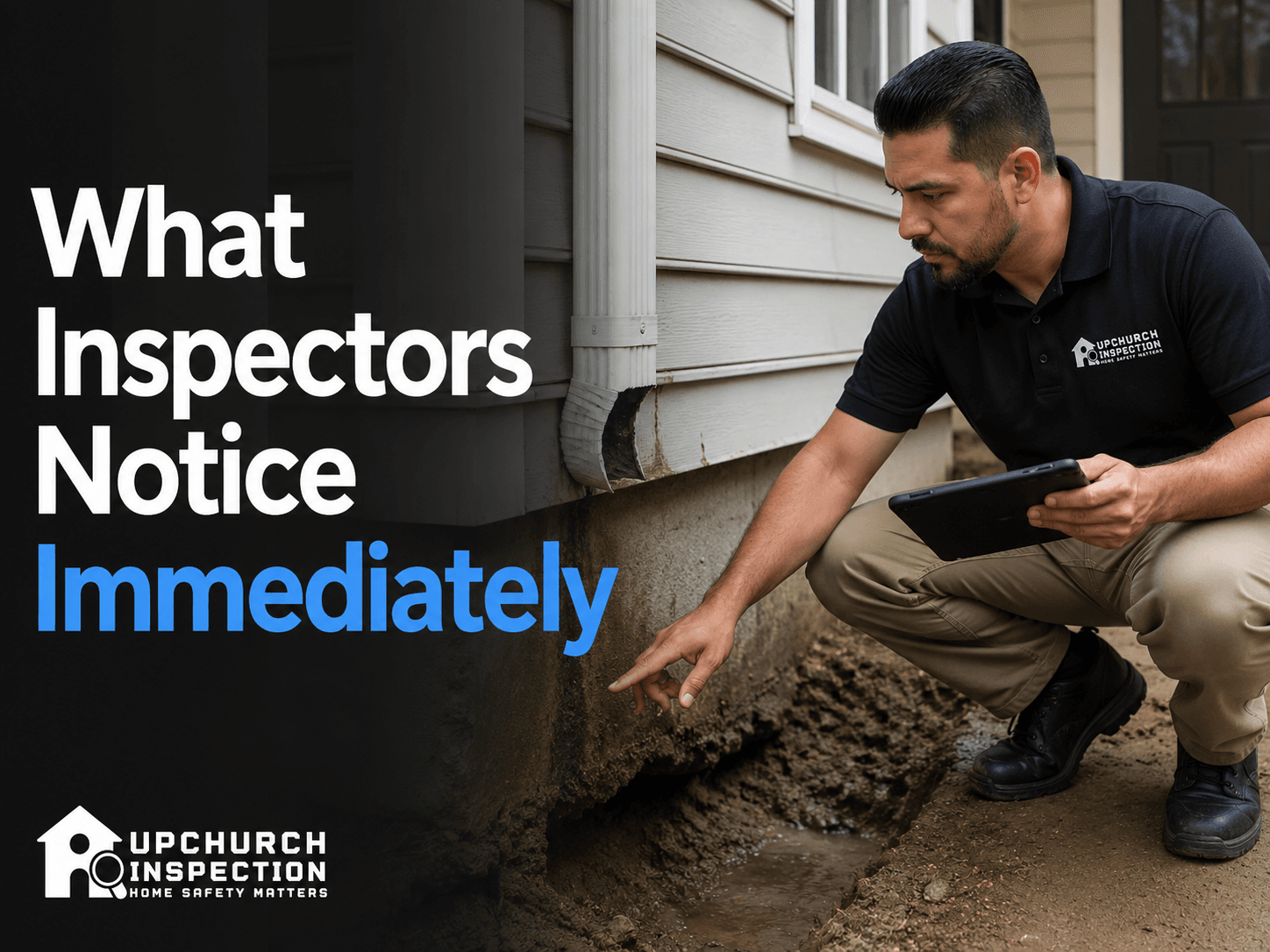
In places like Memphis, Jackson, and Little Rock, soil behavior and drainage matter immediately. Inspectors look at slope, elevation changes, and whether water has a clear path away from the structure. A house that sits low, flat, or boxed in by hardscape often earns closer attention before anything else is evaluated.
In Jonesboro and parts of Southeast Missouri, flat lots raise different questions—where does water go when it rains heavily, and how long does it stay there?
These observations happen almost automatically because they explain many future findings before they’re ever documented.
Rooflines and Transitions
Inspectors don’t start by counting shingles. They look at roof shape.
Complex rooflines, long valleys, multiple tie-ins, and additions often tell a story about how the house evolved. In Middle Tennessee and Central Kentucky, additions are common, and roof transitions are frequent failure points over time.
A simple roof isn’t always better, but a complicated one changes how inspectors interpret everything beneath it—especially moisture-related findings later in the inspection.
Smell, Air, and Feel
The human senses pick up information long before instruments do.
Musty odors, stale air, temperature imbalance, or excessive humidity often register within minutes. In West Tennessee and Central Arkansas, crawl space conditions frequently influence indoor air quality, even when there’s no visible moisture inside.
Inspectors don’t jump to conclusions based on smell alone, but it often tells them where to look more closely.
Floor Plan Behavior
Before measuring slope or opening panels, inspectors notice how the house moves underfoot.
Subtle cues matter:
- Do floors feel consistent from room to room?
- Do transitions align cleanly?
- Do doors operate smoothly or resist movement?
In older homes around Memphis and Jackson, minor irregularities are common and often expected. What stands out is inconsistency—when one area behaves differently than the rest without an obvious reason.
That inconsistency often points to localized stress, repairs, or structural history.
The Relationship Between Finishes and Age
Inspectors quickly compare finishes to the age of the home.
A 1970s house with entirely modern finishes raises different questions than one that looks its age. In Nashville and Little Rock, renovated homes are common, and inspectors naturally ask whether the updates were cosmetic, functional, or both.
This isn’t suspicion. It’s context. Finishes don’t tell inspectors what’s wrong—they tell them where to verify assumptions.
Mechanical Layout, Not Just Equipment
When inspectors locate mechanical systems, they’re not just checking age and operation. They’re noting layout.
Crowded mechanical rooms, tight access, unconventional routing, or multiple systems layered over time all influence how a house will be serviced and maintained.
In Southeast Missouri and Northeast Arkansas, inspectors often see homes where systems were added gradually rather than designed together. That history affects reliability even when everything works on inspection day.
Evidence of How the Home Was Lived In
Inspectors notice signs of use patterns quickly.
Heavy wear in certain areas, uneven appliance aging, or localized repairs often indicate how occupants interacted with the home. A house that was lived in gently ages differently than one that was pushed hard.
These clues don’t imply neglect. They help inspectors understand stress points that may not show up as defects yet.
What Inspectors Don’t Do Immediately
Just as important as what inspectors notice is what they don’t do.
They don’t diagnose in the first five minutes. They don’t assume cause from appearance alone. They don’t let early impressions override measured observation.
Those early signals guide attention—they don’t replace confirmation.
Why This Matters to Buyers
Buyers often assume inspectors discover issues only when they’re written into the report. In reality, the inspection begins the moment the inspector arrives.
Those early observations help inspectors:
- Prioritize areas of focus
- Interpret findings in context
- Recognize regional behavior patterns
- Avoid false assumptions
They’re part of how inspectors turn a standard process into a meaningful evaluation.
The Practical Reality
What inspectors notice immediately isn’t magic, and it isn’t intuition in the casual sense. It’s experience doing quiet work in the background.
Homes communicate long before defects are written down. They show how they handle water, load, air, and time.
A good inspection listens to those signals first—then confirms them carefully, one system at a time.