
Missouri home inspection standards, in practical terms, come down to Standards of Practice like those published by InterNACHI and ASHI. Those SOPs define a visual, non‑invasive walkthrough of a home’s major systems, and the resulting report lists observed material defects along with recommended next steps. It’s not a warranty, not a prediction of how long anything will last, and not a guarantee against future problems.
TL;DR:
- Missouri inspectors primarily follow nationally recognized standards like InterNACHI and ASHI, which focus on visual, non-invasive inspections of major home systems.
- The scope is limited to accessible areas, with any exclusions or limitations documented, and does not include destructive testing or wall openings.
- Buyers should verify an inspector’s membership in a professional association and recent continuing education rather than relying solely on state licensing.
- Regional factors like high radon levels and moisture concerns in older neighborhoods influence inspection priorities beyond the national minimum standards.
- Inspectors can be held liable for missed defects through civil claims or loss of professional credentials, with errors and omissions insurance serving as a key mitigator.
Table of Contents
- What Standards of Practice Actually Set: Scope, Purpose, and the Inspection Agreement
- What Does an On-Site Inspection Checklist Cover?
- Core Limitations and Exclusions: What Inspectors Do Not Do
- How to Read an Inspection Report and Use It in a Transaction
- How Do You Prepare a Property for Inspection Day?
- When to Order Specialist Follow-Ups
- Overview of Missouri’s Legal Requirements Governing Home Inspections
- How Missouri Standards Compare to InterNACHI and ASHI Baselines
- Continuing Education and Certification Renewal for Missouri Inspectors
- What Happens if Missouri Inspection Standards Are Not Followed?
- Field Perspective: What an Experienced Mid-South Inspector Prioritizes
- How Upchurch Inspection Applies These Standards
- Primary SOP and Upchurch Reference Pages
- Sources
What Standards of Practice Actually Set: Scope, Purpose, and the Inspection Agreement
Standards of Practice exist so buyers, sellers, and agents know exactly what an inspector is agreeing to do before anyone shows up with a flashlight and a moisture meter. InterNACHI’s Standards of Practice and ASHI’s version both apply to residential properties, typically covering one to four family units, and both spell out which systems get inspected and how.
The obligation is to inspect systems that are “readily accessible,” meaning the inspector can reach and observe them without moving furniture, dismantling components, or putting themselves or the equipment at risk. ASHI’s Standards of Practice lay out those obligations by system, and both organizations treat their SOPs as a floor, not a ceiling.
That last point matters more than most buyers realize. The scope can be expanded by agreement between the client and inspector. If you want a pool inspection, a detached workshop checked, or a more detailed look at an outbuilding, that gets negotiated into the contract up front. The SOP is the minimum. What you actually get depends on what’s in your agreement.
What Does an On-Site Inspection Checklist Cover?
Every Missouri home inspection follows roughly the same map, whether it’s a 1920s bungalow in a St. Louis neighborhood or newer construction outside Columbia. Here’s what a working inspector actually looks at on site:
- Roof: coverings, drainage, flashing around penetrations, and any visible signs of active leaks, using the InterNACHI checklist as a reference point for coverage and materials.
- Exterior: siding and trim condition, door and window function, grading around the foundation, decks, and railings.
- Foundation and structure: visible signs of movement or water intrusion, plus the major structural elements you can actually see without opening walls.
- Plumbing: main shutoff location, water heater condition, fixtures, visible drains, and sump pumps where present.
- Electrical: service equipment, panel condition, grounding, a representative sample of outlets and switches, and GFCI or AFCI protection where it’s visible, with tips on how to know if your home wiring is safe.
- HVAC: operation through normal thermostat controls, condition of vents, flues, and distribution.
- Attic, insulation, and ventilation, along with interior elements like doors, stairways, and railings.
- Garage, carport, and any other specialized systems visible on the property.
Pro Tip: Ask for a copy of the inspector’s SOP reference before the inspection, not after. If a roof pitch is too steep to walk safely or a crawlspace is too tight to enter, that should be documented as a limitation, not silently skipped.
Core Limitations and Exclusions: What Inspectors Do Not Do
An inspection is “not technically exhaustive.” That phrase from InterNACHI’s Standards of Practice means the inspector isn’t opening walls, running destructive tests, or moving insulation to check every inch of framing. What gets reported is what’s visible and reachable at the time of the walkthrough.
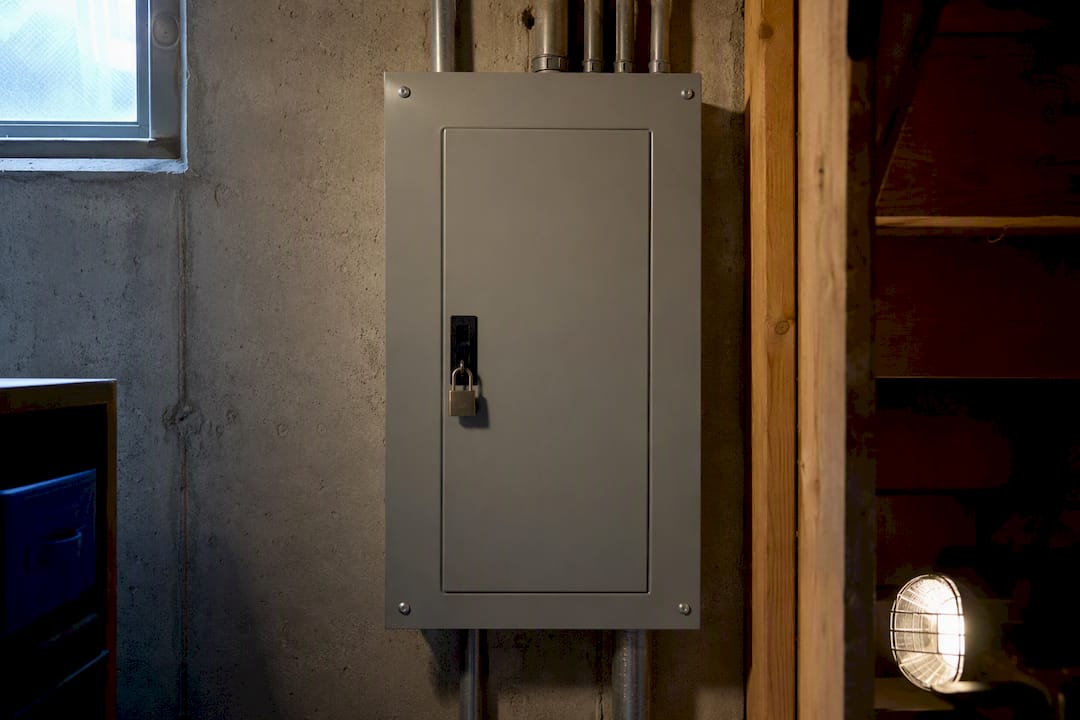
“Readily accessible” excludes locked panels, blocked crawlspace hatches, and anything that would require dismantling to reach. If an area is inaccessible, a competent inspector documents that it wasn’t inspected and states why, rather than guessing.
There’s also a difference between describing condition and predicting life expectancy or judging code compliance. A water heater showing rust at the base gets flagged as a condition observed, not a countdown to failure. Items needing more attention get documented for follow‑up, which is a different category than a defect.
How to Read an Inspection Report and Use It in a Transaction
A useful report separates safety hazards, significant deficiencies, and routine maintenance items instead of dumping everything into one long list. That structure, echoed in InterNACHI’s checklist, lets agents and buyers act on what matters first.
Expect these components in a solid report:
- An executive summary that flags the handful of issues worth your immediate attention.
- Photographed evidence tied to specific conditions, not vague descriptions.
- Clear labeling of urgency, distinguishing a safety issue like an exposed wire from a maintenance note like a sticking door.
- Recommended next steps, including when a specialist should take a closer look.
Buyers and sellers typically use these findings to negotiate repairs, request credits, or ask for specialist evaluations before closing, a pattern Zillow’s guidance on home inspections confirms is standard across most transactions. Upchurch Inspection frames recommendations this way deliberately and will suggest a re‑inspection once agreed repairs are complete, so the fix gets verified rather than assumed. For a deeper walkthrough of report language, see our buyer’s guide to reading inspection reports.
How Do You Prepare a Property for Inspection Day?
A poorly prepared property produces a report full of exclusions that nobody wanted. A few steps fix most of that:
- Clear a path to the attic access panel.
- Unlock electrical panels, water heater closets, and any mechanical rooms.
- Move vehicles out of the garage so the space and its systems can be fully viewed.
- Clear three to four feet around HVAC equipment and the water heater.
- Confirm all utilities, including gas and electric, are on and functioning before the inspector arrives.
Each of these matters because “readily accessible” is the standard the inspector is working from. A blocked attic hatch doesn’t get force‑opened; it gets noted as not inspected. Our page on attic access hazards covers this in more depth if you want the full reasoning.
When to Order Specialist Follow-Ups
Certain findings are outside the scope of a general SOP inspection and call for a different set of eyes:
- Structural engineer: major cracks, signs of foundation movement, or questionable load‑path elements that go beyond visual observation. ASHI’s Standards of Practice specifically call for deferring to an engineer rather than diagnosing structural issues on site.
- Sewer scope: slow drains, sewage odor, or seller disclosure of prior sewer issues.
- Mold or moisture testing: recurring dampness or visible growth that warrants a certified industrial hygienist.
- Radon testing: common in western Missouri basements given regional geology, and worth requesting even when not required.
- HVAC diagnostics: aging or underperforming systems that need a technician’s read beyond a basic operational check.
Any of these can be scheduled as add‑ons, and a re‑inspection afterward confirms the repair actually held.
Overview of Missouri’s Legal Requirements Governing Home Inspections
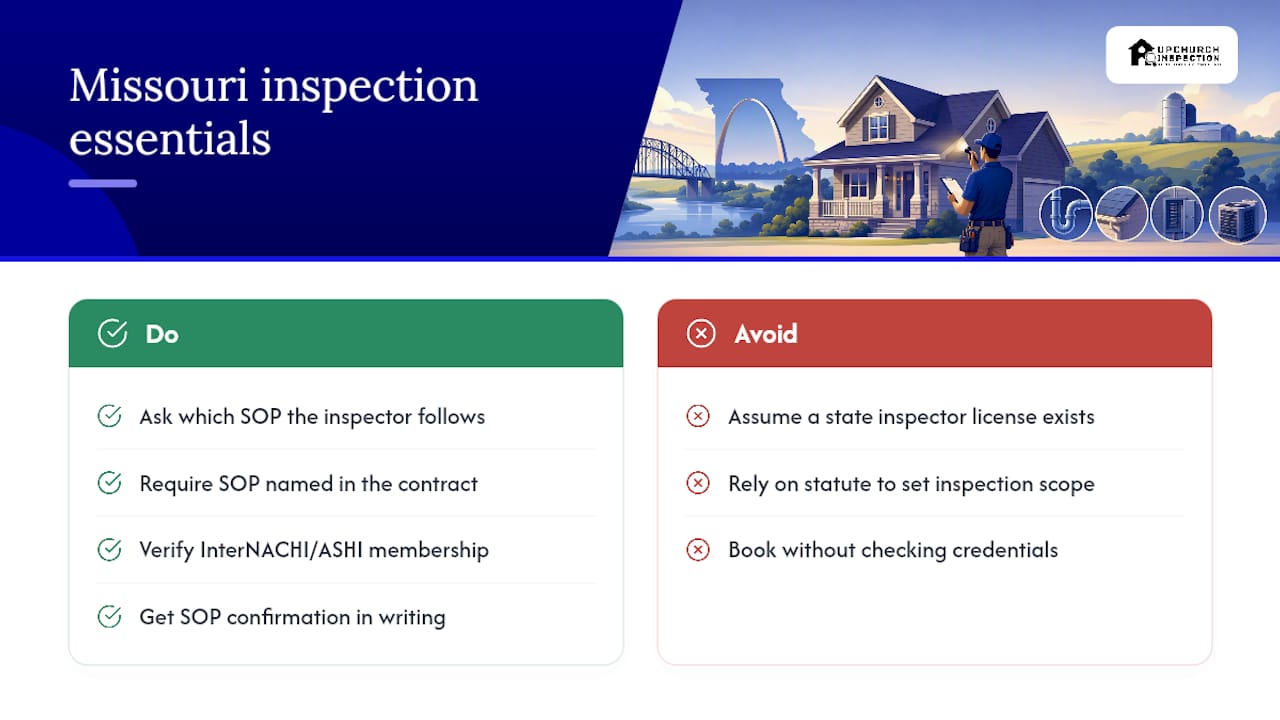
Missouri doesn’t operate a state licensing board for home inspectors the way it does for contractors or real estate agents. There’s no state‑issued inspector license you’ll find posted on a wall. What governs the profession in practice is the SOP framework an inspector voluntarily follows, whether that’s InterNACHI’s, ASHI’s, or a comparable set of guidelines, combined with membership requirements those organizations impose on their own members.
That means the contract you sign with your inspector is doing a lot of the legal heavy lifting. It should name which Standards of Practice govern the inspection, define the scope, and spell out limitations before anyone walks the property. Buyers in Missouri should specifically ask which SOP their inspector references, because that document, not a state statute, is what determines what gets inspected and what a report should contain.
This is different from states with formal licensing boards that dictate minimum education hours and exam requirements by statute. In Missouri, professional association membership and voluntary adherence to an SOP function as the practical substitute. It puts more responsibility on the buyer to vet an inspector’s credentials and membership status before booking, rather than assuming a state license guarantees a baseline quality.
Real estate professionals working Missouri transactions should build SOP disclosure into their standard client conversations. Recommending an inspector who explicitly follows InterNACHI or ASHI standards, and can show that in writing, gives clients a documented basis for what was covered.
How Missouri Standards Compare to InterNACHI and ASHI Baselines
Because Missouri lacks a distinct state‑specific inspection SOP, most working inspectors in the state default to InterNACHI’s or ASHI’s frameworks wholesale, rather than adapting a separate Missouri version. That’s actually a point in the state’s favor: it means Missouri buyers get the benefit of nationally vetted, regularly updated standards instead of a patchwork of local rules that may lag behind current practice.
The practical alignment is close to one‑to‑one. Roof, exterior, structure, plumbing, electrical, HVAC, attic, and interior categories match almost exactly between what a Missouri inspector documents and what InterNACHI’s SOP or ASHI’s SOP specify. There’s no Missouri‑specific carve‑out that expands or narrows those categories in a meaningful way.
Where you’ll see variation is regional emphasis, not standard language. Radon testing gets more attention in Missouri than it might in a coastal state, given the geology across much of the western part of the state. Foundation and moisture concerns get closer scrutiny in older river‑adjacent neighborhoods around St. Louis and Cape Girardeau, where clay soils and seasonal water tables create movement that a generic SOP checklist doesn’t call out by name but an experienced local inspector knows to watch for. The SOP sets the floor; local pattern recognition is what a good inspector adds on top of it.
Continuing Education and Certification Renewal for Missouri Inspectors
Since Missouri doesn’t run its own licensing renewal cycle, continuing education for inspectors in the state is driven almost entirely by professional association membership requirements rather than a state mandate. InterNACHI and ASHI both require members to complete ongoing education to maintain active certification, covering updates to SOP language, new inspection techniques, and emerging system types like solar arrays or updated HVAC technology.
For a buyer or agent, this means the real question isn’t “is this inspector licensed by Missouri,” it’s “is this inspector an active, current member of a recognized association, and can they show recent continuing education.” That distinction should show up in how you vet an inspector before booking, not after a report lands in your inbox with gaps you didn’t expect.
Inspectors who take this seriously tend to renew certifications annually and track coursework hours the same way a contractor tracks license renewal, even without a state mandate forcing it. That voluntary discipline is often the clearest signal of how seriously an inspector treats the work. A framed certificate means less than a current membership number you can verify online.
What Happens if Missouri Inspection Standards Are Not Followed?
Because Missouri doesn’t license inspectors through a state board, there’s no state agency that can revoke a license for a botched inspection. That doesn’t mean there’s no accountability. It shifts differently than it would in a licensed state.
An inspector who skips items required under the SOP they claim to follow, or who misses an obvious material defect, faces exposure through civil liability. A buyer who suffers financial harm from a missed defect can pursue a negligence claim, and courts look to the SOP the inspector represented as their standard when evaluating whether the inspector met a reasonable standard of care. Professional association membership can also be revoked for violations of ethics codes or SOP standards, which removes the credential an inspector relies on for business.
Errors and omissions insurance, which most working inspectors carry, exists specifically because this liability is real even without state licensing. An inspector without that coverage is a red flag worth asking about directly before you book.
Field Perspective: What an Experienced Mid-South Inspector Prioritizes
Moisture in basements, aging wiring, and roofs deferred one too many winters. Those are the recurring themes across Mid‑South homes, not exotic problems.
The SOP is your baseline expectation, not the ceiling on what a good inspector notices. Buyers who treat the report as a starting point for questions, not a final verdict, get the most value from it.
— Holly
How Upchurch Inspection Applies These Standards
Upchurch Inspection is the direct alternative to guessing your way through a transaction based on a generic checklist you found online. We follow SOP frameworks that exceed Missouri’s minimum expectations, because there is no state minimum to speak of, and our reports come with photographed evidence tied to specific conditions rather than vague boilerplate language.
If you’re under contract, ask that your inspection agreement name the SOP being followed, then book with an inspector who can show it in writing. From there, our property inspection reporting guide walks through what to expect in the report itself, and we can arrange specialist follow‑ups, from engineer evaluations to radon testing, without you having to coordinate multiple vendors yourself. Request your inspection through our buyer’s guide to reading inspection reports resource or reach out directly to get on the schedule.
Primary SOP and Upchurch Reference Pages
- InterNACHI Standards of Practice
- ASHI Standards of Practice
- Upchurch Inspection’s Standards of Practice page