
You notice a new crack above a basement window after a long, dry Missouri summer. A door that worked in spring now sticks, the floor seems slightly uneven, and a thin line has appeared in the brick mortar. The natural question is whether you're looking at ordinary seasonal movement or the first visible sign of a foundation problem.
That distinction matters for homeowners, buyers, sellers, and investors. Missouri clay can move enough to stress a structure, but a crack alone doesn't prove that a foundation is failing. The useful diagnosis comes from the pattern, location, moisture history, and whether the condition is changing.
Table of Contents
- Why Missouri Clay Soil Stresses Foundations
- Seasonal Patterns and Regional Climate Impacts
- Triage Guide for Cracks and Structural Movement
- Moisture Management and Drainage Solutions
- Evaluating Foundation Repair Methods
- Action Steps for Buyers and Sellers
Why Missouri Clay Soil Stresses Foundations
A house in Cape Girardeau, Columbia, or the Kansas City area can look sound in spring and show new symptoms by late summer. Saturated ground supports one side of the structure, drought dries the soil around another, and finishes begin to reveal the difference. Drywall cracks, trim gaps, and sticking doors are useful observations, but they are not a diagnosis by themselves.
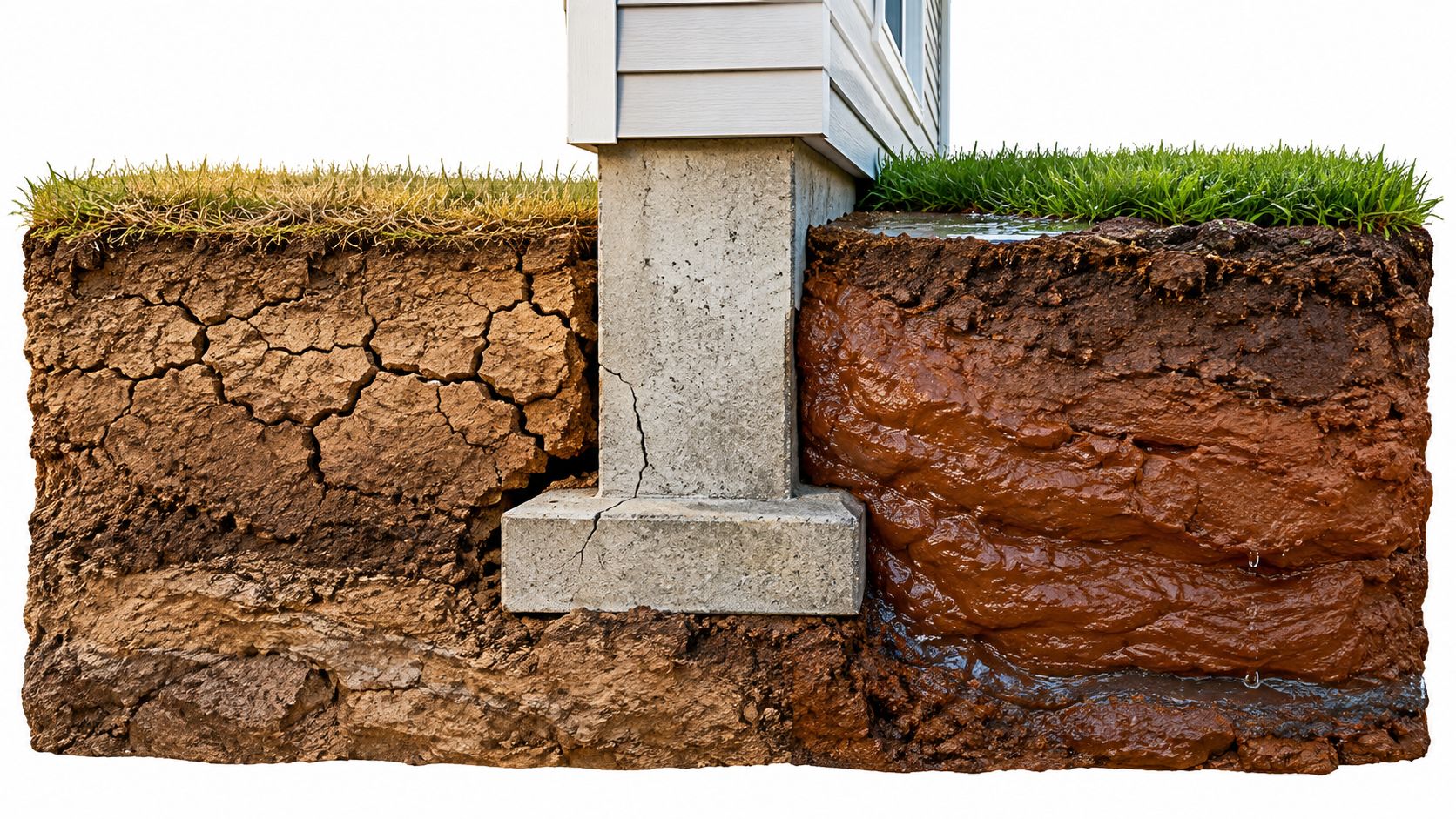
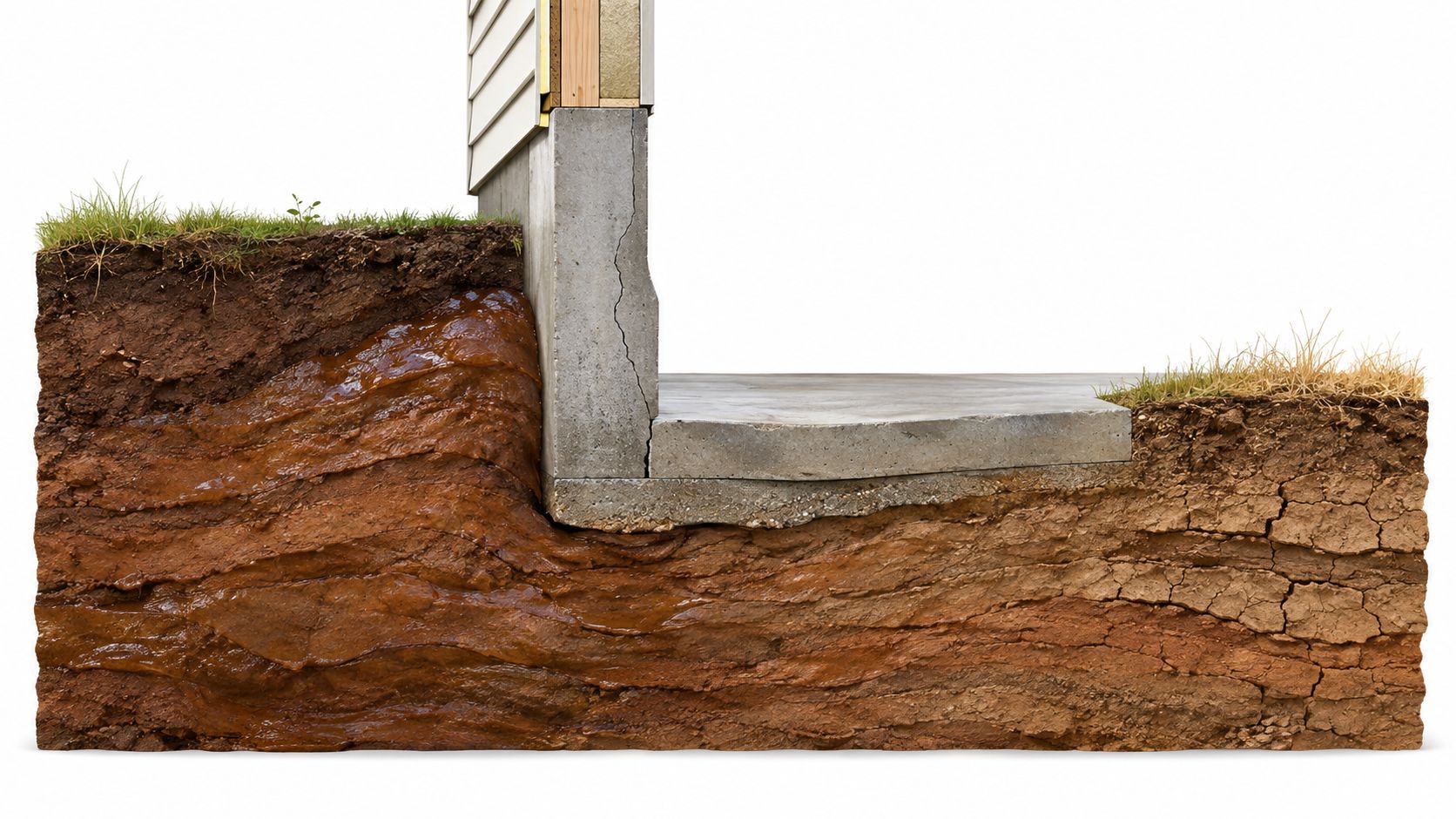
Clay holds water and releases it unevenly. When wet, expansive clay swells and presses against foundation walls or footings. During drought, it contracts and may pull away from the foundation, reducing the consistency of support below the structure. The resulting stress depends on soil, grading, drainage, fill, terrain, and foundation type.
In the Kansas City metro and along the Missouri River corridor, clay-rich soils can create direct structural stress. Saturated clay expands, then shrinks as it dries, making the wet-dry cycle a recurring cause of cracking, wall bowing, and displacement in western Missouri homes. The diagnostic threshold is active change: symptoms that extend, spread, or appear in related locations deserve more attention than an isolated, stable mark.
Why the house can look fine for months
Small foundation changes can show up in finishes before movement is obvious in concrete or masonry. Drywall, mortar joints, flooring, doors, and window frames may respond first.
A single interior crack may reflect material expansion, framing movement, or an old repair reopening. Look for a connected pattern instead: a crack that lengthens, a door that sticks in the same area, and exterior separation that corresponds with the interior symptom. Record dates, photographs, weather conditions, and whether the change continues after moisture returns.
Practical rule: Treat a visible crack as evidence to document, not as a diagnosis.
Local conditions also change the way movement appears. A crawlspace in Jackson may show uneven support differently from a poured-concrete basement in Jefferson City. One side of a home can dry faster because of sun exposure, trees, pavement, poor grading, or a downspout discharge point. Those details help separate a seasonal response from a continuing support problem.
The discussion of managing seasonal foundation heave in Madison County offers useful regional context. Start by identifying the movement pattern and its moisture causes, then decide whether monitoring or further evaluation is warranted.
Seasonal Patterns and Regional Climate Impacts
Missouri clay can shift with the calendar, but the timing and severity vary by site. Spring rain saturates soil beside basement walls and can increase lateral pressure. Summer drought removes moisture, causing clay to contract and pull away from footings. When autumn rain returns, the soil expands again, changing both pressure and support.
Wet clay expands and pushes on foundation walls, while dry clay contracts and may leave voids beneath footings. Freeze-thaw cycles add stress when trapped moisture freezes, expands, and then thaws. These seasonal forces matter most when they produce a continuing pattern rather than a brief change that reverses with normal moisture.

Reading symptoms against the season
A door that sticks during a wet spring may reflect temporary frame movement. The same symptom deserves closer review when the door becomes progressively harder to operate or several openings change together. Our guide to expansive clay foundations in Warrensburg and sticking doors explains how moisture-related soil movement can affect openings.
A crack that appears during drought may stabilize after moisture returns. It may also continue extending as the soil rehydrates. Track the location, length, direction, and nearby symptoms instead of judging the crack from one inspection date.
Do not seal a drought-related crack immediately and assume the issue is resolved. Photograph it, record the weather and soil conditions, and check whether it changes after normal moisture returns. Keeping moisture reasonably consistent is generally safer than alternating between severe drying and careless watering. Adding water to one area can create uneven conditions rather than restore uniform support.
Regional conditions change the diagnosis. Homes near Columbia, Jefferson City, Fulton, Boonville, and Sedalia may differ in clay content, fill, slopes, drainage paths, and foundation materials. Properties near Cape Girardeau, Jackson, Sikeston, Poplar Bluff, Farmington, and Perryville can vary from one lot to the next as well. “Missouri soil” is too broad to explain a specific movement pattern.
What winter adds
Winter damage often appears in masonry, mortar, exterior steps, and exposed concrete. Water enters an existing crack or porous material, freezes and expands, then contracts during thawing. Repeated cycles can enlarge an existing defect even when clay movement is only part of the cause.
A door that sticks in February needs seasonal context. Determine whether the change appeared with cold weather and improves later, or whether it persists across seasons. Related signs raise the concern level, including diagonal drywall cracks, stair-step masonry cracks, uneven floors, gaps at trim, and inward-bowing basement walls.
The useful question is whether the crack changed and what changed around it. A symptom that reverses with seasonal moisture may call for monitoring. A symptom that progresses, spreads, or appears with several related signs warrants further evaluation.
Triage Guide for Cracks and Structural Movement
A buyer notices a diagonal drywall crack beside a sticking door after a wet spring. The right response is not an immediate patch or a worst-case conclusion. Start by determining whether the condition is a stable result of seasonal movement or evidence that the structure is still shifting.
Record the crack's location, direction, length, and relationship to nearby doors, windows, floors, ceilings, or masonry joints. Photograph it from the same position each time, and note recent weather and moisture conditions. A crack that widens or extends between observations is the strongest practical signal of active movement, which is why dated photographs from a consistent position matter more than memory.
A practical first pass
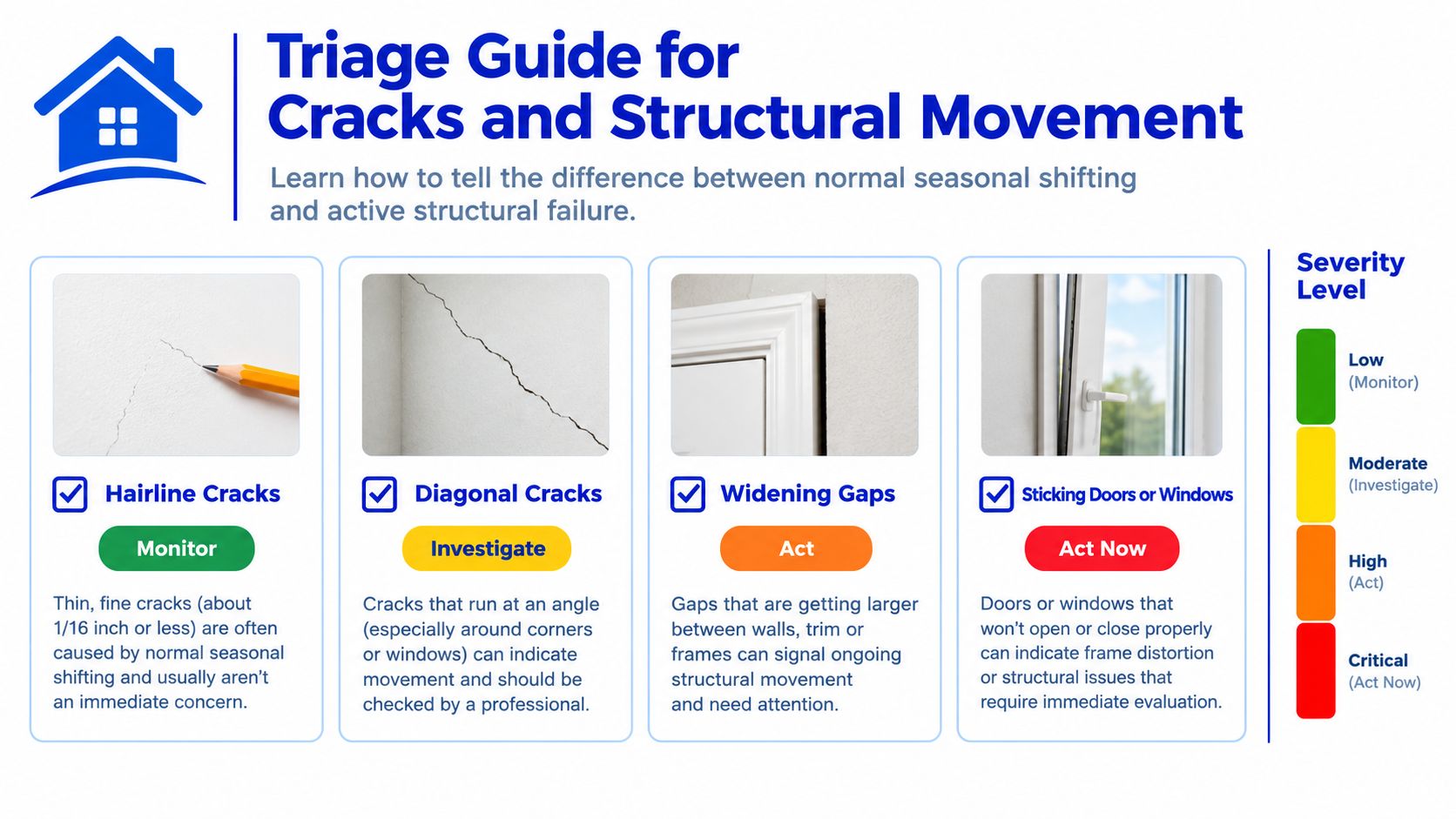
Use these observations to decide how quickly the condition needs further evaluation:
- Hairline and unchanged: A narrow crack with no related symptoms can often start with monitoring and a review of moisture conditions.
- Diagonal or stair-step pattern: Diagonal drywall cracks and stair-step masonry cracks deserve closer attention, particularly when doors stick or floors feel uneven.
- Changing size or length: Measure and photograph any change between observations. Continued growth carries more concern than a stable crack.
- Horizontal basement-wall cracking: A horizontal crack may reflect lateral soil or water pressure. Concern increases when the wall also bows or leans.
- Gaps and displaced surfaces: Separation around window frames, trim, brick, floors, or ceilings can show that connected parts of the structure are moving differently.
No single pattern proves structural failure. A stair-step crack in brick veneer may involve the veneer or mortar rather than a failed footing. A smaller crack may still matter when it appears with settlement, wall displacement, or other connected symptoms. The diagnostic threshold is progression plus a pattern of related movement, not crack size alone.
What you can safely check
Outside, inspect gutters, downspouts, visible grading, foundation surfaces, and places where water collects. Inside, check whether doors and windows operate differently, floors feel newly uneven, or basement and crawlspace moisture appears alongside the cracking. Compare these observations with earlier photographs and inspection records when available.
Avoid excavating beside a foundation, jacking the structure, drilling into a wall, or trying to straighten a bowed wall yourself. These actions can alter load paths and create safety risks. An inspector can document the condition and identify related defects. A structural engineer or qualified foundation specialist should evaluate suspected active movement and recommend stabilization when needed.
A crack becomes a decision problem when it changes, connects to other symptoms, or appears alongside moisture and displacement.
For buyers and investors, request dated photos, previous reports, repair documents, and monitoring records. One visit captures a condition. A timeline shows whether the home is experiencing a reversible seasonal shift or continuing structural movement. That distinction affects negotiation, repair planning, and the urgency of the next inspection.
Moisture Management and Drainage Solutions
A dry spell followed by heavy rain can expose a drainage problem before it becomes a structural one. Missouri clay expands when wet and contracts as it dries, so repeated moisture changes can press against basement walls, leave support uneven, and keep an existing movement pattern active. Water management is often the first practical intervention because it reduces the condition driving soil movement around the home. It will not correct every settlement or wall problem, but poor drainage can continue stressing the structure after a cosmetic repair or stabilization.
The diagnostic threshold is persistence and connected evidence. Seasonal dampness that clears after weather changes may call for maintenance. Recurring seepage, standing water, widening cracks, wall displacement, or new unevenness deserves a closer evaluation. Guidance on Missouri clay soil damage describes how shrink-swell cycles can contribute to hydrostatic pressure, bowed walls, and differential settlement. Use the condition of the house, not a single weather event, to judge urgency.
Start outside the wall
Walk the perimeter after rain and follow the water's actual path. Soil should carry runoff away from the foundation. Low spots, settled backfill, clogged gutters, short downspout outlets, and splashback can concentrate water beside the house even when the grading looks acceptable from a distance.
Routine maintenance is usually manageable:
- Clean and observe gutters: Remove debris and check for overflow during rain.
- Extend downspouts: Discharge runoff away from the foundation, neighboring structures, and low areas beside the house.
- Correct minor surface drainage: Add or redistribute soil only if it will not cover siding, masonry, vents, or other building components.
- Watch the crawlspace or basement: Check for dampness, staining, efflorescence, musty odors, and seepage that returns after storms.
- Manage vegetation thoughtfully: Large trees and dense plantings can draw moisture from one area, while irrigation can wet another.
Commercial owners and facility managers apply the same principles across larger sites. Offices, warehouses, and multi-building properties must account for roof runoff, pavement, hardscape, grading, and shared drainage routes. Guidance on how to choose drainage systems for offices can help organize that site-wide review instead of treating each downspout as an isolated problem.
Be cautious with perimeter watering
Watering dry clay may reduce shrinkage in some situations, but uneven watering can make movement worse. One section may swell while another stays dry. Water can also enter a basement, saturate soil against a wall, or collect beneath a slab when drainage is inadequate.
Do not set a watering schedule from a visible crack alone. Review soil conditions, landscaping, roof drainage, foundation type, and evidence of moisture intrusion first. If the foundation is already moving, a qualified professional should determine whether moisture conditioning is appropriate or likely to increase the imbalance.
Basement moisture requires separate attention. Sealing a crack may hide the symptom without stopping the water source or reducing pressure. Homeowners can use these steps for reducing basement moisture in Missouri to organize the inspection before selecting a repair. A dated record of rain, seepage, crack changes, and drainage work also helps separate a seasonal response from active structural failure.
Evaluating Foundation Repair Methods
Repair methods should follow the movement mechanism. A contractor who recommends a system before documenting whether the issue is settlement, heave, lateral pressure, or moisture intrusion is solving the visible symptom before establishing the cause.
The options below are broad categories, not automatic prescriptions. Soil conditions, foundation construction, access, load paths, drainage, and the degree of movement all affect suitability.
| Repair Method | Best Application | Clay Soil Consideration |
|---|---|---|
| Steel push piers | Supporting a settling foundation by transferring loads to deeper bearing material | They rely on structural load during installation, so an evaluation must confirm that the foundation and soil conditions suit the system |
| Helical piers | Targeted support where a helical system can reach suitable bearing soil | Installation torque and soil resistance help inform capacity, but local soil variability still matters |
| Slabjacking | Raising or supporting a settled concrete slab when voids beneath the slab are the primary concern | It may address a slab elevation problem without correcting movement of the building foundation or surrounding clay |
| Carbon fiber wall stabilization | Reinforcing certain basement-wall cracks or limited inward movement | It stabilizes suitable walls but doesn't replace drainage correction or address every severity of bowing |
| Wall anchors or tie-backs | Resisting inward movement of basement walls caused by lateral pressure | Exterior access, property lines, utilities, and soil conditions influence whether the approach is practical |
Match the repair to the failure mode
Steel push piers and helical piers are generally considered when a foundation has settled and needs deeper support. They don't automatically solve expansive-soil heave, poor drainage, or movement caused by a leaking plumbing line. Raising a settled section may also create new stress if the contractor treats the result as a lifting project rather than a stabilization plan.
Slabjacking can improve a sunken walkway, garage slab, or interior concrete surface, but it isn't a foundation underpinning method. Carbon fiber reinforcement can be useful for a suitable basement wall with limited movement, while a significantly bowed or displaced wall may require a different stabilization strategy.
Get an independent opinion
Before signing a large repair contract, ask for a written scope that identifies observed movement, the suspected cause, the proposed method, limitations, drainage recommendations, and warranty terms. A structural engineer's evaluation can be especially valuable when a transaction, complex settlement pattern, commercial building, or major wall displacement is involved.
An inspection documents visible conditions. Engineering addresses structural design and performance. Those roles work together, but one shouldn't be presented as a substitute for the other.
Action Steps for Buyers and Sellers
A small crack can still matter, while a visible crack may remain stable for years. During a Missouri transaction, the practical question is whether movement is active, what is driving it, and whether the property records support that conclusion. Moisture control, repair history, and independent documentation should guide the decision.
Most available Missouri coverage repeats general signs and repair options without giving buyers a clear threshold between cosmetic cracking and active movement. A useful transaction process fills that gap with evidence.
If you're buying
During the inspection period, request:
- A dated condition record: Photograph cracks, doors, windows, floors, basement walls, crawlspaces, and exterior drainage. Record whether doors stick, floors slope, or cracks change over time.
- Repair history: Collect invoices, applicable permits, warranties, engineering letters, and records showing which condition each repair addressed.
- Moisture evidence: Review gutter discharge, grading, basement seepage, sump equipment, and crawlspace conditions. Poor water control can keep soil movement active.
- Specialist input: Use a structural engineer or qualified foundation professional when movement is active, a wall is bowed, or the proposed scope remains unclear.
- A written transaction decision: Negotiate repair, a credit, monitoring, or a price adjustment only after the cause and remaining risk are reasonably understood.
If you're selling or underwriting
Sellers should disclose known movement and organize supporting records rather than relying on a fresh patch to conceal its history. Investors, property managers, and lenders should separate deferred drainage maintenance from unresolved structural movement, then account for uncertainty in the property evaluation.
An Upchurch Inspection evaluation can document observed foundation conditions, moisture and drainage concerns, and related building defects. Through a professional partnership with a licensed engineering firm, Upchurch Inspection can also help clients obtain an engineer's foundation evaluation when structural documentation is needed.
The right outcome may be repair, monitoring, negotiation, or walking away. The wrong outcome is making that decision from one photograph, one alarming sales statement, or one coat of sealant.
If you're buying, selling, or managing a Missouri property with cracks, sticking doors, moisture, or uneven floors, Upchurch Inspection can document the condition and help clarify the next step. Schedule an inspection when you need a field-informed review, and pursue an engineer's evaluation when the observed movement requires structural analysis.