One of the most misunderstood parts of home inspections is timing. Buyers often assume that if a problem exists, it should be obvious on inspection day. If it’s not visible, it must not be real.
In the regions we serve—Memphis and Jackson in West Tennessee, Nashville and Middle Tennessee, Little Rock and Central Arkansas, Jonesboro in Northeast Arkansas, Cape Girardeau in Southeast Missouri, and Elizabethtown in Central Kentucky—that assumption regularly falls apart.
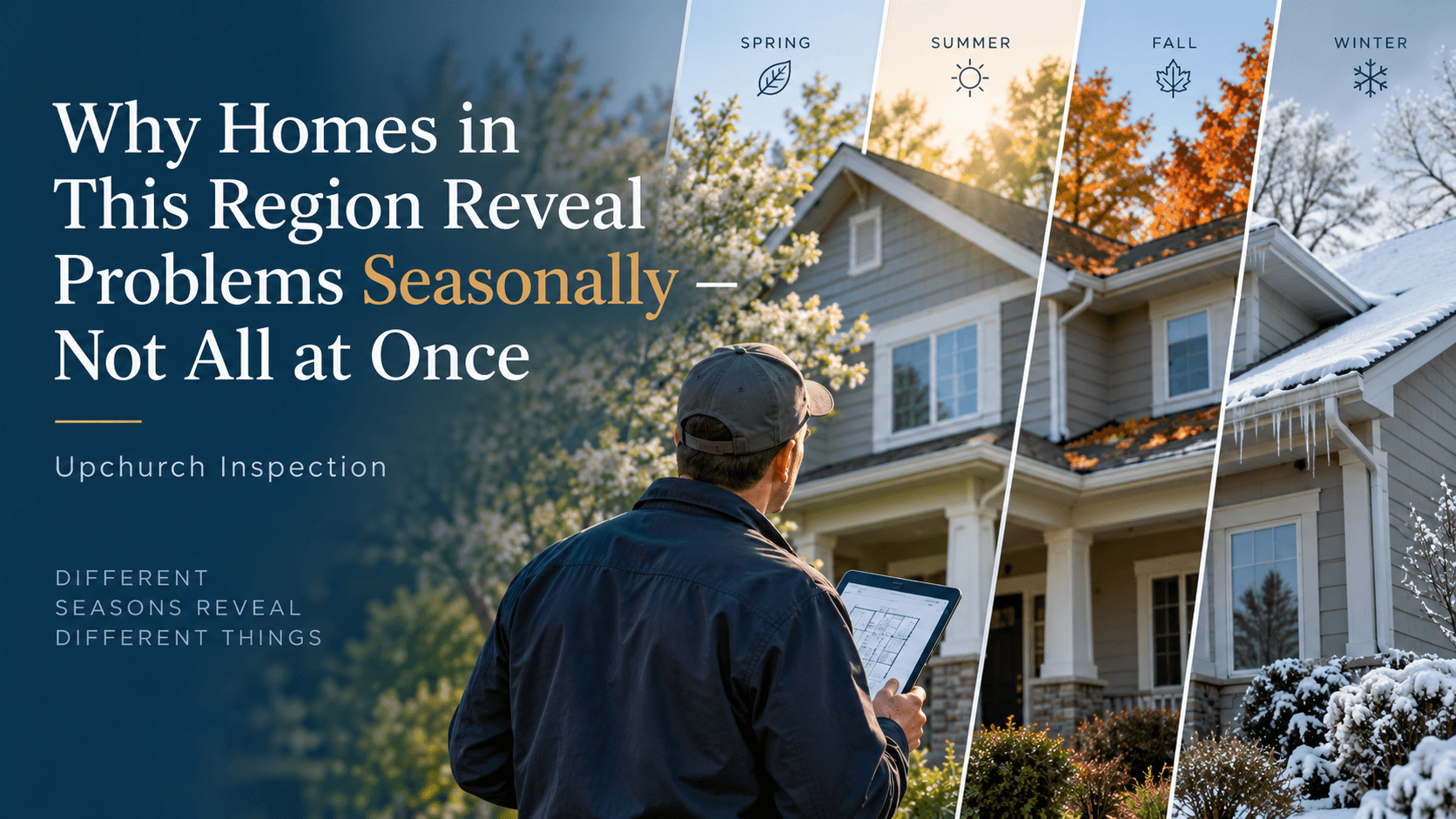
Homes here don’t reveal their issues all at once. They reveal them seasonally.
Our Climate Creates Cycles, Not Constants
This part of the country lives in cycles.
Wet seasons followed by dry stretches. Hot, humid summers followed by cold snaps. Rapid temperature swings that stress materials in ways buyers from more stable climates aren’t used to.
Because of that, many issues only show themselves under specific conditions:
- Heavy rainfall exposes drainage and grading flaws
- Prolonged humidity stresses crawl spaces and HVAC systems
- Freeze-thaw cycles highlight foundation movement and exterior cracking
- High summer loads reveal marginal electrical and cooling capacity
An inspection captures one moment in that cycle—not the whole year.
A Real Example: Drainage That “Looks Fine”
We routinely inspect homes where drainage appears adequate on a dry day. The yard is firm. The crawl space is dry. There’s no standing water anywhere.
But based on grading, soil type, and downspout placement, we know what happens during extended rain. Water moves toward the foundation. Crawl spaces stay damp longer. Moisture accumulates gradually.
Buyers sometimes question why those concerns are documented when there’s no visible problem.
The answer is experience. We’ve seen what happens when the season changes.
Crawl Spaces Are the Best Seasonal Indicators
Across West Tennessee, Arkansas, and Kentucky, crawl spaces tell seasonal stories better than almost any other part of the house.
In summer, humidity drives moisture upward. In winter, temperature differences change airflow. In spring, groundwater levels rise. In fall, drying patterns shift again.
A crawl space that looks acceptable in one season may struggle badly in another. That doesn’t make the inspection wrong—it makes the house predictable if you know how to read it.
Why Buyers Feel “Blindsided” Months Later
When buyers discover issues months after closing, they often say the same thing:
“It wasn’t like this during the inspection.”
That’s usually true.
What changed wasn’t the house—it was the conditions.
A roof that didn’t leak during a light rain leaks during a sustained storm. A basement that stayed dry during summer floods during winter saturation. An HVAC system that kept up in mild weather struggles in extreme heat.
The inspection wasn’t incomplete. It was limited to a moment in time, as all inspections are.
Local Experience Teaches Seasonal Patterns
Inspectors who work one region long enough start recognizing seasonal rhythms.
We know which neighborhoods in Memphis tend to flood after long rains. We know which soil types around Nashville lead to recurring foundation movement. We know which crawl space designs in Arkansas struggle every summer. We know which older homes in Cape Girardeau show predictable winter moisture patterns.
That knowledge doesn’t come from standards or software. It comes from seeing the same houses behave differently as the year unfolds.
Why We Talk About Risk, Not Just Conditions
When we flag concerns that aren’t actively failing, we’re not predicting disaster. We’re identifying conditions that historically change with the seasons.
That’s why our reports often include language about monitoring, drainage improvement, ventilation, or maintenance timing. Those recommendations are about preparing buyers for how the home behaves throughout the year—not just how it looked on one day.
How We Explain This at Upchurch Inspection
We make it clear that inspections are snapshots, not time-lapse videos.
During inspections and walkthroughs, we explain:
- Which conditions are season-sensitive
- What typically changes during heavy rain, heat, or cold
- Which areas deserve extra attention at different times of year
- How homeowners can stay ahead of predictable seasonal stress
That approach helps buyers understand the house as a living structure, not a static object.
Homes Here Don’t Fail Suddenly — They Reveal Themselves Gradually
In this region, serious problems almost never come out of nowhere. They follow patterns tied to weather, moisture, and time.
Buyers who understand those patterns aren’t shocked when something changes seasonally. They expected it. They planned for it. They recognize it as part of ownership in this climate.
That’s the value of a regionally informed inspection.
It doesn’t promise that nothing will ever go wrong.
It teaches you when and how things are most likely to change.
And that understanding is what turns an inspection into real protection.