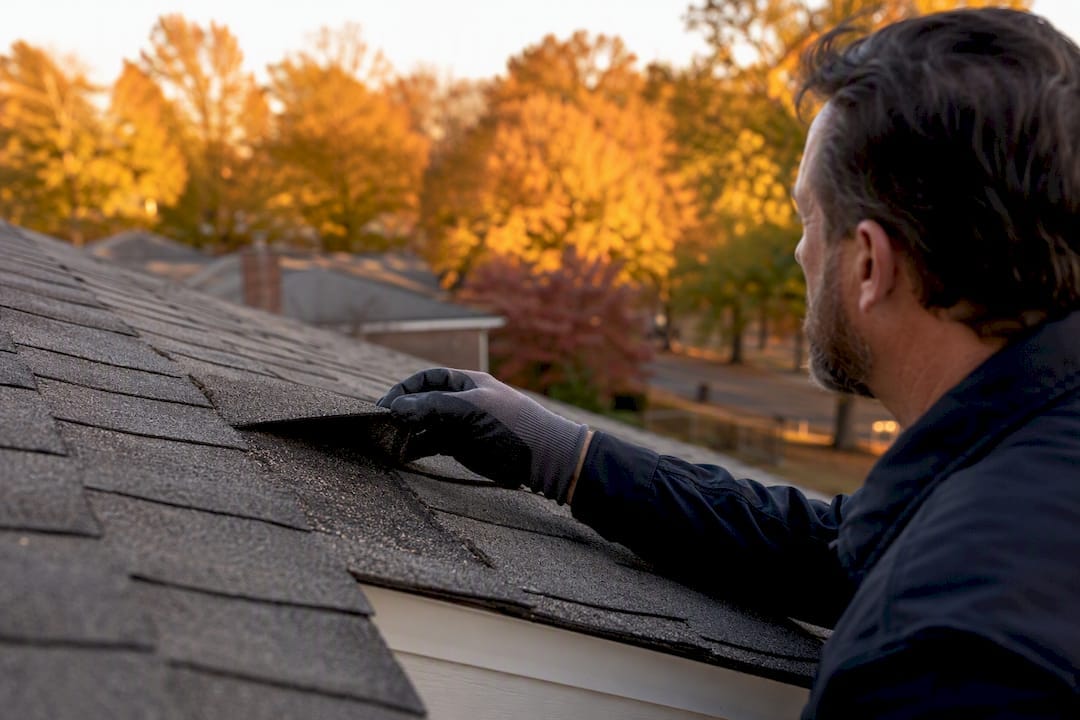
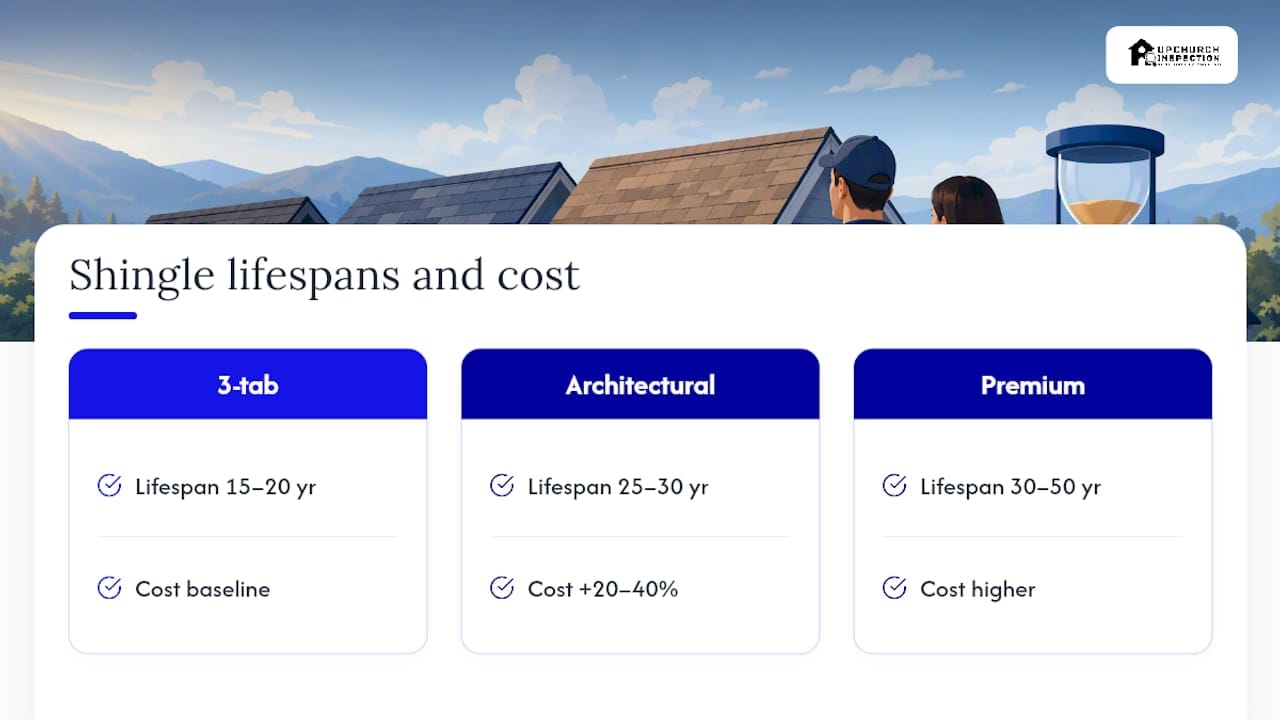
Real-world asphalt shingle lifespan runs about 15 to 20 years for 3-tab shingles, 25 to 30 years for architectural (dimensional) shingles, and 30 to 50 years for premium or designer shingles under near-ideal conditions, that last part matters more than most homeowners realize. The number printed on the wrapper is a warranty category, not a promise about your roof.
Three things decide where your roof lands in those ranges: how well it was installed, whether the attic ventilation is doing its job, and how much sun, heat, and storm damage it has absorbed. I’ve walked enough attics in this region to tell you that a poorly ventilated roof in West Tennessee can burn through half its rated life before the warranty paperwork even matters.
- 3-tab shingles: roughly 15 to 20 years
- Architectural/dimensional shingles: roughly 25 to 30 years
- Premium/designer shingles: roughly 30 to 50 years, conditions permitting
- Next step: check the shingle’s visible condition and age, or schedule a professional inspection before you assume the warranty number applies to you
Key Takeaways
Realistic asphalt shingle lifespan depends far more on installation quality, attic ventilation, and climate exposure than on the warranty year printed on the shingle wrapper.
| Point | Details |
|---|---|
| Lifespan by tier | 3-tab lasts roughly 15 to 20 years, architectural 25 to 30 years, premium 30 to 50 years in good conditions. |
| Warranty years mislead | Warranties often prorate after year 10, so the label year rarely matches real payout value. |
| Installation drives failure | Up to half of premature shingle failures trace back to installation defects, not the shingle itself. |
| Ventilation is the top fix | Balanced ridge and soffit ventilation can add roughly 20 to 30% to a roof’s service life. |
| Insurance shifts with age | Many policies move from replacement cost to actual cash value coverage between 15 and 25 years of roof age. |
Table of Contents
- Asphalt Shingle Lifespan by Type: What the Numbers Actually Mean
- What Determines a Shingle Roof’s Real Service Life?
- Signs Your Roof Is Approaching the End of Its Life
- Maintenance That Actually Extends Shingle Life
- Warranties, Insurance, and Planning Your Replacement Budget
- Roof Inspection Checklist for Mid-South Homeowners
- Why Warranty Marketing Misses What Actually Determines Roof Life
- Sources
Asphalt Shingle Lifespan by Type: What the Numbers Actually Mean
The three shingle tiers aren’t just a price ladder. They represent different mat weights, adhesive strip formulations, and granule densities, and those differences show up in the field over decades, not months.
3-tab shingles are the thinnest and cheapest option, and they typically deliver 15 to 20 years of service. Architectural shingles, sometimes called dimensional or laminate shingles, use a heavier, layered construction and generally last 25 to 30 years. Premium or designer shingles mimic slate or cedar shake and can push 30 to 50 years when everything else lines up.
Pro Tip: Don’t buy a 30-year shingle to solve a ventilation problem. A premium shingle on a poorly ventilated attic can age faster than a mid-grade shingle installed correctly on a well-vented roof.
Those ranges assume proper installation, balanced attic ventilation, and a normal climate without major storm events. A 2026 industry synthesis puts it plainly: shingle tier, installation quality, attic ventilation, climate exposure, and maintenance history compound together, and installation quality plus ventilation usually outweigh which brand or tier you bought.
Here’s the practical math on cost versus life. Architectural shingles typically cost 20 to 40% more than 3-tab per square, but they buy roughly 10 extra years of service. That’s a better dollar-per-year ratio in most cases, which is why 3-tab has largely disappeared from new construction in this market. Premium shingles cost more again, and the extra years only materialize if the roof underneath them is properly ventilated and correctly flashed.
What Determines a Shingle Roof’s Real Service Life?
Some factors are baked in before you ever buy a house. Others you control every single year you own the roof.
Installation quality is the biggest lever, and it’s not close. Industry estimates from NRCA and ARMA attribute 30 to 50% of premature shingle failures to installation defects, not product defects. Missing starter strips, underdriven or overdriven nails, and improperly lapped flashing at valleys, chimneys, and sidewalls all create entry points for water long before the shingles themselves wear out.
Attic ventilation is the second biggest lever, and it’s the one most homeowners never think about. IRC R806 sets minimum net free ventilation area requirements for a reason. Trapped attic heat bakes shingles from underneath, and a balanced ridge-and-soffit system can add roughly 20 to 30% to service life compared to a roof with blocked or mismatched intake and exhaust venting.
Climate and weather events work in two different ways. UV and heat cause slow, cumulative oxidation. NIST laboratory testing confirms that repeated UV, heat, and humidity cycling changes shingle mechanical properties and accelerates granule loss and adhesive strip degradation. Hail and wind, on the other hand, can strip 10 to 20 years off a roof’s remaining life in one afternoon.
Other contributors matter too, just at a smaller scale:
- Routine maintenance history
- Roof color and reflectivity (darker roofs run hotter)
- Overhanging tree cover trapping moisture
- Roof slope and drainage efficiency
Signs Your Roof Is Approaching the End of Its Life
Not every worn-looking roof needs replacement tomorrow, and not every roof without an active leak is fine. Here’s how I sort it in the field.
- Granule loss in gutters. Some granule shedding is normal on a new roof for the first year. Heavy, ongoing granule loss showing up as gritty buildup in gutters or downspouts signals the protective layer is thinning and UV exposure to the asphalt mat is increasing.
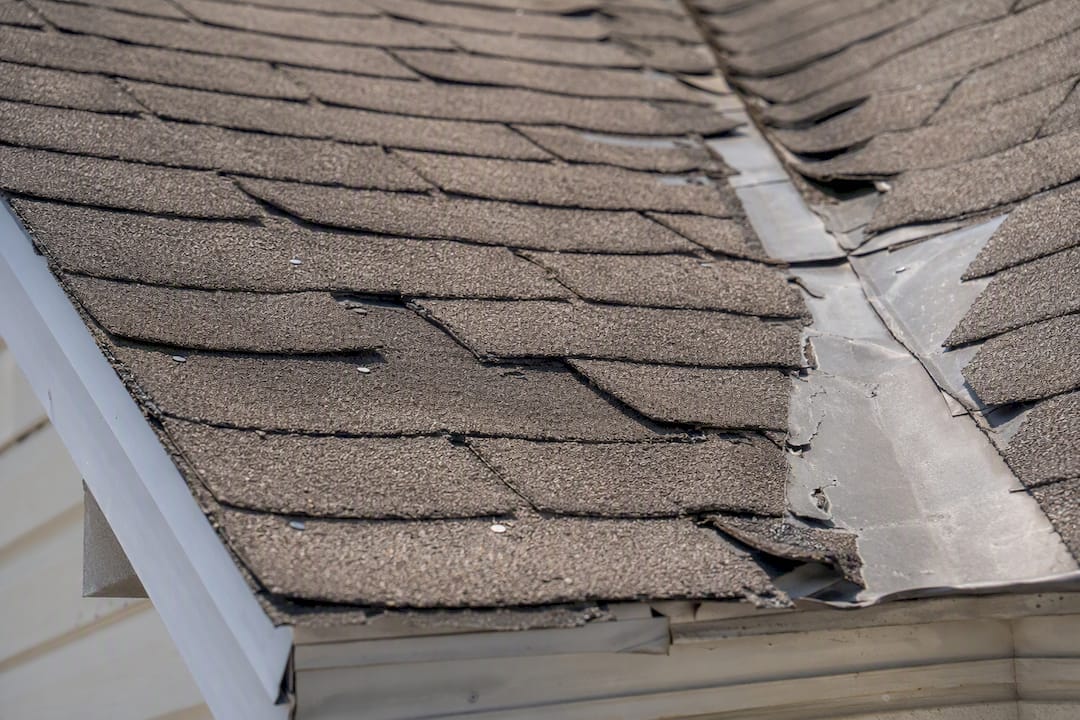
- Curling or cupping shingle edges. This usually points to heat damage from below, often from inadequate attic ventilation, and it’s a strong sign the roof is aging faster than its calendar age suggests.
- Cracking and bald patches. Cracked shingles or bald spots where granules have worn away completely expose the asphalt to direct sun and mean localized failure is close.
- Exposed felt or matting. If you can see the black felt underlayment through the shingle surface, that section has essentially failed and needs attention now, not later.
- Repeated interior leaks, ceiling stains, or a sagging deck. These are functional failures, not cosmetic ones, and they call for a professional inspection immediately rather than a wait-and-see approach.
Granule loss and curling mean monitor closely and plan ahead. Leaks, staining, and deck sag mean act now.
Maintenance That Actually Extends Shingle Life
The interventions that add years to a roof are unglamorous, and that’s exactly why most homeowners skip them.
Ventilation corrections top the list. If your attic lacks balanced net free vent area between soffit intake and ridge exhaust, adding or rebalancing vents is often the highest-return fix available, and it typically costs far less than a full re-roof. Our attic ventilation resource walks through what proper balance looks like and how it’s measured.
Routine maintenance matters more than most people give it credit for. Clean gutters twice a year so water doesn’t back up under the shingle edge. Inspect flashing around chimneys, vents, and skylights annually, since flashing fails long before shingles do. Combined, these habits typically add 5 to 10 years of practical service life.
For algae and moss, ARMA-recommended treatments and gentle rinsing work. Skip the pressure washer entirely. Pressure washing strips granules and does real, permanent damage in seconds. For broader roof-preservation habits, this roof maintenance guide covers useful general practices. Trim overhanging branches so shingles dry out fully after rain, and address small repairs, like a lifted shingle or cracked flashing, before they become a full leak.
Warranties, Insurance, and Planning Your Replacement Budget
Manufacturer warranties are marketing documents dressed up as guarantees, and understanding that difference will save you money.
Most 20, 30, and 50-year warranties carry an initial non-prorated period, often the first 10 years, where a full defect claim gets paid at full value. After that, payouts prorate downward, meaning a manufacturer defect discovered in year 22 of a “30-year” shingle might pay out a small fraction of replacement cost, not the whole roof.
Homeowners insurance follows a similar pattern with age. Many policies shift roof coverage from Replacement Cost Value (RCV) to Actual Cash Value (ACV) once a roof crosses a certain age threshold, commonly somewhere between 15 and 25 years depending on the carrier. That shift can mean the difference between a full payout and a depreciated one after storm damage.
- Confirm whether your policy uses RCV or ACV for roof claims, and at what age it switches
- Ask contractors whether they offer certified-installer workmanship warranties, which often protect you better than the manufacturer’s material warranty
- Keep installation paperwork and inspection reports on file, since insurers and warranty claims both ask for proof of proper installation
Roof Inspection Checklist for Mid-South Homeowners
An inspector’s job isn’t just checking for active leaks. A dry ceiling can hide a roof that’s already failing underneath.
A solid inspection checklist covers ventilation balance, roof deck condition and stiffness, flashing integrity at every penetration, granule loss mapping across roof faces, and attic temperature readings compared to outdoor air. Brittleness in shingles that haven’t cracked yet, and moisture trails along rafters that never reached the ceiling, both show up before a leak ever does. Our roof inspection guide for Mid-South homebuyers and sellers breaks these items down further.
Pro Tip: In Memphis and West Tennessee, ask your inspector specifically about attic heat buildup and moisture cycling. Our humidity swings accelerate the exact oxidation and adhesive degradation NIST’s lab testing documented, and it often shows up years before a visible leak does.
- Ventilation balance check (intake versus exhaust)
- Roof deck condition and deflection
- Flashing inspection at all penetrations
- Granule loss mapping by roof face
- Attic temperature and moisture assessment
Why Warranty Marketing Misses What Actually Determines Roof Life
The conventional advice on roof shopping obsesses over which brand offers the longest warranty. That’s backward. The evidence here points somewhere else entirely: installation quality and attic ventilation drive more of a roof’s real lifespan than the shingle tier printed on the invoice, and NRCA and ARMA commentary attributing up to half of premature failures to installation defects should be the headline, not a footnote.
What gets overlooked is how much of this is controllable after the fact. You can’t undo a bad install without tearing shingles off, but you can correct ventilation, keep gutters clear, fix flashing, and manage tree cover, and those steps buy real years. In a market like Memphis, where summer attic temperatures push shingle aging harder than in cooler regions, that maintenance discipline matters more, not less.
If you’re buying a house with a roof that’s 10, 15, or 20 years old, don’t take the seller’s word for its condition, and don’t lean on the warranty paperwork either. Get eyes on the deck, the flashing, and the attic before you close. That’s the judgment call that actually protects your investment.
— Holly
Scheduling a professional roof and attic evaluation before you buy, sell, or budget for replacement is the single best way to separate cosmetic wear from a roof that’s genuinely near the end. Upchurchinspection’s inspectors check ventilation balance, deck condition, flashing, and granule loss as standard practice on every residential inspection across Tennessee, Arkansas, Mississippi, Missouri, and Kentucky, not as an upsell. If you’re weighing a purchase or planning ahead for replacement costs, our regular property inspection guidance explains why catching these issues early prevents the expensive surprises that show up during closing or after a storm.