
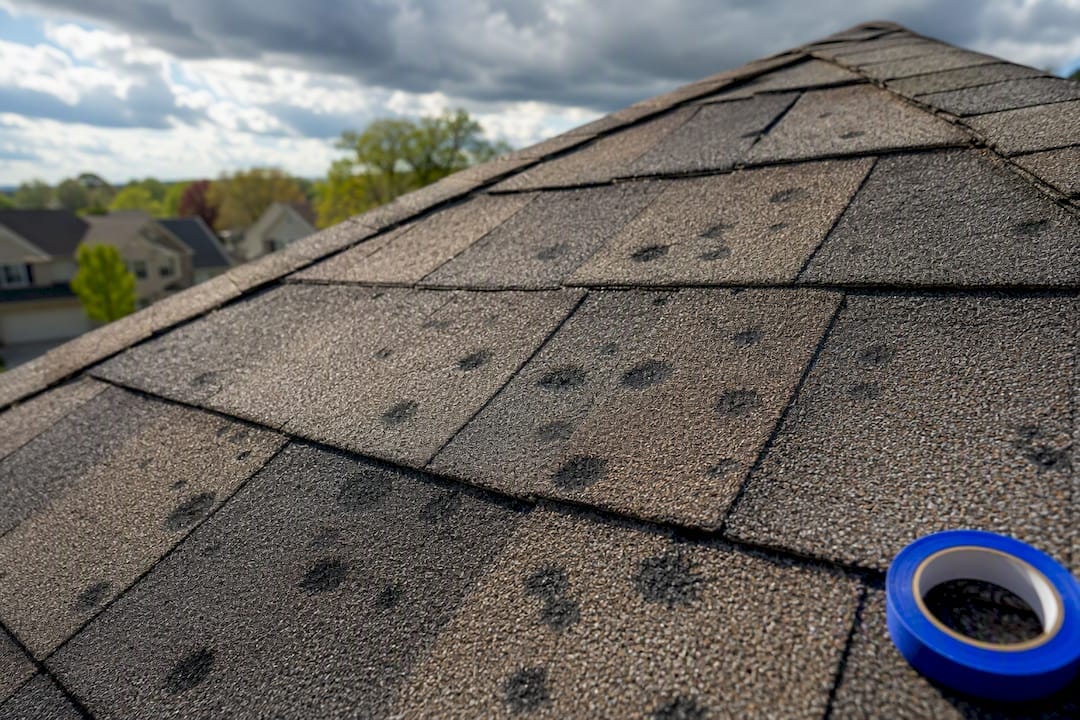
If you’re seeing clustered round dents, fresh black spots where granules used to be, or dented gutters and vents after a documented hailstorm, your roof likely has functional hail damage. Stay off the roof. Photograph what you can see from the ground, note the storm date, and schedule a professional inspection before you sign anything with a contractor or file a claim.
TL;DR:
- Impact size and wind direction during the storm significantly influence the severity and pattern of hail damage on a roof.
- Ground-level inspection of dents and granule buildup, along with a professional test-square assessment, provide the most reliable evidence for hail damage.
- A detailed report should include per-slope photos, impact counts, and soft-metal dents, serving as critical documentation for insurance claims.
- Hail impact causes circular, clustered marks, whereas aging, blistering, and foot traffic leave distinctly different, often linear, damage patterns.
- Regular maintenance and impact-resistant shingles can reduce future hail damage risk, especially in storm-prone regions.
Table of Contents
- What Hail Damaged Shingles Actually Look Like
- How Inspectors Evaluate Hail Damage: Test Squares and Hit Counts
- Hail Damage vs. Blistering, Aging, and Foot Traffic
- Insurance Documentation and What to Do Next
- Repair Options, Cost Ranges, and Timelines
- What a Professional Report Should Include
- How Weather Conditions Shape Hail Damage Severity
- Preventing Future Hail Damage to Your Shingles
- Why the Report Matters More Than the First Impression
- Sources
What Hail Damaged Shingles Actually Look Like
Hail leaves a different fingerprint than everyday wear, and learning to read that fingerprint from the ground saves you from either panicking over nothing or ignoring a real problem.
The biggest tell is pattern. Uniform granule loss spread evenly across a slope usually points to age. Hail, on the other hand, tends to leave clustered, circular impact marks concentrated on the slopes that faced the storm. Where a hailstone actually struck hard enough to matter, you’ll often see a dark, almost black spot where the granules got knocked loose and the asphalt mat underneath is exposed. That fresh, dark asphalt color is a big clue for recency, since older exposed asphalt oxidizes to a dull gray film over time, according to a guideline on assessing hail damage from forensic roofing analysts.
Granule loss by itself doesn’t prove functional damage, though. Inspectors are specifically looking for impacts that reach and fracture the fiberglass mat underneath, not just spots where the surface coating got scuffed, per HAAG Global’s analysis of hail claims. That’s why a trained hand will press on suspected bruises. A soft, springy feel under a thumb often means the mat has fractured even when nothing looks obviously wrong from a few feet away.
From the ground, safely, you can check for:
- Granule buildup in gutters or at downspout outlets, which suggests active shingle degradation
- Dents in gutters, roof vents, or AC condenser fins, which don’t shed granules and hold evidence longer than shingles do
- Cracked or chipped skylight housings and dented window screens
- Splatter marks on siding or fences that match a directional hail path
Pro Tip: Never climb onto a wet or steep roof to inspect hail damage yourself. Soft-metal dents and granule piles at ground level tell you almost as much, and they don’t require a ladder.
How Inspectors Evaluate Hail Damage: Test Squares and Hit Counts
Professional inspections aren’t guesswork. They follow a repeatable process designed to hold up if a claim ever goes to an insurance adjuster or, worse, a dispute.
The core method is the test square. Inspectors chalk or mark off a 10 foot by 10 foot section on a representative area of each roof slope, then count every impact inside that square that qualifies as functional damage, meaning it broke the mat rather than just scuffing the surface. This approach comes straight from field practice described in The Roofing Brief’s inspection walkthrough, and it matters because a single square gives you a standardized, defensible number instead of a vague impression.
A thorough inspection generally covers four zones on a property:
- The shingle field itself — test squares on each slope, since wind direction often means one slope takes a beating while the opposite slope is nearly untouched
- Soft-metal components — vents, flashing, gutters, and AC fins, which dent permanently and serve as some of the most persuasive corroborating evidence available, because they don’t erode or wash away like granules
- Ground collateral — vehicles, decking, fencing, and window screens that took hits during the same storm
- Interior and attic observations — active leaks, water staining, or daylight through the roof deck that suggest the damage already compromised the structure
Insurers don’t all use the exact same trigger point, but a commonly cited informal benchmark is that a certain number of qualifying hits per 100 square feet triggers a decision point for replacement rather than spot repair. Age and existing condition weigh into that decision too. A written report with dated, per-slope photos and hit counts for each test square is what turns “I think we got hailed on” into a claim an adjuster can actually evaluate.
Hail Damage vs. Blistering, Aging, and Foot Traffic
Not every mark on a roof came from the sky. Confusing hail with other causes is one of the fastest ways to either waste an insurance claim or overlook a real maintenance issue.
Hail impacts are round, clustered, and directional, hitting one exposed slope harder than a sheltered one. Blistering looks completely different: raised bubbles scattered randomly across a slope, caused by trapped moisture or poor attic ventilation rather than impact, according to Bob Vila’s comparison of the two conditions. Press on a blister and it often feels hollow or brittle rather than soft and springy the way a hail bruise does.
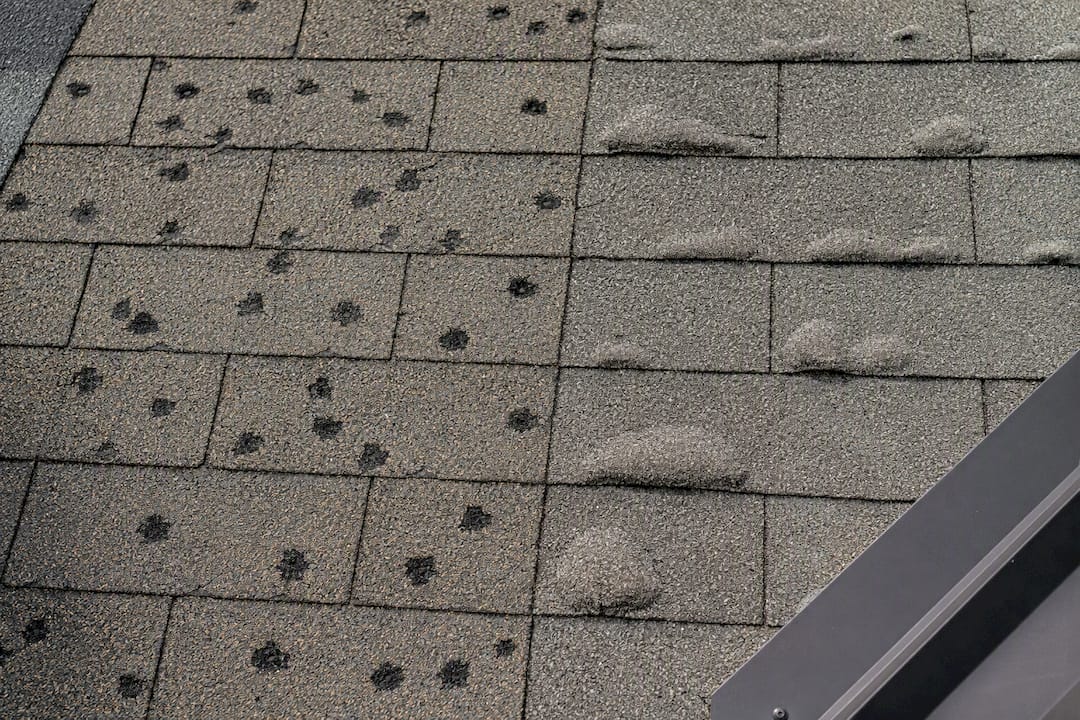
Age-related wear shows up as weathered gray substrate, curling shingle edges, and granule loss that’s fairly uniform across every slope regardless of which direction it faces. Foot traffic and installation defects tend to leave linear scuff marks or edge wear concentrated near vents, chimneys, and walkways rather than the circular, random pattern hail produces.
Here’s the honest limitation: hail damage can be genuinely hard to spot without obvious granule loss, and homeowner guides on finding hail damage note that a lot of it only shows up under a trained tactile check or, in disputed cases, lab analysis of the shingle mat. If you’re not sure what you’re looking at, that uncertainty is the reason to call someone qualified rather than guess.
Insurance Documentation and What to Do Next
The claim you file is only as strong as the evidence behind it, and insurers are trained to poke holes in weak documentation.
Start by pinning down the storm date. You can cross-reference your own memory against NOAA’s Storm Prediction Center climatology records, which log hail events and give you an official date to cite rather than relying on guesswork. From there:
- Photograph every slope, the gutters, vents, and any ground collateral, and timestamp the images
- Save a damaged shingle sample if one has already come loose, but don’t pry one off yourself
- Call your insurer early to learn your deductible, claim filing window, and whether they require their own adjuster to see the roof before repairs start
- Get a written inspection report with per-slope photos and hit counts before you sign a repair contract with anyone
Insurers weigh several factors together: the per-square hit count, the roof’s age and remaining useful life, and whether soft-metal dents corroborate what the shingles show. A roof already past its expected service life may not qualify for full replacement even with real hail damage present, since adjusters distinguish between damage that shortened the roof’s life and damage on a roof that was already near the end of it. Cosmetic marks that don’t reach the mat typically don’t qualify for coverage at all, which is exactly why the test-square method exists. Homeowners in storm-prone parts of the Mid-South should keep a folder of dated photos from every major weather event, not just the one they think caused the damage, since that habit is what separates a smooth claim from a drawn-out dispute.
Repair Options, Cost Ranges, and Timelines
Not every hail-damaged roof needs full replacement, and knowing the difference protects your wallet and your patience.
Isolated functional hits on an otherwise healthy roof are usually candidates for spot repair. Widespread impacts across multiple slopes, or damage on a roof that already had limited remaining life, typically point toward slope-level or full replacement instead. Shingle age matters here too. Our guide to how long asphalt shingles actually last breaks down how manufacturer class ratings and existing wear influence whether an insurer will approve a full swap versus a patch.
Cost drivers include total roof area, pitch and access difficulty, the material class installed, and how busy local roofing crews are after a regional storm event. Timelines stretch out for the same reasons: getting an estimate, waiting on the adjuster visit, ordering matching materials, and dodging the next round of bad weather. Before you authorize any work, ask for a written estimate tied to the same per-slope photo documentation your inspector or adjuster used.
What a Professional Report Should Include
A report worth paying for gives you more than “yes, there’s hail damage.” It should include per-slope test-square photos with hit counts, documented dents on soft metals, ground collateral photos, and attic or interior observations where access allows. For commercial buildings, that report should also state remaining useful life, flag deferred maintenance, and recommend specific CapEx actions rather than vague warnings. Every finding should be dated, tied to a labeled slope, and paired with a clear next step, whether that’s a claim, a repair, or monitoring. And any inspector worth hiring verifies safe access first and only performs tactile checks when conditions allow it. Our commercial roof inspection services are built around exactly this level of documentation.
How Weather Conditions Shape Hail Damage Severity
Not all hailstorms leave the same mark, and understanding why helps you judge whether a “hail event” in your area was actually severe enough to matter for your roof.
Stone size is the biggest factor. Pea-sized hail rarely fractures a shingle mat, while golf-ball or larger stones regularly do, especially on older or already-weathered roofing. Wind speed during the storm changes the angle of impact, which is why damage often concentrates on one or two slopes rather than spreading evenly across the whole roof. A storm with strong sustained wind can drive hail almost sideways into a west-facing slope while a sheltered east-facing slope stays nearly untouched.
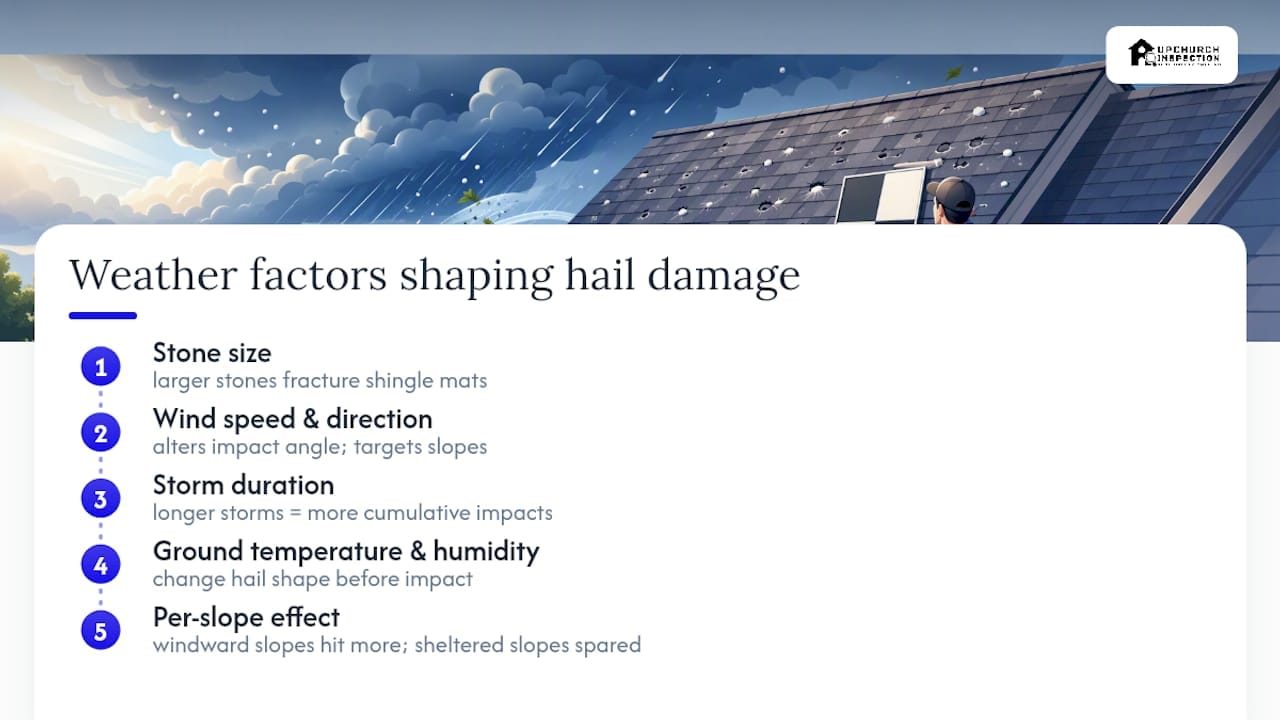
Storm duration matters too. A short, intense burst can do less cumulative damage than a longer event with smaller stones, because total impact count adds up. Ground temperature and humidity affect how hailstones form and hold their shape before they hit the roof, which is part of why two storms with similar reported stone sizes can leave very different damage patterns. This variability is exactly why per-slope inspection matters more than a single glance at the roof from the driveway. It’s also why citing the specific storm date against official records carries more weight with an insurer than a general claim that “it hailed pretty bad this spring.”
Preventing Future Hail Damage to Your Shingles
You can’t control the weather, but you can control what’s on your roof when the next storm rolls through.
The most direct step is choosing impact-resistant shingles when it’s time to replace or reroof. IBHS shingle performance ratings grade materials specifically on how well they hold up against hail impact, and that data is worth reviewing before you pick a product, not after the next storm proves the old roof couldn’t take it. Class 4 impact-rated shingles cost more upfront but hold up meaningfully better in hail-prone regions, and some insurers offer premium discounts for installing them.
Beyond materials, regular maintenance keeps a roof closer to full strength going into storm season. Trim overhanging branches that drop debris and scratch surface granules prematurely. Clear gutters so water doesn’t pool and accelerate deterioration in already-weakened areas. Schedule a maintenance inspection after any major storm, even if nothing looks obviously wrong, since some functional damage doesn’t show visible signs for months. For commercial property owners managing multiple buildings, budgeting for scheduled inspections as part of routine CapEx planning catches early wear before it turns into an emergency repair bill. Our guide to the benefits of regular inspections covers how that habit reduces deferred maintenance risk over the life of a property.
Why the Report Matters More Than the First Impression
Most of the advice out there tells homeowners to look for damage and then call someone. That’s not wrong, but it undersells what the actual inspection process is for. The value isn’t in confirming that hail hit your roof. It’s in the documentation that turns a subjective impression into a number an adjuster can’t easily dismiss: per-slope hit counts, dated photos, soft-metal corroboration.
Where conventional advice falls short is treating every hail claim the same way. A ten-year-old roof and a two-year-old roof with identical hit counts are not the same claim, and pretending otherwise sets homeowners up for disappointment when an adjuster factors in remaining useful life. Commercial owners face this even more sharply, since a denied or underpaid claim on one building can cascade into a deferred maintenance problem across a whole portfolio.
My honest read: prioritize the written report over the first walk-around. A test square and a hit count won’t feel as satisfying as someone pointing at a dent and saying “yep, that’s hail,” but it’s the difference between a claim that gets approved and one that gets argued over for months.
— Holly
If you suspect hail damage on a residential or commercial roof anywhere across Tennessee, Arkansas, Mississippi, or Southeast Missouri, a documented, per-slope inspection is the strongest tool you have before filing a claim or hiring a repair crew. Upchurchinspection’s commercial inspection services are built for property owners and investors who need a written report with real evidence behind it, not just a quick look from a ladder.