Every low-slope commercial roof falls into one of six families: single-ply membranes (TPO, PVC, EPDM), modified bitumen or built-up roofing, metal panels, liquid-applied or spray foam coatings, and vegetative or blue roofs. The right pick comes down to five questions: how long you plan to hold the building, how much foot traffic the roof sees, what chemicals or grease might hit it, whether you need energy savings, and whether the drainage design actually works. Get drainage wrong and the membrane brand won’t save you.
TL;DR:
- Proper drainage and installation quality are far more critical than membrane type in determining roof lifespan and performance.
- Seam quality, ponding, UV degradation, and patches are key inspection points for single-ply membranes, regardless of material choice.
- Multi-ply systems like built-up roofs and modified bitumen are ideal for heavy traffic, redundancy, and retrofit scenarios, despite longer installation times.
- Drainage surveys and moisture inspections should be completed before finalizing any roofing material choice to avoid costly future repairs.
- Vegetative and blue roofs require enhanced waterproofing and structural support, with significant stormwater benefits only if installation is flawless.
Table of Contents
- What Are the Main Commercial Roof Types?
- Single-Ply Membranes: TPO, PVC, and EPDM Compared
- Modified Bitumen and Built-Up Roofing: Why Redundancy Still Matters
- Metal Roofing and Insulated Metal Panels
- Liquid-Applied Membranes and Spray Polyurethane Foam
- Vegetative and Blue Roofs: Stormwater and Structural Trade-Offs
- How to Choose the Right Roof System for Your Building
- Why “It’s Not Leaking” Doesn’t Mean the Roof Is Fine
- An Inspector’s Take on Roof System Hype
- Sources
What Are the Main Commercial Roof Types?
Low-slope roofs, meaning anything under about a 3:12 pitch, cover the vast majority of commercial buildings, and they get grouped into a handful of system families rather than individual products. Single-ply membranes are rolled out in wide sheets and either glued down, mechanically fastened, or held in place with ballast rock. Multi-ply systems, like modified bitumen and built-up roofing, layer several courses of material for redundancy. Metal roofing and insulated metal panels form a rigid, long-life shell. Liquid-applied coatings and spray polyurethane foam create a seamless membrane in place, no seams to fail. Vegetative and blue roofs add a layer of soil, plants, or stored water on top of a waterproofing base.
The mistake I see most often isn’t picking the wrong family, it’s picking a family and then ignoring the installation quality and drainage design that actually determines how long it lasts. A $9 per square foot PVC roof installed over bad drainage will leak before a $6 TPO roof installed correctly. Most high-severity roof losses trace back to a handful of predictable weak points: ponding water, wind uplift at edges and corners, and penetration or flashing transitions. Think of the membrane as the skin. The drainage, flashing details, and attachment method are the skeleton underneath it, and that’s what fails first.
Single-Ply Membranes: TPO, PVC, and EPDM Compared
Single-ply membranes dominate American low-slope roofing, and TPO alone accounts for more than half of all new low-slope installations. Each of the three main polymers, however, fits a different job.
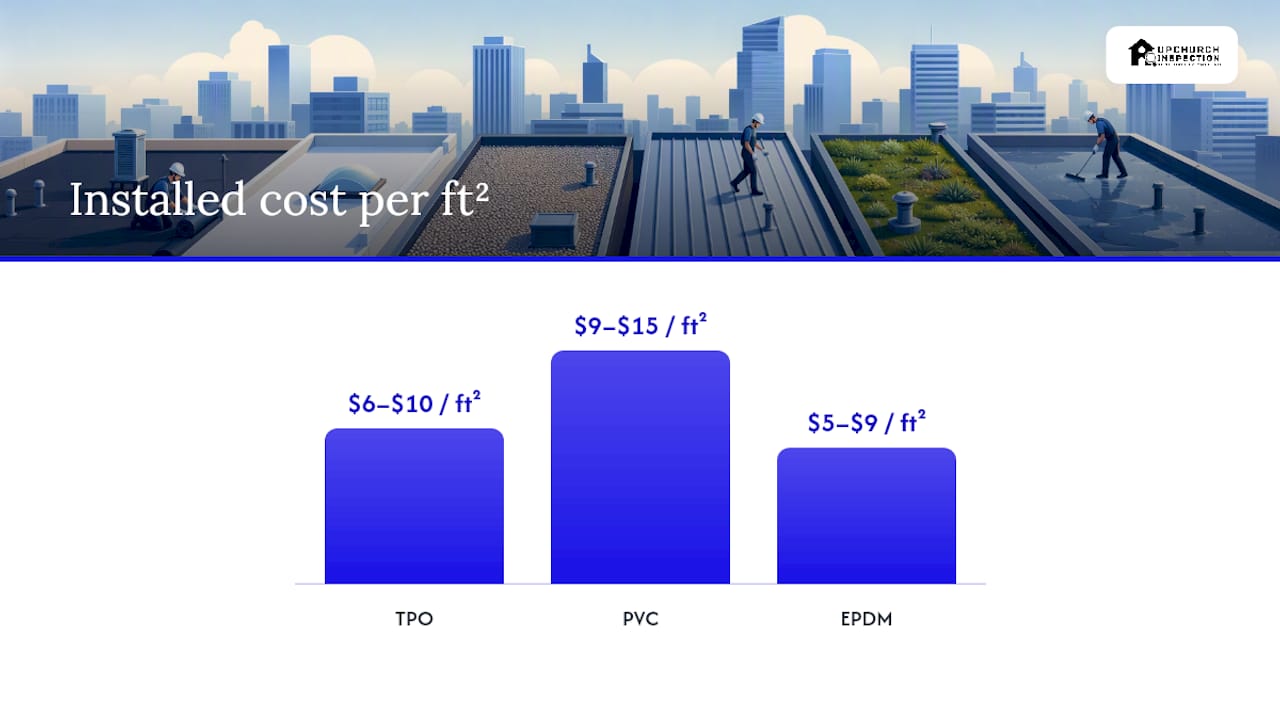
TPO (thermoplastic polyolefin) ships in sheets typically 45 to 80 mils thick and comes in white or light colors that reflect sunlight rather than absorb it, which matters if you’re chasing lower cooling loads. It’s heat welded at the seams, and welding quality is the whole game with TPO. A crew that runs hot enough and tests every seam gets a roof that lasts. A crew that rushes it leaves you with seams that split at year eight instead of year twenty. Installed cost typically runs $6 to $10 per square foot with a service life of 18 to 25 years.
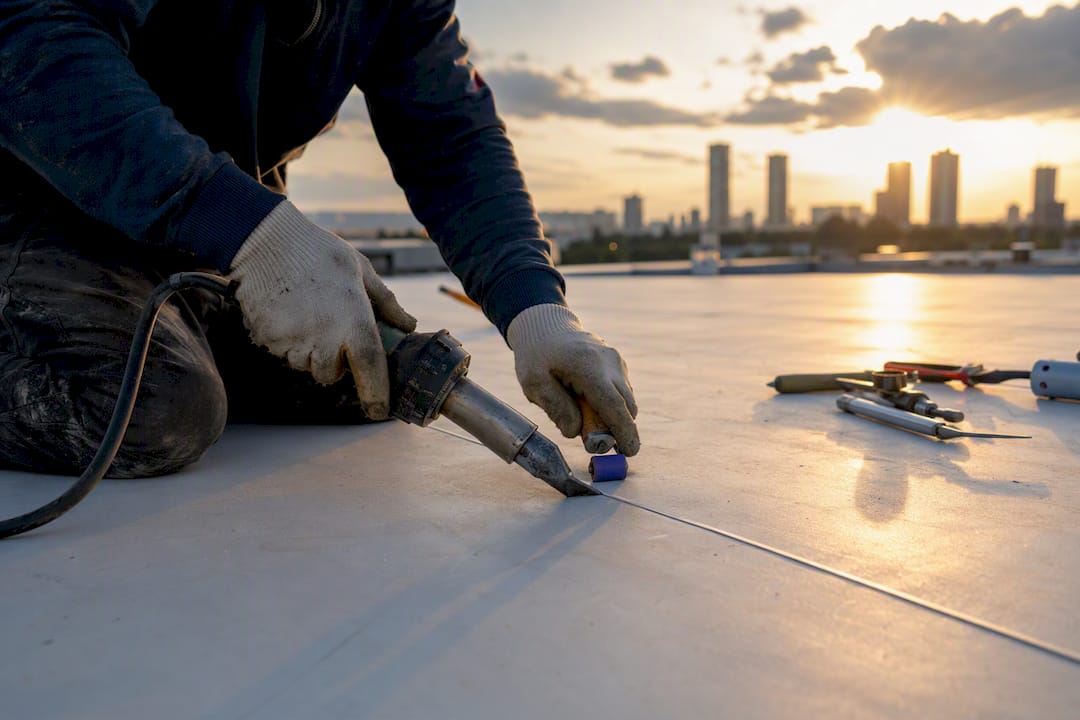
PVC costs more, usually $9 to $15 per square foot, but it earns that premium through chemical and grease resistance that TPO and EPDM can’t match. If you own a restaurant building, a food processing plant, or anything with grease-laden exhaust venting across the roof deck, PVC is close to non-negotiable. Grease breaks down TPO seams over time in ways that don’t show up in a warranty claim until it’s too late.
EPDM, the black rubber membrane, has been around the longest and tends to hold up best under mechanical abuse. Expect a 25 to 35 year service life with installed costs around $5 to $9 per square foot, and it’s a strong pick for roofs with heavy foot traffic from maintenance crews, HVAC techs, or telecom work, and for owners planning a long hold period. EPDM can be finished in reflective coatings if cool-roof performance matters, though it doesn’t come reflective out of the box the way TPO does.
Pro Tip: Don’t just ask “what membrane is on this roof.” Ask when the seams were last inspected and whether any patches show scorch marks or lifting edges. Patched-over seams are usually cheaper to catch early than to discover during a rainstorm.
Field inspection cues worth knowing for any single-ply roof:
- Seam edges lifting, curling, or showing daylight between the sheets
- Shrinkage, visible as membrane pulled taut and away from parapet walls or curbs
- Multiple generations of patches clustered in one area, a sign of a recurring leak that was never actually fixed
- Chalking or fading on TPO that signals UV degradation past the coating’s protective layer
- Ponding water sitting more than 48 hours after rainfall, which stresses seams and accelerates aging everywhere it collects
TPO now represents the majority of new low-slope work because it balances cost, reflectivity, and installation speed. But specification and installation quality control determine real-world longevity more than the small chemistry differences between these three polymers. A well-installed EPDM roof will outlast a poorly installed PVC roof every time.
Modified Bitumen and Built-Up Roofing: Why Redundancy Still Matters
Built-up roofing, the old tar-and-gravel system, layers alternating plies of bitumen and reinforcing fabric, often finished with a gravel or mineral cap. Installed cost runs roughly $5 to $10 per square foot with lifespans of 18 to 30 years depending on the number of plies. It’s heavy, it’s slow to install, and it’s still one of the toughest roofs you can put over a building that takes real abuse.
Modified bitumen comes in two chemistries, SBS and APP, and gets installed either torch down, heat welded, or self-adhered with a peel-and-stick backing. Mod-bit installed cost typically sits within a mid-range commercial roofing membrane pricing per square foot, and cap sheets can include reflective granules for a partial cool-roof benefit.
Where multi-ply systems earn their keep:
- Industrial roofs with regular equipment traffic, ladder access, or staged rooftop work where a single-ply membrane would get punctured repeatedly
- Buildings where redundancy matters more than reflectivity, since a multi-ply system can lose one course and still hold
- Retrofits over existing multi-ply roofs where tear-off costs make recover a smarter financial move
Torch-down installation carries real fire risk, and plenty of jurisdictions and insurers now require specific permits, fire watches, or restrict torch work entirely near combustible substrates. If your roofer proposes torch-applied mod-bit, ask about the fire-safety plan before you ask about price. Self-adhered mod-bit sidesteps that risk entirely and has become the more common choice for exactly that reason.
Metal Roofing and Insulated Metal Panels
Standing seam metal roofing is the long-life option in this lineup, often rated for 40 to 60 years with proper maintenance, though the premium install cost and steeper learning curve for repairs keep it out of some budgets. It sheds water fast, handles snow load well, and rarely fails outright. It fails at the details: fastener corrosion, sealant breakdown at penetrations, and seam clips that loosen over decades of thermal cycling.
Insulated metal panels (IMPs), which sandwich a rigid foam core between two metal skins, solve a different problem: thermal performance. Cold storage warehouses, refrigerated distribution centers, and food processing buildings lean on IMPs because they deliver wall and roof insulation and structure in one panel, cutting down on thermal bridging that plagues built-up insulation systems.
For older metal roofs with dead-flat or low-slope sections, restoration coatings can extend service life without a full tear-off, and adding tapered insulation during a recoat can finally correct the ponding problems the original design never addressed. When inspecting metal roofs, look closely at fastener heads for rust bleed, check exposed seams for sealant cracking, and pay attention to any area where a curb or pipe penetration meets the panel, that’s where movement and thermal cycling do the most damage.
Liquid-Applied Membranes and Spray Polyurethane Foam
Liquid-applied coatings and spray polyurethane foam (SPF) solve a problem membranes struggle with: complex geometry. Pipe clusters, HVAC curbs, parapet transitions, and irregular decking are hard to flash with sheet goods but straightforward to coat or spray in place, since the result is seamless by nature.
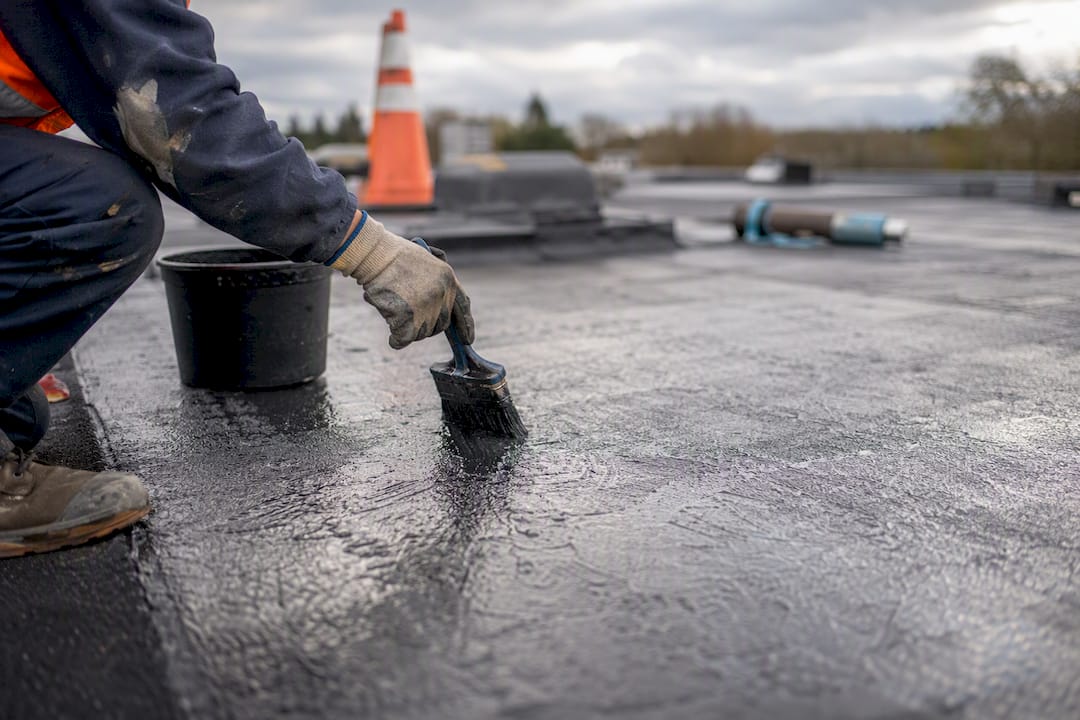
Both systems live or die on substrate prep. Moisture trapped under a coating or SPF layer doesn’t evaporate, it blisters. Any roofer proposing liquid-applied or SPF work should be doing a moisture survey first, not skipping straight to spraying. Expect a recoat cycle every 10 to 15 years to maintain the waterproofing layer’s integrity.
Watch for blistering, soft spots underfoot, or delamination at the edges. Those signs usually mean moisture got trapped before or during application, and a core sample or infrared moisture scan is the only way to know how far it’s spread.
Vegetative and Blue Roofs: Stormwater and Structural Trade-Offs
Vegetative roofs come in two flavors: extensive systems with a few inches of lightweight growing medium and low-maintenance plantings, and intensive systems that support deeper soil, larger plants, even walkable garden space. Blue roofs skip the vegetation and instead detain stormwater temporarily on the roof surface, releasing it slowly to reduce peak load on municipal storm systems.
Both demand a root barrier and protection board over the waterproofing membrane, plus a structural engineer’s sign-off, since the added weight from soil, plants, or standing water can exceed what the original roof deck was designed to carry. Green roofs deliver real stormwater control and can measurably reduce urban heat island effects, which is increasingly part of ESG reporting for institutional owners. But that benefit only shows up if the waterproofing underneath is bulletproof, because a leak under a green roof is one of the most expensive and disruptive repairs in commercial roofing.
How to Choose the Right Roof System for Your Building
Work through this checklist before you sign off on any roofing proposal:
- Hold period. Planning to sell in five years? Don’t overpay for a 35-year EPDM system. Holding for 20-plus years changes the math toward higher upfront cost and lower lifecycle cost.
- Rooftop foot traffic. Heavy service traffic from HVAC techs or telecom crews favors EPDM or a multi-ply system over a thinner single-ply membrane.
- Chemical exposure. Restaurant exhaust, industrial fumes, or grease call for PVC or a coated system rated for chemical resistance.
- Energy and cool-roof goals. Reflective membranes lower roof surface temperature and can reduce cooling energy use, which matters more in some climates and utility rate structures than others.
- Drainage evaluation. Has anyone actually surveyed the roof for ponding? A roof should achieve positive drainage within 48 hours of a rain event, and retrofits over a deflected deck need a documented ponding stability check.
- Wind-uplift design. Edge and corner zones need engineered attachment, not the same fastening pattern as the field of the roof.
- Budget vs. lifecycle cost. The cheapest bid on installed cost per square foot isn’t always the cheapest roof over 20 years. For a deeper look at how to weigh those numbers, replacement planning guidance walks through the timing decisions worth having in writing before you sign a contract.
Pro Tip: Ask every contractor bidding your roof three questions: what’s their seam welding QA process, how do they document ponding areas before design, and what exactly voids the warranty. If the answer to any of those is vague, that’s your red flag, not the price.
Watch for proposals that skip a ponding evaluation entirely, offer a vague “we’ll address drainage as needed” line instead of a design, or provide no detail on wind-uplift attachment patterns. Those are the gaps that turn into six-figure claims later.
Why “It’s Not Leaking” Doesn’t Mean the Roof Is Fine
A dry ceiling tells you almost nothing about what’s happening in the insulation layer or at the drain bowls. Wet insulation can sit undetected for years, quietly rotting the deck from below while the membrane on top looks fine from a walk-through. That’s the gap between a visual check and an actual inspection.
A proper commercial roof inspection covers drainage performance, moisture conditions in the deck and insulation, penetration and flashing integrity, and the condition of HVAC curbs where equipment meets the roof surface. Rooftop HVAC units are a common source of penetration failures that get overlooked because everyone’s looking at the membrane, not the curb underneath the unit.
The findings that change a repair-versus-replace decision are rarely dramatic. It’s usually wet insulation confirmed by a moisture scan, or a secondary drain that’s been clogged so long it no longer functions as a backup. Those findings should shape what you negotiate in a purchase, what scope you put in front of contractors, and what you push back on in a warranty claim. Upchurchinspection’s commercial roof inspection services are built around exactly that: giving owners documented findings before they sign a repair contract, not after.
An Inspector’s Take on Roof System Hype
Membrane marketing loves to fight over polymer chemistry, TPO versus PVC versus EPDM, like the choice of plastic is the deciding factor in whether a roof lasts. It isn’t. I’ve walked plenty of TPO roofs that failed in twelve years because of bad seam welds, and EPDM roofs pushing 30 years because someone kept the drains clear and fixed flashing issues before they became leaks.
The conventional advice tells owners to pick a membrane and move on. That’s backwards. Pick the membrane family that fits your hold period, traffic, and chemical exposure, sure, that part matters. But the bigger lever is drainage design and installation QA, and those get almost no attention in most roofing conversations because they’re less interesting to sell than a new polymer blend.
If you take one thing from this, prioritize the inspection before the material debate. Know your ponding conditions. Know your seam quality. Know what’s happening in the insulation layer before you’re negotiating a claim or a purchase price around a surprise. The roof material is a five-year decision at most. The drainage and installation quality decide whether you get the other twenty.
— Holly