
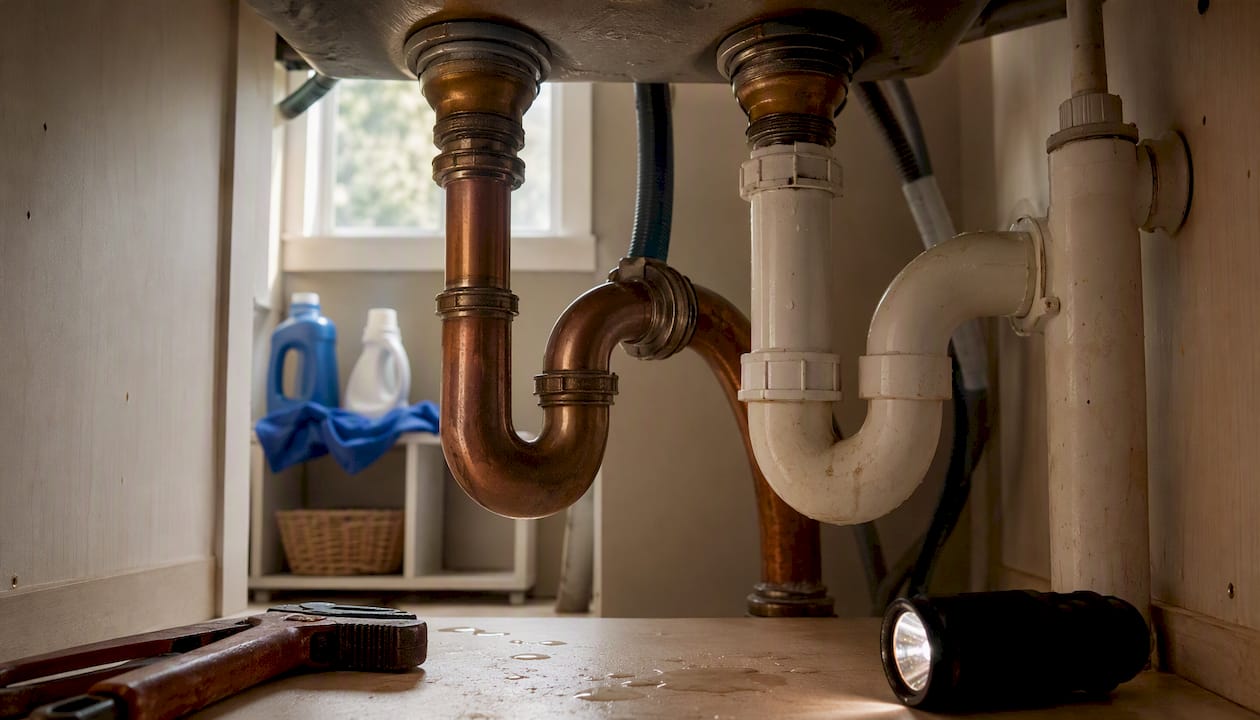
The bottom line is straightforward: a P-trap is the correct, code-compliant configuration, and an S-trap is prohibited in new residential plumbing work under modern model codes. The functional difference comes down to one thing — venting. A P-trap connects horizontally to a vented wall drain, which allows air to break any vacuum that forms during drainage and keeps the water seal intact. An S-trap drops vertically into the floor with no functioning trap arm, creating a siphoning condition that can pull the water seal right out of the trap. Once that seal is gone, sewer gas has a direct path into the living space. IRC 2024 Section P3201.6 explicitly lists the S-trap as a prohibited trap type for this reason, and that prohibition has been consistent across the 2018, 2021, and 2024 editions of the International Residential Code.
Key Takeaways
P-traps are the only code-compliant trap configuration for new residential plumbing work; S-traps are prohibited under IRC, IPC, and UPC model codes because their geometry causes self-siphonage and trap-seal loss.
| Point | Details |
|---|---|
| P-trap is the compliant choice | A horizontal trap arm connected to a vented drain is required; the vent prevents siphoning. |
| S-trap is prohibited in new work | IRC Sections P3201.5 and P3201.6 explicitly ban S-traps due to self-siphonage risk. |
| Key visual identifier | If the trap outlet drops through the floor with no horizontal run, it is an S-trap. |
| Symptoms to watch | Gurgling after draining, intermittent sewer odor, and traps that dry out signal seal loss. |
| Correction triggers | Permitted remodels, fixture replacements, final inspections, and some real estate transactions require repair. |
| Upchurchinspection | Documents trap conditions with photos, code citations, and contractor-ready repair language in every inspection report. |
Table of Contents
- What is a P-trap and how does it protect your drain?
- What is an S-trap and why does it siphon?
- Side-by-side differences: P-trap vs S-trap
- Why codes ban S-traps and what inspectors cite
- How to tell if you have an S-trap
- Can you replace or convert an S-trap?
- When correction will be required and how inspectors report it
- DIY vs hiring a pro: quick decision steps
- Inspection checklist: how inspectors document S-trap conditions
- Upchurch Inspection documents what’s under your sink — and everything else
- Sources
What is a P-trap and how does it protect your drain?
A P-trap is the U-shaped fitting you see under most sinks. Its name comes from the profile it makes when viewed from the side — a shape that loosely resembles a sideways “P.” The trap holds a small amount of standing water in the bottom of the U, and that water column is what physically blocks sewer gas from traveling back up through the drain.
What makes a P-trap work correctly is what comes after the U-bend: a horizontal trap arm that runs to a vented branch drain in the wall. That horizontal run, combined with a vent stack or wet vent above, allows air into the drain system during water flow. Without that air, the draining water acts like a piston and creates a vacuum. The vent breaks the vacuum before it can pull the water seal out.
The path water takes through a properly installed P-trap looks like this:
- Tailpiece: the vertical pipe dropping from the drain basket
- Trap cup (inlet): where the tailpiece meets the trap body
- Trap bend (U-section): the low point that holds the water seal
- Trap arm: the horizontal pipe running from the trap outlet to the wall
- Vented branch drain: the fitting in the wall where the trap arm terminates, connected to a vent above
Common fixtures that use P-traps include kitchen sinks, bathroom lavatories, laundry tubs, and utility sinks. Tub and shower drains use a variation — often a drum trap or a built-in P-trap configuration — but the same venting principle applies.
One caveat worth knowing: a P-trap installed with a trap arm that is too short, too long, or sloped incorrectly will not perform as intended even though it looks right from the outside. The IRC specifies a maximum trap-arm length and a slope of ¼ inch per foot toward the drain. Get either of those wrong and you can still end up with slow drainage or intermittent seal loss — even with a technically compliant trap shape.
What is an S-trap and why does it siphon?
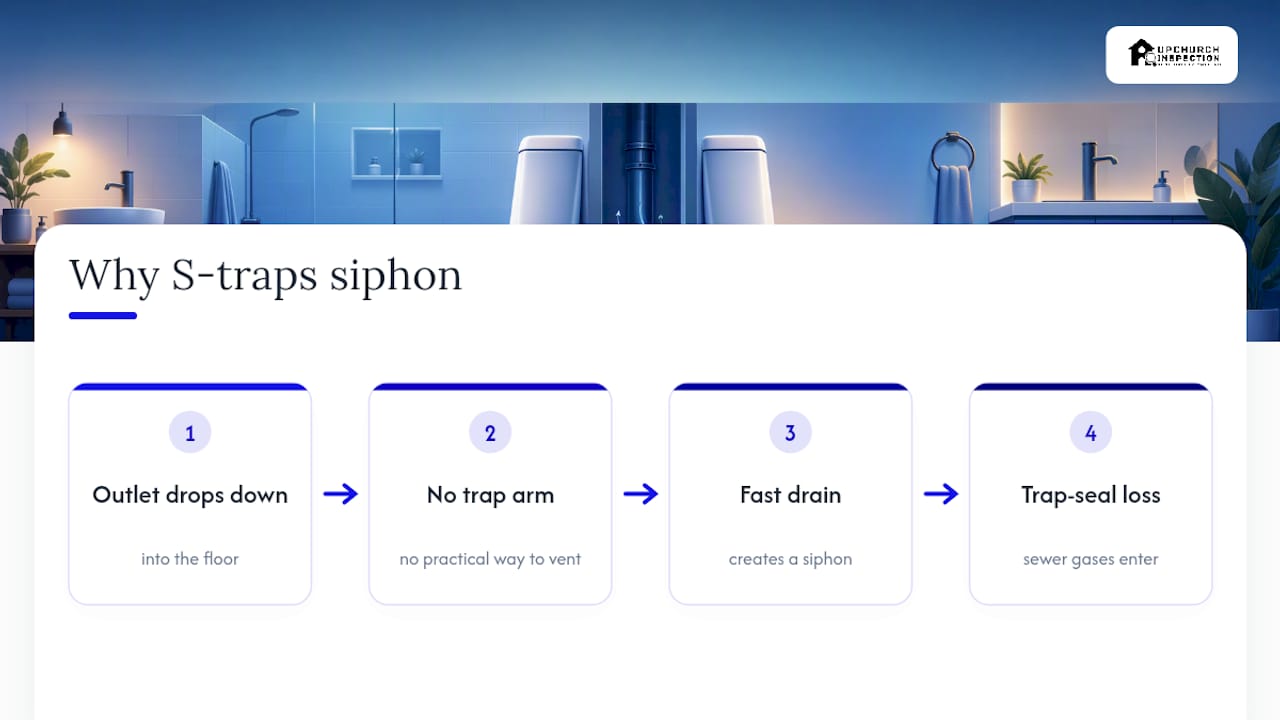
An S-trap forms when the trap outlet drops straight down into the floor instead of running horizontally to a wall. Viewed from the side, the fitting traces an S-curve: down from the drain, through the U-bend, then back down into the floor. There is no horizontal trap arm, which means there is no practical way to connect a vent.
During a fast drain — say, emptying a full sink basin — the column of water rushing through that vertical drop creates a siphon. The water pulls against the standing water in the trap bend, and if the flow is strong enough, it drags the seal out entirely. S-traps are obsolete for exactly this reason: the geometry reliably causes trap-seal loss, and once the seal is gone, sewer gases including hydrogen sulfide and methane can enter the building.
Inspectors find S-traps most often in homes built before the 1970s, when the configuration was common and sometimes even required by older local codes. But they also show up in newer work — usually because a homeowner or handyman pushed a trap outlet into a floor stub to avoid cutting into a wall, or used a flexible accordion connector to bridge an awkward gap. Short trap arms are another common cause: if the trap arm is so short that the outlet effectively drops before reaching the wall, the assembly behaves like an S-trap even if it was not intentionally built that way.
Buying parts at a hardware store does not make those parts legal to install. S-trap kits and flexible accordion drain tubes are still sold at most home improvement retailers. The IRC 2018 explicitly prohibits both — accordion drains because they accumulate debris and collapse, S-traps because of self-siphonage. Availability on the shelf reflects what manufacturers produce, not what your local authority having jurisdiction will approve.
Pro Tip: If you are replacing a drain assembly under a sink and the parts kit includes a flexible corrugated tube, set it aside. That tube is a code violation in most jurisdictions regardless of how it is configured.
Side-by-side differences: P-trap vs S-trap
The practical differences between these two configurations show up in four areas: how they handle venting, how they behave under load, what code says about them, and what symptoms they produce when something goes wrong.
Venting behavior
A P-trap relies on a connected vent to equalize pressure during drainage. An S-trap has no vent connection — the vertical drop is its only outlet, which is exactly what creates the siphon.
Siphon resistance
A properly vented P-trap maintains its water seal under normal use. An S-trap can lose its seal during a single fast drain cycle, especially when the basin empties quickly (a kitchen sink with a garbage disposal is a common example).
Code status
P-traps are required in new work. S-traps are prohibited under the IRC, IPC, and UPC for new installations. Existing S-traps may be grandfathered in some jurisdictions until a permit or remodel triggers correction.
Common symptoms when failing
- Gurgling sounds from the drain after water clears
- Intermittent sewer odor, often worse in the morning or after extended absence
- Traps that dry out faster than expected, especially in low-use fixtures
- Slow drainage when another nearby fixture is running simultaneously
Repair complexity
Replacing a P-trap is usually a straightforward swap. Correcting an S-trap typically requires rerouting the drain outlet to a wall stub or adding a vent — work that often means opening a wall or floor.
To illustrate how the same part name can produce different results: a kitchen sink with a garbage disposal drains fast and hard, which makes an S-trap under that sink far more likely to siphon than the same configuration under a bathroom lavatory that drains slowly. The hydraulics matter. A lavatory S-trap might go years without obvious symptoms, whereas the kitchen version produces odor complaints within weeks.
From an inspection standpoint, both configurations get flagged. The kitchen version is more likely to produce active odor at the time of inspection; the lavatory version may only show symptoms intermittently, which can make it harder for a homeowner to connect the smell to the drain.
Why codes ban S-traps and what inspectors cite
The prohibition is not new. S-traps have been excluded from model plumbing codes for decades, and the rationale has never changed: the geometry causes self-siphonage, and self-siphonage causes trap-seal loss. IRC 2021 Section P3201.5 and IRC 2024 Section P3201.6 both name the S-trap explicitly as a prohibited trap type. The Uniform Plumbing Code (UPC) and International Plumbing Code (IPC) carry equivalent language. When inspectors write up an S-trap, they are citing a prohibition that has been in place across multiple code cycles.
The code sections inspectors most commonly reference:
Correction is not always mandatory the moment an S-trap is found. Jurisdictions vary in how they handle existing conditions. The triggers that most reliably force a correction are: a permitted remodel that touches the affected plumbing, a fixture replacement that requires a permit, a final inspection on new work, or a safety complaint filed with the local authority. Home sales do not automatically require correction, but a buyer’s inspector will document the condition, and a buyer’s agent or lender may push for repair as a condition of closing.
Pro Tip: If an S-trap is in a part of the home that has not been touched in decades and no permit work is planned, many jurisdictions will treat it as grandfathered. The moment you pull a permit for any plumbing work in that area, the grandfathering typically ends and the condition must be brought to current code.
How to tell if you have an S-trap
Visual identification is straightforward once you know what to look for. Open the cabinet under the sink and trace the drain path from the basket down.
- Step 1: Look at the trap outlet — the pipe leaving the bottom of the U-bend. Does it run horizontally toward the wall, or does it turn and drop straight down through the floor?
- Step 2: If it goes to the wall, check that the horizontal run is at least a few inches long before it enters the wall fitting. A trap arm that is only an inch or two long may still behave like an S-trap.
- Step 3: If the outlet drops through the floor, you have an S-trap configuration.
- Step 4: Check the material. Flexible accordion tubing anywhere in the drain assembly is a separate code violation regardless of trap shape.
- Step 5: Note whether the drain pipe in the wall has a vent connection above it. No vent means no air break, which compounds any trap-arm problem.
Symptoms to watch for between visual checks:
- Gurgling from the drain immediately after the basin empties
- Sewer odor that comes and goes, often strongest in the morning
- Traps that seem to dry out in low-use bathrooms or utility sinks
- Slow drainage that worsens when a toilet or nearby fixture flushes
These symptoms can also indicate a venting problem further down the line or a partial blockage, so an S-trap finding should prompt a look at the broader drain-waste-vent system, not just the trap itself.
Pro Tip: Take a photo of the trap assembly before calling a plumber. A clear photo showing whether the outlet goes to the wall or the floor tells a plumber everything they need to scope the repair before they arrive.
Can you replace or convert an S-trap?
Yes — but the correct fix is not just swapping curved fittings. The goal is to create a vented trap arm that connects to a branch drain, and that usually means changing where the drain outlet goes, not just the shape of the trap.
Three practical conversion paths, in order of complexity:
- Reroute the trap outlet to a vented wall stub. This is the cleanest fix. A plumber cuts into the wall, installs a proper drain fitting with a vent connection above, and runs the trap arm horizontally to that stub. It almost always requires opening the wall, and in older homes with cast iron or galvanized pipe, it may require additional work to tie into the existing stack.
- Install a vent stack or wet vent. Where the drain layout allows, a plumber can add a vent pipe that ties into the drain line above the trap and runs up through the wall to the roof or ties into an existing vent stack. This is the textbook solution and the one most inspectors will recommend as the preferred repair.
- Install an air admittance valve (AAV) where local code permits. An AAV is a one-way mechanical vent that opens to admit air during drainage and closes to prevent sewer gas from escaping. Conversion options including AAVs are widely discussed, but AAV acceptance varies by jurisdiction — some local codes prohibit them outright, others allow them only in specific locations (not under a slab, not as the sole vent for a building). Always confirm with your local authority before specifying an AAV as the fix.
A few cautions worth knowing before starting:
- Mixing ABS and PVC pipe requires a listed transition coupling — do not use standard couplings across material types.
- Any work that changes the drain configuration typically requires a permit in most jurisdictions.
- Replacing an S-trap often involves more than swapping fittings — the trap arm and vent arrangement must be corrected, which can mean opening walls or floors.
- A handyman can swap a trap body; a licensed plumber is the right call when the fix involves cutting into walls, adding vent pipe, or working with the drain-waste-vent stack.
For practical plumbing repair guidance on scope and typical costs, a licensed plumbing contractor is the most reliable source before committing to a repair approach.
When correction will be required and how inspectors report it
Not every S-trap triggers an immediate mandatory repair order. The situations that most commonly force correction are:
- A permitted remodel that includes plumbing work in the affected area
- A fixture replacement that requires pulling a permit
- A final inspection on new construction or an addition
- A code-compliance inspection triggered by a safety complaint
- A buyer’s inspection where the buyer’s lender requires repairs before closing
When an inspector documents an S-trap, the report language is typically direct and specific. A standard write-up might read: “S-trap configuration observed at the kitchen sink drain. This trap type is prohibited under current model plumbing codes due to self-siphonage risk. Recommend correction to a vented P-trap configuration by a licensed plumber.” The condition is classified as a code deficiency, not a cosmetic issue, which means it carries more weight in a real estate negotiation than a maintenance note would.
For buyers and sellers, the documentation matters as much as the repair itself. A seller who has an S-trap corrected before listing should keep the plumber’s invoice and any permit documentation — that paper trail answers the buyer’s inspector’s question before it becomes a negotiating point. A buyer who accepts the property with a known S-trap should get the repair scope and cost estimate in writing before closing so there are no surprises after the transaction.
Communicating clearly with contractors also matters. Telling a plumber “fix the S-trap” without specifying that the correction must include a vented trap arm can result in a plumber swapping the trap body and leaving the underlying venting problem unresolved. The repair scope should specify: correct to a vented P-trap configuration meeting current IRC requirements, including a proper trap arm and vent connection.
DIY vs hiring a pro: quick decision steps
The right call depends on what the fix actually involves.
- Is the trap arm visible and accessible under the sink, and does the outlet already go to the wall? If yes, and the problem is just an incorrectly shaped trap or a flexible connector, a competent DIYer can replace the trap body and trap arm with rigid PVC or ABS fittings. This is a parts-and-patience job.
- Does the outlet drop through the floor? Stop. This is not a fitting swap — it requires rerouting the drain to a wall stub or adding a vent. That work involves cutting into finished surfaces and working with the drain-waste-vent system. Hire a licensed plumber.
- Is an AAV being considered? Confirm with your local building department that AAVs are permitted in your jurisdiction and in the specific location before purchasing one. If they are allowed, installation is relatively straightforward, but the permit question still applies.
- Is a permit required? In most jurisdictions, any work that changes the drain configuration requires a permit. Unpermitted plumbing work can create problems at resale. When in doubt, call the local building department before starting.
- Do you want documentation for a real estate transaction? Skip the DIY entirely and hire a licensed plumber who will pull a permit and provide a final inspection sign-off. That documentation is worth more than the labor savings.
Inspection checklist: how inspectors document S-trap conditions
A thorough inspection of a drain trap assembly covers more than just the shape of the fitting. Here is what a field inspection typically captures:
- Photograph the full trap assembly from the drain basket to the wall or floor stub, showing the trap arm length and outlet direction clearly
- Note the trap arm length and whether it meets the minimum horizontal run before the outlet
- Identify the pipe material (PVC, ABS, chrome, flexible accordion) and flag any prohibited materials or mixed-material connections without proper couplings
- Check for the presence of a vent above the drain connection at the wall
- Test for active symptoms by filling the basin and draining it fully, then listening for gurgling and checking for odor
- Record the fixture location (kitchen, bathroom lavatory, utility sink) since code enforcement context differs by fixture type
- Note any prior repair attempts — a trap body that has been replaced recently but still drops to the floor is still an S-trap
The difference between a cosmetic comment and a code deficiency matters in a report. A cosmetic comment (“trap shows minor surface corrosion”) does not require action. A code deficiency (“S-trap configuration — prohibited under IRC Section P3201.6”) signals a condition that may require correction before a permit closes or a lender approves financing. Inspectors who blur that line do their clients a disservice.
Sample report language: “S-trap configuration observed at the [fixture] drain. The trap outlet drops vertically to the floor with no horizontal trap arm or vent connection. This configuration is prohibited under IRC Section P3201.6 due to self-siphonage risk and potential for trap-seal loss. Recommend correction to a vented P-trap by a licensed plumber prior to closing / prior to permit final.”
For a broader look at how common plumbing defects are flagged and prioritized in inspection reports, the distinction between maintenance items and code deficiencies is one of the most practically useful things a homeowner or agent can understand before a transaction.
What inspectors see in the field
S-traps come up regularly in pre-1970s homes across the Mid-South — older bungalows, ranch-style houses, and early postwar construction where floor-stub drains were standard practice. What surprises most homeowners is not the finding itself but how often a recent DIY repair has made it worse. Someone replaces a leaking trap body, buys a kit from the hardware store, and reassembles it with a flexible accordion connector — now there are two code violations instead of one.
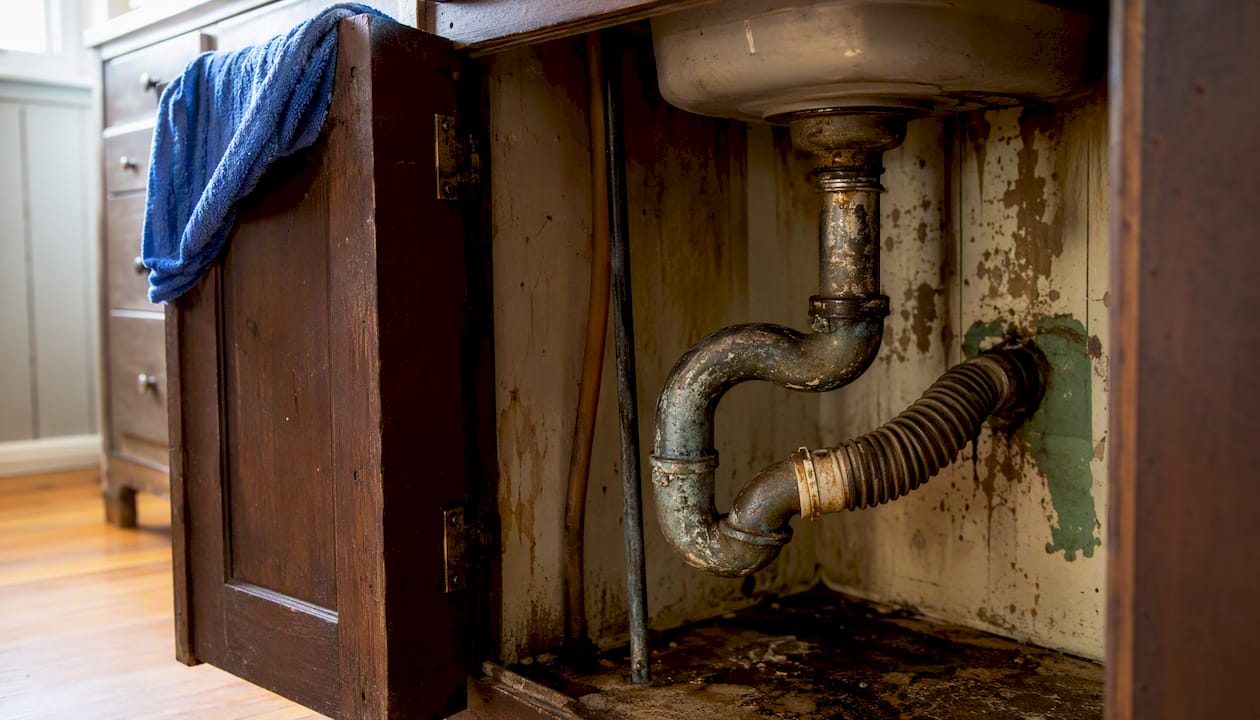
The practical priority, if you find an S-trap, is straightforward: document it, get a licensed plumber to assess the correct fix, and do not attempt to resolve it with flexible tubing or a parts-kit swap. If you are in a transaction, get the repair scope in writing before closing. If you are a seller, correcting it before listing removes a negotiating chip from the buyer’s side and keeps the deal cleaner.
Upchurch Inspection documents what’s under your sink — and everything else
Plumbing defects like S-traps are exactly the kind of condition that looks minor until it is not. Upchurchinspection inspects drain configurations, trap assemblies, and visible supply and waste lines as part of every residential inspection across Tennessee, Arkansas, Mississippi, Missouri, and Kentucky. When a trap condition warrants a closer look at the main line, Upchurchinspection can refer a sewer scope to confirm whether the problem is isolated or part of a larger drainage issue.
Every inspection produces a written report with photographs, specific code references, and recommended corrective language your contractor can act on without a back-and-forth. If you are buying, selling, or managing a property and want to know exactly what you are dealing with before it becomes a problem, schedule a specialized inspection or review the benefits of a professional property evaluation to understand what a thorough inspection covers.
Sources
The sources below are the authoritative references for S-trap and P-trap code status. Before assuming a condition is grandfathered, confirm which code edition your jurisdiction has adopted and contact your local permit office directly.
Always verify the specific code edition adopted in your jurisdiction. Model code language is consistent, but local amendments and enforcement practices vary. Your local building department or authority having jurisdiction is the final word on what triggers mandatory correction in your area.