A standard home inspection on a single-family house runs $300 to $500 in most of the country, with the national figure landing around $343 to $400 depending on which survey you check. Add radon, sewer scope, or mold testing and you’re often looking at $500 to $900 total. For a purchase that’s likely the biggest check you’ll write in your life, that fee is cheap insurance.
- Base inspection: roughly $300–$500 for an average-size home
- Add-ons (radon, sewer scope, mold, WDI): often cost a few hundred dollars each
- Verdict: skipping it to save a few hundred dollars is how buyers end up eating a $15,000 foundation repair six months after closing
Key Takeaways
Home inspection cost typically runs $300 to $500 nationally, but square footage, region, and add-ons like radon or sewer scope can push the real total higher.
| Point | Details |
|---|---|
| National price band | Budget $300–$500 for a standard single-family home inspection, more for homes over 3,000 sq ft. |
| Regional swing is real | Expect costs 30–60% above or below the national average depending on your metro’s cost of living. |
| Add-ons add up fast | Radon, sewer scope, and mold testing each run $125–$600 and often get bundled at a discount. |
| Negotiate off safety, not cosmetics | Use contractor quotes on structural and safety items to request credits, not paint touch-ups. |
| Upchurch Inspection standard | Upchurch Inspection pairs Tennessee-exceeding credentials with thermal imaging on every inspection across the Mid-South. |
Table of Contents
- How Much Is a Home Inspection, Really?
- Why Does Home Inspection Cost Vary So Much by Region?
- What Actually Drives an Inspector’s Price Quote?
- What Do Add-On Inspections Cost, and Do You Need Them?
- What Does a Standard Inspection Actually Cover?
- How Do You Use the Report to Negotiate?
- How Do You Pick an Inspector Who’s Worth the Fee?
- What Does Upchurch Inspection Bring to That Price Tag?
- What the Data Actually Tells Buyers to Prioritize
- Get a Straight Answer on What Your Inspection Will Cost
- Frequently Asked Questions
- Sources
How Much Is a Home Inspection, Really?
Ask five sources what a home inspection costs and you’ll get five slightly different numbers, because they’re measuring different things. Bankrate’s data puts the national average around $343 to $400 for a typical single-family home, while other industry surveys quote a broader $300 to $500 band. Neither number is wrong. One is closer to a median (the middle price when you line up every inspection), the other leans toward a mean that gets pulled upward by bigger, more complex homes.
What matters more than the exact average is where your home falls on the size curve, since square footage is the single biggest lever on price.
- Under 1,000 sq ft (condos, small starter homes): often $250–$350
- 1,000–2,000 sq ft (the most common range): typically $325–$450
- 2,000–3,000 sq ft: usually $400–$550
- 3,000+ sq ft or multi-structure properties: $550 and up, sometimes well past $700 on large or older homes
If a quote you’re comparing sits way outside the band for your square footage, ask why before you assume it’s a deal. It’s either a stripped-down inspection or a highly experienced inspector charging for depth.
Why Does Home Inspection Cost Vary So Much by Region?
Home inspection cost in Tennessee doesn’t match home inspection cost in Seattle, and that’s not random. Rocket Mortgage’s analysis shows coastal and major metro markets running roughly 30% to 60% above national averages, while a lot of the Midwest and South, Tennessee included, tends to land closer to or slightly below the national midpoint.
A few things drive that gap:
- Cost of living and local labor rates push inspector overhead up in expensive metros
- States and cities with stricter licensing requirements often see higher baseline fees
- Insurance costs (general liability and errors & omissions) run higher in litigious markets
- Demand during a hot selling season can tighten inspector availability and nudge prices up
- Rural properties add travel time, which some inspectors build into the quote
If you’re pricing home inspection cost in Tennessee against a friend’s experience in California or the Northeast, don’t expect the numbers to line up. Local licensing and market pressure explain most of that difference.
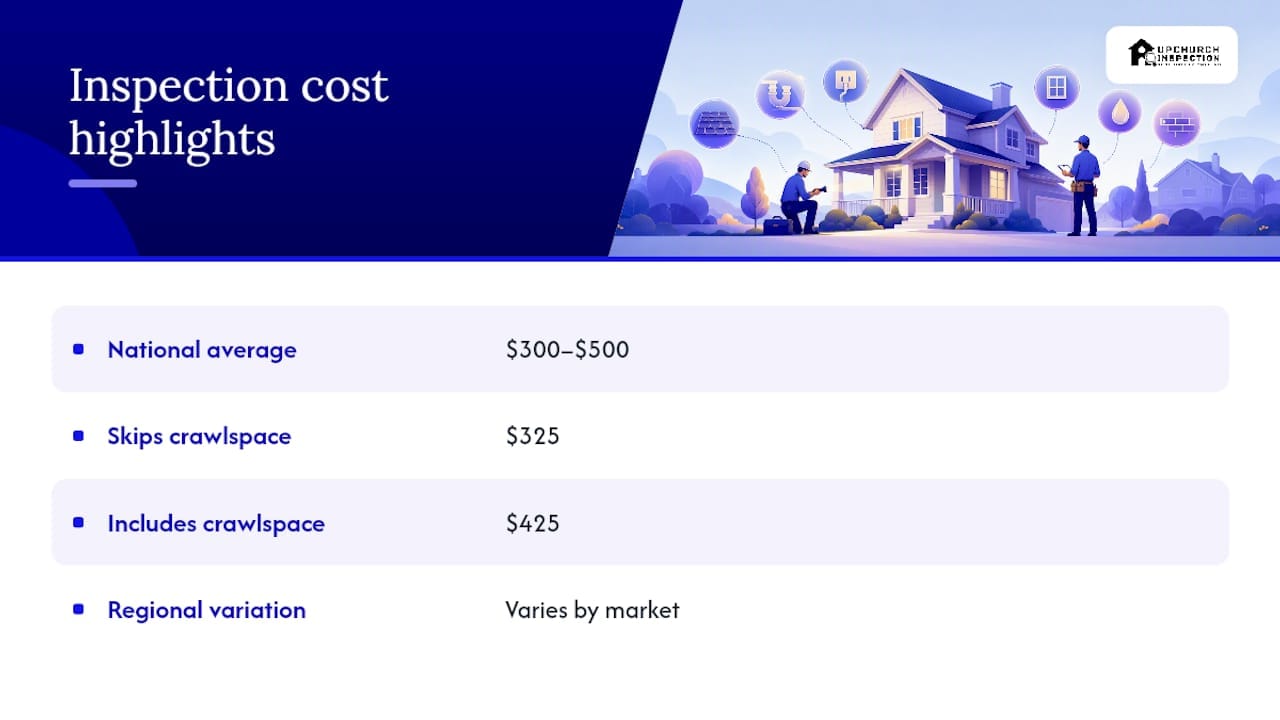
Pro Tip: When comparing quotes, ask what’s included in the base fee before comparing dollar figures. A $325 quote that excludes the crawlspace and a $425 quote that includes it aren’t actually competing on the same service.
What Actually Drives an Inspector’s Price Quote?
Every inspector prices differently, but the line items behind the number are pretty consistent across the industry.
- Square footage tiers. Most inspectors work off a bracketed pricing model, a flat fee up to a certain size (say, 2,000 sq ft), then an incremental charge per additional 500 to 1,000 square feet.
- Age and condition of the home. A 1920s house with knob-and-tube wiring remnants, an unpermitted addition, or a crawlspace that hasn’t been touched in decades takes longer to inspect properly than a 2018 build.
- Number of structures and access difficulty. Detached garages, workshops, pool houses, tight attic hatches, and low crawlspaces all add time, and time is what you’re paying for.
- Roof complexity. A steep, multi-pitch roof that requires a ladder and careful footing takes longer than a simple ranch roof you can walk from a ladder alone.
- Inspector overhead. Credentials, liability insurance, and diagnostic tools like thermal cameras and moisture meters cost money to maintain, and that shows up in the fee. A quote that’s dramatically below market is worth questioning, since it may signal a missing E&O policy or gear that’s due for an upgrade.
- Distance and scheduling. Rural or far-flung properties often carry a small travel surcharge to cover the drive time.
What Do Add-On Inspections Cost, and Do You Need Them?
The base inspection covers the visible, accessible systems. Anything that requires specialized equipment or lab analysis gets quoted separately, and these are the ones that catch first-time buyers off guard.
- Radon testing: ~$150–$250, worth doing in almost any home with a basement or slab-on-grade in a moderate-to-high radon zone
- Sewer scope: ~$125–$400, strongly recommended on homes over 20 years old, especially with mature trees near the lateral line
- Mold testing: $200–$600, warranted when there’s visible staining, a musty smell, or past water intrusion
- Termite/WDI inspection: $50–$280, often required by the lender in southern and humid states
- Thermal imaging: $100–$300, useful for chasing hidden moisture or insulation gaps behind walls
Per industry cost breakdowns, bundling two or three of these with the main inspection usually saves you something versus scheduling them separately, since the inspector is already on-site. If the seller’s disclosure mentions a septic system, an older roof, or known moisture history, budget for the matching add-on before you even get a quote.
What Does a Standard Inspection Actually Cover?
A base fee gets you a visual, non-invasive evaluation of the home’s major systems: roof, foundation, structure, electrical panel and visible wiring, plumbing, HVAC, attic, crawlspace, windows, doors, and grading around the foundation. What it does not include are code compliance verification, pest control treatment, or a guarantee against cosmetic wear like scuffed paint or worn carpet.
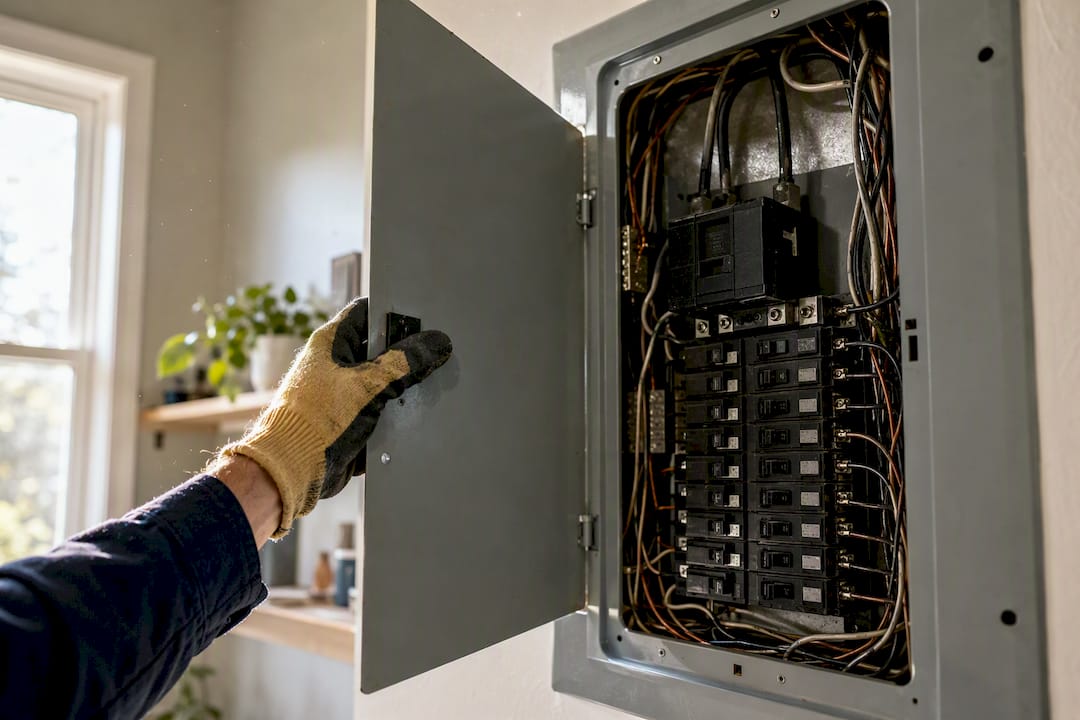
For a typical single-family home, expect the inspector on-site for 2 to 4 hours, with the written report landing in your inbox within 24 to 48 hours. Our new home systems checklist breaks down exactly what gets tested room by room.
Don’t panic when the report comes back long. A typical inspection report lists 30 to 40 items, and most of them are minor maintenance notes, a loose GFCI cover, a slow drain, a cracked walkway, not deal-breakers. The handful that matter are the ones flagged as safety or structural.
How Do You Use the Report to Negotiate?
The report is a negotiating tool, not a wish list. Sort findings into two buckets before you do anything else:
- Safety and structural items (active roof leak, foundation cracking, undersized electrical panel, missing GFCI protection near water) are legitimate negotiation targets.
- Cosmetic and routine maintenance items (worn caulk, minor drywall cracks, a dated water heater still within its service life) generally aren’t worth burning goodwill over.
Get a contractor quote on the big-ticket items before you go back to the seller, then propose a specific credit or repair request tied to that number, not a vague “fix everything” demand. Buyers who negotiate off real inspection findings often recover meaningful money at the table, though the size of that savings varies by market and item. Our guide to reading inspection reports walks through prioritizing findings line by line.
Pro Tip: If you’re up against a cash offer, know that many cash buyers skip inspections entirely to close faster. That’s their risk to take. Don’t let a competing offer pressure you into waiving yours.
How Do You Pick an Inspector Who’s Worth the Fee?
Price alone tells you almost nothing about quality. Here’s what actually separates a thorough inspector from a rubber-stamp checklist.
Verify before you book:
- State license, where the state requires one
- ASHI or InterNACHI membership, which signals ongoing training standards
- Proof of errors & omissions (E&O) and general liability insurance
- A sample report you can review before hiring
Ask these questions on the phone:
- How long have you been inspecting homes in this market?
- Can I attend the inspection and walk the property with you?
- Does the fee include the crawlspace, attic, and all outbuildings?
- What’s your typical turnaround time for the written report?
- Do you carry E&O insurance, and can you provide proof?
A fair contract spells out scope, timeline, and price in writing before you pay a deposit. If an inspector dodges the insurance question or won’t show a sample report, that’s your answer. Our guide to choosing inspection services covers the full vetting process, and a licensing verification checklist can help you confirm credentials before you sign anything.
What Does Upchurch Inspection Bring to That Price Tag?
We built Upchurch Inspection around one idea: a report should tell you what’s actually wrong with the house, not just check boxes. Our inspectors carry qualifications that exceed Tennessee’s state minimums, and every inspection includes thermal imaging as a diagnostic tool, not an upcharge tacked on later.
- Detailed reports covering structural, electrical, plumbing, and HVAC condition, not a generic pass/fail form
- Inspectors trained and equipped for both residential and commercial properties across the Mid-South
- A track record built on hundreds of Memphis and West Tennessee inspections, documented here
That level of detail is what keeps a $400 inspection from missing a $15,000 problem.
What the Data Actually Tells Buyers to Prioritize
The conventional advice on home inspection cost obsesses over shaving fifty dollars off the quote. That’s backward. The national averages hold up fine, $300 to $500 for a standard inspection, but the number that should actually worry you is the gap between a $325 inspector who skips the crawlspace and a $425 inspector who doesn’t.
I’d push back on the idea that price comparison should drive this decision at all. The research is consistent: reports flag dozens of items, but only a handful, safety and structural, carry real negotiating weight. Buyers who fixate on finding the cheapest inspector often end up with a report too thin to negotiate anything meaningful. Buyers who ask about credentials, insurance, and sample reports end up with leverage.
Regional variation matters more than most guides admit. If you’re comparing your Tennessee quote to a number you saw online for Seattle or Boston, you’re comparing apples to a different fruit altogether. Anchor your expectations to your own market, then spend your scrutiny on the inspector’s process, not the last fifty dollars on the invoice.
Get a Straight Answer on What Your Inspection Will Cost
Upchurch Inspection is the direct route to a real answer on price, not a generic online estimate that ignores your home’s actual size, age, and systems. Where national averages leave you guessing between a $325 and a $500 quote, we walk you through exactly what’s included before you book, crawlspace, attic, thermal imaging, and all. Buyers, sellers, and real estate professionals across Tennessee, Arkansas, Mississippi, Missouri, and Kentucky use our reports to make real decisions at the closing table, not just check a box. If you’re weighing whether regular inspections matter for a property you already own, our breakdown of the benefits of regular inspections lays out the case plainly. Ready to see what your specific property will run? Reach out to Upchurch Inspection for a quote tied to your home’s actual square footage and condition, not a national average.
Frequently Asked Questions
How much is a home inspection on average?
Most standard single-family home inspections cost between $300 and $500, with national averages centering around $343 to $400. Larger or older homes typically land at the higher end.
How much is a home inspection in Tennessee specifically?
Home inspection cost in Tennessee generally tracks close to or slightly below the national average, since the Mid-South doesn’t carry the licensing and insurance overhead seen in coastal metros.
What’s the average cost of a home inspection with add-ons included?
Once you factor in common add-ons like radon testing ($150–$250) or a sewer scope ($125–$400), total home inspection fees often land between $500 and $900.
Is a home inspection worth the cost?
Yes, in nearly every case. A $400 inspection that catches a failing roof or a cracked foundation before closing can save you tens of thousands of dollars in post-purchase repairs.
Who pays for the home inspection, the buyer or seller?
The buyer typically pays for and orders their own inspection, since it’s performed on their behalf to inform the purchase decision, though sellers sometimes order a pre-listing inspection at their own cost.