
Certified commercial property inspections in Little Rock are standardized, walk-through evaluations conducted by trained professionals following the ASTM E2018 standard guide and CCPIA guidance. They are not code compliance checks. They are investment-grade assessments designed to identify physical deficiencies across a building’s major systems before money changes hands.
A properly scoped inspection covers:
- Structural components — foundation, framing, load-bearing walls
- Mechanical and HVAC systems — equipment age, condition, service life
- Electrical systems — panel capacity, wiring condition, safety concerns
- Plumbing — supply, drain, and fixture condition
- Roofing — membrane, drainage, penetrations, and flashing
- Life safety systems — fire suppression, egress, alarms
- Interior finishes and vertical transport — elevators, stairs, ADA considerations
- Site conditions — grading, paving, drainage, and utilities
Certification matters because it ties the inspector to a defined standard of practice, a Code of Ethics, and documented competence. Without it, you have no reliable way to compare one inspector’s report to another. Little Rock also requires building permits for projects exceeding the local threshold for permit requirements, with Certificate of Occupancy fees at varying rates depending on building status. A thorough inspection report gives you the context to understand which findings may trigger those thresholds.
Table of Contents
- What types of commercial inspections are available in Little Rock?
- Certifications and standards that define a qualified inspector
- Scheduling a commercial inspection in Little Rock: service area and process
- What Upchurchinspection brings to certified commercial inspections in Little Rock
- Upchurchinspection: certified commercial inspections for Little Rock investors and managers
- Key Takeaways
- FAQ
What types of commercial inspections are available in Little Rock?
The right inspection type depends on where you are in the transaction and what you need to know. These are the primary service categories:
- Baseline Property Condition Assessment (PCA): The standard pre-purchase evaluation aligned with ASTM E2018, covering all major building systems with a written Property Condition Report (PCR) and Opinions of Probable Costs (OPC).
- Pre-purchase inspection: Buyer-focused risk assessment identifying deferred maintenance, system failures, and capital expenditure exposure before closing.
- Pre-listing inspection: Seller-side evaluation to surface repair needs and support accurate disclosure, reducing renegotiation risk.
- Roof survey: Dedicated assessment of commercial roofing systems, including membrane condition, drainage, and penetration integrity. See commercial roof inspection services for scope details.
- HVAC assessment: Focused evaluation of commercial mechanical systems, including equipment age, refrigerant condition, and remaining service life.
- Structural evaluation: Targeted review of load-bearing systems, foundation movement, and framing integrity when baseline findings raise concerns.
- Mold and environmental testing: Air quality sampling and surface testing when moisture intrusion or visible growth is observed.
- Maintenance inspection: Ongoing condition monitoring for property managers tracking lifecycle costs across a portfolio.
- Due diligence inspection with OPC: Full-scope assessment including cost estimates for observed deficiencies, supporting lender requirements and investment underwriting.
Asset type shapes scope. A retail strip center has different exposure points than an industrial warehouse or a multifamily building. Inspectors familiar with mixed-use property risks recognize that overlap and adjust accordingly.
Certifications and standards that define a qualified inspector
The two benchmarks that matter most in commercial property inspection are CCPIA certification and ASTM E2018 compliance.

CCPIA certification requires passing an online examination covering commercial building systems, defect recognition, property condition evaluation procedures, and the ComSOP Code of Ethics, which includes a time limit and assesses knowledge of the International Standards of Practice for Inspecting Commercial Properties. Inspectors who hold this credential have demonstrated baseline competency in a structured, verifiable way.
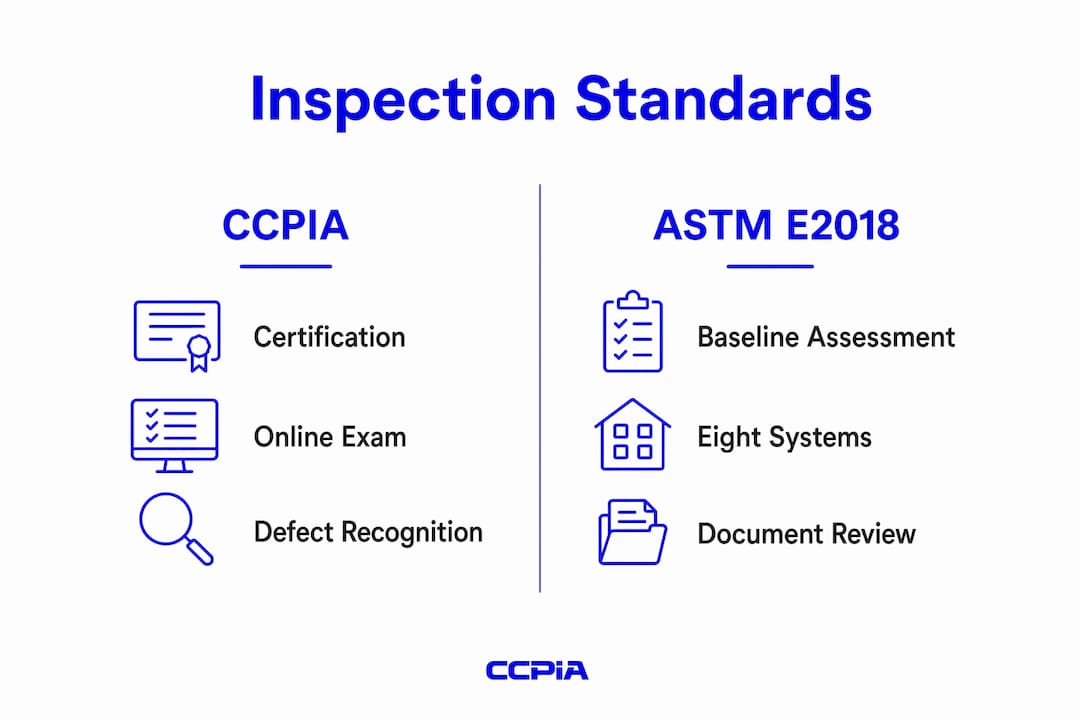
ASTM E2018 defines what a baseline property condition assessment must include: the walk-through survey, document review, research, and a PCR with Opinions of Probable Costs. Many low-cost reports skip the OPC entirely, leaving buyers without any cost framework for what they are inheriting. That omission is not a minor gap. It is the difference between a report that informs a decision and one that just documents observations.
Municipal building inspections serve a different purpose entirely. They verify code compliance at a point in time. They do not assess deferred maintenance, estimate remaining service life, or evaluate total cost of ownership. Third-party certified inspections fill that gap, and relying on a city final inspection as a substitute for due diligence is a mistake experienced investors do not make twice.
ASTM E2018 also recommends that inspectors disclose their qualifications transparently. Ask for credentials, insurance certificates, and documented commercial experience before you book.
Scheduling a commercial inspection in Little Rock: service area and process
Upchurchinspection covers Little Rock and the surrounding Central Arkansas communities, including North Little Rock, Conway, Sherwood, Jacksonville, Cabot, and Maumelle. The scheduling process is straightforward:
- Initial contact — call or submit a request online to discuss property type, square footage, and inspection scope.
- Booking and agreement — confirm the inspection date and sign a pre-inspection agreement defining scope and deliverables.
- Walk-through inspection — the field observer conducts a systematic on-site evaluation of all accessible systems and components.
- Report delivery — a written PCR with findings, photographs, and cost opinions is delivered within a few business days.
Commercial inspection fees vary by property size, age, and complexity. Pricing is not publicly listed as a flat rate because a 4,000-square-foot retail space and a 40,000-square-foot industrial building are not the same scope. Contact Upchurchinspection directly for a quote tied to your specific property.
Pro Tip: Before scheduling, confirm that the inspector carries errors and omissions (E&O) insurance and general liability coverage. A certified inspector without proper insurance is a liability you do not want to absorb.

What Upchurchinspection brings to certified commercial inspections in Little Rock
We inspect commercial properties across Tennessee, Arkansas, Mississippi, Missouri, and Kentucky. That regional breadth means we have seen the same deferred maintenance patterns, aging HVAC equipment, and moisture intrusion problems repeat across property types and markets. Local knowledge of Little Rock’s regulatory environment, combined with strict adherence to CCPIA and ASTM standards, gives our clients a clearer picture of what they are buying.
Our reports go beyond a checklist. Every finding is documented with photographs, a plain-language description of the condition, and where warranted, an Opinion of Probable Cost. That last piece is what separates a useful report from a liability waiver dressed up as due diligence. A property condition assessment without cost context leaves buyers negotiating blind.
When reviewing any commercial inspection report, watch for these red flags:
- Missing or vague OPC estimates for significant deficiencies
- No documentation of inspector credentials or insurance
- Reports that list observations without distinguishing deferred maintenance from active safety concerns
- Absence of photographs for flagged conditions
- No mention of systems that were inaccessible or excluded from scope
A property condition report that identifies physical deficiencies without estimating their financial impact does not protect your investment. It documents it. Buyers who skip or accept incomplete reports often discover the real cost of deferred maintenance after closing, when negotiating leverage is gone.
Questions worth asking before you hire any inspector: Are you CCPIA-certified? Do you follow ASTM E2018? Does your report include Opinions of Probable Costs? What is excluded from scope, and why?
Upchurchinspection: certified commercial inspections for Little Rock investors and managers
When you need a commercial inspection that holds up under scrutiny, Upchurchinspection delivers reports built on CCPIA certification and ASTM E2018 compliance. Our inspectors exceed state minimums, carry full insurance coverage, and produce reports that give buyers, sellers, and property managers the cost context they need to make sound decisions. Whether you are acquiring a retail center in West Little Rock, managing a multifamily portfolio in North Little Rock, or preparing a building for sale, we cover the full scope. Contact Upchurchinspection to schedule your inspection or review the benefits of regular inspections for ongoing property management.
Key Takeaways
Certified commercial property inspections in Little Rock follow ASTM E2018 and CCPIA standards to identify physical deficiencies and cost exposure before a transaction closes.
| Point | Details |
|---|---|
| ASTM E2018 is the baseline standard | It covers eight building systems and requires Opinions of Probable Costs in the final report. |
| CCPIA certification verifies competence | Inspectors must pass a timed exam on commercial systems, ethics, and ComSOP procedures. |
| Municipal inspections are not substitutes | Code compliance checks do not assess deferred maintenance or estimate total cost of ownership. |
| Little Rock permit thresholds matter | Projects over $5,000 require permits; Certificate of Occupancy fees run $60–$100 depending on building status. |
| Upchurchinspection covers Central Arkansas | CCPIA-certified, ASTM-compliant reports with OPC estimates serve buyers, sellers, and property managers across the region. |
FAQ
What does a certified commercial property inspection cover?
A certified commercial inspection covers eight major systems per ASTM E2018: site conditions, structural components, mechanical/HVAC, electrical, plumbing, vertical transport, fire safety, and interior finishes. The report includes Opinions of Probable Costs for identified deficiencies.
How is a certified inspection different from a municipal building inspection?
Municipal inspections verify code compliance at a specific point in time. A certified third-party inspection evaluates physical condition, deferred maintenance, and cost of ownership, which code enforcement does not address.
What certifications should a Little Rock commercial inspector hold?
Look for CCPIA certification and confirmed adherence to ASTM E2018. Inspectors should also carry errors and omissions insurance and general liability coverage, and disclose their qualifications in writing before the inspection begins.
How long does a commercial inspection take from scheduling to report delivery?
Timeline varies by property size and complexity. After the walk-through, most certified inspectors deliver a written PCR within a few business days. Confirm the turnaround expectation before booking.
What are the biggest red flags in a commercial inspection report?
Missing OPC estimates, no inspector credentials listed, observations without photographs, and no explanation of excluded or inaccessible systems are all signs the report may not meet ASTM E2018 or ComSOP standards.