
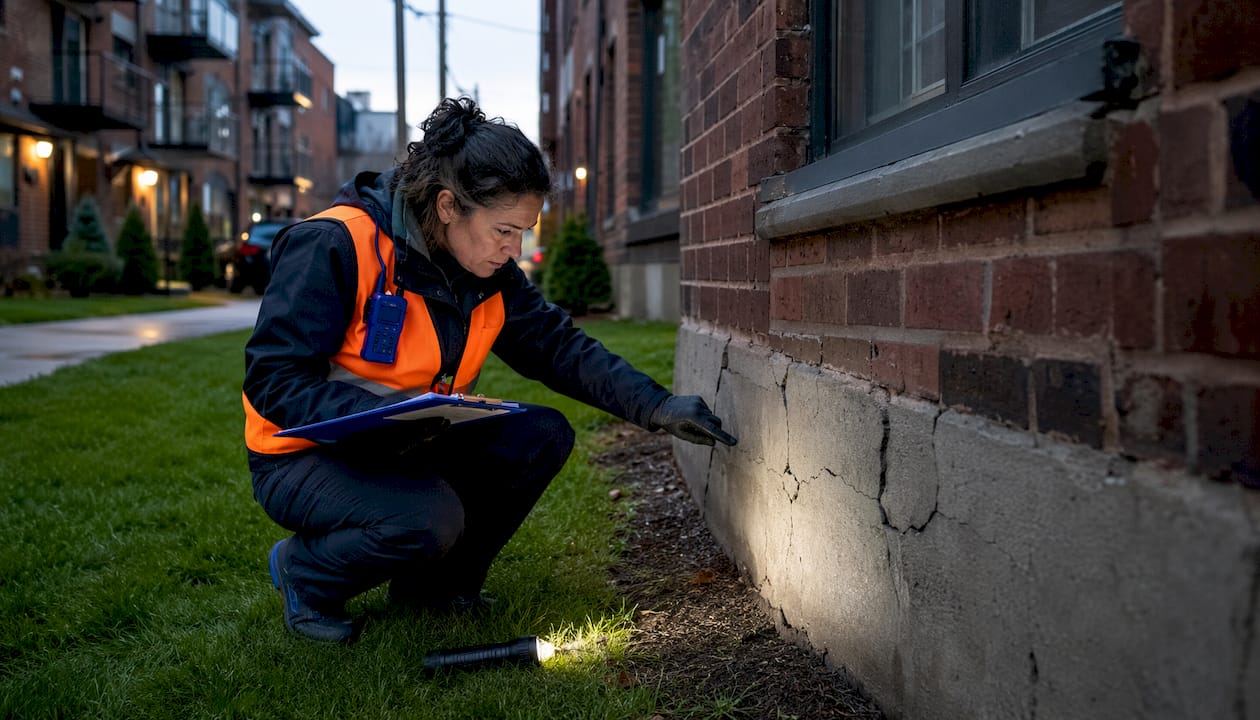
A multi-unit inspection is a visual, non-destructive evaluation of a property containing two or more dwelling units, covering unit interiors, shared mechanical systems, and common areas to give buyers, investors, lenders, and property managers a clear picture of physical condition before a transaction closes or a capital plan is set.
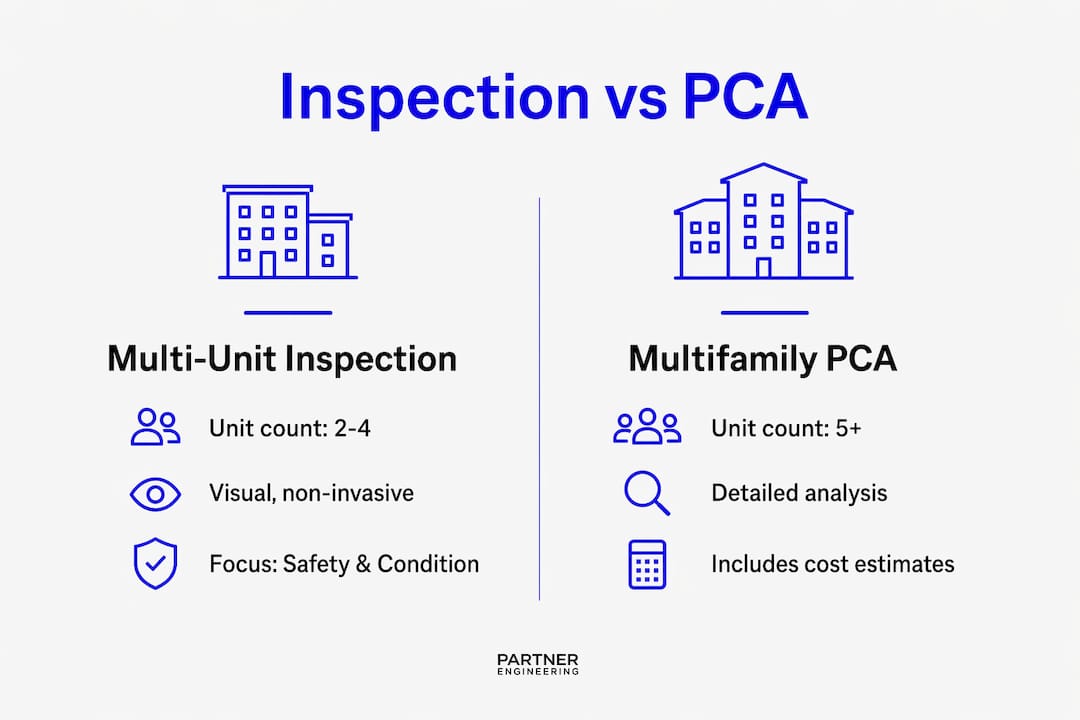
- Unit count matters: Properties with 2–4 units are typically treated as residential for inspection and financing purposes; 5+ units usually trigger commercial procedures and may require a Property Condition Assessment (PCA).
- What you get: A written report with photo evidence, prioritized deficiencies, and cost opinions covering immediate repairs and longer-term capital expenditure (CAPEX) estimates.
- Quick action: Schedule a multi-unit inspection during your due diligence contingency period. If the property has 5 or more units, or your lender requires it, escalate to a formal PCA.
Table of Contents
- What does a multi-unit inspection actually cover?
- Who needs a multi-unit inspection and what do they gain?
- What systems and areas does an inspector check?
- How does a multi-unit inspection differ from a multifamily PCA?
- What does a multi-unit inspection report look like?
- When should you schedule and what does it cost?
- What red flags should concern you most?
- When should you add specialty inspections?
- How do you act on the inspection report?
- Key Takeaways
- What most buyers get wrong about multi-unit inspections
- Upchurchinspection covers multi-unit due diligence across the Mid-South
- Useful sources for further reading
What does a multi-unit inspection actually cover?
The scope of a multi-unit property inspection depends on unit count, building configuration, and whether the engagement follows residential or commercial standards of practice. Properties with 2–4 units commonly follow residential inspection protocols. At 5 or more units, most jurisdictions and lenders expect commercial procedures, and many states classify those buildings as commercial outright.
Inspected areas typically include:
- Unit interiors: Plumbing fixtures and supply/drain lines, electrical panels and outlets, HVAC equipment, windows, doors, ceilings, walls, and floors
- Shared systems: Main electrical service, central boiler or HVAC, fire suppression and alarm systems, domestic water supply and main drain lines
- Common areas: Lobbies, corridors, stairwells, laundry rooms, mechanical rooms, and parking structures
- Exterior and site: Roof, exterior cladding, foundation, grading, drainage, and site utilities
The inspection is visual and non-invasive. Inspectors do not cut into walls, pull permits, or operate systems outside normal controls. When a condition warrants destructive investigation, that requires a separate specialist engagement with the owner’s consent.
Pro Tip: Tenant access is the single biggest scheduling obstacle on multi-unit work. Coordinate with the property manager early, provide proper notice to tenants per state law, and build a sampling plan if full access to every unit isn’t feasible. On larger properties, a representative sample across floors, building wings, and unit types gives you defensible findings without requiring access to every door.
Who needs a multi-unit inspection and what do they gain?
The short answer: anyone with money on the line. But the specific value differs by role.
- Buyers use the report to confirm the property’s physical condition matches the seller’s representations and to identify defects that warrant price negotiation or repair credits before closing.
- Investors treat the inspection as a risk-management tool that quantifies deferred maintenance and projects near-term CAPEX, both of which directly affect cash flow modeling and return assumptions.
- Lenders rely on inspection findings to set loan conditions, require escrow holdbacks for critical repairs, or determine whether a full PCA is needed before underwriting.
- Property managers use the report to build a prioritized maintenance schedule and plan capital reserves across 1, 5, and 10-year horizons.
A concrete example: a roof inspection finding active leaks over two units and saturated decking does not just mean a repair bill. It means potential insurance complications, tenant habitability concerns, and a lender who may require the repair to be completed or escrowed before closing. That single finding can restructure deal terms. Regular inspections also give property managers an ongoing baseline so deferred maintenance doesn’t accumulate silently between transactions.
Physical due diligence, including inspections and PCAs, is one component of a broader multifamily due diligence checklist that also covers rent rolls, leases, and operating statements. The inspection informs the financial picture; it doesn’t replace it.
What systems and areas does an inspector check?
| System / Area | Typical Checks |
|---|---|
| Roofing | Covering condition, flashing, drainage, penetrations, visible decking |
| Foundation | Visible cracking, settlement, moisture intrusion, efflorescence |
| Exterior envelope | Cladding, soffits, fascia, windows, doors, caulking, paint condition |
| Plumbing | Supply pressure, drain flow, fixture condition, water heater age and condition |
| Electrical | Service size, panel condition, breaker labeling, visible wiring, GFCI/AFCI protection |
| HVAC | Equipment age, operation, filter condition, ductwork, refrigerant lines |
| Fire / life-safety | Smoke and CO detectors, fire extinguishers, egress paths, stairwell integrity |
| Unit interiors | Walls, ceilings, floors, windows, doors, appliances, moisture indicators |
| Common areas | Corridors, lobbies, laundry, mechanical rooms, parking |
| Site / drainage | Grading, surface drainage, retaining walls, paving condition |
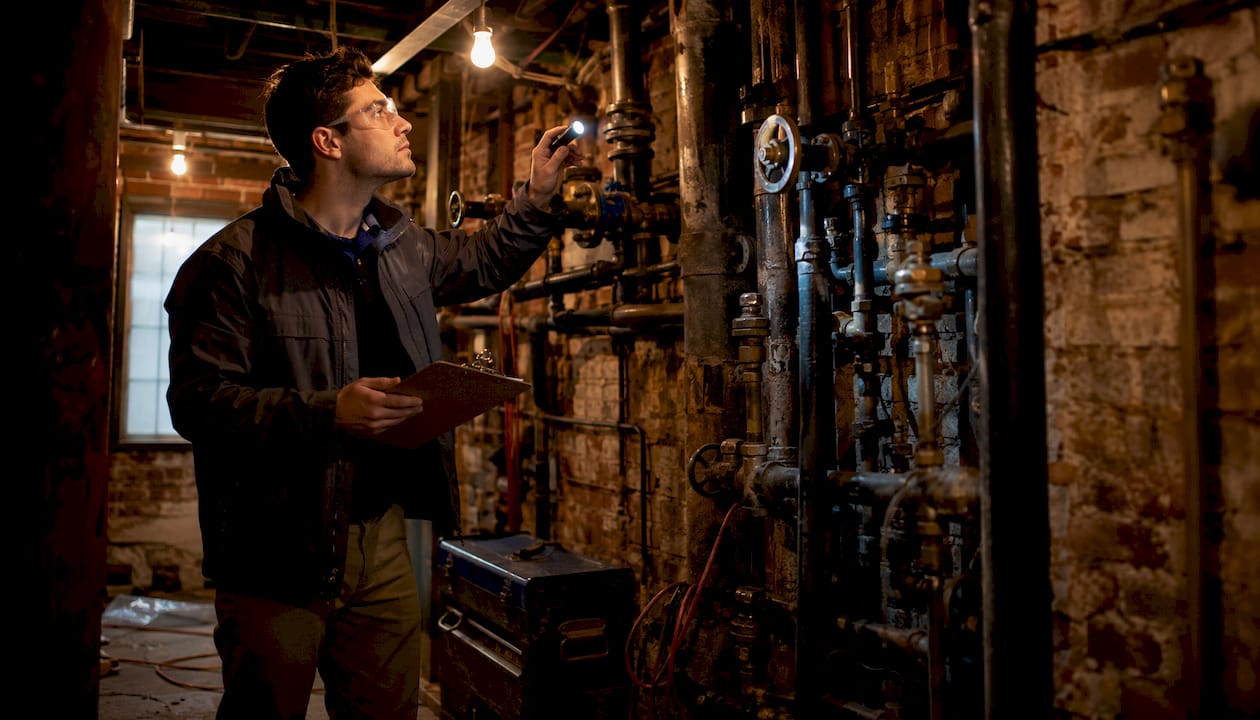
Life-safety items carry immediate underwriting weight. A missing or non-functional fire alarm system, blocked egress, or compromised stairwell is not a deferred maintenance note; it is a condition that can halt a closing or trigger a lender requirement for immediate correction. Inspectors flag these separately from routine maintenance items.
Standard limits apply: the inspection is visual and non-invasive. Inspectors do not perform destructive openings, test for mold or asbestos, or certify elevators or pressure vessels. Those require licensed specialists. On larger properties, inspectors apply representative sampling across unit types, floors, and building sections rather than inspecting every unit individually.
Communal and high-use systems in multi-unit buildings experience accelerated wear compared with single-family homes. A shared boiler serving 12 units runs continuously in a way a residential furnace never does, and that continuous load compresses service life.
How does a multi-unit inspection differ from a multifamily PCA?
These two deliverables serve overlapping but distinct purposes, and choosing the wrong one can leave gaps in your due diligence.
| Factor | Multi-unit inspection | Multifamily PCA |
|---|---|---|
| Typical unit count | 2–4 units (residential) | 5+ units; required for agency financing |
| Standard followed | Residential or ComSOP | baseline |
| CAPEX forecasting | Basic cost opinions | Formal 1, 5, 10-year reserve schedules |
| Sampling rules | Inspector judgment | Fannie Mae minimum sampling requirements |
| Lender acceptance | Conventional residential lenders | Fannie Mae, Freddie Mac, HUD, CMBS |
| Report depth | Deficiency list with photos | Narrative + cost tables + reserve analysis |
Fannie Mae’s PCA instructions set minimum unit sampling rules where unit counts determine survey requirements. For example, smaller properties require a fixed minimum number of units inspected; medium-sized properties require sampling by percentage; larger properties require a minimum number of units to be sampled.
When to upgrade to a PCA:
- The property has 5 or more units
- Financing involves Fannie Mae, Freddie Mac, HUD, or a CMBS lender
- The transaction size or complexity warrants formal capital reserve analysis
- Large deferred maintenance is suspected and you need defensible cost opinions
- You are acquiring a portfolio and need consistent reporting across properties
For a deeper look at when a PCA is the right call, this investor’s guide to PCAs walks through the decision criteria.
What does a multi-unit inspection report look like?
A well-structured multi-unit inspection report typically includes an executive summary, scope and limitations statement, unit-by-unit summaries, common area and system assessments, photo documentation, and a prioritized deficiency list with repair cost opinions.
Three sample findings and their typical investor responses:
- Safety finding: Non-functional smoke detectors in three units and a blocked stairwell exit. Investor response: require correction before closing or escrow funds; notify lender immediately since this affects habitability and insurance.
- Near-term cost finding: Water heaters in six units are 14–16 years old, past expected service life. Investor response: budget for replacement within 12 months; factor cost into offer or negotiate a seller credit.
- CAPEX finding: Roof covering shows granule loss and multiple patched areas with an estimated 3–5 years of remaining life. Investor response: include a roof replacement reserve in the 5-year CAPEX model; use the finding as negotiation leverage.
Pro Tip: Pay close attention to how your inspector labels priority. Safety items and items affecting habitability are not in the same category as deferred maintenance or cosmetic issues. A good report separates these clearly. If yours doesn’t, ask for clarification before you use the findings in negotiations.
When should you schedule and what does it cost?
Schedule the inspection as early as possible in your due diligence period, ideally within the first few days after going under contract. Site visits for a 2–4 unit property typically run 3–5 hours; larger properties with 8–20 units may require a full day or a multi-inspector team. Report delivery generally follows within 24–48 hours of the site visit for residential-scale work, though complex commercial engagements may take longer.
Fee drivers for multi-unit inspections:
- Number of units and total square footage
- Building age and system complexity
- Accessibility (tenant coordination, locked areas)
- Travel distance from the inspector’s base
- Number of inspectors required
- Specialty testing ordered (sewer scope, mold sampling, thermal imaging)
- Required sampling percentage on larger properties
Pro Tip: If you know you’ll need a sewer scope, Phase I ESA, or mold sampling, schedule them on the same mobilization as the inspection. Combining due diligence services on one site visit reduces tenant disruption, cuts travel costs, and compresses your due diligence timeline. Investors who sequence these separately often end up paying more and extending their contingency period unnecessarily.
What red flags should concern you most?
Experienced investors know that not every deficiency carries the same weight. These are the physical conditions that most directly affect underwriting, insurance, and near-term cash flow:
- Chronic roof leaks: Active moisture intrusion into units or mechanical spaces signals deferred maintenance that compounds quickly. Water damage leads to mold, structural deterioration, and tenant habitability claims.
- Main plumbing riser failures: Corroded or failing supply or drain risers serving multiple units are expensive to replace and often require temporary tenant displacement. Cast iron drain lines in older Mid-South buildings are a known issue.
- Overloaded electrical service: Panels that are undersized for current tenant loads, double-tapped breakers, or aluminum branch wiring in older buildings create both safety and insurance problems.
- Widespread moisture and mold patterns: Isolated moisture is a maintenance item. Patterns across multiple units or in mechanical spaces suggest systemic failures in the building envelope, plumbing, or HVAC drainage.
- Deferred exterior envelope maintenance: Failed caulking, deteriorated siding, and unaddressed window failures allow water infiltration that accelerates structural decay.
- Compromised life-safety systems: Non-functional fire alarms, missing extinguishers, and blocked egress paths are immediate concerns that affect both tenant safety and lender approval.
For a closer look at systemic defects and how they affect valuation, this resource on multifamily systemic defects covers the patterns we see most often in the Mid-South.
When should you add specialty inspections?
A standard multi-unit inspection tells you what is visually apparent. Specialty tests answer the questions a visual survey cannot.
- Sewer scope: Order this on any property older than 20 years, or when slow drains, backups, or root intrusion are noted. Cast iron and clay sewer lines in older Memphis-area buildings fail in ways that don’t show up until a camera goes in.
- Mold sampling: Triggered by visible suspect growth, musty odors, or moisture patterns across multiple units. Sampling identifies species and concentration; remediation scope follows from that data.
- Asbestos and lead inspections: Standard on pre-1980 construction, especially if any renovation work is planned. Disturbing asbestos-containing materials without proper abatement creates liability and regulatory exposure.
- Structural engineer review: Warranted when the inspector notes significant foundation cracking, settlement, framing concerns, or any condition outside the inspector’s scope to evaluate definitively.
- Elevator inspection: Required by state law in most jurisdictions and must be performed by a licensed elevator inspector. Never rely on a general inspector’s visual observation as a substitute.
- Thermal imaging: Useful for identifying moisture intrusion, insulation gaps, and electrical hot spots that are invisible to the naked eye. Particularly valuable in older building stock.
Pro Tip: Budget for at least one or two specialty tests on any multi-unit acquisition. Specialty inspections are far less expensive than discovering a failed sewer main or active mold remediation need after closing. Sequence them so results come back before your negotiation deadline, not after.
How do you act on the inspection report?
The report is only useful if you know what to do with it. Here is a practical action sequence by role.
Buyers and investors:
- Separate safety and habitability items from maintenance and cosmetic items. Address safety findings first in any negotiation.
- Get contractor bids on major items before finalizing your offer or repair request. A line item that reads “$15,000–$25,000 roof replacement” is a negotiating position; a contractor bid is a number.
- Build immediate repair costs and near-term CAPEX into your offer, escrow request, or reserve assumptions.
- If the report reveals material defects that were not disclosed, consult your attorney and consider whether to re-negotiate or withdraw within your contingency period.
Lenders:
- Use the report to set loan conditions: require completion of safety items before closing, establish repair escrows for near-term capital needs, or order a full PCA if the property size or condition warrants it.
Property managers:
- Create an immediate repair plan for safety and habitability items.
- Add maintenance items to a preventive maintenance schedule with assigned timelines.
- Build a 1/5/10-year CAPEX plan from the report’s cost opinions and update it annually.
Pro Tip: Get contractor bids before you finalize your offer, not after. Inspection findings without cost context are just a list of problems. Bids turn them into numbers you can negotiate with. On a duplex or fourplex, this step takes a few days and can save you tens of thousands of dollars.
Key Takeaways
A multi-unit inspection is a visual, non-destructive risk-management tool that translates physical condition into repair priorities and CAPEX estimates investors and lenders can act on.
| Point | Details |
|---|---|
| Definition and scope | A visual, non-destructive evaluation of unit interiors, shared systems, and common areas for properties with 2 or more units. |
| Unit-count threshold | Properties with 2–4 units follow residential protocols; 5+ units typically require commercial procedures or a formal PCA. |
| When to order a PCA | Escalate to a PCA when financing involves Fannie Mae, Freddie Mac, HUD, or CMBS, or when the property has 5+ units. |
| Top investor action | Get contractor bids on major findings before finalizing your offer so you negotiate with real numbers, not estimates. |
| Upchurchinspection | Upchurchinspection provides multi-unit and apartment inspections across the Mid-South with prioritized reports and CAPEX cost opinions. |
What most buyers get wrong about multi-unit inspections
The most common mistake we see is treating the multi-unit inspection as a pass/fail test rather than a risk-quantification exercise. Buyers walk away from deals over $8,000 in deferred maintenance they could have negotiated as a credit, and they close on deals with $80,000 in systemic problems they didn’t ask the right questions about. The report is a tool. How you use it determines whether it protects you.
The second mistake is scheduling the inspection too late in the contingency period. We have seen buyers receive a report with significant findings two days before their inspection deadline, leaving no time to get contractor bids or order specialty tests. In the Mid-South, where older building stock is common and drainage issues are a real seasonal concern, that timing error is expensive. Schedule early, and if the initial inspection turns up moisture patterns or aging cast iron drain lines, get the sewer scope on the calendar the same week.
One more thing worth saying plainly: inspector credentials matter. Tennessee requires licensure, but state minimums are a floor, not a ceiling. Look for inspectors who carry commercial certifications, follow recognized standards of practice like ComSOP, and can document their qualifications. A credential from CCPIA or equivalent body signals that the inspector has been trained specifically for multi-unit and commercial work, not just adapted their residential process to a larger building.
Upchurchinspection covers multi-unit due diligence across the Mid-South
When you need a multi-unit inspection that goes beyond a basic checklist, Upchurchinspection delivers photo-rich reports with prioritized deficiency lists and CAPEX cost opinions built for real investment decisions. We inspect duplexes, triplexes, fourplexes, and larger apartment buildings across Tennessee, Arkansas, Mississippi, Missouri, and Kentucky, with multi-inspector teams available for larger properties and specialty testing coordination for sewer scopes, mold sampling, and thermal imaging.
Our inspectors exceed state licensing standards and follow recognized commercial standards of practice, so the report you receive holds up in lender review and negotiation. For investors and property managers who need recurring evaluations, our regular inspection programs help you track building condition over time and plan capital reserves before problems become emergencies.
Ready to protect your acquisition? Book your apartment building inspection or contact Upchurchinspection directly to discuss scope, timeline, and whether your deal calls for a standard multi-unit inspection or a full Property Condition Assessment.
Useful sources for further reading
- CCPIA: Inspecting Multifamily Properties — Covers jurisdictional standards, the residential vs. commercial threshold, and inspector scope considerations for multi-unit buildings.
- CCPIA: Multi-Unit Residential Property Inspection — CCPIA’s specific guidance on multi-unit residential inspections, including scope, report format, and standards of practice.
- CCPIA: ComSOP (Commercial Standards of Practice) — The recognized commercial inspection standard; relevant when a multi-unit property triggers commercial procedures.
- Fannie Mae: Instructions for Performing a Multifamily PCA — Defines PCA scope, CAPEX forecasting horizons, and minimum unit sampling requirements for agency-financed acquisitions.
- Fannie Mae: Minimum Unit Inspection Sampling Requirements — Specific sampling schedule by unit count; essential reference for lenders and investors using agency financing.
- CCPIA Sample Multi-Unit Inspection Report (PDF) — A real sample report showing how deficiencies, photos, and cost opinions are structured in a multi-unit inspection deliverable.