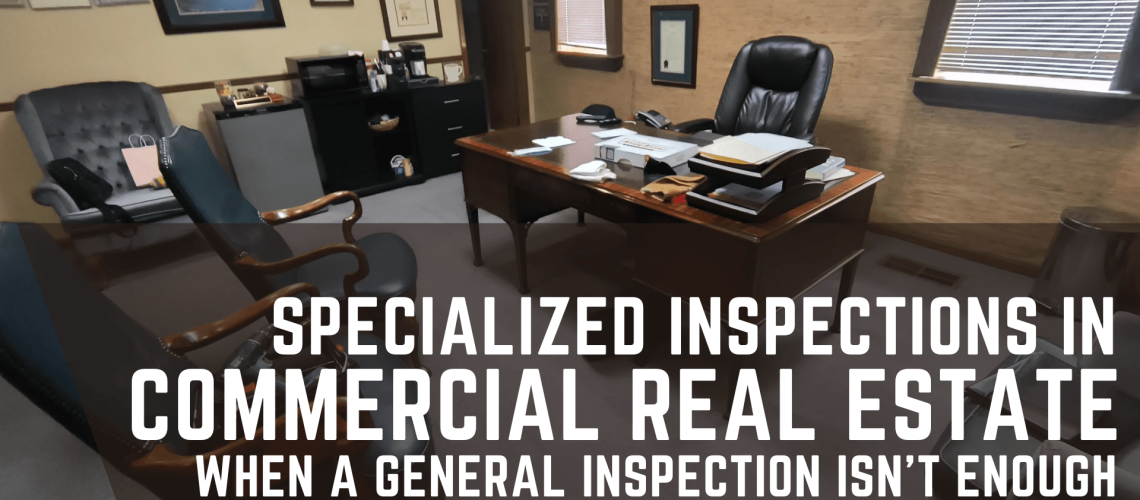
One of the most common misunderstandings in commercial real estate is assuming that a single inspection answers every question. A general commercial inspection provides critical, broad visibility—but it is not designed to exhaustively evaluate every system, material, or risk pathway.
At Upchurch Inspection, we treat specialized inspections as decision tools, not add-ons. They exist to narrow uncertainty in areas where failure carries outsized financial, operational, or liability consequences.
Why Commercial Properties Often Need More Than One Lens
Commercial buildings are layered assets. Structure, roofing, mechanical systems, drainage, environmental conditions, and usage history all intersect—but not all risks are visible at the same depth.
A general inspection is intentionally non-invasive. It identifies where risk likely exists, not every detail of how that risk plays out. Specialized inspections step in when:
- A system is critical to operations
- The cost of failure is high
- The building’s history suggests hidden exposure
- Planned use will stress a specific component
These inspections don’t contradict the general inspection—they refine it.
Roof Inspections: Because “Not Leaking” Isn’t a Condition
In commercial real estate, roof failure is rarely sudden. It’s progressive, localized, and often invisible until damage is widespread.
Specialized roof inspections focus on:
- Membrane condition beyond visible seams
- Drainage performance under real conditions
- Penetration quality and history
- Evidence of trapped moisture
- Repair patterns that signal end-of-life trajectory
A roof can pass a visual inspection and still represent one of the largest near-term capital expenses a buyer will face.
Structural Evaluations: When Load and Modification Matter
Commercial buildings are frequently modified over time. Mezzanines added. Walls removed. Equipment installed. Loads increased.
Specialized structural evaluations become appropriate when inspectors observe:
- Field-modified framing
- Settlement inconsistent with age
- Cracking tied to load changes
- Evidence of past structural repair
- Planned changes that increase demand
These evaluations aren’t about condemning structures—they’re about confirming assumptions buyers are already making, often without realizing it.
Sewer and Drainage Inspections: The Hidden Infrastructure Risk
Sewer and drainage systems are among the least visible and most disruptive failures in commercial buildings.
Specialized sewer inspections are recommended when:
- Buildings are older
- Drainage issues are reported or suspected
- Past repairs suggest recurring problems
- High-volume use stresses the system
- Site drainage directs water toward foundations
A collapsed or failing sewer line doesn’t show up during a walkthrough—but it can halt operations instantly.
Environmental Testing: Risk Is Use-Dependent
Environmental risk isn’t universal. It depends on how a building is used, occupied, and modified.
Specialized environmental inspections are appropriate when:
- Moisture patterns suggest hidden mold risk
- Building age raises material concerns
- Air quality affects operations or compliance
- Prior use introduces uncertainty
- Occupants are especially sensitive
These inspections don’t exist to alarm buyers. They exist to eliminate blind spots where health, liability, or remediation costs could intersect.
Electrical Evaluations: Capacity Is the Real Question
Commercial electrical systems often “work” right up until they don’t.
Specialized electrical evaluations become important when:
- Service appears undersized for current or planned use
- Panels are heavily modified
- Load growth has outpaced upgrades
- Future tenant changes are anticipated
- Equipment sensitivity demands stability
Capacity limitations don’t announce themselves as defects—but they quietly restrict flexibility and growth.
Why Skipping Specialized Inspections Creates False Confidence
Many buyers skip specialized inspections to save time or money, assuming the general inspection covered enough. What they often skip is clarity.
Specialized inspections:
- Reduce uncertainty
- Support negotiation with evidence
- Clarify capital planning
- Prevent post-closing surprises
- Align expectations with reality
They don’t guarantee outcomes. They improve decisions.
How Experienced Buyers Decide When to Go Deeper
Seasoned commercial buyers don’t order every specialized inspection automatically. They order them strategically.
They ask:
- What failure would hurt the most?
- Which systems are hardest to replace?
- Where is the building least forgiving?
- What assumptions am I making without proof?
Specialized inspections exist to answer those questions directly.
The Practical Reality
Commercial inspections are not about collecting reports—they’re about managing risk intelligently.
A general inspection shows where the building is asking questions.
Specialized inspections provide the answers that matter most.
Inspectors who understand commercial properties don’t oversell specialization. They recommend it where consequences justify clarity—and that judgment is what protects buyers long after closing.