
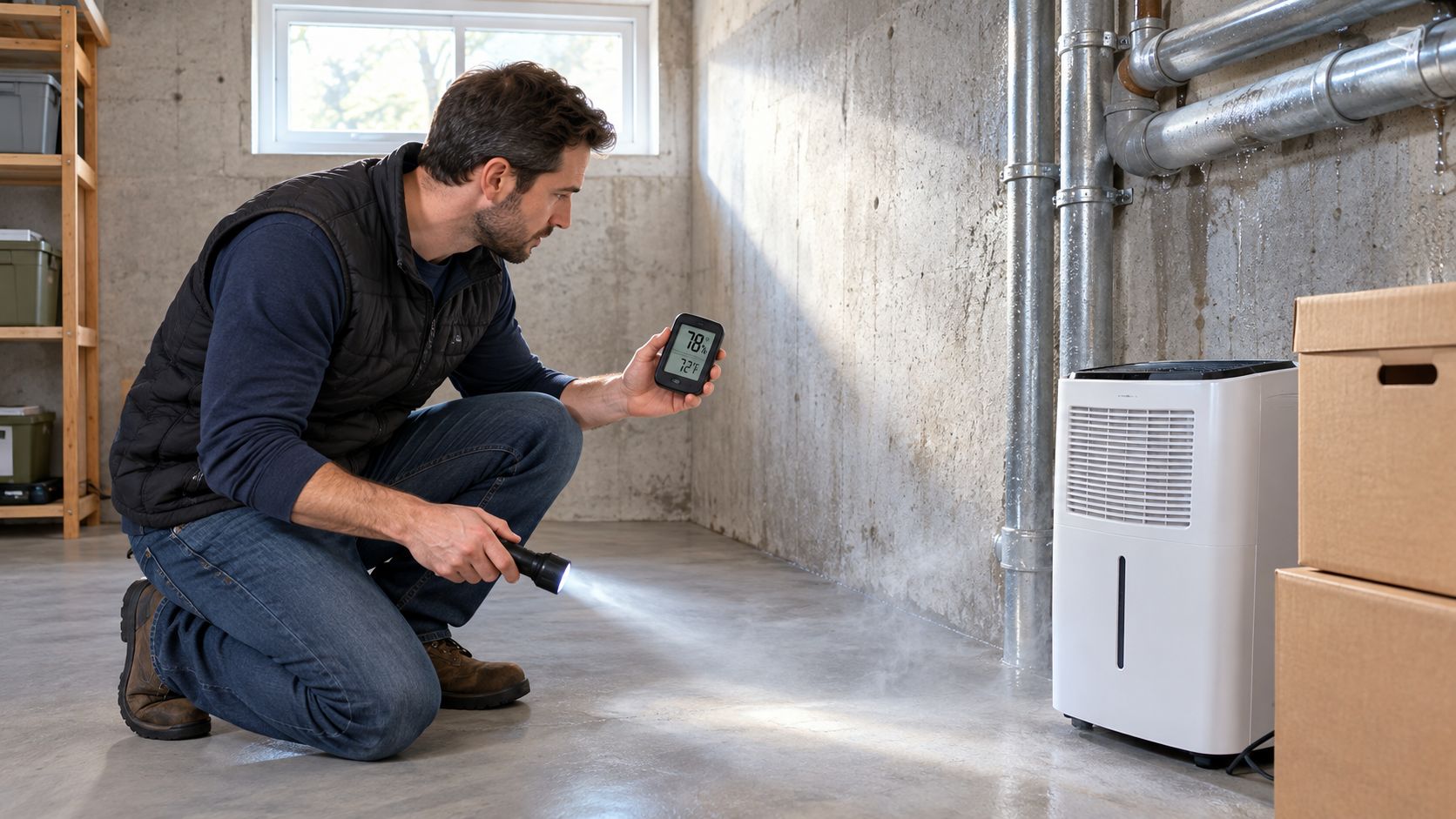
You notice it when you open the basement door. The room looks clean, the walls are painted, and there isn't an obvious mold spot anywhere, but the air has that damp, earthy smell that clings to clothing and cardboard. You may be wondering whether you're dealing with mold, a plumbing problem, or a basement that needs better ventilation.
A musty smell in a basement but no visible mold is best treated as a diagnostic clue, not a reason to panic or a problem to cover with fragrance. Below-grade spaces can hold moisture behind walls, along slab edges, under flooring, and inside stored materials before staining or fuzzy growth becomes visible. The practical response is to measure humidity, trace the odor, identify damp materials, and correct the source before cleaning or demolishing anything.
Table of Contents
- Why Your Basement Smells Musty With No Mold in Sight
- Common Hidden Causes Behind a Musty Basement Odor
- How to Inspect Your Basement System by System
- DIY Tests That Help and When You Need Professional Testing
- Fixing the Source and Keeping the Smell From Coming Back
- When to Call Upchurch Inspection or a Specialist
Why Your Basement Smells Musty With No Mold in Sight
A homeowner in Cape Girardeau, Jackson, Columbia, or any other Missouri community may see the same pattern after a stretch of rain. The basement looks dry during a quick walk-through, but the odor gets stronger near an exterior wall or a stack of stored boxes. A few days later, the smell fades, then returns with the next humid spell.
That pattern matters. The HUD analysis of American Housing Survey data found that 5.85% of residents reported frequent musty smells in 2015, while the later American Healthy Homes Survey II found self-reported frequent musty smells at 13.4% and technician-observed smells at 12.7%. The same analysis found that 3.77% of occupied households reported a large indoor mold area, defined there as at least 8.5 by 11 inches. Odor and visible growth don't always appear together.
Smell is an early warning, not a diagnosis
A musty odor may point to microbial activity, damp wood, wet carpet padding, cardboard, insulation, dust, or another moisture-holding reservoir. It doesn't automatically prove that a large mold colony exists, and it doesn't tell you where the moisture began.
Basements are especially prone to hidden conditions because foundation walls, slab edges, cold corners, and utility penetrations can stay damp without producing a puddle. In Southeast Missouri and Mid-Missouri, seasonal rain, humid air, clay soils, and older drainage systems can make the odor intermittent. A basement may smell fine during dry weather and noticeably earthy after rain or when warm indoor air meets cool masonry.
Practical rule: Don't ask only, “Where is the mold?” Ask, “Where is moisture being held, and what material is carrying the odor?”
A useful explanation of the moisture-to-mold relationship is available in this overview of how moisture problems lead to mold growth in homes. The goal isn't to label every musty basement as a mold emergency. The goal is to avoid dismissing an odor that may be the first visible clue of a concealed moisture problem.
Common Hidden Causes Behind a Musty Basement Odor
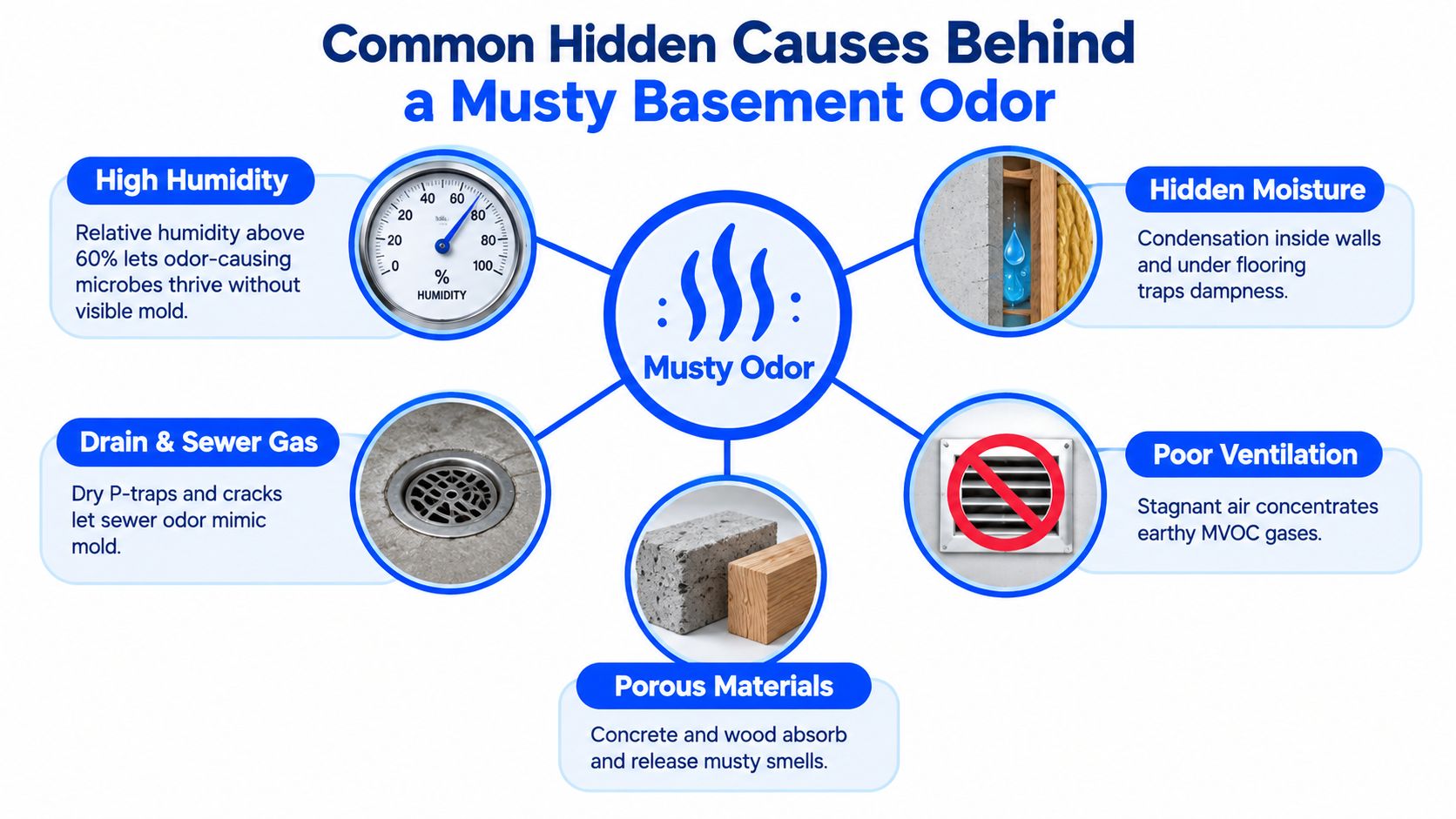
A musty smell usually comes from one of several source categories, and more than one can be present. High humidity may create the conditions, while a cardboard box, carpet pad, or HVAC return holds the odor.
Air and surface moisture
The EPA recommends keeping indoor relative humidity below 60%, with an ideal range between 30% and 50%. That guidance appears in the EPA mold course discussion of moisture control, and it matters even when the basement has no visible growth. Humidity and dampness can supply enough moisture for mold-supportive conditions on organic surfaces.
Condensation is another common source. Cold water pipes, metal ductwork, window frames, and cool foundation walls can collect moisture when humid air reaches them. Look for beads of water, softened insulation, damp paper, or a cool corner where the odor is stronger. The material may dry before you inspect it, leaving the smell behind.
Moisture can also move through concrete and masonry as vapor. That process won't necessarily create a dramatic leak, but it can keep flooring edges, stored items, or wood framing damp. A foundation wall may look clean while the back of a finished wall or the underside of flooring remains affected.
Hidden leaks and odor reservoirs
A slow plumbing leak can stay inside a wall, beneath a fixture, or near a drain without forming a visible pool. Past seepage near a sump pit, window well, foundation crack, or slab edge can leave porous material holding odor long after the original water event has ended.
Common reservoirs include:
- Cardboard and paper: Boxes absorb basement humidity and can smell earthy even when the floor is dry.
- Carpet and padding: A small wet area below the surface can retain odor and support hidden contamination.
- Wood and drywall paper: These materials can hold moisture inside cavities or behind finished surfaces.
- Dust and HVAC returns: A return-air pathway can collect odor and distribute it through the home.
For carpet or fabric that has only a small, clearly understood affected area, a careful DIY mildew removal carpet guide can help with basic cleaning decisions. It won't replace moisture diagnosis, and cleaning won't solve a continuing leak.
A sewer odor belongs in a separate category. Dry floor-drain traps, damaged drain connections, or sump and sewer issues can produce unpleasant smells that a homeowner may describe as musty. If the odor is strongest near a drain and doesn't follow humidity or rain, plumbing evaluation deserves priority.
How to Inspect Your Basement System by System
Start with the least destructive method. Don't open walls or pull up flooring just because the room smells earthy. A short log of humidity, weather, and odor location can show whether you're dealing with general dampness or a localized reservoir.

Begin with the air
Place a hygrometer in the basement area where the smell is strongest, not upstairs in a hallway. Record the reading on multiple days, including a humid day and a dry day. Independent practical guidance uses 60% relative humidity as an upper action threshold, with 30% to 50% as the preferred control range, so repeated readings above 60% deserve attention.
Notice whether the smell changes after rainfall, when the HVAC system runs, or when the dehumidifier operates. A stronger odor after rain points toward seepage, drainage, or vapor movement. A smell that spreads when the HVAC runs raises questions about return-air dust, damp insulation, or a contaminated air pathway.
Follow the odor
Walk slowly through the basement and identify the strongest point. Check exterior walls, corners, windows, stored materials, the sump pit, floor drains, mechanical equipment, and any finished wall or flooring transition. Odor mapping works best when you compare one zone with another rather than deciding that the entire basement smells equally.
Near the strongest area, look for:
- Condensation: Water on pipes, ductwork, window frames, or cold masonry.
- Efflorescence: A powdery mineral deposit on masonry that can indicate moisture movement.
- Staining: Discoloration around windows, plumbing, foundation cracks, or the base of walls.
- Damp insulation: Compressed, discolored, or earthy-smelling insulation.
- Stored materials: Cardboard, textiles, wood, and paper pressed against exterior walls.
Don't rely on sight alone. A clean painted surface may conceal damp drywall paper or framing behind it.
Check water systems and equipment
Inspect the sump pit cover, discharge arrangement, nearby walls, and pump operation without placing yourself in an unsafe position. Look at exposed plumbing joints, water heaters, HVAC condensate components, and the area beneath mechanical equipment. Don't remove electrical covers, enter unsafe crawlspaces, or disturb suspect materials without appropriate protection and training.
The basement humidity guidance from The Basement Guide is useful for recognizing that moisture doesn't require a puddle. High humidity, condensation, vapor movement, slow leaks, and damp porous materials can all contribute to odor. If the source remains unclear after these checks, the next step is moisture measurement rather than stronger deodorizer.
DIY Tests That Help and When You Need Professional Testing
Homeowners can gather useful information without trying to perform a mold investigation. Humidity logging, odor mapping, and careful visual checks help establish a pattern. They become less useful when the odor persists while surfaces appear dry, or when finished materials block access to the likely source.
A moisture meter can help identify high moisture in accessible wood, drywall paper, or other materials, but readings require context. Different materials and surfaces respond differently, and a single reading doesn't explain whether moisture is active, historic, or coming from an adjacent area. Surface-only inspection also can't reliably rule out growth behind walls, under flooring, around sump pits, or near an old leak.
Match the test to the pattern
| Odor Pattern | Likely Clue | Best Next Test | Who to Call |
|---|---|---|---|
| Stronger after rain | Seepage, drainage trouble, or vapor movement | Moisture mapping and exterior drainage review | Inspector or foundation and drainage specialist |
| Strongest near a drain | Dry trap or plumbing connection issue | Drain and trap evaluation | Plumber |
| Spreads when HVAC runs | Damp return-air dust, insulation, or concealed moisture | HVAC and moisture inspection | HVAC professional or inspector |
| Persists below the preferred humidity range | Hidden reservoir or past wet material | Targeted moisture checks and mold assessment | Inspector or qualified mold professional |
| Concentrated in carpet or stored boxes | Porous material holding odor | Material inspection and controlled removal | Inspector, flooring professional, or remediation specialist |
| No odor clue but basement occupancy concerns | Separate indoor-air hazard | Radon test | Qualified radon tester |
A professional can use moisture mapping, targeted material checks, thermal imaging where appropriate, and a closer review of concealed areas. Mold assessment may involve air sampling or surface testing, but testing should answer a practical question. A sample by itself won't repair a leak or tell you every place moisture has traveled.
For a plain explanation of why consumer kits can create uncertainty, see why DIY mold test kits often cause confusion. Testing for mold and testing for radon are separate decisions. Radon has no smell, sight, or taste, and the EPA action level is 4.0 pCi/L, so only a radon test can determine whether it is present at a concerning level, as explained in this basement air-quality guidance.
Fixing the Source and Keeping the Smell From Coming Back
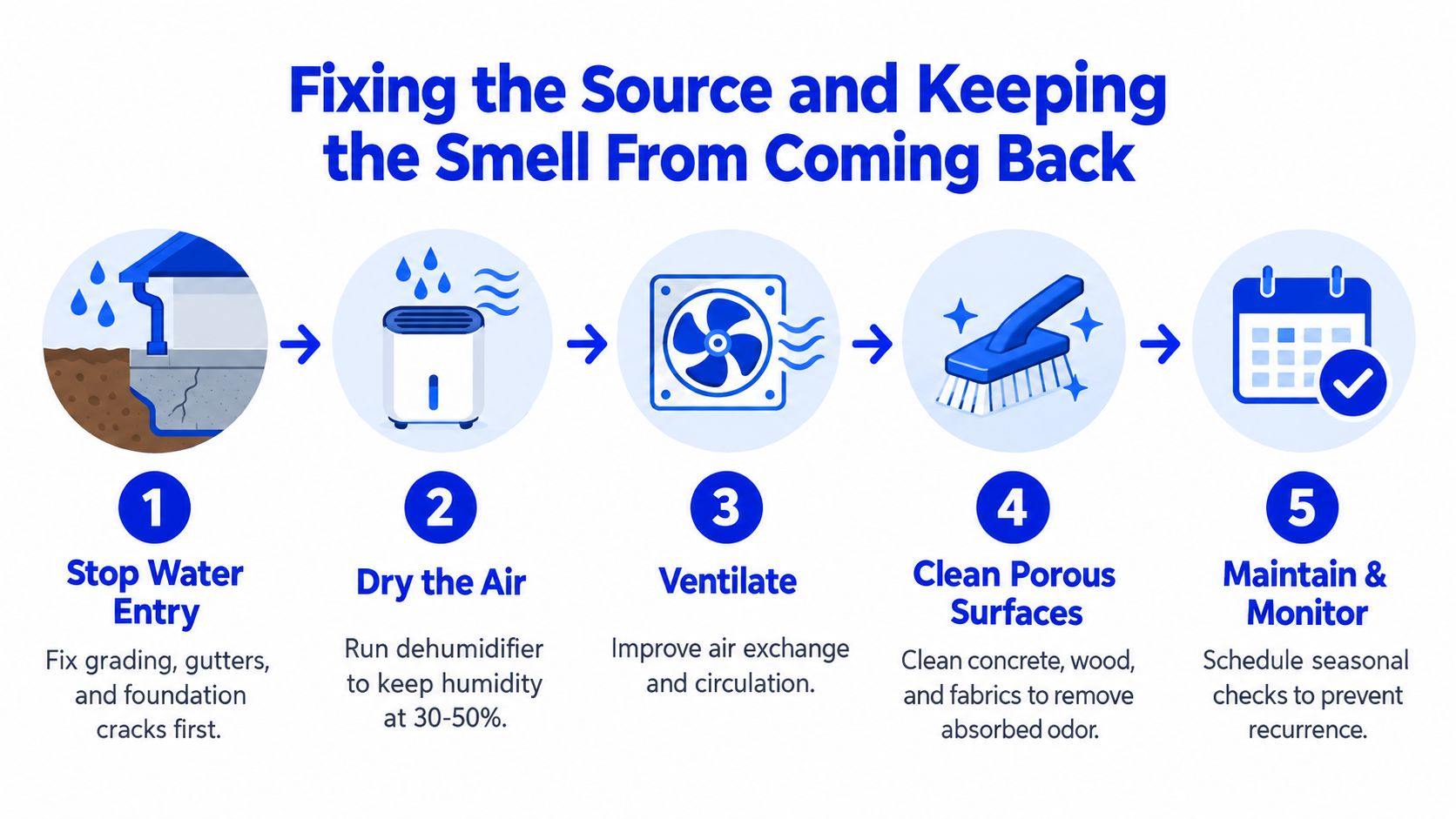
Odor control works best in the right order. If you clean the visible surfaces but leave water entering at the foundation, the smell will return. Dehumidification can improve the air, but it won't correct failed drainage, a slow plumbing leak, or damp material inside a wall.
Put repairs before deodorizing
Start outside and work inward. Clean gutters, confirm that downspouts move water away from the foundation, and correct obvious grading problems. If you see recurring seepage, foundation movement, or water after storms, a foundation or drainage specialist should assess the cause rather than relying on interior sealants alone.
Next, remove or dry wet reservoirs. Cardboard and fabric may need to leave the basement, while carpet padding, insulation, drywall, or wood may require targeted removal if moisture testing confirms a problem. Clean sound, nonporous surfaces carefully, but don't disturb suspected contamination aggressively or spread debris through the house.
Then control the basement environment. Use dehumidification to keep humidity in the EPA's preferred 30% to 50% range, and improve air circulation where safe and appropriate. Ventilation can help in some conditions, but bringing humid outdoor air into a damp basement can make the problem worse.
For broader cleaning and odor-control considerations, this Pine Country odor elimination guide offers additional practical context. Keep monitoring after rain, during seasonal changes, and after repairs. In Missouri homes, storm runoff, clay soil movement, freeze-thaw deterioration, and older foundation details can expose weaknesses that weren't obvious during a dry inspection.
When to Call Upchurch Inspection or a Specialist
Call for professional help when the smell continues despite humidity control, returns after rain, spreads through the HVAC system, or comes with suspected sewer gas. A professional inspection can document foundation and drainage clues, plumbing and HVAC conditions, accessible moisture readings, and areas that deserve specialist evaluation.
For a real estate transaction in Cape Girardeau, Poplar Bluff, Farmington, Perryville, Columbia, Jefferson City, Fulton, Boonville, Sedalia, or surrounding communities, timing matters because buyers and sellers need clear findings rather than guesses. A home inspection, targeted moisture evaluation, mold assessment, sewer scope, radon test, or referral to a plumber, HVAC professional, foundation specialist, or remediation contractor may be appropriate depending on the pattern. This resource on mold testing providers also explains why testing should be matched to the question you're trying to answer.
Before scheduling, note the strongest odor location, recent rainfall, humidity readings, visible staining, drain behavior, HVAC operation, and any prior leaks. That information helps the inspector focus the evaluation and helps you avoid paying for demolition before the source is understood.
Upchurch Inspection can evaluate basement and crawlspace moisture clues, document findings with photos and reports, and coordinate relevant services such as mold or radon testing when the symptoms justify them. Visit Upchurch Inspection to schedule an inspection and bring a persistent basement odor into a clear, practical plan.