
TL;DR:
- Hiring local inspectors offers faster scheduling, region-specific expertise, and better post-inspection communication that national providers cannot match. Their deep understanding of local climate, soils, and construction practices results in more accurate assessments, reducing costly surprises after closing. Strong community reputation and adherence to updated standards make them more accountable and reliable for property evaluations.
Local inspectors are property evaluation professionals with direct knowledge of regional building practices, local codes, and climate-specific risks that national providers routinely miss. For homebuyers and real estate investors, the decision to hire locally is not a matter of preference. It is a matter of protection. Whether you are purchasing a single-family home in the Mid-South or evaluating a multi-unit investment property, the advantages of hiring local inspectors translate directly into better information, faster decisions, and fewer costly surprises after closing. The American Society of Home Inspectors (ASHI) updated its Standard of Practice in January 2026, raising the bar for what a thorough inspection must cover. Local inspectors who meet and exceed that standard are your strongest asset in any transaction.
Why choose local inspectors over national providers?
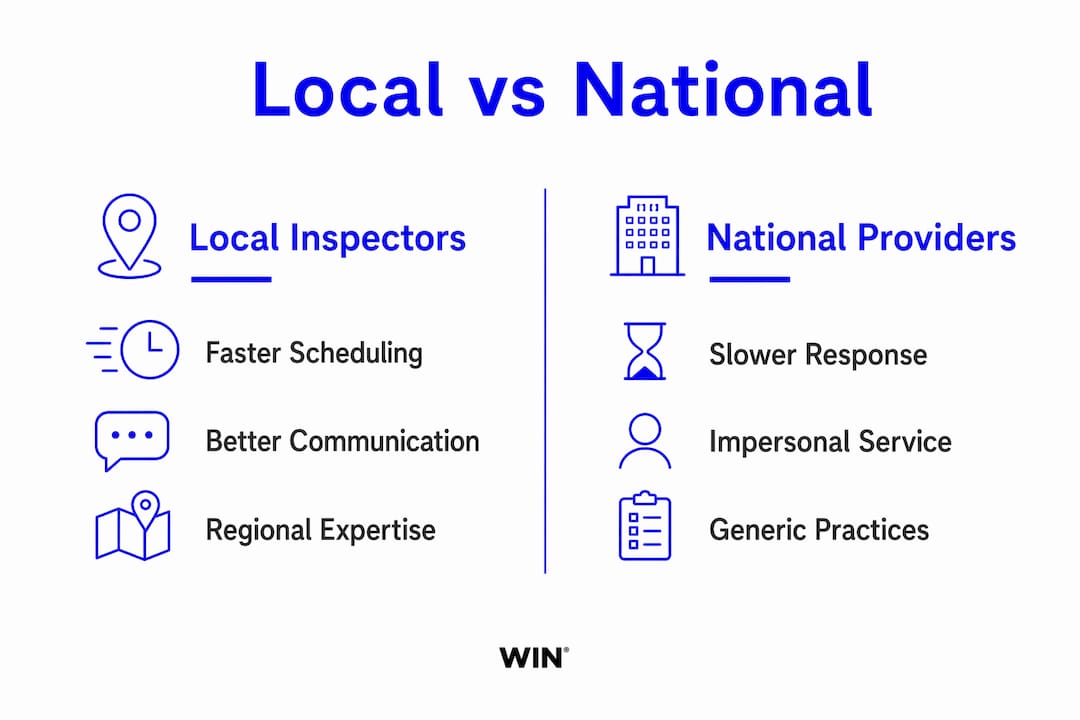
Local inspectors deliver faster scheduling, more direct communication, and region-specific expertise that national inspection chains cannot replicate at scale. Delays in scheduling or receiving results can complicate decisions during a transaction, and local providers are positioned to respond quickly and accommodate flexible timing. That responsiveness is not a minor convenience. In competitive real estate markets, a one-day difference in receiving your inspection report can affect your negotiation window and repair request timeline.

Local inspectors facilitate quicker communication during transactions, which aids in clarification and decision-making when it matters most. A national provider dispatching an inspector from three counties away cannot offer the same follow-up access as someone who works in your market every week. When you have a question about a flagged electrical panel at 7 p.m. before a contract deadline, proximity and familiarity make a real difference.
The comparison below illustrates where local and national providers diverge most sharply:
| Category | Local inspectors | National providers |
|---|---|---|
| Scheduling speed | Same-day or next-day availability common | Often 3-5 business days |
| Regional code knowledge | Deep, current, market-specific | Generalized or inconsistent |
| Post-inspection follow-up | Direct access to the inspector | Call center or ticketing system |
| Community accountability | Reputation-driven, referral-based | Brand-driven, volume-based |
| Report customization | Tailored to local risk factors | Standardized templates |
Pro Tip: Ask any inspector you are considering how many inspections they have completed in your specific zip code or county in the past 12 months. A local inspector with 80 inspections in your market knows the neighborhood’s common defects before they walk through the door.
Local inspectors rely heavily on referrals and community reputation, which creates strong incentives to deliver high-quality service on every job. A national chain can absorb a bad review. A local inspector whose livelihood depends on word-of-mouth from real estate agents and past clients cannot afford to cut corners.
How does local knowledge improve inspection accuracy?
Regional insight is the single most undervalued factor in property inspection quality. Home inspections often reveal issues related to local climate, soil, and construction practices that non-local inspectors routinely miss. In the Mid-South, for example, expansive clay soils cause foundation movement patterns that look different from frost-heave damage in northern states. An inspector trained primarily in the Northeast may flag the wrong cause and recommend the wrong remedy.
Local inspectors also understand which materials were commonly used in specific construction eras within their market. A home built in Memphis in the 1970s carries different risk profiles than a home built in Phoenix during the same decade. Knowing what to look for, and where, is the product of years of inspecting the same types of structures in the same environment.
Region-specific inspection considerations that local inspectors address with greater precision include:
- Foundation movement caused by clay soil expansion and contraction through wet and dry seasons
- Moisture intrusion patterns specific to high-humidity climates, including crawl space condensation and vapor barrier failures
- Roof wear accelerated by local storm patterns, hail frequency, and UV exposure levels
- HVAC strain from extreme seasonal temperature swings that shorten equipment service life
- Pest damage from termites and wood-boring insects prevalent in specific geographic zones
- Local code compliance for additions, electrical upgrades, and plumbing modifications permitted under regional standards
Local inspectors also know when to recommend specialized follow-up evaluations. Under ASHI’s 2026 Standard of Practice, inspectors are required to clarify the limitations of a visual, non-invasive inspection and identify when additional specialist assessments are warranted. A local inspector familiar with your area’s common issues knows exactly when to call in a structural engineer or a licensed electrician, rather than leaving that judgment to a generic checklist.
What qualifications should trustworthy local inspectors meet?
Professional qualifications separate a reliable local inspector from someone who simply operates nearby. ASHI’s updated Standard of Practice, approved in January 2026, reflects an industry-wide commitment to depth, accuracy, and defensible inspection methodology. Inspectors who align with ASHI’s SOP commit to evaluating structural components, roofing, plumbing, electrical systems, HVAC, and more under a defined and auditable framework.
State-level requirements add another layer of consumer protection. In Arkansas, for example, home inspectors must complete at least 64 hours of qualifying education and 16 hours of field training within three years prior to registration. That baseline exists to protect buyers from unqualified practitioners. Inspectors who exceed those minimums, through additional certifications, continuing education, or membership in professional organizations like ASHI, signal a higher commitment to their craft.
When evaluating a local inspector’s qualifications, ask these direct questions:
- Are you registered or licensed in this state, and can you provide your license number?
- Do you follow ASHI’s Standard of Practice or a comparable industry framework?
- How many years have you inspected properties in this specific market?
- What does your report cover, and what are its stated limitations?
- Do you carry errors and omissions insurance and general liability coverage?
That last question matters more than most buyers realize. An inspector without errors and omissions coverage offers you no recourse if a missed defect costs you tens of thousands of dollars after closing.
Pro Tip: Request a sample report before booking. A well-structured report includes photos, condition ratings, and clear language distinguishing safety hazards from maintenance recommendations. If the sample looks like a basic checklist, keep looking.
Strong community reputation reinforces professional qualifications. Local inspectors’ deep understanding of transaction rhythms and client expectations enhances their reliability in ways that credentials alone cannot capture. An inspector with 200 five-star reviews from buyers in your market has demonstrated performance, not just training.
How do you find and evaluate the best local inspectors?
Selecting the right local inspector requires more than a Google search. Checking credentials, local experience, sample reports, and customer reviews is the foundation of a sound selection process. Here is a structured approach that protects your investment:
Start with referrals from local real estate professionals. Agents who work your target market daily know which inspectors produce thorough reports and which ones create problems at closing. A referral from a trusted agent is worth more than a top search result.
Verify state registration and professional memberships. Confirm the inspector’s license is current and check for ASHI or InterNACHI membership. These affiliations indicate ongoing education and adherence to published standards.
Request and review a sample report. Look for clear descriptions, supporting photos, and explicit statements about what was and was not inspected. A report that identifies deferred maintenance on HVAC units and flags the remaining service life of a roof gives you negotiating leverage. A vague checklist does not.
Read reviews with specificity in mind. Look for reviews that mention the inspector by name, describe specific findings, and comment on communication quality. Generic five-star reviews with no detail are less informative than a detailed four-star review explaining exactly what the inspector found and how they communicated it.
Schedule a phone call before booking. A five-minute conversation tells you whether the inspector communicates clearly, understands your property type, and can explain their process without jargon. Clear communication during and after inspections is a direct indicator of the inspector’s reliability and client focus.
Confirm availability and turnaround time. Faster clarification on inspection findings can influence negotiation timing and follow-up repair requests within the contract window. An inspector who delivers a detailed report within 24 hours gives you a tactical advantage.
For investors evaluating multi-unit or commercial properties, the selection criteria are even more demanding. You need an inspector who understands the role inspections play in protecting both buyers and sellers throughout the transaction, not just someone who can walk through a building and check boxes.
Key takeaways
Local inspectors outperform national providers on every factor that directly affects buyer and investor outcomes: regional expertise, scheduling speed, communication quality, and accountability.
| Point | Details |
|---|---|
| Local expertise reduces risk | Inspectors familiar with regional soils, climate, and codes catch defects others miss. |
| Faster scheduling protects deals | Local availability shortens report turnaround and preserves negotiation windows. |
| Reputation drives quality | Referral-dependent inspectors have stronger incentives to deliver thorough, accurate reports. |
| Qualifications set the floor | ASHI’s 2026 SOP and state registration requirements define the minimum standard to verify. |
| Selection requires active vetting | Credentials, sample reports, reviews, and a direct conversation all factor into a sound choice. |
What I’ve learned about local inspectors after years in the field
I have watched transactions fall apart because an out-of-area inspector missed a foundation issue that any experienced Mid-South inspector would have flagged immediately. The clay soil movement patterns in this region are not subtle once you know what you are looking for. But if you have spent your career inspecting homes in a different climate, you may not recognize the signs until the damage is already significant.
The accountability factor is real and it is underappreciated. When a local inspector’s next ten jobs depend on the referral from the agent standing in the room with them today, they inspect differently. Not because they are cutting corners otherwise, but because the stakes are personal. Their name is on the report, their phone number is on the business card, and their neighbor might be the buyer. That is a level of investment in the outcome that a national provider dispatching a contractor cannot manufacture.
I also think buyers underestimate the value of post-inspection access. The inspection report is not the end of the conversation. Questions come up during the repair negotiation, during the re-inspection, and sometimes months after closing. A local inspector who picks up the phone and walks you through a finding in plain language is worth more than a polished report from someone you can never reach again.
My advice: prioritize local market knowledge over brand recognition every time. The inspector who knows your neighborhood’s construction history, its common failure points, and its local code requirements will always deliver more value than a national chain with a slick website.
— Holly
How Upchurchinspection serves property owners in the Mid-South
Upchurchinspection was built on the premise that thorough, locally informed inspections protect buyers and investors from the costly surprises that generic evaluations miss. Our inspectors exceed Arkansas state registration requirements and follow ASHI’s 2026 Standard of Practice on every job, whether it is a single-family home or a commercial property. We deliver detailed reports covering structural components, plumbing, electrical systems, HVAC, and more, with clear language and supporting photos that give you real leverage in negotiations. If you want to understand the ongoing value of regular inspections for protecting your property investment, we are ready to walk you through it. Contact Upchurchinspection to schedule your evaluation and get the local expertise your transaction deserves.
FAQ
Why do local inspectors outperform national chains?
Local inspectors bring region-specific knowledge of building codes, climate risks, and common defects that national providers cannot replicate at scale. Their reliance on community referrals also creates stronger accountability for report quality.
What credentials should a local home inspector have?
At minimum, verify state registration, errors and omissions insurance, and alignment with ASHI’s 2026 Standard of Practice. In Arkansas, registration requires at least 64 hours of qualifying education and 16 hours of field training.
How does inspector responsiveness affect a real estate transaction?
Faster report delivery and direct post-inspection access allow buyers and investors to act within contract windows. Delays in clarifying findings can cost you negotiation leverage or cause you to miss repair request deadlines.
What should I look for in a local inspection report?
A strong report includes photos, condition ratings, clear descriptions of defects, and explicit statements about inspection limitations. It should distinguish between safety hazards, deferred maintenance items, and general recommendations.
When should I find a local inspector in the buying process?
Find your inspector before you make an offer when possible. Knowing who you will call and confirming their availability prevents scheduling delays that can compress your due diligence window at a critical point in the transaction.