TL;DR:
- Mold testing involves laboratory analysis of samples to identify mold species and spore levels, differing from visual inspection and moisture assessment. It is most beneficial after remediation, when investigating unseen issues, or for documentation, but not necessary if visible mold and moisture problems are already identified. Proper interpretation requires professional expertise, as testing alone cannot determine safety or compliance without context.
Mold testing is defined as the collection of air or material samples from a property, followed by laboratory analysis to identify mold species and measure spore concentrations in the indoor environment. This process is distinct from a mold inspection, which relies on visual assessment, moisture readings, and sensory detection to locate mold growth and its source. The CDC and NIOSH both note that visual inspections and musty odors are often more reliable than air sampling for finding problem areas. Understanding what mold testing actually is, and when it genuinely helps, keeps you from spending money on tests that won’t answer the questions you’re actually asking.
What is mold testing and how does it differ from inspection?
Mold testing, in the formal sense, means sending samples to a certified laboratory for analysis. A mold inspection, by contrast, is the on-site process of looking for visible growth, identifying moisture intrusion, checking building materials for staining or deterioration, and noting musty odors. These two processes serve different purposes, and confusing them leads to poor decisions. Many homeowners request testing when what they actually need is a thorough inspection with moisture assessment.
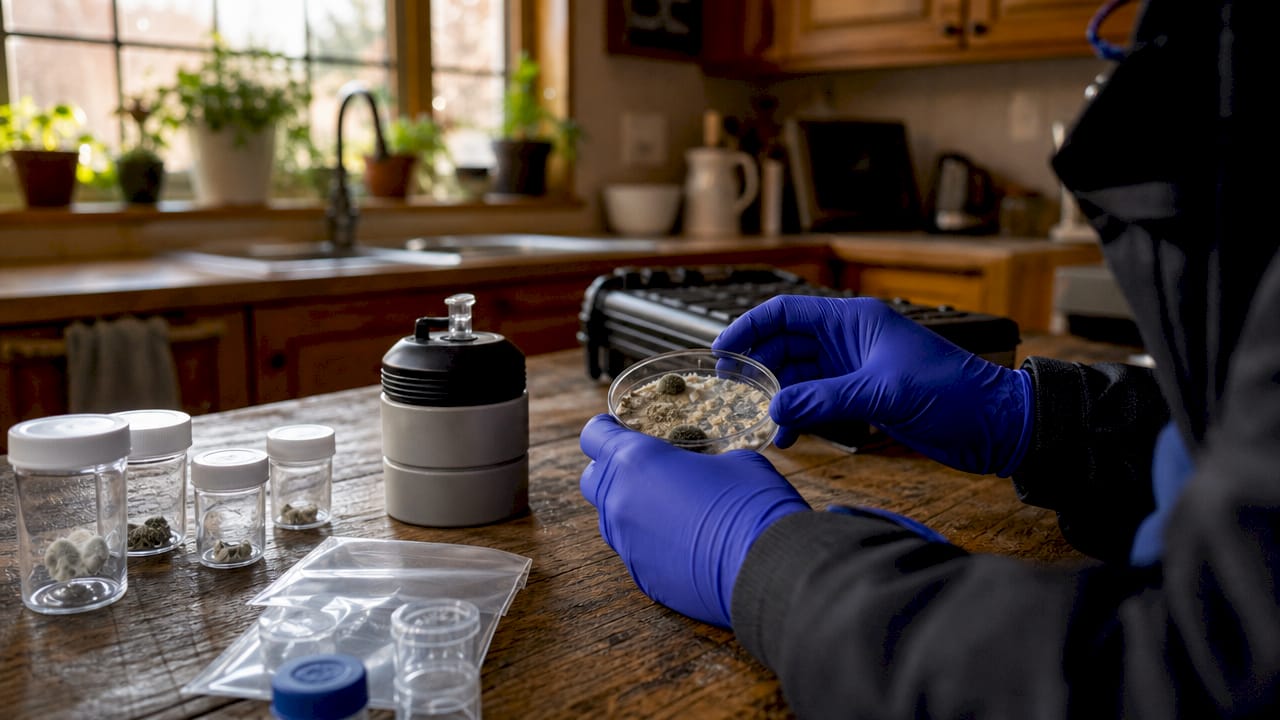
The distinction matters practically. An inspector who finds water staining behind a bathroom wall, elevated moisture readings in the subfloor, and a musty odor in the crawl space has already identified a mold-risk condition. Sending an air sample to a lab at that point rarely changes the response: find the moisture source, contain the affected area, and remediate. Testing becomes more useful after remediation, to confirm the cleaning was effective, or in situations where mold is suspected but not visually confirmed.
For more on how these two processes compare, the Upchurchinspection article on mold inspection vs. testing breaks down the differences in practical terms for homeowners.
What mold testing methods are used and how do they work?
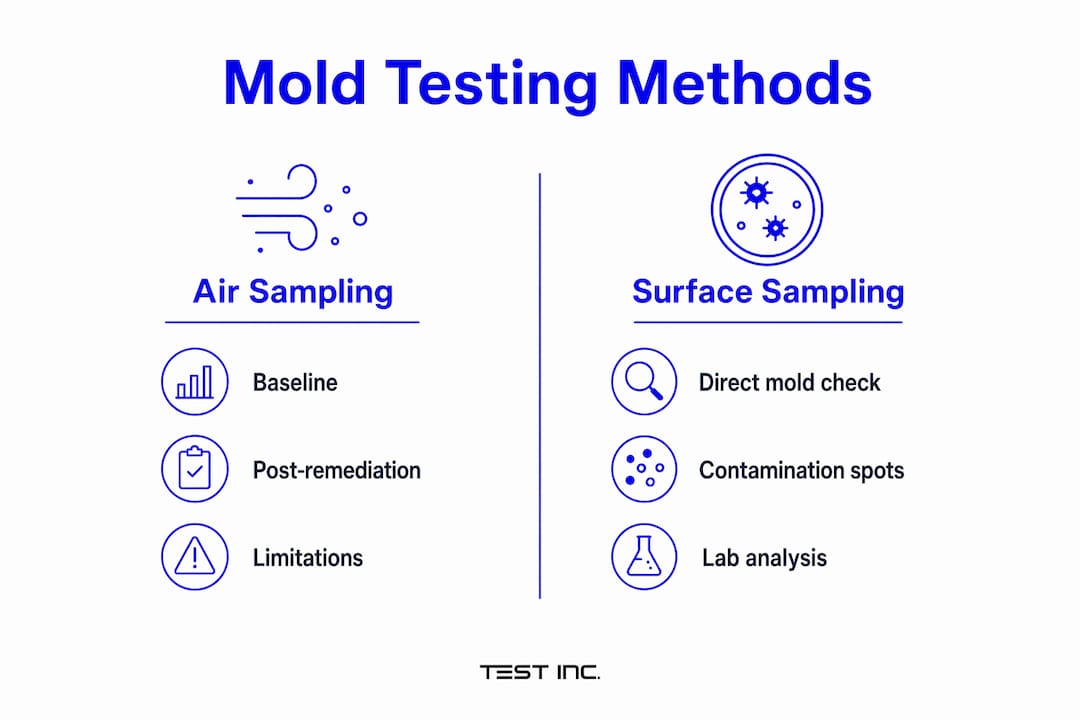
Professional mold testing uses several sample types, and experienced inspectors choose the method based on the specific situation rather than applying one approach to every job. The main methods are:
- Air sampling: A pump draws a measured volume of air through a collection cassette, which is then analyzed under a microscope for spore type and count. This method captures what is airborne at the moment of sampling, which can vary significantly by hour, season, and HVAC operation.
- Surface swabs and tape lifts: A swab or clear tape is pressed against a suspect surface to collect material for lab analysis. This method identifies what species are present on a specific surface but does not indicate how much is airborne or how widely distributed the growth is.
- Bulk sampling: A physical piece of building material, such as drywall, insulation, or carpet, is removed and sent to the lab. This is useful when the material itself is suspect and surface sampling would not capture what is embedded deeper in the substrate.
- DNA-based dust analysis (ERMI): The EPA Relative Moldiness Index uses DNA sequencing to identify mold species from settled dust samples. This method is more sensitive than spore counting but is not standardized for routine diagnostic use and can produce results that are difficult to interpret without professional context.
| Method | Best use case | Key limitation |
|---|---|---|
| Air sampling | Baseline comparison, post-remediation check | Results vary by time, conditions, and HVAC status |
| Surface swab / tape lift | Identify species on a specific surface | Does not reflect airborne concentration |
| Bulk sampling | Confirm contamination in building materials | Invasive; requires material removal |
| DNA-based dust (ERMI) | Sensitive species identification | Not standardized; interpretation is complex |
Pro Tip: A single air sample taken without a baseline outdoor comparison sample is of limited diagnostic value. Reputable professionals always collect an outdoor control sample alongside indoor samples so the lab can compare what is naturally present in the environment versus what is elevated inside the building.
One-size-fits-all testing packages sold by some services often include methods that do not match the actual concern. A buyer worried about a musty basement does not necessarily need a full ERMI panel. An inspector who understands the mold testing process will match the method to the question being asked.
When is mold testing necessary and what are its limitations?
The EPA’s position is direct: if visible mold is present, testing is usually unnecessary because no federal standards exist for acceptable mold spore levels indoors. There is no threshold a test can confirm you are above or below. This means mold testing cannot produce a pass or fail result in any regulatory sense, and treating it as though it can is a common and costly mistake.
Testing is genuinely useful in specific situations:
- Confirming that remediation was successful and spore levels have returned to normal ranges
- Investigating complaints of odor or health symptoms when no visible mold is found
- Documenting conditions before and after remediation for insurance or legal purposes
- Evaluating hidden areas where disturbance is not yet warranted
The Minnesota Department of Health warns that testing can be expensive and that poor or inappropriate testing exploits consumers. The guidance is consistent: prioritize moisture assessment and visual inspection before ordering lab work. Moisture is the root cause. Mold is the symptom. Fixing the moisture source without testing will resolve the problem. Testing without fixing the moisture source will not.
“The most important step in solving a mold problem is finding and fixing the moisture source. Testing tells you what is there. It does not fix it.” — Minnesota Department of Health
There is also a meaningful limitation around health interpretation. NIOSH states that spore counts and culture results do not capture the full exposure range and cannot be reliably linked to health risk without additional context. Occupant reactions may be caused by mold-related compounds or bacteria, not spores alone, which makes air sample data ambiguous as a health indicator.
Pro Tip: Be cautious of any testing company that offers to test, interpret, and remediate in the same transaction. That is a structural conflict of interest. Testing and remediation should be handled by separate parties whenever possible.
How to interpret mold test results without unnecessary panic
Mold test results typically report spore types and counts per cubic meter of air, or identify species present on a surface. Neither number alone tells you whether you have a health problem or a remediation emergency. Context is everything, and results without context produce confusion more often than clarity.
A few principles help frame what you are actually looking at:
- Spore counts are not health thresholds. There are no health-based indoor air standards for mold. A count of 500 spores per cubic meter is not inherently safe, and 2,000 is not inherently dangerous. What matters is whether indoor counts are elevated relative to outdoor baseline levels and whether the species present are consistent with active growth.
- Species identification has limited practical value in most cases. Knowing that Cladosporium or Penicillium is present does not change the remediation approach. Stachybotrys, often called “black mold,” generates significant anxiety, but remediation decisions focus on visible presence and moisture control regardless of species.
- Short-term samples may not represent actual exposure. A single air sample taken on a dry, low-humidity day in a well-ventilated room may show low counts even when a significant mold problem exists nearby. NIOSH notes that short-term air sampling can underrepresent true exposure conditions.
- Results should be interpreted alongside visual findings and moisture data. A lab report is one data point. It should be read together with what the inspector observed, what the moisture meter measured, and what the occupants reported.
Pro Tip: If a test result is confusing or alarming, get a second opinion from a certified industrial hygienist before committing to expensive remediation. The Upchurchinspection resource on reading mold test results is a useful starting point for understanding what the numbers actually mean.
What steps should homeowners and buyers take about mold concerns?
Practical mold concerns call for a structured response, not an immediate rush to testing. Here is how to approach it:
- Start with a thorough visual inspection. Walk the property and look for visible staining, discoloration, or growth on walls, ceilings, around windows, under sinks, and in the crawl space or basement. Note any musty odors, which are often more reliable indicators than air samples.
- Identify and address moisture sources first. Roof leaks, plumbing failures, condensation on cold surfaces, and poor drainage are the conditions that allow mold to grow. Fixing the moisture source is the non-negotiable first step, regardless of whether testing follows.
- Hire a qualified professional when testing is warranted. The EPA advises that sampling be conducted by experienced professionals following recommended methods to produce results that are actually interpretable. Credentials to look for include Certified Industrial Hygienist (CIH) or Certified Mold Inspector (CMI) designations.
- Avoid DIY test kits for diagnostic decisions. Petri-dish style kits sold at hardware stores are designed to detect whether mold is present, not to quantify it or identify where it is coming from. They almost always return a positive result because mold spores exist everywhere. The Upchurchinspection article on DIY mold test kits explains why these kits create more confusion than clarity.
- Incorporate mold evaluation into home purchase inspections. Buyers should request that their home inspector assess moisture conditions, check for visible mold, and recommend targeted testing when conditions warrant it. This is especially relevant in the Mid-South, where high humidity and older housing stock create persistent moisture risk. For buyers specifically, the Upchurchinspection guide on mold testing in home buying covers what to ask for and when.
Key takeaways
Mold testing is a targeted diagnostic tool, not a routine screening, and its value depends entirely on whether the right method is used in the right context with professional interpretation.
| Point | Details |
|---|---|
| Testing vs. inspection | Mold testing collects lab samples; inspection locates mold and moisture through visual and sensory assessment. |
| No pass/fail standard | No federal health-based standard exists for indoor mold levels, so test results cannot confirm safety or compliance. |
| Moisture comes first | Identifying and fixing the moisture source resolves mold problems; testing alone does not. |
| Method selection matters | Air sampling, surface swabs, bulk samples, and DNA analysis each serve specific scenarios, not all situations. |
| Professional interpretation required | Short-term samples without baseline comparisons and professional context produce unreliable conclusions. |
What I’ve learned from years of mold calls in the field
The calls we get most often go something like this: a homeowner smells something musty, gets a DIY kit from the hardware store, sees a positive result, and calls in a panic. By the time we arrive, they have already been quoted thousands of dollars in remediation by a company that also did the testing. That is a pattern worth being skeptical of.
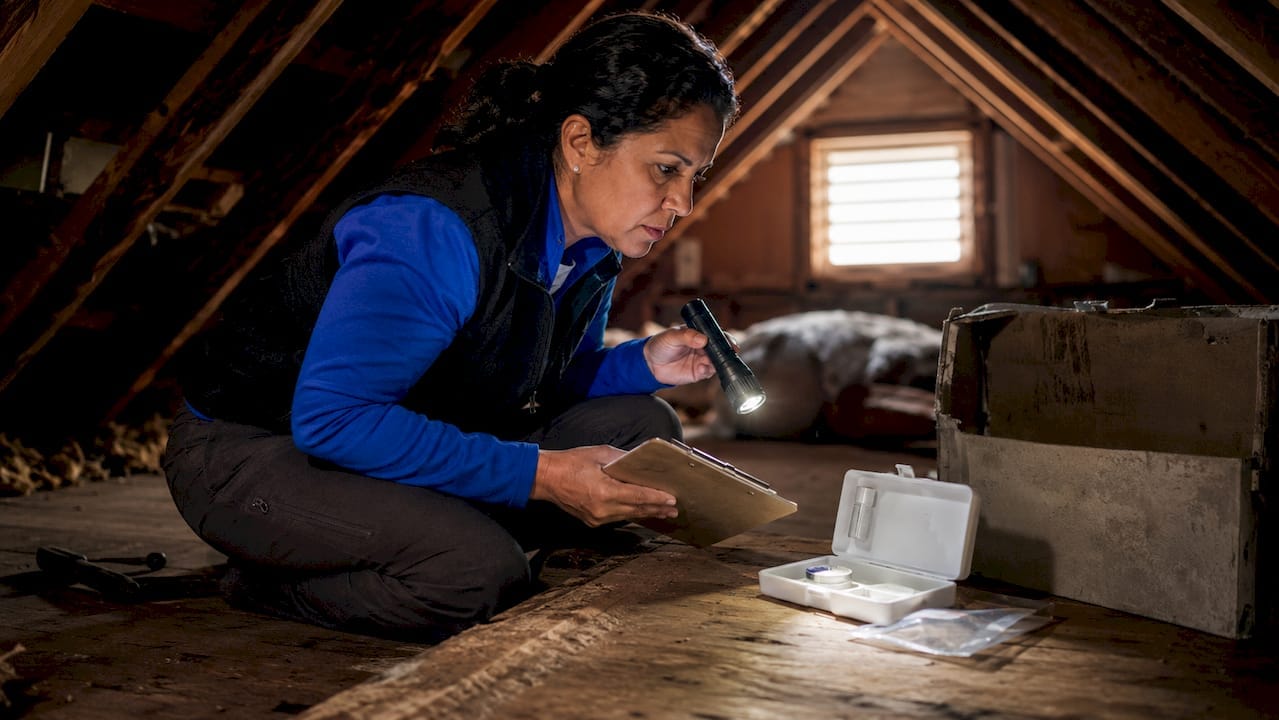
In my experience, the properties with the most serious mold conditions are often the ones where no one thought to test because the problem was not yet visible. A crawl space with standing water and saturated insulation, an attic with blocked soffit vents and condensation on the sheathing, a bathroom exhaust fan venting into the wall cavity instead of outside. These conditions do not require a lab report to act on. They require an inspector who knows where to look and what to measure.
Testing has genuine value in specific situations: post-remediation verification, litigation support, or investigating symptoms without a visible source. But it is not the starting point. The starting point is a thorough inspection by someone who understands how moisture problems lead to mold and knows how to find conditions that are not yet visible. Results from a lab mean very little without that foundation.
— Holly
Get a professional mold evaluation from Upchurchinspection
If you are concerned about mold in your home or a property you are considering buying, the right first step is a professional inspection that assesses moisture conditions, identifies visible growth, and determines whether targeted testing is warranted. Upchurchinspection serves homeowners and buyers throughout the Mid-South with thorough evaluations that go beyond surface-level checklists. Our inspectors are qualified to assess the conditions that drive mold risk and to recommend testing only when it will produce useful, interpretable results. Learn more about our professional mold testing services or review the benefits of regular property inspections to understand how proactive evaluation protects your investment.
FAQ
What is mold testing in a home?
Mold testing is the collection of air or surface samples from a home, followed by laboratory analysis to identify mold species and measure spore concentrations. It is distinct from a mold inspection, which uses visual assessment and moisture readings to locate mold and its source.
Do I need mold testing if I can see mold?
The EPA advises that testing is usually unnecessary when visible mold is already present, because no federal standard exists for acceptable mold levels. The priority is identifying the moisture source and remediating the visible growth.
Can mold test results tell me if my home is safe?
No. There are no health-based indoor air quality standards for mold, so test results cannot confirm that a space is safe or unsafe. Spore counts must be interpreted alongside visual findings, moisture data, and occupant history by a qualified professional.
Are DIY mold test kits reliable?
DIY petri-dish kits detect whether mold spores are present, but mold spores exist in virtually every indoor environment, so they almost always return a positive result. They do not identify the source, quantify the problem, or provide the context needed for remediation decisions.
When does mold testing actually add value?
Testing adds clear value when verifying that remediation was successful, when symptoms or odors are present but no visible mold is found, or when documentation is needed for insurance or legal purposes. In these cases, testing should be conducted by a certified professional using standardized methods.

One Response
This is an incredibly helpful breakdown! I really appreciated the point about how DIY test kits can cause unnecessary panic since mold spores naturally exist everywhere anyway. It makes total sense that finding and fixing the moisture source is the real priority. Thanks for sharing such clear, practical advice!