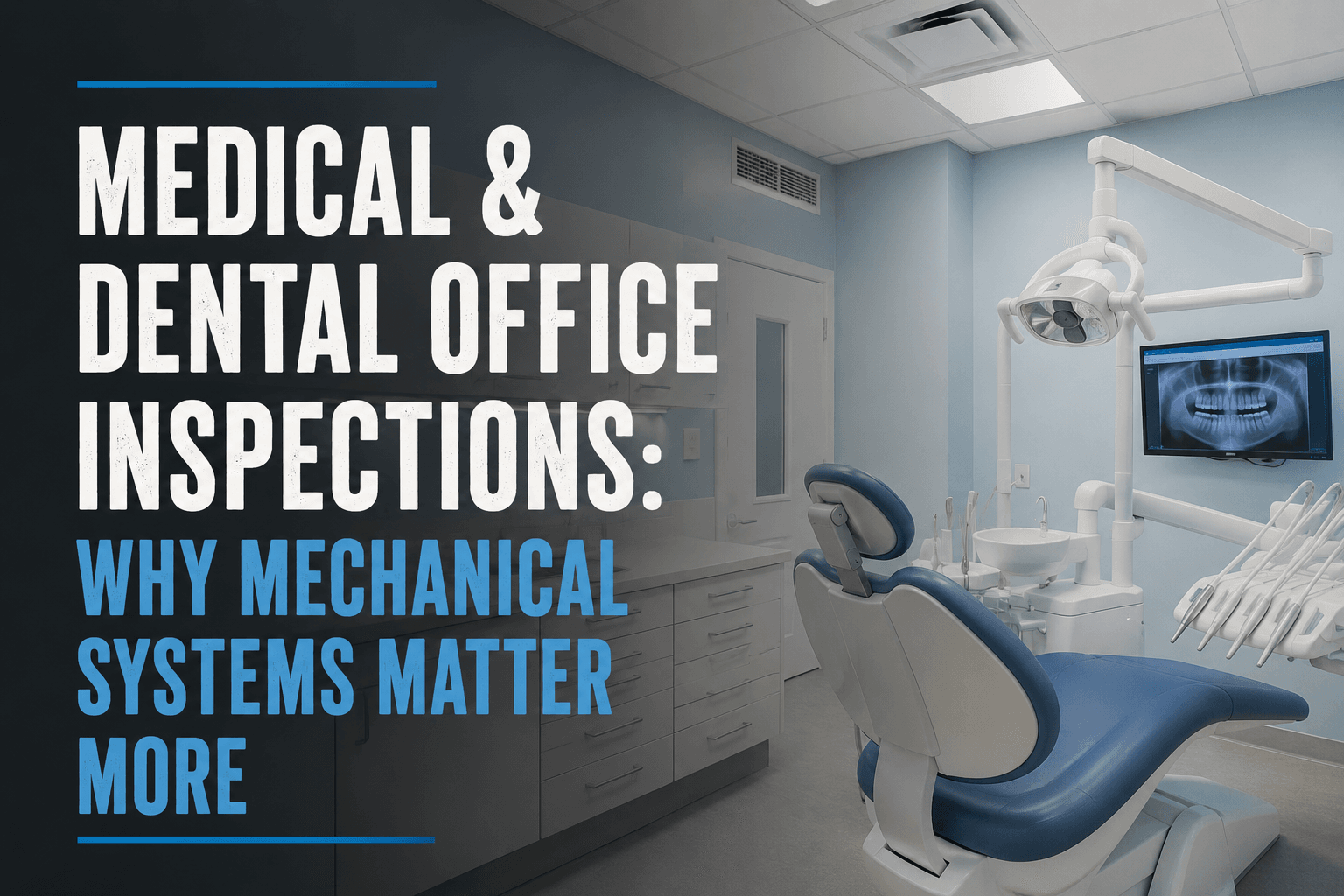
Medical and dental offices are some of the most deceptively complex commercial spaces to inspect. On the surface, they often look clean, modern, and well-maintained. Finishes are typically upgraded, equipment appears orderly, and tenants are highly invested in presentation.
What makes these properties risky isn’t what you see—it’s what the building is being asked to support.
At Upchurch Inspection, medical and dental office inspections focus heavily on mechanical reliability, because in these spaces, mechanical failure isn’t an inconvenience. It’s an operational shutdown.
Mechanical Systems Carry Operational Consequences
In a standard office, HVAC downtime is uncomfortable. In a medical or dental practice, it can cancel procedures, disrupt schedules, and create compliance concerns.
Inspectors evaluate mechanical systems in these properties with a different lens:
- Can the system maintain consistent temperature and humidity?
- Is there redundancy or backup?
- How quickly can failures be addressed?
- Are systems accessible for service without disrupting operations?
Medical spaces often operate on tight margins of tolerance. Mechanical instability shows up quickly—and expensively.
Load Is More Important Than Age
Medical and dental offices place unusually high demands on mechanical systems.
Inspectors pay attention to:
- Extended operating hours
- Heat loads from specialized equipment
- Airflow demands from treatment rooms
- Localized temperature control needs
- Exhaust requirements tied to procedures
A system that looks adequate on paper may be operating at its limits every day. Age matters, but stress history matters more.
Air Quality Is a System Performance Issue, Not a Feature
Indoor air quality in medical settings isn’t just about comfort—it’s about functionality.
Inspectors look for:
- Evidence of uneven airflow
- Improvised exhaust routing
- Inadequate return paths
- Filtration limitations
- Condensation or moisture in ductwork
Problems here often don’t announce themselves as failures. They appear as recurring complaints, equipment sensitivity issues, or operational inefficiencies that get normalized until they become unavoidable.
Mechanical Access Is Often Compromised by Build-Outs
Medical and dental build-outs are frequently dense. Equipment, cabinetry, and partition walls often encroach on mechanical access over time.
Inspectors evaluate:
- Whether air handlers and controls remain serviceable
- If access panels are blocked or removed
- Whether maintenance can occur without disrupting tenant operations
- Signs of deferred service due to poor accessibility
A well-designed system becomes a liability if it can’t be serviced properly.
Plumbing and Mechanical Systems Interact Constantly
Dental and medical offices often push plumbing systems harder than typical commercial spaces. That interaction affects mechanical performance as well.
Inspectors consider:
- Hot water demand and recovery capacity
- Drainage performance under frequent use
- Venting adequacy
- Moisture generation near mechanical components
When plumbing and mechanical systems are mismatched, failures cascade instead of staying isolated.
Redundancy Isn’t a Luxury in Medical Spaces
Many medical facilities require some level of redundancy—even if it wasn’t part of the original design.
Inspectors look for:
- Single points of failure
- Systems without backup or contingency planning
- Evidence of emergency workarounds
- Temporary fixes that became permanent
Buildings without redundancy aren’t necessarily unsuitable, but buyers need to understand what happens when—not if—a system goes down.
Why Medical Tenants Are Less Forgiving
Unlike retail or office tenants, medical and dental tenants can’t easily adapt to building issues.
Canceled procedures, rescheduled patients, and regulatory exposure create pressure that standard commercial tenants don’t experience. Inspectors factor that reality into how mechanical risks are framed.
A condition that’s acceptable in another building type may be operationally unacceptable here.
Mechanical Issues Often Drive Lease Decisions
Medical tenants tend to be sensitive to reliability. Comfort, consistency, and predictability matter more than aesthetics.
Inspectors often see patterns where:
- Mechanical issues contribute to non-renewals
- Temporary fixes lead to repeated service calls
- Equipment is replaced reactively instead of strategically
Understanding those patterns helps buyers anticipate tenant behavior—not just repair costs.
The Practical Reality
Medical and dental office inspections aren’t about spotless finishes or modern equipment. They’re about whether mechanical systems can support uninterrupted, high-demand use without becoming a liability.
In these spaces, mechanical reliability isn’t a background concern—it’s the backbone of the operation.
Inspectors who understand that focus less on appearances and more on performance under pressure. That’s what protects buyers in one of the most demanding commercial property categories there is.