
What the key terms in your inspection report actually mean
Inspection report terminology follows a specific, standardized vocabulary that describes the condition, safety, and maintenance status of home components. The core terms you’ll encounter, defined by professional standards from ASHI and InterNACHI, include Material Defect, Deferred Maintenance, Further Evaluation, Unsafe, and Accessible. Understanding these terms before you read your report is the difference between a well-informed negotiation and a panicked phone call to your agent.
Most buyers skim the summary page and react to the word count. That’s the wrong approach. The language inspectors use is deliberate and carries specific meaning. A “defect” is not the same as a “maintenance item,” and “further evaluation needed” is not the inspector hedging. Each phrase maps to a defined category with real implications for safety, cost, and your negotiating position.
Here is the full glossary of terms you’ll see in a professional home inspection report, organized for quick reference.

Core report terms defined
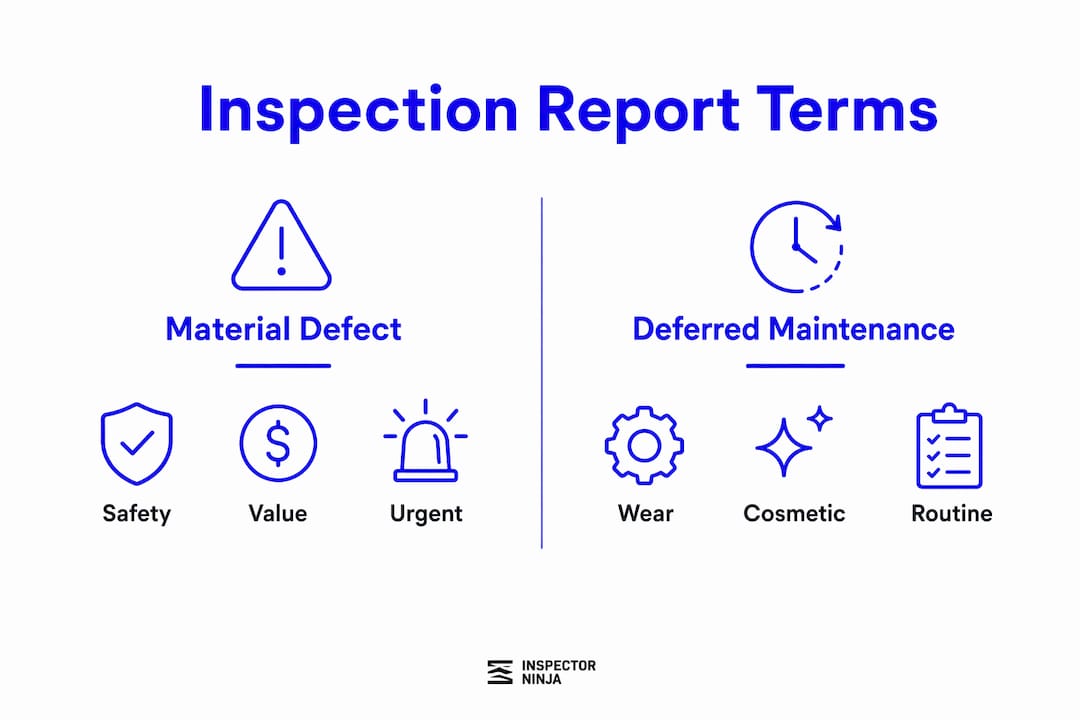
- Material Defect: A condition that significantly affects safety, habitability, or property value. This is the most serious category. Examples include a failing roof structure, active water intrusion into the foundation, or a compromised electrical panel. When you see this label, the item warrants immediate attention and typically drives negotiation.
- Deferred Maintenance: Routine upkeep that has been postponed. Peeling paint, a dirty HVAC filter, caulk failure around windows, or a gutter pulling away from the fascia all fall here. These items are not emergencies, but left unaddressed, they can escalate into material defects. The distinction between deferred maintenance and a material defect is one of the most consequential calls an inspector makes.
- Further Evaluation Needed (or Recommended): The inspector observed something outside the scope of a visual inspection that requires a licensed specialist. This is not a sign of inspector uncertainty. It is a professional boundary that protects you. A crack pattern in a foundation wall, evidence of past moisture in a crawl space, or an aging electrical service panel may all trigger this language.
- Unsafe: A condition that poses a significant risk under normal use. Missing stair railings, open junction boxes, exposed wiring, and improperly vented gas appliances are typical examples. “Unsafe” is not used loosely in a professional report. When it appears, the item must be corrected before occupancy.
- Accessible: Per InterNACHI’s standards, an area or component the inspector can safely approach or enter without dismantling anything or facing danger. Accessible does not mean “easy to reach.” It means the inspector could get there safely and observe it without causing damage.
- Inaccessible: An area the inspector could not safely reach or observe. Common examples include a crawl space with standing water, an attic blocked by stored items, or a wall cavity. Inaccessible areas are excluded from the inspection scope, and the report must state why. This is not a failure on the inspector’s part. It is an honest boundary.
- Significantly Deficient: A system or component that is not performing its intended function or is performing it poorly enough to warrant reporting. The 2026 ASHI Standards of Practice use this term to define what must be reported, alongside “unsafe” and “near the end of its service life.”
- Near the End of Its Service Life (or Normal Useful Life): The component is still functioning but is aging out. A 20-year-old water heater, a roof at year 22 of a 25-year shingle warranty, or an HVAC unit running past its expected lifespan all qualify. This language signals a capital expense on the horizon, not an emergency today.
- Not Functioning Properly: The system or component operates, but not as intended. A bathroom exhaust fan that vents into the attic instead of outside, a window that won’t lock, or a dishwasher that doesn’t drain fully. These may or may not be material defects depending on severity.
- Normal Operating Controls: The inspector operates equipment as a homeowner would, without dismantling or performing invasive testing. Flipping a light switch, running the dishwasher, setting the thermostat. Per ASHI’s 2026 Standards, this preserves property integrity and defines the inspection’s non-invasive scope.
- Readily Observable: Visible to the inspector during a normal walk-through without moving furniture, lifting floor coverings, or opening walls. If a defect is hidden behind a finished wall, it is not readily observable and falls outside the inspection scope.
- Monitor: The inspector noted a condition that does not currently meet the threshold for a defect but should be watched over time. Hairline cracks in drywall, minor efflorescence on a block wall, or a slow-draining sink might carry this label. “Monitor” is not dismissal. It is a flag to check again in six months.
- Authority Having Jurisdiction (AHJ): The organization or individual responsible for enforcing building codes and approving installations in a given area. This could be a municipal building department, fire marshal, or health department. When a report references the AHJ, it means the condition may require a permit, code review, or official approval.
Pro Tip: Read the definitions section of your specific report before you read the findings. Most professional reports include a glossary or legend. The same word can carry slightly different weight depending on whether your inspector follows ASHI, InterNACHI, or a state-specific standard.
How these terms play out in real inspection scenarios
Understanding the vocabulary is step one. Knowing how these terms affect your decisions at the negotiating table is where it actually matters.
Material Defect vs. Deferred Maintenance: the financial stakes
The line between a material defect and deferred maintenance can shift thousands of dollars in a negotiation. A material defect on a roof, for example, is not just a repair item. It can affect insurability, lender approval, and the home’s appraised value. Deferred maintenance on the same roof, say, granule loss on aging shingles without active leaks, is a different conversation entirely. Misreading one for the other is how buyers either overpay or walk away from a perfectly sound property.
We see this pattern regularly in Memphis and West Tennessee. Buyers receive a report with 40 or 50 line items, see the word “defect” a dozen times, and assume the house is falling apart. Often, the majority of those items are deferred maintenance or cosmetic issues. A few may be genuine material defects requiring immediate repair. The difference between the two shapes every conversation that follows.
What “Further Evaluation Needed” actually signals
When an inspector writes “further evaluation needed,” they are drawing a professional boundary, not admitting defeat. A visual inspection cannot determine whether a foundation crack is structural movement or cosmetic settling. It cannot confirm whether a stain on a ceiling is from an active leak or a repair made five years ago. The inspector flags what they see and directs you to the right specialist.
Further evaluation typically means a licensed structural engineer, a licensed electrician, a plumber, or an HVAC technician. These are not optional follow-ups when the language appears in a report. Skipping them is how buyers inherit problems the inspector clearly flagged. The cost of a specialist evaluation is almost always a fraction of the repair cost if the issue is confirmed.
How “Unsafe” affects your timeline
“Unsafe” conditions are not items to negotiate over a 30-day repair window. They need to be corrected before you move in, and in some cases before closing. Open wiring in a panel, a gas line without proper support, a deck with no railing over a significant drop. These are liability and safety issues, not cosmetic ones. Sellers who push back on unsafe items are asking you to accept risk that no inspector, lender, or insurer will overlook.
- Electrical: Exposed wiring, double-tapped breakers in panels not rated for it, missing GFCI protection near water sources.
- Structural: Compromised load-bearing members, unsupported beams, significant foundation movement.
- Gas and mechanical: Improper venting on water heaters or furnaces, flexible gas connectors in confined spaces, cracked heat exchangers.
- Life safety: Missing or non-functional smoke alarms, absent carbon monoxide detectors, blocked egress windows in sleeping areas.
Accessible and Inaccessible: scope limits you need to understand
An inspector cannot report on what they cannot see. That sounds obvious, but buyers sometimes treat an inaccessible area as a clean bill of health. It is not. If the crawl space had standing water and the inspector could not safely enter, that section of the report is blank, not clear. The attic access matters for the same reason. A blocked or unsafe attic hatch means the inspector cannot evaluate insulation, ventilation, or roof structure from the interior.
Pro Tip: Before your inspection, ask the seller to clear access to the attic hatch, crawl space entry, and electrical panel. Inaccessible areas are not the inspector’s problem to solve, but they are your problem to live with if the condition turns out to be serious.
How to read and interpret your home inspection report
A home inspection report is a written document of observations made during a limited visual examination of the property, as of the date and time of the inspection. That last part matters. The report reflects conditions on one specific day, not a warranty about future performance.
Report structure: what you’re actually looking at
Most professional reports follow a consistent structure, though formatting varies by inspector and software platform. You’ll typically see:
- Cover page and property information: Address, inspection date, inspector name and license number, client name, and weather conditions at the time of inspection.
- Scope and limitations: What was and was not inspected, and why. Read this section carefully before you read the findings.
- Summary page: A condensed list of defects, safety items, and items needing further evaluation. The summary page is a roadmap, not a substitute for the full report. It tells you what to look at, not everything you need to know.
- Detailed findings by system: Roof, exterior, structure, electrical, plumbing, HVAC, interior, insulation, and so on. Each section describes what was observed, the condition, and any recommendations.
- Photos: Most modern reports include photographs of every noted condition. If a photo is unclear, ask the inspector to clarify what they were documenting.
Severity levels and rating systems
Inspectors use different rating systems depending on their training, software, and the standards they follow. Common labels include:
- Safety Hazard / Unsafe: Requires immediate correction.
- Major Defect / Material Defect: Significant repair or replacement needed.
- Minor Defect: Functional issue that needs repair but is not urgent.
- Deferred Maintenance: Routine upkeep that has been neglected.
- Monitor: Watch for changes over time.
- Improvement Recommended: Not a defect, but an upgrade worth considering.
- Informational: Observation provided for awareness, no action required.
Not every inspector uses all of these categories, and the labels may differ. What matters is understanding the system your specific report uses. That’s why the definitions section of the report comes first.
Reading beyond the summary
The summary page is where most buyers spend most of their time. That’s a mistake. The summary page identifies items but rarely provides the context needed to understand their severity. A “defect” noted in the summary might be a missing outlet cover plate or a failing main electrical panel. Both appear on the same list. The detailed body of the report tells you which is which, what it looks like, where it is located, and what the inspector recommends.
Pro Tip: Read the detailed findings for every item flagged in the summary. If the inspector’s language seems vague or you’re unsure what a term means, call them directly. A good inspector will walk you through the report on the phone. That conversation is part of what you paid for.
Communicating with your inspector
Most buyers treat the inspection report as a final document. It is not. It is the start of a conversation. If a term is unclear, ask. If a photo does not show what you expected, ask. If you want to understand whether a noted condition is common for homes of that age in this area, ask. Inspectors who follow ASHI or InterNACHI standards are trained to explain their findings in plain language. You are entitled to that explanation.
When you call, be specific. “What did you mean by ‘further evaluation needed’ on the HVAC system?” gets a useful answer. “Is the house okay?” does not. Come with the section number, the item description, and your specific question.
Why terminology varies by region and inspection standard
Not every inspector uses the same words, and that is not an accident. Terminology in home inspection reports reflects a mix of national standards, state regulations, and individual inspector training.
National standards: ASHI and InterNACHI
The two dominant national standards in the United States are ASHI (American Society of Home Inspectors) and InterNACHI (International Association of Certified Home Inspectors). Both publish Standards of Practice that define what must be inspected, what must be reported, and how findings should be described. The 2026 ASHI Standards of Practice, for example, require inspectors to report systems and components that are “not functioning properly, significantly deficient, unsafe, or are near, at, or beyond the end of their normal useful lives.” InterNACHI’s standards use similar language but differ in specific definitions and scope requirements.
An inspector certified by ASHI may use slightly different terminology than one certified by InterNACHI, even when describing the same condition. Both are legitimate. What matters is that your inspector follows a recognized standard and that their report defines the terms they use.
State-level regulations add another layer
Many states regulate home inspectors independently and impose their own reporting requirements on top of national standards. Virginia’s administrative code, for instance, defines a home inspection report as a written evaluation of “readily accessible components” and specifies exactly which systems must be described. Texas has its own inspection report form through the Texas Real Estate Commission (TREC), which uses standardized checkboxes and condition ratings that differ from a narrative-style ASHI report. Wisconsin passed legislation in 2021 requiring inspectors to label defects explicitly as “defects” in the report and to include a summary page with specific components.
The result is that a buyer in Tennessee may receive a report that looks and reads very differently from one a buyer in Virginia or Texas receives, even if the underlying conditions are identical. The terminology may shift, but the core categories, safety issues, material defects, deferred maintenance, and scope limitations, remain consistent across standards.
Regional conditions shape what inspectors emphasize
Beyond formal standards, local climate and construction practices influence which terms appear most often in reports from a given area. In Memphis and West Tennessee, we inspect a lot of older housing stock, pier-and-beam foundations, and homes with crawl spaces that see significant moisture. “Further evaluation needed” appears frequently in crawl space sections because moisture intrusion and wood deterioration are genuinely common here. That same language in a report from a dry climate might be less common and carry different weight.
Brick veneer construction, common throughout the Mid-South, produces specific terminology around mortar joint deterioration, lintel rust, and weep hole blockage that buyers from other regions may not recognize. Knowing your local context helps you calibrate how seriously to take certain terms. A property inspection guide written for a general audience may not reflect the specific conditions and terminology patterns common in your market.
When terminology conflicts with your contract
One area where terminology differences create real problems is the gap between the inspector’s definition of “defect” and the real estate contract’s definition. In Wisconsin, for example, the home inspector’s statutory definition of defect focuses on health, safety, and component lifespan. The standard purchase contract defines defect more broadly to include conditions that “significantly adversely affect value.” A condition can meet the contract’s definition of defect without being labeled a defect in the inspection report, and vice versa. Buyers who assume the two definitions are identical can miss legitimate grounds for negotiation or object to items the inspector never flagged as defects.
Your real estate agent and attorney can help you navigate that gap. The inspector’s job is to describe conditions accurately using their professional standards. Translating those findings into contract language is a separate step.
What a veteran inspector wants you to know about reading these reports
We have been doing this work in Memphis and West Tennessee long enough to know where buyers consistently go wrong with inspection reports. The terminology is not the hard part. The hard part is calibrating your reaction to it.
The report is a snapshot, not a verdict
A home inspection is a non-invasive visual assessment of conditions at one moment in time. It is not a warranty. It does not predict what will fail next year or guarantee that everything not mentioned is in perfect condition. When we write “no defects observed” in a section, we mean no defects were visible during our walk-through on that day. That is an honest and useful statement. It is not a promise.
Buyers who understand this read reports more calmly and make better decisions. The report tells you what we could see. What we could not see is documented in the scope limitations section, and that section deserves as much attention as the findings.
Prioritizing what actually matters
Not every item in a report carries equal weight, and the volume of findings does not indicate the severity of the home’s condition. A report with 60 items, most of them deferred maintenance and informational observations, may describe a sounder home than a report with 15 items that include two material defects and a safety hazard. Read for category, not count.
The items that warrant immediate attention are safety hazards, material defects, and anything flagged for further evaluation by a specialist. Deferred maintenance items are real costs, but they are manageable and often negotiable. “Monitor” items are exactly that: watch them, but do not lose sleep tonight. Buyers who misread severity either overpay for repairs they negotiate aggressively or walk away from homes that were genuinely fine.
Why inspectors phrase things carefully
Inspection reports use measured, specific language for a reason. When we write “evidence of past moisture intrusion was observed at the base of the north foundation wall,” we are telling you exactly what we saw and where. We are not telling you the basement floods every spring. We are not telling you it never will again. We are documenting a condition that warrants attention and, in most cases, further evaluation. That careful phrasing is not evasion. It is accuracy. The language inspectors use reflects the limits of what a visual inspection can confirm.
The same principle applies to “defect” language. When we label something a defect, we are making a professional judgment based on what we observed, the standards we follow, and our field experience. We are not predicting catastrophe. We are identifying a condition that, in our judgment, needs to be addressed. Read it that way, and the report becomes a useful tool rather than a source of anxiety.
Field notes from Memphis and West Tennessee
Older homes in this region, particularly those built before 1980, frequently exhibit conditions that prompt the use of specific terminology in reports. Knob-and-tube wiring, where it still exists, will always be flagged as a safety concern and trigger a recommendation for further evaluation by a licensed electrician. Cast-iron drain lines, common in pre-1970 construction, often appear in reports with language about “evidence of deterioration” or “further evaluation recommended via sewer scope.” That is not alarmist. Cast-iron has a finite service life, and a sewer scope inspection is the only way to confirm the pipe’s actual condition.
Pier-and-beam foundations in this area produce a lot of “monitor” and “further evaluation” language around wood deterioration, moisture, and settling. That does not mean every pier-and-beam home is a problem. It means the crawl space is a place where conditions change, and a thorough inspection is the only way to know what you’re dealing with on the day you buy.
Pro Tip: When a report flags “further evaluation needed” on a structural or mechanical system, get the specialist evaluation before closing, not after. Post-closing discoveries are your problem. Pre-closing discoveries are negotiating points.
Key Takeaways
Inspection report terminology uses standardized categories, Material Defect, Deferred Maintenance, Further Evaluation, and Unsafe, that carry specific meanings tied to safety, cost, and negotiation strategy.
| Point | Details |
|---|---|
| Material Defect vs. Deferred Maintenance | Material Defects affect safety or value and drive negotiation; Deferred Maintenance is postponed upkeep that can escalate if ignored. |
| “Further Evaluation” is a boundary, not a gap | When an inspector writes this, a licensed specialist is required before you can assess the true scope of the condition. |
| The summary page is a roadmap only | Reading only the summary misses the context and severity detail found in the full report body. |
| Accessible and Inaccessible define scope | Inaccessible areas are excluded from findings; a blank section is not a clean bill of health. |
| Terminology varies by standard and state | ASHI, InterNACHI, and state regulations each shape the language inspectors use, so read your report’s definitions section first. |
FAQ
What are the main components of a home inspection report?
A home inspection report covers the structural system, roof, exterior, interior, plumbing, electrical, HVAC, and insulation. It also includes a scope and limitations section, a summary page, and detailed findings with photographs for each system inspected.
What does “material defect” mean in an inspection report?
A material defect is a condition that significantly affects the safety, habitability, or value of the property. It is the most serious category in a report and typically requires immediate repair or specialist evaluation before closing.
What are the four points of a home inspection?
The “four-point inspection” is a specific, limited inspection covering four systems: the roof, electrical, plumbing, and HVAC. It is commonly required by insurance companies for older homes and is narrower in scope than a full home inspection, which also covers structure, interior, and other components.
What does “further evaluation needed” mean in a report?
It means the inspector observed a condition that cannot be fully assessed through a visual inspection alone and recommends review by a licensed specialist such as a structural engineer, electrician, or plumber. It is a professional boundary, not an indication that the inspector missed something.
What’s included in a home inspection report that buyers often overlook?
The scope and limitations section is the most overlooked part of any report. It documents what was not inspected and why, including inaccessible areas. Buyers who skip this section sometimes assume a clean finding where the inspector simply could not observe the condition at all.