
TL;DR:
- Proper parking lot inspections are crucial for liability, property value, and long-term maintenance, especially in regions like the Mid-South with aggressive weather patterns. Regular, documented, zone-specific assessments help identify critical risks such as surface distresses, lighting failures, and ADA compliance issues, enabling timely repairs. Partnering with professional services ensures comprehensive, auditable reports that support safety, compliance, and cost-effective maintenance strategies.
Parking lot inspection considerations rarely get the attention they deserve until a pothole swallows a wheel, a slip-and-fall lawsuit lands on your desk, or an ADA audit reveals costly noncompliance. For homebuyers evaluating commercial properties and property managers responsible for tenant and visitor safety across Tennessee, Arkansas, Mississippi, and Southeast Missouri, the condition of a parking lot is not a cosmetic issue. It directly affects liability exposure, property value, and long-term maintenance budgets. The Mid-South’s freeze-thaw cycles, heavy seasonal rainfall, and extreme summer heat accelerate pavement deterioration faster than many owners realize. This article walks you through what to inspect, how to document it, and where the most critical risks hide.
Table of Contents
- Essential criteria for effective parking lot inspections
- Identifying and measuring common pavement distresses
- Ensuring signage, lighting, and ADA compliance
- Special considerations for parking structures and EV charging stations
- Comparison of key parking lot inspection considerations
- Why common parking lot inspection approaches often miss critical risks in the Mid-South
- How professional parking lot inspections support Mid-South property safety and compliance
- Frequently asked questions
Key Takeaways
| Point | Details |
|---|---|
| Tailored inspection cadence | Adjust parking lot inspection frequency based on traffic, climate, and lot age for optimal safety and longevity. |
| Document with evidence | Measure and photo-document all pavement distress and compliance issues to support effective repairs and audits. |
| Focus on signage and lighting | Conduct regular signage audits and evening lighting inspections to minimize accidents and legal risks. |
| Prioritize by safety risk | Address high-risk pavement and safety hazards immediately while planning medium and lower risks promptly. |
| Professional inspections add value | Specialized inspections ensure thorough compliance, connect findings to repairs, and reduce liability exposure. |
Essential criteria for effective parking lot inspections
A parking lot inspection that actually protects you is one that runs on a defined schedule, documents findings with precision, and maps conditions against compliance standards. Without that structure, inspections become informal walkthroughs that miss exactly the problems that generate liability.
Inspection frequency should be tiered based on traffic volume, lot age, and climate. In practical terms, that means:
- Daily or post-storm visual checks for obvious hazards: new potholes, standing water, trip hazards near curb edges, and any displaced signage
- Monthly reviews covering drainage function, lighting operability, and surface condition in high-traffic lanes
- Quarterly inspections that assess striping visibility, ADA compliance markers, and any developing crack patterns
- Annual full evaluations that include ADA compliance audits, structural assessments for garages, and a complete condition rating of all pavement zones
Defensible inspection checklists must include measured distress quantities, such as crack length in linear feet, and photo documentation tied to specific locations. Guesswork is not documentation. If a maintenance dispute or legal claim arises, you need records that show what was found, when, and what action followed.
Organizing the lot into zones is equally important. Breaking a parking facility into zones tied to specific standards, including IBC (International Building Code), OSHA, ADA, NFPA, and NEC, allows you to run audit-ready inspections with clear evidence logs for each area. Zone categories typically include pavement, lighting, signage, drainage, safety hardware, and fire access lanes.
For Mid-South properties, adjust your inspection rigor based on surface age and seasonal timing. Asphalt laid more than 10 years ago is entering its most vulnerable window. Start preparing for your next inspection cycle by preparing for property inspections with organized documentation and a zone-by-zone approach before the inspector arrives.
Identifying and measuring common pavement distresses
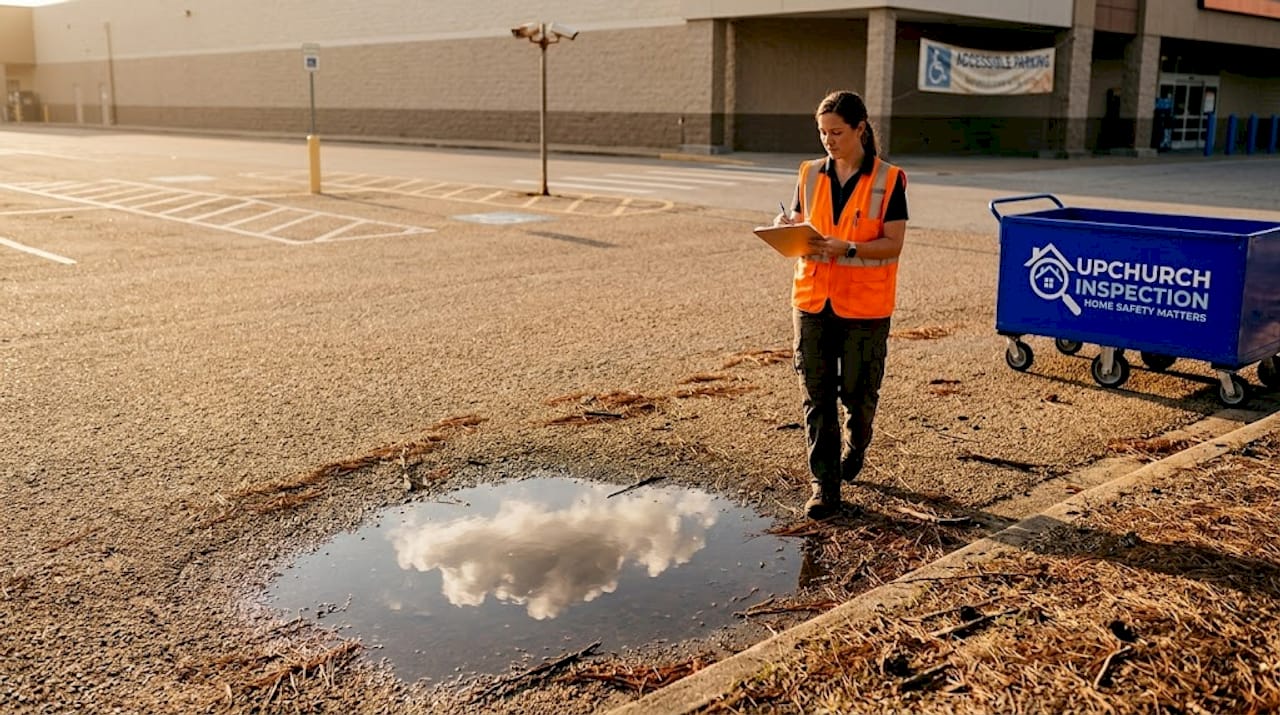
Knowing what you are looking at matters as much as looking. Common parking lot distresses include linear cracks, block cracking, alligator cracking, potholes, rutting, raveling, and standing water. Each signals a different failure mechanism and demands a different repair response.
Here is a practical breakdown:
- Linear cracks (shrinkage or thermal movement): seal early with crack filler before water infiltration begins
- Block cracking (aging binder): typically signals the pavement is drying out and approaching the end of its maintenance window
- Alligator cracking (interconnected fatigue cracks resembling scales): indicates sub-base failure and requires structural repair, not just surface patching
- Potholes: need immediate patching because they create vehicle damage and trip-and-fall liability
- Rutting (wheel-path depressions): usually signals inadequate base thickness or mix design failure
- Raveling (loose aggregate at the surface): indicates binder degradation, often accelerated by UV exposure in Mid-South summers
- Standing water or “birdbaths”: point to drainage grading problems that will accelerate sub-base deterioration if not corrected
| Distress type | Primary cause | Measurement method | Repair urgency |
|---|---|---|---|
| Linear cracks | Shrinkage, thermal cycling | Linear feet | Moderate, seal promptly |
| Alligator cracking | Sub-base failure | Square feet of affected area | High, structural repair needed |
| Potholes | Water infiltration, freeze-thaw | Dimensions, depth | Immediate |
| Standing water | Poor drainage or grading | Area and frequency of occurrence | High, drainage correction required |
| Raveling | UV binder degradation | Square feet | Moderate, treat before worsening |
Measuring and mapping distress locations is what separates an actionable inspection from a vague concern. Record crack length in linear feet and patch areas in square feet. Note GPS coordinates or reference distances from fixed landmarks. These measurements allow contractors to scope repairs accurately and let you track whether conditions are worsening between inspection cycles.
Pro Tip: Review deferred maintenance patterns on similar commercial properties before your inspection. Knowing what fails first in your property type sharpens what you prioritize when walking the lot.
Ensuring signage, lighting, and ADA compliance
Signage and lighting failures are the two fastest paths to parking lot liability claims. They are also the two most commonly under-inspected elements on any property.
Signage audits:
Signage audits should occur twice annually and immediately after any layout change. Faded or damaged signs directly increase accident frequency and ADA risk. During each audit, check:
- Legibility and reflectivity of all directional and regulatory signs
- Proper sign placement relative to stall lines and entry/exit points
- Presence and correct mounting height of ADA accessible parking signs
- Fire lane markings and no-parking zones visible and unobstructed
Lighting inspections:
Over 40% of parking lot criminal claims cite poor lighting, and inadequate lighting must be verified during evening walkthroughs, not just noted on a daytime checklist. Log outages by zone, record fixture numbers, and establish response timelines for repairs. A fixture that appears functional at noon may be completely dead at 9 p.m.
ADA compliance:
ADA requires one accessible space per 25 total spaces, with at least one van-accessible stall, specific access aisle dimensions (60 inches standard, 96 inches for van-accessible), correct surface slopes (no more than 1:48 in any direction), and sign mount heights at a minimum of 60 inches to the bottom of the sign. Measuring these dimensions during your inspection is not optional. Estimating them is a compliance risk.
Replace signs or restripe only after confirming current dimensions meet ADA specs. Repainting over noncompliant stall layouts locks the violation in place and starts an expensive rework cycle.
Pro Tip: Review lighting safety best practices to understand how electrical issues in lighting systems create safety and code risks that go beyond simple bulb replacement.
Special considerations for parking structures and EV charging stations
Surface lots and parking garages are two different inspection categories. Multi-level structures carry structural, waterproofing, and electrical risks that require specialized attention and defined intervals.
Structural inspection schedule for garages:
- Annual visual inspections by qualified personnel covering all decks, columns, ramps, and connections
- Detailed structural condition assessments every five years for structures older than 10 years, conducted by licensed structural engineers
- Targeted inspections after significant weather events, vehicle impact incidents, or visible new cracking
- Post-repair follow-up inspections to confirm remediation was effective
During structural reviews, pay close attention to expansion joints (which fail from thermal cycling), waterproofing membranes on upper decks (where delamination begins before it is visible from below), and post-tensioned cable condition in concrete decks, since cable deterioration is invisible until failure is imminent.
EV charging station inspections:
EV charging stations require monthly inspections covering cable condition, connector integrity, emergency disconnect function, accessibility compliance, and GFCI (ground fault circuit interrupter) operation. Quarterly inspections should add wear assessments and thermal imaging for DC fast chargers, which operate at higher power levels and carry greater risk if connections are degrading.
| Inspection type | Frequency | Key elements | Documentation required |
|---|---|---|---|
| Garage visual survey | Annual | Decks, columns, joints, ramps | Photos, condition rating by zone |
| Structural assessment | Every 5 years (10+ yr structures) | Load capacity, cables, membranes | Licensed engineer report |
| EV charger monthly check | Monthly | Cables, GFCI, disconnects, access | Signed inspection log |
| EV charger quarterly check | Quarterly | Thermal imaging, wear assessment | Thermal scan report |
Pro Tip: Consolidate EV charging inspections with your monthly parking lot walk so both happen on the same schedule. Separate calendar items for related tasks often result in one being skipped. Review our commercial inspection services to understand where structured professional inspections support your internal maintenance program.
Comparison of key parking lot inspection considerations
Understanding what needs immediate action versus what can be scheduled weeks out protects both safety and budget. High-priority items such as potholes and trip hazards require immediate repair, while medium and lower-priority items support planned maintenance cycles.
| Inspection element | Priority level | Frequency | Documentation needed | Regulatory impact |
|---|---|---|---|---|
| Potholes and broken edges | High | After storms and quarterly | Photos, dimensions, repair work order | OSHA, liability |
| Trip hazards at curb edges | High | Monthly | Measured height differential, photo | ADA, OSHA |
| ADA stall compliance | High | Annually and after restriping | Measured dimensions, sign heights | ADA |
| Faded striping | Medium | Quarterly | Photo comparison, square footage | ADA, traffic flow |
| Drainage pooling | Medium | After storms | Photo, pooling area, inlet condition | IBC, sub-base protection |
| Surface oxidation | Lower (preventive) | Annually | Visual rating, area in square feet | Long-term pavement life |
| Early linear cracking | Lower (preventive) | Quarterly | Linear feet, location map | Prevents escalation |
Key priorities for your inspection planning:
- Immediate action: potholes, broken curb edges, non-functioning lighting, any ADA sign missing or downed
- Plan within 30 to 60 days: faded striping, drainage pooling, early-stage block cracking
- Annual preventive: surface sealing, oxidation treatment, full ADA audit, structural condition assessment
Every finding should generate a documented work order through a commercial property inspection guide process that tracks the repair from identification to completion and re-inspection. That closed loop is what transforms inspection findings into actual safety improvements.
Why common parking lot inspection approaches often miss critical risks in the Mid-South
Here is something we see regularly in our work across the Mid-South. Property managers run a solid inspection program on paper, check the boxes, and still get caught off-guard by failures that were entirely predictable. The reason is almost always the same: the inspection program was designed around convenience rather than the actual conditions of the property and the region.
The Mid-South gets significant weather. Thunderstorms dump several inches of rain in hours. Water problems often hide until after storms, tracing back to clogged inlets or grading failures that only become visible when the lot is flooded. If your inspection schedule does not include a post-storm walk within 24 hours of significant rainfall, you are missing the single most revealing condition your lot will show you all year. Sub-base damage builds silently under standing water, and by the time surface cracking appears, the repair cost has multiplied.
Daytime inspections miss lighting outages entirely. We have walked lots that passed their annual inspection only to find that three of five light standards in the back row were completely dark at 8 p.m. Liability does not care that your inspector came at 10 a.m. Evening walkthroughs are not optional. They are the only way to verify what your tenants and customers actually experience.
The ADA restriping issue is one that surprises even experienced property managers. Restriping without ADA verification risks compliance violations and expensive rework cycles. A contractor who lays fresh paint over existing stall lines that were never properly measured is not correcting the problem. They are making the noncompliance look new. Always measure before you paint.
Finally, the maintenance loop rarely closes. Inspections generate findings. Findings go into reports. Reports sit. Repairs never happen or happen without re-inspection. The result is that the same deficiencies appear year after year on the same property, with growing severity and cost. Building property inspection preparation tips into your process, including follow-up inspections after repairs, is what separates a compliance program that works from one that only looks like it works on paper.
Pro Tip: Implement a post-storm inspection protocol specifically for Mid-South conditions. A 15-minute walk within 24 hours of any storm producing more than an inch of rain will catch drainage failures, new surface damage, and displaced signage before they escalate.
How professional parking lot inspections support Mid-South property safety and compliance
Partnering with professional inspection services brings expertise and systems to close the compliance gaps that in-house walkthroughs consistently miss. At Upchurch Inspection, we provide detailed, auditable reports with photo documentation and measurements that connect directly to repair prioritization and work-order tracking. Our specialized commercial inspections cover ADA compliance audits, evening lighting verification, structural assessments for parking garages, and EV charging equipment reviews, all tailored to the specific demands of the Mid-South climate. Our team understands freeze-thaw pavement behavior, regional drainage challenges, and the regulatory standards that apply to your property. Whether you are evaluating a commercial acquisition or managing an existing portfolio, our commercial inspection services and full property inspection services give you the documentation and confidence to act on what you find.
Frequently asked questions
How often should I inspect a Mid-South parking lot for safety and compliance?
Quick visual checks should occur daily or within 24 hours of any significant storm, with deeper quarterly reviews of pavement, signage, and drainage, plus a full annual evaluation that includes ADA compliance. Inspection cadence is tiered by traffic and climate, making the Mid-South’s weather patterns a primary factor in setting your schedule.
What are the key signage and lighting elements to check during inspections?
Verify all signs for legibility, correct placement, and ADA compliance at least twice annually and after any layout change, and always confirm lighting operation during an evening walkthrough. Twice-annual signage audits and evening lighting checks are the minimum standard for reducing accident frequency and liability exposure.
Why is ADA compliance so critical during parking lot restriping?
Restriping is a trigger event that requires you to verify all accessible stall counts, dimensions, aisle widths, and signage heights meet current ADA standards before applying fresh paint. ADA restriping verification prevents compliance violations that lead to costly rework and potential legal exposure.
What special inspections are needed for parking garages and EV charging stations?
Parking garages need annual visual inspections by qualified personnel and a licensed structural assessment every five years for structures older than a decade, while EV chargers require monthly electrical and accessibility checks plus quarterly wear and thermal imaging reviews. Garages and EV stations each carry defined inspection intervals that must be tracked separately from your standard surface lot schedule.
Recommended
- Mixed-Use Property Inspections: Where Residential and Commercial Risks Collide – Upchurch Inspection
- Self-Storage Facility Inspections: Risks Buyers Underestimate – Upchurch Inspection
- Auto Repair & Service Building Inspections: Structural, Environmental, and Liability Risks Buyers Miss – Upchurch Inspection
- Commercial Property Condition Assessments (PCA) in the SEMO Corridor – Upchurch Inspection