
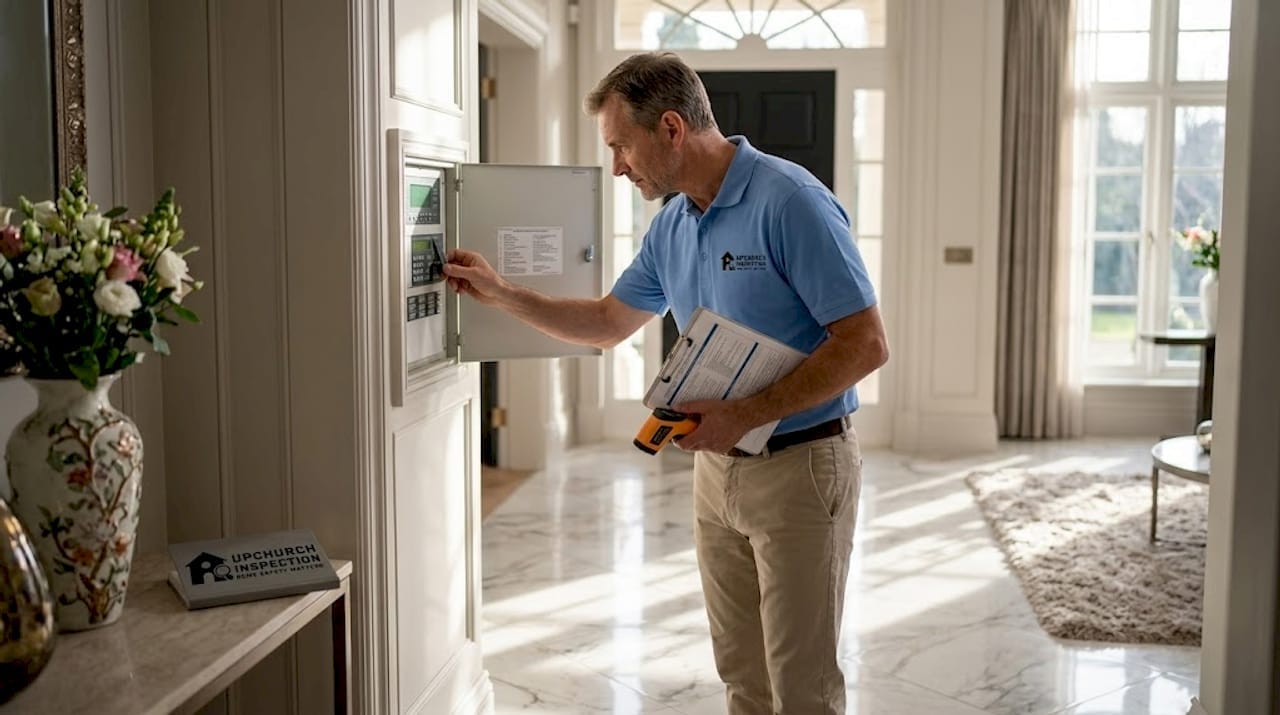
TL;DR:
- Luxury home inspections in the Mid-South demand extensive planning, specialized expertise, and detailed documentation due to their complexity. They often require multiple specialists, longer timeframes, and thorough reports to ensure all high-end systems are properly evaluated. Skipping critical inspections like sewer scopes poses significant financial risks, making qualified inspectors essential for safeguarding your investment.
Buying a luxury home in the Mid-South is a serious financial commitment, and the inspection process should match that weight. Too many buyers assume that because a property looks pristine or carries a premium price tag, it will hold up under scrutiny. That assumption has cost people tens of thousands of dollars in repairs they never saw coming. A luxury home inspection is not a longer version of a standard walkthrough. It is a fundamentally different process involving more systems, more specialists, and significantly more documentation. This guide breaks down exactly what that means for you.
Table of Contents
- How luxury home inspections differ from standard inspections
- The core systems and specialized features: What’s covered (and what isn’t)
- Critical local considerations: Sewer scope and Mid-South risk factors
- Choosing a qualified luxury home inspector: Credentials, scope, and verification
- A perspective you won’t find in typical inspection guides
- How Upchurch Inspection supports luxury buyers and sellers
- Frequently asked questions
Key Takeaways
| Point | Details |
|---|---|
| Luxury equals complexity | Inspections for luxury homes require more time, organization, and specialists than standard homes. |
| Scope clarity is crucial | Buyers and sellers need written scopes and explicit exclusions to avoid risky surprises. |
| Local risks demand local checks | Sewer scope inspections are essential for Mid-South properties with mature trees. |
| Credentials matter | Only certified, experienced inspectors—and their subcontracted specialists—can give a reliable report. |
| Expert coordination pays off | Smart buyers treat luxury inspections as a team effort with clear documentation and specialist input. |
How luxury home inspections differ from standard inspections
A standard home inspection covers the basics: roof, foundation, electrical panels, plumbing, HVAC, and visible structural components. It typically takes two to four hours. A luxury home inspection operates on a different scale entirely.
Luxury home inspections expand beyond a basic checklist, requiring more time on site, often multiple visits, and specialist sub-inspections for complex upscale systems. A 6,000-square-foot estate in Germantown with a home theater, wine cellar, heated pool, elevator, and geothermal HVAC is not a property any single inspector can fully evaluate in one afternoon.
The differences fall into several categories:
- Scope: Luxury properties contain systems and amenities not found in average homes, including smart home automation, whole-house generators, and radiant floor heating.
- Time: Inspections regularly run six or more hours, and some properties require return visits to assess specific systems.
- Specialist involvement: Licensed pool technicians, elevator inspectors, and electricians may be brought in to evaluate features beyond the generalist’s scope.
- Documentation: Reports are more detailed and often include exclusions, hold-harmless agreements when specialists are used, and photographic evidence of hard-to-access areas.
| Feature | Standard inspection | Luxury inspection |
|---|---|---|
| Duration | 2 to 4 hours | 5 to 8+ hours |
| Specialists required | Rarely | Often, multiple |
| Systems covered | Core building systems | Core + advanced amenities |
| Report complexity | Moderate | Extensive with exclusions |
| Sewer scope included | Optional | Strongly recommended |
One often-overlooked area in luxury transactions is the sewer line. Properties with mature landscaping and older lateral lines are especially vulnerable. Understanding what a sewer scope inspection is before your inspection day gives you the context to ask for it proactively. You should also review the situations where a sewer scope is strongly recommended so you know when skipping it is a genuine financial risk.
“The inspection of a luxury or very large home requires careful planning and coordination with specialists. Treating it as a scaled-up version of a basic inspection is a mistake that can leave major systems unexamined.” — ASHI, on luxury home inspections
The bottom line is that luxury properties require a staged, coordinated process. Not a single-inspector checklist visit.
The core systems and specialized features: What’s covered (and what isn’t)
With the framework of how luxury inspections stand apart established, we can break down the actual systems and features in play and why specialists matter so much.
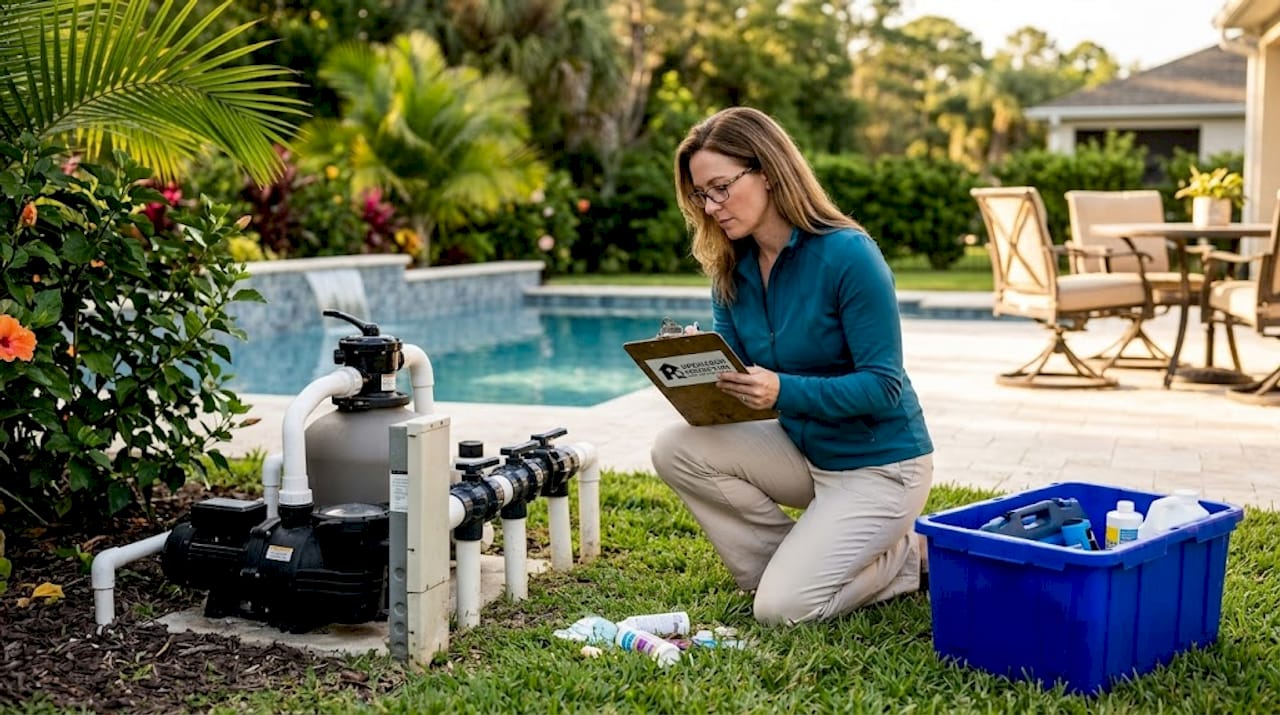
A structured “systems + specialists + documentation” workflow is the practical standard for luxury inspections, rather than a purely visual assessment. Here is how that breaks down in practice.
What the generalist inspector typically covers:
- Structural components: foundation, framing, load-bearing walls
- Roofing systems: materials, flashing, drainage, skylights
- Electrical: service panels, branch circuits, outlets, fixtures
- Plumbing: supply and drain lines, water heaters, fixtures
- HVAC: equipment condition, ductwork, filters, performance
- Insulation and ventilation: attic, crawl space, vapor barriers
- Doors, windows, and exterior components
- Visible moisture conditions and potential mold indicators
What commonly falls outside the generalist’s scope:
- Elevators and residential lifts (require licensed elevator inspectors)
- Advanced or commercial-grade HVAC with building automation systems
- Custom security and surveillance systems
- Inaccessible structural areas (finished crawl spaces, sealed mechanical rooms)
- Private septic systems and well water (require separate testing)
- Wine cellars with specialized climate controls
- Smart home integration platforms and networked systems
Specialized and hidden systems force scope exclusions when they cannot be safely evaluated by a generalist. This is not a failure of the inspection. It is a sign of a professional who knows their limits and coordinates accordingly.
Pro Tip: Before any luxury inspection, ask your inspector for a written pre-inspection agreement that clearly states what is included, what is excluded, and which specialists will be brought in. This protects you from assuming coverage that was never actually provided.
It is also worth understanding what inspectors are not allowed to test or disassemble so your expectations align with the actual inspection process. Knowing these limitations in advance prevents frustration and helps you plan for additional specialist evaluations.
| System category | Generalist covers | Specialist needed |
|---|---|---|
| HVAC | Standard residential units | Commercial-grade or geothermal |
| Pool and spa | Visual check | Licensed pool technician |
| Elevator | Visual only | Licensed elevator inspector |
| Smart systems | Basic operation check | AV/automation specialist |
| Sewer lines | Not visible | Sewer camera operator |
| Structural concerns | Visible components | Structural engineer |
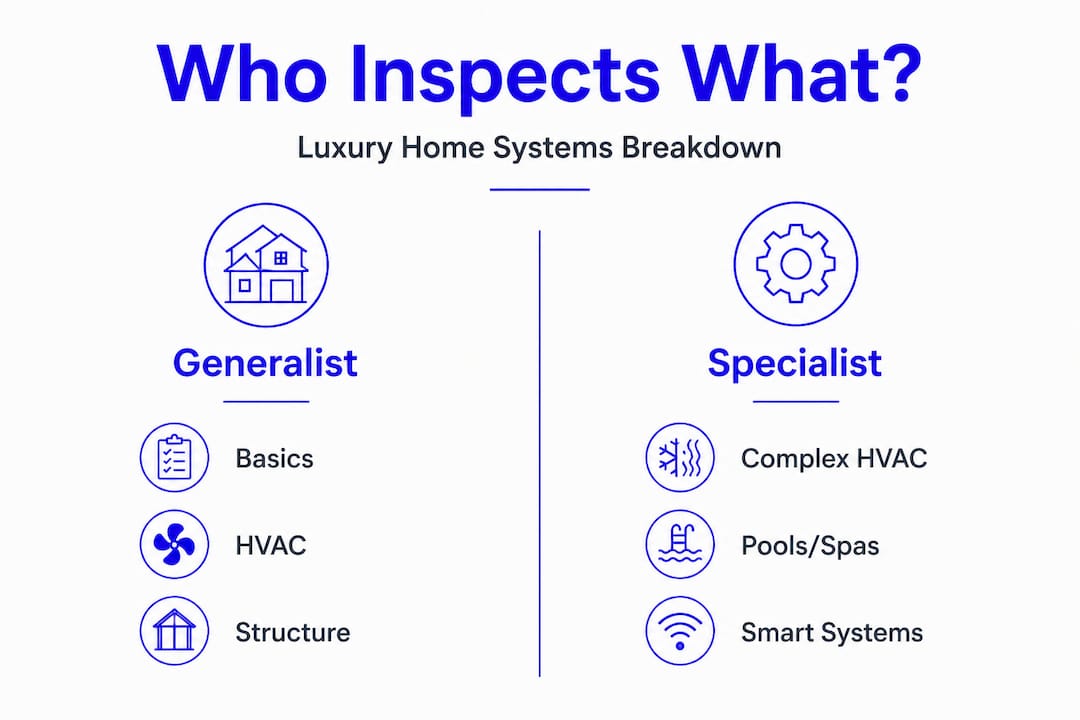
The documentation piece matters enormously. When a specialist is involved, a hold-harmless agreement clarifies who is responsible for what. Without it, liability for missed items becomes a gray area that can turn contentious during negotiations.
Critical local considerations: Sewer scope and Mid-South risk factors
Armed with the essentials of coverage and specialist needs for luxury homes, let us focus on one of the most important and expensive local risks: sewer lines.
The Mid-South is tree country. Properties in East Memphis, Germantown, Collierville, and Olive Branch are often surrounded by mature oaks, sweetgums, and magnolias. These trees are beautiful. They are also aggressive when it comes to underground utilities. Root systems follow moisture, and sewer lines are a reliable moisture source. Over time, roots infiltrate pipe joints, cracks, and aging clay tile sections in ways that no visual exterior inspection can detect.
Memphis-area buyers frequently add sewer camera scopes because mature-tree root intrusion is common enough that skipping it is a calculated risk, not just a precaution. In luxury transactions, where a sewer line replacement can cost $8,000 to $25,000 or more depending on depth and material, that risk is hard to justify.
Here are the specific local risk factors that make a sewer scope nearly essential in the Mid-South:
- Aging infrastructure: Many established luxury neighborhoods in East Memphis and Germantown were built with clay tile sewer lines that are now 40 to 60 years old.
- Dense tree canopies: Root intrusion occurs more frequently in neighborhoods with mature, established landscaping.
- High water tables in low-lying areas: Parts of the region see seasonal soil movement that stresses older sewer laterals.
- Long setback distances: Luxury properties on larger lots often have longer sewer runs to the main, increasing the number of potential failure points.
Pro Tip: Schedule your sewer scope inspection on the same day as the main inspection whenever possible. This reduces your overall coordination burden and ensures the findings are part of a single, integrated report discussion.
Learning more about tree root intrusion risks can help you evaluate whether a specific property’s landscaping warrants heightened concern. Not every mature tree is a problem. But sellers and buyers alike benefit from knowing what is actually happening underground before the transaction closes.
A buyer who skips the sewer scope to save $300 to $500, then discovers significant root intrusion after closing, is facing a repair bill that will feel catastrophic by comparison. We have seen it happen. The cost savings of skipping specialized scopes rarely survive contact with reality.
Choosing a qualified luxury home inspector: Credentials, scope, and verification
Now that you understand what gets inspected and why, your choice of inspector could make or break your luxury purchase. Here is how to ensure you do not get shortchanged or exposed to preventable risks.
Not every licensed inspector is equipped to handle luxury properties. State licensure establishes a baseline. It does not guarantee relevant experience with high-end amenities, large-square-footage properties, or complex building systems. Verifying training, experience, and certification matters because minimum legal requirements vary and credentialing bodies like ASHI and InterNACHI set a higher standard than state law alone requires.
Here is a step-by-step approach to vetting a luxury inspector:
- Confirm professional certification: Ask specifically about ASHI or InterNACHI membership, not just state licensure. These organizations require continuing education, tested knowledge, and adherence to standards of practice.
- Ask directly about luxury property experience: How many properties over 4,000 square feet have they inspected in the past two years? Do they have a roster of preferred specialists for pools, elevators, and smart systems?
- Request a sample luxury inspection report: A well-organized, photo-supported report with clearly marked exclusions is a strong indicator of process quality.
- Get the scope in writing before scheduling: The written agreement should list every system included, every system excluded, and the plan for specialist coordination.
- Clarify the timeline: Understand whether the inspection will require multiple visits and when the final report will be delivered.
Additional factors to verify when choosing your inspector:
- Do they carry errors and omissions (E&O) insurance? This protects you if a missed item results in a costly dispute.
- Are they willing to walk the property with you after the inspection, not just deliver a report?
- Do they communicate clearly about what they physically cannot access and why?
Understanding how to choose a specialized inspection is an important part of preparing for a luxury transaction. The right inspector brings expertise, but they also bring coordination skills. Managing a team of specialists and delivering a coherent, integrated assessment requires experience that goes beyond technical knowledge alone.
Pro Tip: Never rely solely on a referral from a selling agent when selecting your inspector. Agents want smooth transactions. Your inspector’s primary obligation should be to you, not to keeping a deal on track.
A perspective you won’t find in typical inspection guides
Here is something we rarely see discussed openly: many luxury inspection guides circulating online are written by real estate marketing teams, not inspection professionals. They overstate typical costs, cite unrealistic timeframes, and sometimes describe inspection scopes that do not reflect how actual inspections are structured. Some exist primarily to funnel you toward a specific referral network.
Cross-checking marketing-oriented luxury inspection guides against standards from established bodies like ASHI, InterNACHI, and Consumer Reports is the right approach. Then verify the actual inspector’s scope, exclusions, and methods in writing before you commit.
We have also seen buyers place too much weight on reputation alone. A well-reviewed inspector who primarily works standard suburban homes is not automatically qualified to coordinate a luxury inspection involving geothermal HVAC, a residential elevator, and a custom wine cellar with humidity controls. Reputation is a starting point. It is not a substitute for documented luxury property experience.
Every major system that gets excluded or subcontracted should appear in writing before the inspection begins. Not after. Not in the final report. Before. This protects everyone. If something goes wrong with a system that was not in scope, the written agreement becomes the factual record of what was agreed to. Without it, disputes become subjective and expensive.
The professionals we respect most in this field treat each luxury property as a genuinely unique assignment. They do not assume a pool inspection from a Memphis property translates cleanly to an Arkansas estate with a different system configuration. That discipline, treating each property as new, is what separates a reliable luxury inspector from one who is simply billing at a higher rate. You can find additional resources for navigating complex property decisions at Leevli, which offers tools designed to support smooth, informed home-buying experiences.
How Upchurch Inspection supports luxury buyers and sellers
After learning what genuine due diligence looks like for a luxury property, the next step is making sure your inspection team is actually built to deliver it. At Upchurch Inspection, we serve buyers, sellers, and their agents across Tennessee, Arkansas, Mississippi, and Southeast Missouri with inspection services designed to go well beyond a basic walkthrough. Understanding what a home inspection covers is the foundation, and we build from there based on the specific demands of your property.
For luxury transactions, we coordinate specialized inspection services to address the systems and amenities that require more than a generalist assessment. Our regional expertise means we understand the specific risks that come with Mid-South properties, from mature-tree sewer line intrusion to the moisture conditions common in the region. When you are preparing for a luxury transaction, choosing the right specialized inspection starts with a conversation about what your property actually contains and what it requires. Contact Upchurch Inspection to protect your investment before you close.
Frequently asked questions
What does a luxury home inspection typically cover?
It covers all basic building systems, plus specialized amenities like pools, smart technology, and complex HVAC systems, and calls in licensed specialists for features outside the generalist’s scope. Luxury home inspections expand beyond a basic checklist to address the greater complexity and multiple systems unique to high-end properties.
Why should Mid-South buyers always get a sewer scope?
Mature tree root intrusion is a documented and common problem in established Mid-South neighborhoods, making a sewer camera inspection one of the most cost-effective protections available. Memphis-area buyers frequently add sewer scopes precisely because the risk of root intrusion in clay tile lines is too significant to ignore.
Can one inspector do everything in a luxury home?
No. Most luxury properties require a generalist inspector to coordinate with licensed specialists for advanced or complex systems. A structured “systems + specialists + documentation” approach is the practical standard rather than a single-inspector walkthrough.
What credentials should a luxury home inspector have?
Look for ASHI or InterNACHI certification, documented experience with luxury properties, and a written scope covering inclusions, exclusions, and specialist coordination before any work begins. Verifying training and certification matters because state minimum requirements alone do not guarantee the expertise a luxury property demands.
Why do luxury inspections cost more?
They require significantly more time, often involve teams of licensed specialists, and document complex systems not present in standard homes. Luxury inspections expand well beyond a basic checklist, with multiple return visits and specialist involvement driving both the cost and the value of the process.