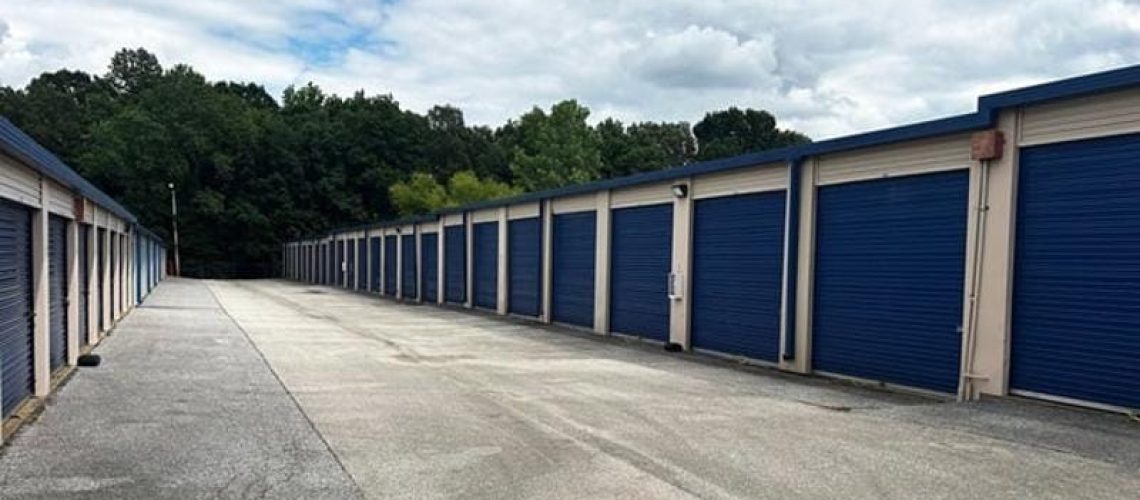
Unlike offices or apartments, storage units don’t have conditioned interiors buffering the building from the environment. Exterior walls, roofs, doors, and slabs are exposed to daily thermal swings, moisture cycles, and wind loads without much moderation.
Inspectors pay close attention to:
- Roof performance under repeated expansion and contraction
- Wall panel movement and fastener integrity
- Door alignment and track condition
- Evidence of wind-driven moisture intrusion
- Drainage patterns around slab edges
Small construction shortcuts that would be hidden inside a conditioned space tend to show up faster—and more aggressively—in storage facilities.
Drainage Is the Quiet Profit Killer
Drainage issues are one of the most underestimated risks in self-storage ownership.
Inspectors often see facilities where:
- Site grading directs water toward buildings
- Downspouts discharge near unit thresholds
- Pavement slopes trap water along door lines
- Slabs lack adequate elevation above grade
- Repairs focus on sealing rather than water control
Water intrusion doesn’t just damage the building—it damages stored contents. That creates customer claims, reputational harm, and insurance complications that aren’t reflected in inspection checklists alone.
A storage facility that “mostly stays dry” is still a liability if water behavior hasn’t been controlled intentionally.
Roll-Up Doors Reveal Structural and Drainage Problems Early
Roll-up doors are one of the most informative components in a self-storage inspection.
Inspectors look for:
- Uneven door gaps
- Binding or misalignment
- Corrosion at lower tracks
- Evidence of repeated door replacement
- Improvised weather sealing
Doors don’t fail randomly. They reflect slab movement, drainage problems, wind exposure, and structural shifts. When multiple doors show similar issues, inspectors treat it as a building-level signal—not a hardware problem.
Slab and Foundation Behavior Matters More Than Buyers Expect
Many self-storage facilities are built with large slab-on-grade footprints and minimal foundation complexity. That doesn’t make them immune to movement—it makes movement more consequential.
Inspectors pay close attention to:
- Slab cracking patterns
- Joint separation and displacement
- Evidence of differential settlement
- Repairs made to address symptoms rather than causes
- Door alignment issues tied to slab behavior
Slab movement that would be tolerated in a warehouse becomes an operational problem in storage facilities because it directly affects door operation and water intrusion.
Roof Systems Carry Repetition Risk
Self-storage roofs often span long runs with repeated details. When something goes wrong, it usually goes wrong everywhere.
Inspectors look for:
- Consistency of flashing methods
- Drainage performance across roof sections
- Ponding patterns after rainfall
- Patchwork repairs that repeat across the facility
- Evidence of long-term moisture exposure beneath membranes
A single weak roof detail, repeated dozens of times, becomes a predictable capital expense—not a surprise.
Ventilation Is Often an Afterthought—Until It Isn’t
Many self-storage units rely on passive ventilation. When it’s inadequate, moisture becomes trapped inside units, even without active leaks.
Inspectors evaluate:
- Vent placement and coverage
- Evidence of condensation inside units
- Rusting at interior metal components
- Odors indicating long-term moisture
- Modifications made to “improve airflow” after complaints
Moisture-related tenant issues are often blamed on customer behavior, but inspectors know when building design contributes to the problem.
Electrical Systems Are Simple—but Often Marginal
Electrical systems in self-storage facilities are usually minimal by design. Lighting, gate controls, security systems, and office spaces all draw from systems that may not have been designed with expansion in mind.
Inspectors assess:
- Electrical service sizing relative to site demands
- Panel condition and capacity
- Outdoor-rated equipment exposure
- Security system integration
- Evidence of incremental additions without upgrades
As facilities modernize—adding cameras, access control, climate-controlled units—electrical limitations become expensive quickly.
Climate-Controlled Units Change the Risk Profile Entirely
Facilities with climate-controlled storage introduce a completely different level of exposure.
Inspectors treat these buildings more like light industrial or warehouse properties, focusing on:
- HVAC system sizing and distribution
- Humidity control capability
- Envelope tightness
- Condensation management
- Mechanical access and serviceability
Buyers often underestimate how unforgiving climate-controlled storage can be when systems drift out of balance.
Why Self-Storage Buyers Get Caught Off Guard
Self-storage properties often operate well enough to mask developing issues. Units rent. Doors open. Complaints are manageable.
Buyers are often surprised after closing by:
- Repeated door failures
- Moisture-related customer claims
- Accelerated roof repairs
- Drainage-driven maintenance cycles
- Insurance scrutiny after water events
Inspections aim to identify the trajectory of these issues, not just their current state.
How Experienced Buyers Use Self-Storage Inspection Findings
Seasoned buyers don’t expect self-storage facilities to be perfect. They expect them to be predictable.
They want to understand:
- Where water wants to go
- How the slab is behaving
- Which components fail repeatedly
- What repairs are inevitable versus optional
- How design choices affect long-term maintenance
Inspection findings become a tool for pricing, planning, and prioritization—not a reason to walk away blindly.
The Practical Reality
Self-storage facilities look simple because they are simple. That simplicity leaves less room for error.
Drainage, slabs, roofs, and doors do the heavy lifting. When they’re right, these properties perform quietly. When they’re wrong, problems repeat relentlessly.
Inspectors who understand self-storage don’t just look for damage. They look for patterns, because in these buildings, patterns are where profit and risk intersect.