TL;DR:
- Many investors underestimate the importance of thorough apartment inspections, risking hidden deferred maintenance and system failures. Proper evaluations follow specific frameworks like PCA and NSPIRE, tailored to transaction type and regulatory requirements, ensuring accurate assessment of conditions and costs. Implementing comprehensive inspections with careful documentation helps protect long-term asset value and avoids costly surprises post-closing.
Many investors assume a quick walk-through of the lobby, a glance at a few units, and a conversation with the property manager is enough to understand the true condition of an apartment building. That assumption is costly. About 24% of damage instances in apartment buildings tie directly to inadequate maintenance or management, meaning the biggest risks often hide inside walls, mechanical rooms, and shared systems that no surface-level tour will reveal. In this guide, we break down why thorough inspections matter, how the leading frameworks work, what a professional inspection process looks like in the Mid-South, and the pitfalls that trip up even experienced buyers and property managers.
Table of Contents
- Why apartment building inspections matter
- Key inspection frameworks: PCA and NSPIRE explained
- How a thorough inspection is performed: Process, areas, and timing
- Common pitfalls and how to avoid them
- What most investors and property managers get wrong about multifamily inspections
- Protect your investment with professional apartment inspections
- Frequently asked questions
Key Takeaways
| Point | Details |
|---|---|
| Inspection frameworks matter | Using the right standard (PCA/ASTM E2018 or NSPIRE) is crucial for both compliance and investment planning. |
| Maintenance drives risk | Poor management and regular maintenance failures are a leading cause of costly building damage. |
| Coverage must be thorough | Complete inspections require checking every unit, common area, and shared system. |
| Documentation prevents surprises | Inspectors must clearly log inaccessible areas and never estimate unseen conditions. |
| Local timing varies | Inspection frequency and repair timelines can differ by region and regulatory program. |
Why apartment building inspections matter
Buying or managing an apartment building without a thorough inspection is like purchasing a vehicle without looking under the hood. You might get lucky, but the odds are not in your favor. Deferred maintenance, which refers to repairs and replacements that have been postponed over time, compounds quickly in multi-unit buildings because shared systems serve many tenants simultaneously. One failing boiler or deteriorating roof deck is not just a maintenance expense. It is a liability.
From a legal and financial standpoint, missed deficiencies translate directly into negotiation leverage lost, repair costs absorbed post-closing, and sometimes code violation penalties. Lenders financing multi-family acquisitions routinely require formal inspection reports before underwriting the deal. In many regulated markets, local housing authorities mandate periodic inspections to protect tenants. Inspection frequency and method vary according to local program requirements and property characteristics, so what applies to a 12-unit building in Memphis may differ substantially from a 50-unit complex in Jonesboro, Arkansas.
The stakes scale with unit count. A single-family home inspection and a 20-unit apartment inspection share some procedural overlap, but the scope, cost implications, and documentation standards are entirely different. Our apartment and multi-family inspections follow a framework that accounts for unit count, shared system complexity, and local regulatory requirements.
Key risks that proper inspections address:
- Structural deterioration in foundations, load-bearing walls, and stairwells serving all tenants
- HVAC system failures that can cascade in a domino effect across multiple units sharing a single chiller or boiler
- Plumbing deficiencies in shared supply and drain lines that affect every tenant simultaneously
- Electrical hazards in common panels, shared metering configurations, and breaker capacity
- Moisture intrusion and mold concealed behind walls, under flooring, or in crawl spaces
- Roof and exterior envelope issues that accelerate interior damage if left unaddressed
“Experienced investors know that the line item they cannot see on a property tour is the one most likely to appear on a post-closing repair invoice. A formal inspection framework closes that gap.”
For investors reviewing larger portfolios, our multifamily inspection guide provides a broader overview of how to evaluate properties across different asset classes and condition levels.
Key inspection frameworks: PCA and NSPIRE explained
Two frameworks dominate apartment building inspections in the United States: the Property Condition Assessment (PCA) under ASTM E2018 and HUD’s National Standards for Physical Inspection of Real Estate, known as NSPIRE. Understanding when and why each applies is not a minor technical detail. Choosing the wrong one for your transaction can mean receiving a report that answers the wrong questions entirely.
A property condition assessment (PCA) guided by ASTM E2018 is the standard for commercial real estate transactions. PCA under ASTM E2018 delivers a visual evaluation of primary building systems, identifies deficiencies, and estimates the remaining useful life of major components. That last point matters enormously for capital planning. If a roof has three to five years of service life remaining, a buyer can factor that replacement cost into their acquisition price or negotiate a credit. PCAs are lender-driven in most cases, required before a commercial mortgage closes.
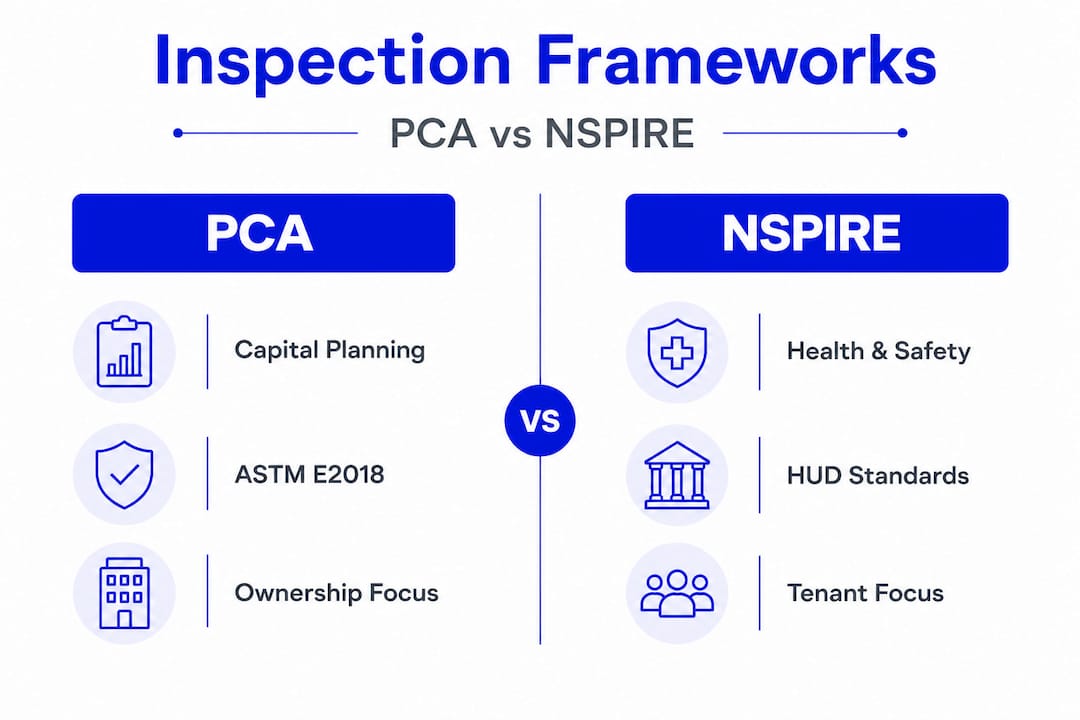
NSPIRE takes a different approach. Rather than capital planning, it focuses on health, safety, and habitability for HUD-assisted housing. NSPIRE organizes inspections into three distinct areas: Unit (individual living spaces), Inside (common areas, corridors, and mechanical rooms), and Outside (building exterior and site). Each area receives a scored evaluation tied to specific health and safety benchmarks. Non-compliance triggers mandatory remediation timelines and can affect a property’s ability to remain in a HUD-assisted program.
PCA vs. NSPIRE at a glance
| Feature | PCA (ASTM E2018) | NSPIRE (HUD) |
|---|---|---|
| Primary purpose | Capital planning and transaction due diligence | Health, safety, and regulatory compliance |
| Who requires it | Lenders, buyers, commercial investors | HUD, housing authorities, assisted housing programs |
| Scoring system | Deficiency list with cost estimates | Numerical scoring with pass/fail thresholds |
| Inspection areas | All major systems, site, and structure | Unit, Inside (common), Outside (site/building) |
| Typical timing | Pre-purchase or refinance | Annual, biennial, or triggered by complaints |
| Best for | Acquisition decisions, loan underwriting | Regulatory compliance, tenant safety assurance |
Selecting the right framework for apartment building inspections depends on your role in the transaction and your end goal.
- Identify your transaction type. Is this a conventional acquisition, a HUD-financed deal, or an assisted housing program renewal?
- Clarify lender requirements. Most commercial lenders require a PCA. HUD-assisted programs require NSPIRE.
- Assess your planning horizon. If you need cost projections for the next 10 to 20 years, a PCA delivers that. NSPIRE does not.
- Confirm local regulatory requirements. Some Mid-South municipalities layer their own inspection requirements on top of federal standards.
Pro Tip: If you are acquiring a property currently enrolled in a HUD voucher program, request both the most recent NSPIRE score and an independent PCA. The NSPIRE report tells you whether the building is currently compliant; the PCA tells you what it will cost to keep it operational over the next decade.
How a thorough inspection is performed: Process, areas, and timing
Knowing which framework applies is one thing. Understanding how a professional executes the inspection is what separates a reliable report from one that leaves gaps. The methodology matters as much as the framework, particularly in multi-unit properties where access limitations are common and documentation standards must be rigorous.

Best practice methodology moves from exterior and common areas first, then proceeds unit-by-unit, and finishes with shared mechanical systems, with clear documentation of any inaccessible areas throughout. This sequence is logical because exterior and envelope conditions give context to interior moisture findings, and shared system conditions help explain unit-level symptoms.
Inspection process step by step
- Pre-inspection review. Collect available documentation: prior inspection reports, maintenance logs, utility records, and any open permits or code violations.
- Exterior and site evaluation. Assess roofing, facade, drainage, parking, walkways, and any outbuildings. Note grade slope, foundation visible exposure, and signs of water infiltration.
- Common area inspection. Walk all corridors, stairwells, lobbies, laundry rooms, storage areas, and mechanical rooms. Inspect fire suppression systems, lighting, and shared electrical panels.
- Unit-by-unit inspection. Evaluate each accessible unit for plumbing, HVAC supply and return, electrical outlets and fixtures, windows and doors, flooring, ceiling, and signs of moisture or pest activity.
- Shared mechanical systems. Assess boilers, central HVAC equipment, water heaters, main electrical service, elevator equipment if present, and any shared utility infrastructure.
- Documentation of inaccessible areas. Record all units or systems that could not be inspected, with clear notes on the reason and the recommended follow-up.
- Report preparation. Compile findings with photographs, deficiency descriptions, severity ratings, and estimated costs or remaining service life per PCA standards.
Timing and regulatory context for Mid-South properties
| Property type | Typical inspection cycle | Regulatory driver |
|---|---|---|
| HUD-assisted units (Tennessee) | Annual or biennial | THDA NSPIRE guidance |
| Conventional multi-family (purchase) | At acquisition + periodic | Lender PCA requirement |
| Market-rate apartments (local program) | Varies by municipality | Local housing code |
| Section 8 voucher properties | Biennial minimum | HUD/THDA program rules |
THDA’s NSPIRE guidance requires landlords to complete required repairs within 30 days of a failed inspection finding, a timeline that can create real pressure on property owners who discover deferred maintenance late in a transaction cycle.
Pro Tip: Schedule your inspection at least 60 to 90 days before a planned acquisition closing. This buffer gives you time to negotiate repair credits, request further specialist evaluations, and avoid being forced into accepting an as-is condition under deadline pressure.
For investors using inspections to guide real estate investment decisions, timing and documentation quality are often the difference between a well-structured deal and an expensive surprise.
Common pitfalls and how to avoid them
Even well-intentioned inspections fail investors when they rely on incomplete processes or faulty assumptions. The pitfalls below show up repeatedly in multi-family inspections across the Mid-South, and each one carries a financial consequence.
Blind spots from inaccessible units. Failing to inspect every unit or assess shared systems can create blind spots that undermine the entire inspection value. In occupied buildings, tenants may refuse entry or be unavailable. When this happens, many buyers mistakenly assume the uninspected units are probably fine. That assumption has no basis. One water-damaged unit or failed HVAC air handler in a unit that was never inspected can become a five-figure repair post-closing.
Underestimating shared system risk. Individual unit conditions are visible. Shared mechanical and plumbing systems often are not. A central boiler that serves 30 units near the end of its service life represents a replacement cost that no individual unit inspection will reveal. Shared electrical panels, particularly in older buildings with original wiring, pose both fire risk and code compliance exposure.
Documentation lapses. A report that lists findings without photographs, severity ratings, or cost estimates is not a usable document for negotiation or capital planning. Detailed documentation also matters for long-term asset management, especially if the property changes hands again in the future.
Sampling pitfalls. Investor-grade inspections sometimes inspect only a percentage of units to save time and cost. This approach has real risks. Responsible inspectors explicitly discourage estimating the condition of uninspected or inaccessible units. Sampling can miss isolated but severe deficiencies in units that were skipped.
Key practices to ensure nothing slips through:
- Require advance notice to tenants so access is maximized on inspection day
- Include all mechanical rooms, attic spaces, and crawl spaces in the inspection scope
- Insist on a written log of every inaccessible area and the reason for each
- Follow up with specialist inspections for HVAC, plumbing, or electrical if primary findings raise concerns
Understanding the full scope of deferred maintenance in multi-units and the common inspection findings that inspectors identify most frequently can sharpen your expectations before you walk into any multi-family property.
What most investors and property managers get wrong about multifamily inspections
Here is the uncomfortable truth we see play out repeatedly in the Mid-South market: most investors and property managers approach the inspection as a checkbox. They treat it as something the lender requires or the transaction demands, rather than as the most valuable due diligence tool available to them. That mindset leads to scoped-down reports, rushed timelines, and missed findings that cost far more to address after closing than before it.
The “one size fits all” fallacy is probably the most damaging mistake. A duplex and a 40-unit apartment complex are legally and functionally different asset classes, yet we regularly see investors apply the same inspection expectations to both. Buildings with 2 to 4 units are frequently treated as residential properties and inspected accordingly. Buildings with 5 or more units require PCA-based due diligence, a completely different scope and standard. Applying a residential home inspection to a 10-unit building means you are receiving a report designed for the wrong asset. You will miss capital planning data, remaining useful life estimates, and shared system assessments that are critical to pricing the deal correctly.
The second major mistake is conflating lender-driven inspections with owner-driven due diligence. Mixing up HUD compliance-driven inspections with transactional PCAs creates mismatched expectations that cause real problems during negotiations. A lender requires a PCA to protect their loan collateral. An investor should use an inspection to protect their capital and long-term returns. Those two goals overlap but are not identical. The PCA answers the lender’s question. The investor needs to ask additional questions: What does this property need in years three, five, and ten? What is the true cost of the deferred maintenance the current owner has let accumulate?
Documentation and follow-through separate professional-grade investors from everyone else. A report that sits in a transaction folder and is never actioned is wasted money. The best operators we work with treat inspection findings as living documents, updating capital reserve schedules as systems age and prioritizing proactive replacements over reactive emergency repairs.
Understanding the overlap and distinction between residential vs commercial inspections is foundational for any investor operating across property types in the Mid-South. The investors who get this right consistently outperform those who treat inspection as a formality rather than a strategic tool.
Protect your investment with professional apartment inspections
At Upchurch Inspection, we provide apartment building inspection services built around the real stakes of multi-family investment in the Mid-South. Our certified inspectors go well beyond surface-level walkthroughs, delivering detailed reports that cover structural components, electrical, plumbing, HVAC, moisture conditions, and shared system assessments. Whether you are a buyer seeking acquisition-ready due diligence, a property manager responding to a regulatory inspection cycle, or a seller preparing your building for market, our commercial inspection solutions and property condition assessments deliver the documented clarity you need to make confident decisions. Reach out today to schedule your inspection or discuss the right scope for your property.
Frequently asked questions
What is typically included in an apartment building inspection?
A thorough inspection covers all major systems, including roofing, HVAC, plumbing, and electrical, along with all accessible units, shared common areas, and the building exterior, following PCA and NSPIRE frameworks that require assessment of both individual spaces and Unit, Inside, and Outside areas.
How often should apartment buildings be inspected in the Mid-South?
Annual or biennial inspections are standard for HUD-assisted and regulated properties, with THDA-regulated landlords having 30 days to complete required repairs, though lender requirements and local housing codes may call for additional evaluations depending on the property and transaction type.
What if parts of my building are inaccessible during an inspection?
All inaccessible areas must be clearly documented in the inspection report; responsible inspectors never estimate the condition of uninspected spaces, and a follow-up inspection should be scheduled to close those gaps before closing or lease renewal.
Does the inspection standard change for smaller buildings like duplexes?
Yes, buildings with 2 to 4 units are often treated as residential, while properties with 5 or more units typically require a PCA under ASTM E2018, which provides the capital planning data and system-level assessments that residential inspection reports do not include.