
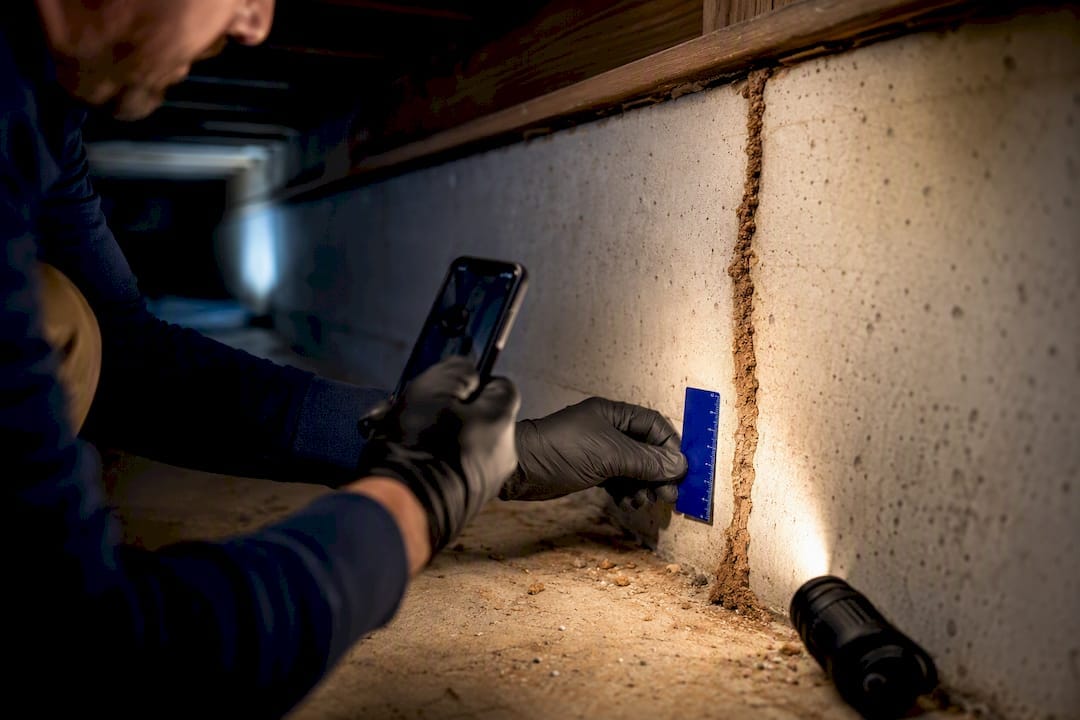
Finding termite mud tubes in your house almost always means subterranean termites have been actively foraging on your property, and that your structure’s termite protection has a gap somewhere. Don’t reach for a can of insecticide or panic. Photograph the tubes, note their location and size, and get a licensed inspection scheduled. Termites work slowly, so you typically have weeks or months to gather bids and make an informed decision rather than a rushed one.
TL;DR:
- Most mud tubes are signs of potential entry points, but many are abandoned or seasonal, so active inspection and testing are essential before treatment.
- Quickly assess whether tubes are active by probing and monitoring for repairs over a few days, and document all findings with photos and measurements.
- Professional inspection and treatment are crucial, especially when tubes reappear after initial treatment, or wood feels soft or hollow upon probing.
- Preventive measures include maintaining clearance from soil or mulch, fixing leaks, and removing wood debris, since moisture and easy paths sustain termite activity.
- Seasonal conditions such as heavy rain or drought influence termite activity and visibility, but colonies work year-round underground regardless of weather.
Table of Contents
- What Are Termite Mud Tubes and Why Do Termites Build Them?
- What Do Mud Tubes Look Like, and What Are the Common Types?
- Where Should You Inspect for Mud Tubes?
- How Do You Tell If a Mud Tube Is Still Active?
- What Should You Do After Finding Mud Tubes?
- How Do You Prevent Mud Tubes From Forming Again?
- When Should You Call a Licensed Inspector or Pest Control Professional?
- What Seasonal or Environmental Conditions Increase Termite Activity?
- What Other Signs of Termite Damage Should You Watch For Beyond Mud Tubes?
- What Misconceptions Do People Have About Termite Mud Tubes?
- What Health and Safety Issues Come With Termites and Their Treatment?
- What Do Inspectors Actually Look for When They Report on Termite Findings?
- How Can Upchurch Inspection Help With Termite and WDI Concerns?
- Where Can You Find More Authoritative Guidance on Termites?
- Sources
What Are Termite Mud Tubes and Why Do Termites Build Them?
Mud tubes are a survival tool. Subterranean termites build these narrow, hardened pathways out of soil, digested wood particles, fecal matter, and salivary secretions, essentially cementing a protective shell around themselves as they travel between the soil and a food source. That shell isn’t decorative. Termites are soft-bodied and moisture-dependent, and exposure to dry air can kill them within three to six hours. A mud tube keeps humidity locked in and hides the termites from ants, birds, and other predators while they feed.
That’s why finding one matters more than its size suggests. A tube on your foundation means termites found a route from the ground into (or toward) wood they wanted to eat, and that route bridges whatever protective barrier was supposed to stop them.
Here’s what typically makes up a mud tube:
- Soil particles, often the same color as the surrounding dirt
- Partially digested wood fibers
- Fecal matter, which helps bind the structure
- Salivary secretions that harden the mixture into a shell
Inspectors treat every tube as evidence of a breach until proven otherwise. Even an old, abandoned tube tells you where termites once found (or tried to find) a way in.
What Do Mud Tubes Look Like, and What Are the Common Types?
Most mud tubes measure about 1/4 to 1/2 inch wide, roughly the width of a pencil to a finger, and look like veins of dried mud running vertically up a foundation wall, support pier, or piece of wood. The surface is usually gritty and brittle when dry, though it stays slightly pliable when the colony is actively maintaining it.
Statistic to remember: Swarm tubes, the exit structures termites build during mating season, can extend 4 to 8 inches above the ground, far larger than the typical foraging tube.
Not every tube means the same thing. There are four recognized types:
- Exploratory tubes are thin, fragile, and often abandoned. Termites build these while randomly searching for cellulose, since they can’t detect wood from a distance.
- Working (utility) tubes are thicker, more durable, and actively maintained. These carry termites back and forth between soil and a feeding site.
- Drop or suspended tubes hang from an upper structure back down toward the soil and tend to run lighter in color.
- Swarm tubes appear seasonally as exit points for winged reproductives leaving to start new colonies.
The practical difference matters. An exploratory tube might be an abandoned dead end. A working tube almost always signals an active, ongoing threat.
Where Should You Inspect for Mud Tubes?
Termites gravitate toward the path of least resistance, which usually means anywhere wood, soil, and moisture sit close together. Work through these locations in order:
- Exterior foundation walls, especially where soil, mulch, or landscaping beds touch the siding or brick veneer.
- Sill plates, the wood framing that sits directly on top of the foundation.
- Support piers and columns in crawlspaces, where wood meets concrete or soil.
- Plumbing penetrations, since leaking pipes create the moisture termites are drawn to.
- Crawlspaces and basements, particularly dark, damp corners with limited airflow.
- Interior walls near flooring, where a tube may have traveled up through a wall void.
Extension entomologists recommend maintaining 4 to 6 inches of clearance between soil or mulch and your siding or foundation cover. Stack mulch against the house and you’ve hidden the exact spot where a tube would otherwise be visible.
Bring a flashlight and wear gloves before crawling into any tight space. Avoid disturbing wiring, HVAC ductwork, or ventilation equipment while you look. If a crawlspace feels unsafe to access, that’s a job for a professional, not a reason to skip the inspection entirely.
How Do You Tell If a Mud Tube Is Still Active?
Not every tube you find is currently in use. Termites build exploratory tubes constantly, and plenty end up abandoned. Two simple field checks help you tell the difference.
- Break a one-inch section of the tube with a screwdriver or your fingernail, then leave it alone and check back over the next few days. Termites typically repair an active tube within that window because they can’t survive long outside the humid shell. No repair after several days suggests the tube is abandoned, though it’s still worth mentioning to an inspector.
- Probe nearby wood with a screwdriver. Push gently into sill plates, trim, or structural framing near the tube. Wood that feels soft, gives way easily, or sounds hollow when tapped often signals internal damage, even if the surface paint looks fine.
Pro Tip: Photograph every tube before you break it, with a coin or tape measure in the frame for scale, and note the date. That timestamped record gives your inspector a baseline to compare against and can shorten the time it takes to confirm activity.
Write down any nearby moisture sources you notice, leaking spigots, downspouts dumping near the foundation, standing water in a crawlspace. That detail often explains why termites found that exact spot appealing in the first place.
What Should You Do After Finding Mud Tubes?
Your first move isn’t a spray bottle. It’s documentation. Photograph the tube’s location, measure its size, and mark where it sits relative to doors, windows, or corners so you (or an inspector) can find it again easily.
Avoid scattering over-the-counter insecticide around the area. Random chemical treatment rarely reaches the colony, and it can actually interfere with a licensed technician’s ability to properly diagnose and treat the infestation later, since disturbed termites sometimes relocate or seal off the tube instead of continuing normal activity.
A few short-term steps are reasonable to handle yourself:
- Remove wood-to-soil contact where you find it, stacked firewood, wood trim buried in dirt, old fence posts touching the house.
- Pull mulch back from the foundation if it’s piled higher than a few inches.
- Fix obvious leaks and redirect downspouts away from the foundation to cut down on the moisture that draws termites in.
Pro Tip: When you request bids, ask each company specifically whether they’re proposing a liquid termiticide barrier or a bait station system, what the warranty covers, how often they’ll monitor afterward, and whether that monitoring is included in the price or billed separately. Get at least two or three quotes before signing anything. Because termite damage develops over months or years rather than overnight, there’s rarely a legitimate reason to sign a contract under pressure during a single sales visit.
How Do You Prevent Mud Tubes From Forming Again?
Prevention comes down to controlling the two things termites need most: an easy path and steady moisture.
- Keep 4 to 6 inches of clearance between soil, mulch, or landscaping and your siding or foundation.
- Never stack firewood, lumber, or wood debris directly against the house or buried in the ground.
- Address roof drainage, gutter overflow, and plumbing leaks quickly, since chronic moisture is what makes a foundation attractive in the first place.
- In crawlspaces, improve ventilation or consider encapsulation if standing moisture is a recurring issue, a topic covered in more depth in our look at common crawlspace problems in West Tennessee homes.
- If you already have a termite contract, keep it active. Liquid soil barriers and bait stations both require ongoing professional monitoring to stay effective, and lapsed coverage is one of the more common reasons tubes reappear.
Annual termite inspections, even outside a real estate transaction, catch new tubes long before they turn into structural repair bills.
When Should You Call a Licensed Inspector or Pest Control Professional?
Certain findings should move you straight to a licensed call, not a wait-and-see approach.
- You find a working tube with visible mud, especially one that shows repair activity after your break test.
- Probed wood feels soft, crumbly, or hollow, regardless of whether you can see a tube nearby.
- Tubes keep reappearing despite an existing termite treatment contract, which suggests the barrier has a gap or the bait system needs adjustment.
A licensed inspector will locate the breach point, assess the extent of activity, and recommend a specific treatment approach with a warranty and monitoring schedule attached. Licensed application matters here: treatment requires professional-grade equipment and chemicals that aren’t available over the counter, and DIY attempts often fail to reach the actual colony or accidentally complicate the diagnosis for the professional who treats it next.
What Seasonal or Environmental Conditions Increase Termite Activity?
Termite activity isn’t constant throughout the year. Warm, humid conditions in spring and early summer typically trigger swarming season, when winged reproductives leave established colonies to start new ones nearby, often producing those distinctive swarm tubes extending several inches above the soil line. That’s usually the moment homeowners first notice a problem, even though the colony causing it may have been established for a year or more already.
Heavy rainfall and rising groundwater push subterranean colonies to build tubes higher up foundation walls, since saturated soil near the surface sometimes forces termites to seek moisture and shelter elsewhere. Drought conditions have the opposite effect in one sense: termites retreat deeper underground and rely more heavily on tubes to reach the humidity they can’t find near the surface, which occasionally makes activity harder to spot until a swarm reveals it.
Across the Mid-South, this pattern shows up reliably. Humid summers combined with older housing stock, especially homes with crawlspaces or slab foundations built before more recent grading and drainage standards, create ideal conditions for sustained termite pressure in Tennessee, Arkansas, Mississippi, and Southeast Missouri. Properties near creeks, in low-lying areas, or with poor lot grading tend to see repeat activity even after treatment, simply because the underlying moisture problem never got addressed.
None of this means termites only show up seasonally. Colonies work year-round underground. What changes seasonally is how visible their activity becomes above ground.
What Other Signs of Termite Damage Should You Watch For Beyond Mud Tubes?
Mud tubes are the most recognizable signal, but termites leave other clues that are easy to miss if you’re only looking for tubes.
Wood damage from termites usually follows the grain, creating long, hollow galleries packed with mud and debris, distinct from the powdery frass left by wood-boring beetles or the smooth tunnels of carpenter ants. Tap suspect wood with the handle of a screwdriver: a dull, hollow sound instead of a solid thud often means the interior has been eaten away while the surface stays intact.
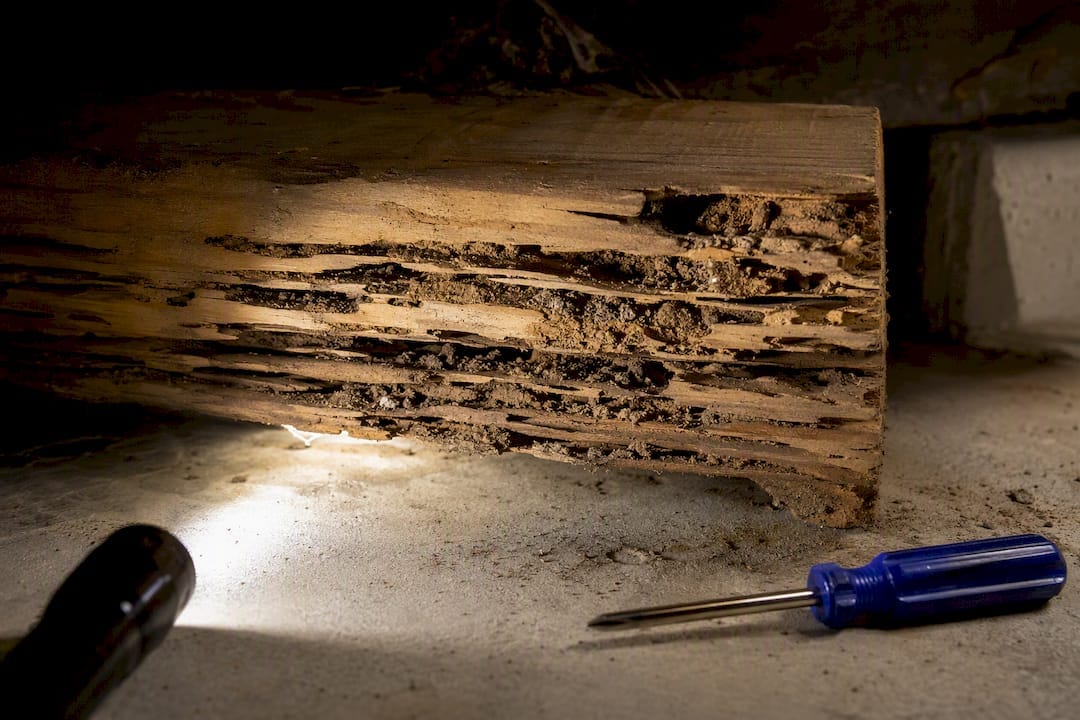
Blistering or bubbling paint on wood trim can indicate moisture trapped beneath the surface, sometimes from termite activity chewing through the wood underneath and sometimes from unrelated water intrusion. Either cause warrants a closer look. Sagging floors, sticking doors and windows that used to close fine, and small pinholes in drywall or baseboards (sometimes from discarded termite wings after a swarm) round out the list of secondary indicators worth documenting.
None of these signs alone confirms an active infestation. Taken together with a mud tube, though, they build a much stronger case for calling in a professional rather than waiting to see what happens next.
What Misconceptions Do People Have About Termite Mud Tubes?
The biggest misconception is that every mud tube means an active, ongoing infestation happening right now. That’s not accurate. Because subterranean termites forage randomly rather than sensing wood from a distance, they build plenty of exploratory tubes that get abandoned once they don’t lead anywhere useful. A tube with no repair activity after your break test may simply be a dead end.
Another common mistake is assuming treated wood or a poured concrete foundation makes a structure immune. Termites can’t eat concrete, but mud tubes routinely run right across it, bridging the gap between soil and untreated wood above. Visual clearance around the foundation is a far more reliable early warning than trusting the building materials themselves to stop them.
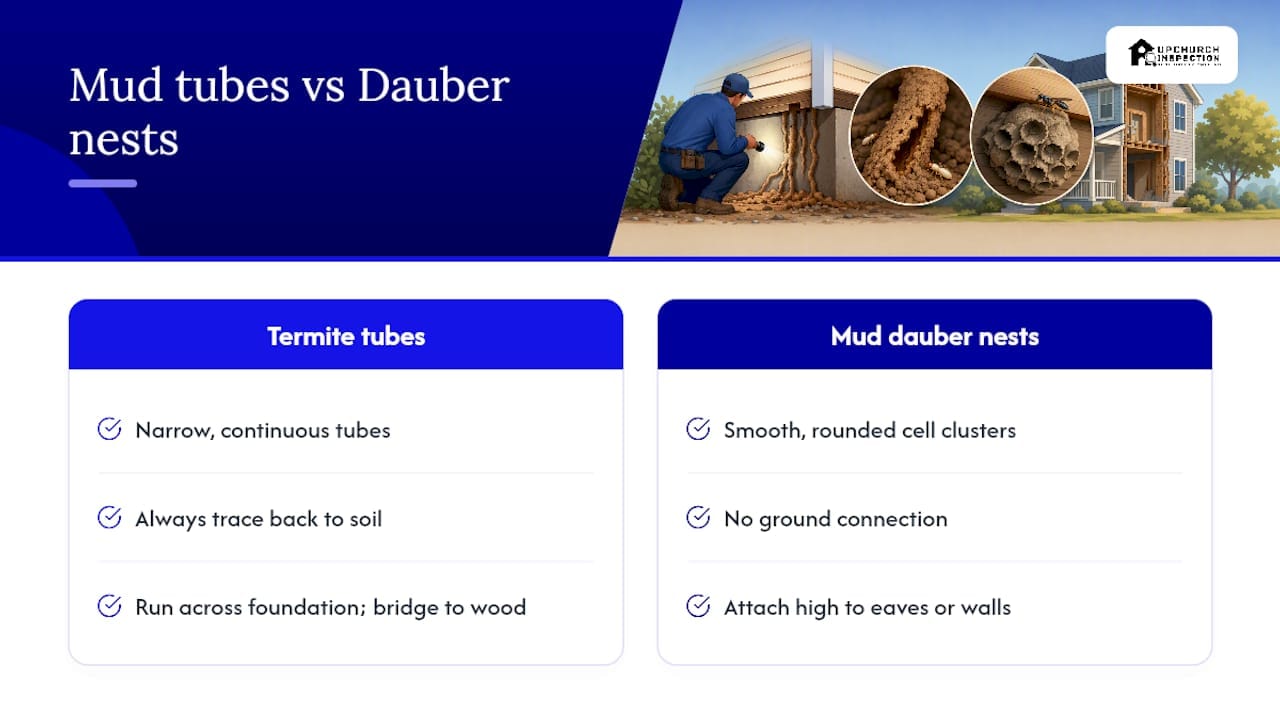
People also frequently confuse termite mud tubes with the nests built by mud daubers, a type of solitary wasp. Mud dauber nests are typically smooth, rounded clusters of individual cells attached to eaves, ceilings, or wall surfaces, and they don’t connect to the ground. Termite tubes are narrow, continuous, and always trace back to a soil source. If what you’re looking at is up high on a wall with no visible connection to the ground, it’s worth confirming it isn’t simply a dauber nest before assuming the worst.
Finally, some homeowners believe a single store-bought termite bait stake solves the problem permanently. Professional bait systems require regular monitoring and replenishment on a schedule, and a handful of retail stakes placed without follow-up rarely match that level of ongoing protection.
What Health and Safety Issues Come With Termites and Their Treatment?
Termites themselves pose minimal direct health risk to people. They don’t bite, sting, or spread disease the way some other pests do. The real safety concerns show up in two other places: structural risk and treatment chemicals.
Severe, long-term termite damage can weaken support beams, floor joists, and load-bearing walls to the point where structural integrity becomes a genuine safety issue, particularly in crawlspace-heavy construction common across the Mid-South. That’s a slow-developing risk, not an emergency, but it’s a real one worth taking seriously once damage is confirmed.
Treatment chemicals require caution too. Liquid termiticides and bait station formulations are regulated pesticides, and licensed application exists specifically because improper handling, mixing, or placement can create exposure risks for household members, pets, and groundwater. This is the core reason DIY chemical treatment is discouraged beyond just effectiveness. Follow any product label instructions exactly if you use consumer-grade products for minor prevention steps, and keep children and pets away from treated areas until a licensed technician confirms it’s safe to resume normal use.
What Do Inspectors Actually Look for When They Report on Termite Findings?
When we walk a crawlspace or foundation, we’re documenting more than just “found a tube.” We photograph location, measure severity, probe adjacent wood, and note whether the tube connects to an active moisture source, since regional crawlspace conditions across the Mid-South so often explain why termites picked that exact spot.
For buyers and property managers, that detail translates directly into repair risk and CapEx planning. A report that separates “likely cosmetic repair” from “structural concern requiring engineering review” gives you a far more useful basis for negotiating price or budgeting reserves than a simple pass or fail.
— Holly
How Can Upchurch Inspection Help With Termite and WDI Concerns?
If you found tubes and want a straight answer instead of a sales pitch, a dedicated termite inspection (WDI) gives you documented evidence of activity, severity, and likely origin, the same kind of detail you’d want in hand before comparing treatment bids. Our inspection services cover properties across Tennessee, Arkansas, Mississippi, and Southeast Missouri, and reports are designed to separate cosmetic concerns from genuine structural risk to help you understand repair costs.
For commercial owners and investors, that same documentation feeds directly into deferred maintenance and CapEx planning, giving you a defensible number instead of a rough estimate. If you’re weighing a purchase or already managing a property with a moisture or crawlspace history, our guide on specialized inspections for commercial real estate walks through when a standard inspection isn’t enough. Ready to get a tube identified properly? Schedule a termite inspection with our team before you commit to any treatment contract.
Where Can You Find More Authoritative Guidance on Termites?
- FSA-7061, University of Arkansas Cooperative Extension Service, tube identification, composition, and measurements.
- University of Missouri Extension, Urban Entomology, inspection clearance guidance and building-material bridging.
- University of Maryland Extension, termite resource page, timeline expectations and bid-gathering advice.
- Mississippi State University Extension, termite control overview, licensed treatment standards and DIY limitations.