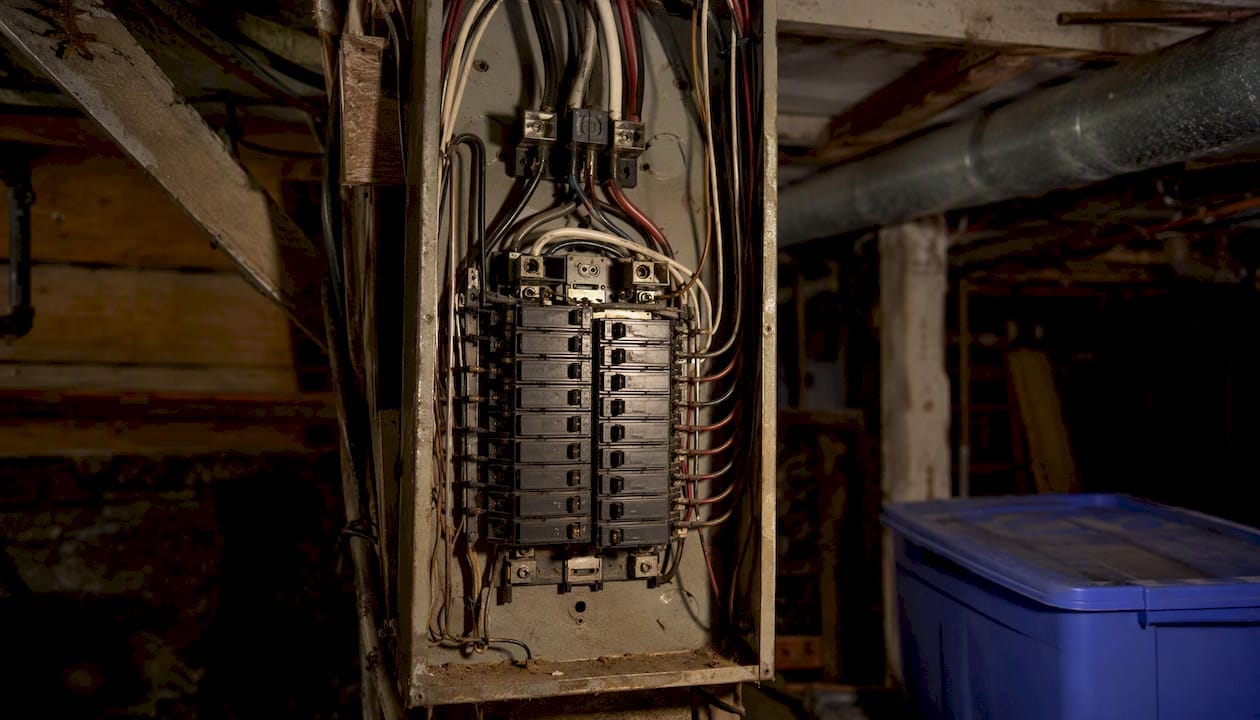
Federal Pacific (FPE) Stab-Lok panels are a documented safety concern. If you find one in a home you own, are buying, or manage, the right move is to schedule a qualified electrical inspection without delay. These panels were installed in millions of American homes between the 1950s and 1980s. The core problem is straightforward: the breakers can fail to trip when a circuit is overloaded, which means the protection you assume is there may not function when you need it most.
Here is what to do immediately:
- Identify the panel. Look for the “Federal Pacific,” “FP,” or “Stab-Lok” label on the panel cover or breaker faces.
- Limit heavy loads. Until the panel is evaluated, avoid running multiple high-draw appliances simultaneously on suspect circuits.
- Schedule an electrical inspection. A licensed electrician or qualified inspector should perform a visual assessment and targeted trip testing.
- Contact your insurer. Many carriers restrict new policies or require replacement before they will bind coverage. Get that conversation started early.
- Get a replacement quote in writing. Do this before closing on a purchase, not after.
Pro Tip: If you are under contract on a home with an FPE panel, request a written replacement estimate from a licensed electrician before your inspection contingency expires. That number gives you real negotiating leverage and prevents a surprise cost after closing.
Key Takeaways
Federal Pacific Stab-Lok panels carry a documented failure risk that no regulatory closure has resolved, and replacement is the right call in most cases where original breakers remain in service.
| Point | Details |
|---|---|
| FPE panels are a real risk | Stab-Lok breakers have documented no-trip failure rates under overload test conditions; the CPSC closure was not a safety finding. |
| Identification is visual | Look for “Federal Pacific,” “Stab-Lok,” or “FP” markings on the panel cover and breaker faces; common in homes built 1950–1985. |
| Full replacement beats breaker swaps | The bus contact design is the root issue; swapping individual breakers does not resolve the underlying failure mechanism. |
| Insurance and lenders will ask | Many carriers restrict coverage or require replacement; confirm underwriting requirements before closing on any affected property. |
| Upchurchinspection documents the condition | Our inspections include thermal imaging, severity ratings, and written corrective action recommendations across the Mid-South region. |
Table of Contents
- What are Federal Pacific panels, and why are they controversial?
- How to identify an FPE Stab-Lok panel in your home
- What testing and investigations actually show about FPE breaker failures
- How inspectors evaluate Federal Pacific panels
- Should you replace an FPE panel, and what are your options?
- What to expect during a panel replacement project
- How FPE panels affect buying, selling, and insurance
- An inspector’s honest take on FPE panels in the field
- Upchurchinspection provides the electrical inspection clarity you need before you commit
- Sources
What are Federal Pacific panels, and why are they controversial?
Federal Pacific Electric Company was one of the largest electrical equipment manufacturers in the United States during the mid-20th century. The company supplied Stab-Lok breaker panels to residential and commercial construction projects across the country from roughly the 1950s through the early 1980s, a period of rapid suburban expansion when millions of homes were wired quickly and at scale.
The controversy centers on the Stab-Lok breaker design and whether those breakers reliably trip under overload conditions. The regulatory timeline matters here:
- Late 1970s to early 1980s: Concerns about FPE breaker performance surfaced through consumer complaints and testing reports. The Consumer Product Safety Commission opened a formal investigation.
- 1983: The CPSC closed its investigation without concluding that FPE Stab-Lok breakers presented a definitive serious risk to consumers. Staff documented test failures against UL calibration requirements but said available data did not establish a serious risk. The CPSC advised general circuit safety precautions rather than issuing a recall.
- Corporate changes: Federal Pacific was acquired by Reliance Electric, and the company eventually ceased panel production. With no surviving manufacturer and no recall order, no federal mandate to remove these panels ever followed. Millions of units remained in service.
- Later legal record: State court proceedings and class action filings addressed FPE test and certification issues in subsequent decades, adding to the documented record without producing a federal removal requirement.
The practical result: these panels are still in homes today, they carry no recall sticker, and their presence is not automatically a code violation. That does not mean they are safe.
How to identify an FPE Stab-Lok panel in your home
Identification is straightforward once you know what to look for. You do not need to open the panel or touch any wiring. A visual check of the exterior is enough to make a preliminary determination.
On the panel cover and deadfront:
- The brand name “Federal Pacific” or “Federal Pioneer” printed on the cover or inside the door
- An “FP” logo mark, often in a distinctive font
- The word “Stab-Lok” stamped or printed on the breaker faces or panel interior label
- Manufacture date labels typically showing production between the 1950s and early 1980s
Breaker appearance:
- Narrow, single-pole breakers with a distinctive toggle profile
- Some models feature a thin red indicator strip visible on the breaker face when tripped
- Double-pole breakers (240V circuits) with a paired toggle design that may feel loose or inconsistent when manually operated
Where these panels appear:
Homes built or substantially rewired between 1950 and 1985 are the primary population. In the Mid-South, that covers a large share of the existing housing stock in Memphis, West Tennessee, and surrounding areas. They appear in basements, garages, utility rooms, and exterior alcoves.
What a non-expert should do:
- Photograph the panel label, breaker faces, and any visible wiring at the top of the panel
- Note any visible charring, discoloration, or burn marks around breaker slots
- Do not open the deadfront cover or touch bus bars if you are not qualified
- Record whether any breakers appear to be aftermarket replacements (different brand markings, mismatched sizes)
- Flag loose neutral wires or any wiring that appears to have been modified
For a broader understanding of panel components before your inspection, this guide to your home’s electrical panel covers the basics clearly.
What testing and investigations actually show about FPE breaker failures
The evidence on FPE Stab-Lok performance is substantial, though not without limits. Understanding both sides keeps you from either dismissing the risk or overstating it.
The CPSC’s 1983 closure is frequently misread as a clean bill of health. It was not. The agency’s own staff release explicitly stated that the closure was not a finding of safety and recommended that consumers take general circuit precautions. Test failures against UL 489-style calibration requirements were documented; the agency simply concluded that the available data did not meet the threshold for a definitive serious-risk determination.
Independent calibration and testing summaries tell a more pointed story. Testing summaries compiled from inspection literature report substantial no-trip failure rates on sample sets of FPE Stab-Lok breakers under UL-style overload test conditions, with some reports showing high failure rates at 135% of rated current on individual poles. Sample sizes and test conditions vary across these reports, so the specific percentages should be read as directional rather than definitive. The consistent finding across multiple independent tests is that a meaningful share of tested breakers failed to trip as required.
The primary failure modes in plain terms: A breaker that does not trip on overload allows a circuit to carry more current than its wiring is rated for. That sustained overload heats conductors, degrades insulation, and can ignite surrounding materials. Separately, the Stab-Lok bus contact design has been associated with arcing at the breaker-to-bus connection point, which generates heat independent of the load on the circuit.
Municipal fire departments have drawn their own conclusions. The Columbus, Indiana Fire Department issued a public advisory recommending replacement of FPE panels, citing testing and investigative experience with failing breakers and fire risk. Fire departments that issue these advisories typically do so based on local investigative findings and take a conservative position recommending replacement to mitigate fire risk.
Primary failure modes, summarized:
| Failure Mode | Mechanism | Practical Risk |
|---|---|---|
| Breaker fails to trip on overload | Breaker mechanism does not release under excess current | Wiring overheats; insulation degrades; fire potential |
| Arcing at bus contact | Poor contact between breaker stab and bus bar | Localized heat generation independent of circuit load |
| Breaker handle feels tripped but circuit stays live | Internal mechanism failure without visible indicator | No protection; circuit remains energized |
The honest nuance: most FPE panels in service have not caused fires. The risk is probabilistic, not certain. But inspectors and electricians generally recommend replacement because the failure mode, when it occurs, is severe, and because no reliable field test can confirm that a given breaker will perform correctly under actual overload conditions.
How inspectors evaluate Federal Pacific panels
A qualified inspection of an FPE panel goes well beyond noting the brand name. Here is the methodology we follow at Upchurchinspection:
Visual inspection and documentation:
- Photograph the panel label, breaker markings, and interior condition
- Check for evidence of overheating: discoloration, melted plastic, burn marks, or heat staining around breaker slots
- Identify any non-original or incompatible replacement breakers installed in the panel
- Note wiring methods: aluminum branch circuit wiring, shared neutrals, double-tapped breakers, or undersized conductors
Thermal imaging:
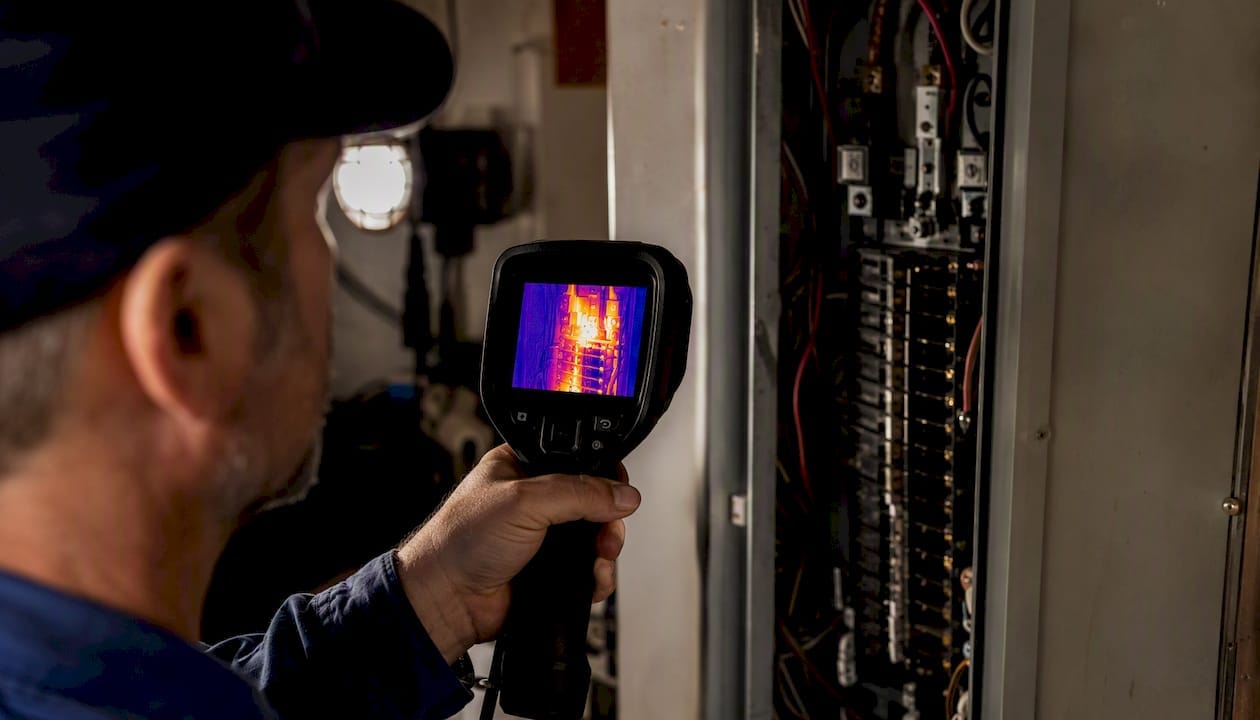
Infrared scanning of the panel under load can reveal hot spots at breaker-to-bus connections or within the bus bar itself. This is one of the most useful tools for identifying active arcing or resistance heating that is not visible to the eye. Thermal imaging does not replace trip testing, but it adds a layer of evidence that a visual-only inspection cannot provide.
Controlled trip testing:
Where safe and permitted, we manually test double-pole breakers by operating the handle to confirm the mechanism responds. We do not perform live-load overload testing on a standard home inspection; that requires a licensed electrician with appropriate equipment and consent. What we can document is whether breakers feel mechanically sound, whether handles are loose or inconsistent, and whether any breakers appear to be in a failed or partially tripped state.
Load analysis:
When multiple suspect panels are present, or when the property has high electrical demand (commercial use, multiple HVAC systems, EV charging infrastructure), a capacity study may be warranted. For commercial properties, electrical capacity studies can reveal whether the existing service is adequate for current or planned loads, separate from the panel condition question.
What the report will say:
Findings are documented with photographs, severity ratings, and specific recommended corrective actions. An FPE Stab-Lok panel will typically be flagged as a safety concern requiring evaluation by a licensed electrician, with a recommendation for replacement. If thermal imaging reveals active hot spots, the report will note that as requiring immediate attention. Understanding how to read those severity ratings is covered in this buyer’s guide to inspection reports.
Pro Tip: Property managers with multiple buildings should request a scoped electrical evaluation that covers all panels in the portfolio, not just the one flagged during a single inspection. A single defective panel in a building is a problem; an unaudited portfolio is a liability.
Should you replace an FPE panel, and what are your options?
The short answer for most situations is yes, replacement is the right call. The longer answer depends on a few specific factors.
Decision criteria:
- Replace immediately if: thermal imaging shows active hot spots, any breaker has failed a trip test, there is visible charring or burn damage, or your insurer or lender requires replacement before coverage or loan funding.
- Strongly recommended replacement if: the panel contains original Stab-Lok breakers, the home is being sold or purchased, or the panel is more than 30 years old with no documented service history.
- Monitor with documented plan if: a licensed electrician has inspected the panel, confirmed no active damage, and provided a written assessment with a defined replacement timeline. This is the exception, not the rule.
Why swapping individual breakers rarely solves the problem:
Replacement Stab-Lok-compatible breakers have been manufactured and sold as drop-in substitutes, but the underlying issue is the bus bar contact design, not just the breaker mechanism. Swapping a breaker does not address the contact geometry or the bus bar condition. Most electricians and regional industry advisories recommend full panel replacement rather than individual breaker substitution for this reason.
Typical replacement cost factors:
National cost ranges for a full panel replacement vary based on amperage (100A, 150A, 200A), service disconnect location, whether a meter relocation is required, permit fees, and regional labor rates. As a general reference, full panel replacements in the residential market commonly range from roughly $1,500 to $4,000 or more when service upgrades or meter work are included. For a 200-amp panel upgrade, the scope typically includes new breakers, updated labeling, and permit inspection. Get at least two written quotes from licensed electricians in your area before committing to a number.
Replacement decision flow:
- Active damage or insurer/lender requirement: schedule replacement before any other step.
- Original Stab-Lok breakers, no active damage: plan replacement within a defined timeline and document that plan in writing.
- Panel has been partially upgraded with non-Stab-Lok breakers: have a licensed electrician assess the current configuration before deciding scope.
- No replacement planned: document the decision, the inspection findings, and any mitigation steps in writing for insurance and disclosure purposes.
What to expect during a panel replacement project
A panel replacement is a one-to-three day project in most residential situations, though complications can extend that timeline.
Typical project stages:
- Estimate and scope: Electrician visits, assesses current service size, meter location, and any code upgrade requirements. This usually takes one to two hours.
- Permit submission: Most jurisdictions require a permit for panel replacement. Submission and approval can take a few days to two weeks depending on the municipality.
- Replacement day: Power is shut off at the meter, typically coordinated with the utility company. The old panel is removed, the new panel is installed and wired, circuits are labeled, and the service is restored. Most straightforward replacements are completed in one day.
- Inspector approval: A municipal electrical inspector visits to verify the installation meets code. This is a required step in permitted work and provides documentation useful for insurance and resale.
Common complications that add time or cost:
- Aluminum branch circuit wiring requiring aluminum wiring repairs or copper pigtailing at devices
- Shared neutrals (multi-wire branch circuits) that must be handled carefully during the transition
- Service upgrades from 100A to 200A, which may require utility coordination and meter work
- Added circuits for HVAC, EV charging, or kitchen loads requested at the same time
Permits are not optional. A panel replacement done without a permit creates problems at resale, may void your homeowner’s insurance coverage for related claims, and leaves no documentation that the work was inspected. Always confirm your electrician is pulling the permit before work begins.
How FPE panels affect buying, selling, and insurance
Federal Pacific panels create real friction in real estate transactions and insurance underwriting. Knowing where that friction appears lets you plan around it rather than get surprised.
Insurance realities:
Many carriers restrict new homeowner’s policies or require panel replacement as a condition of coverage when an FPE Stab-Lok panel is identified. Four-point inspections, which are commonly required for older homes in certain markets, specifically evaluate the electrical panel and will flag an FPE panel by name. Aluminum wiring and insurance underwriting are related concerns: homes with both aluminum branch-circuit wiring and an FPE panel face heightened scrutiny from underwriters. Contact your insurance agent before closing, not after.
Lender and closing impacts:
Some lenders, particularly those underwriting FHA or VA loans, may require panel replacement before loan funding when an FPE panel is identified in an inspection report. Conventional lenders vary. The safest approach is to disclose the panel condition to your lender early and confirm their requirements in writing.
Negotiation tactics for buyers:
- Obtain a written replacement quote from a licensed electrician during the inspection period.
- Request a seller credit equal to the replacement cost, or negotiate for the seller to complete the replacement before closing.
- Include the panel condition and replacement requirement in your inspection contingency documentation.
For property managers:
Include panel replacement in your capital planning schedule rather than waiting for an insurer non-renewal to force the issue. Proactive disclosure to tenants and insurers is far less disruptive than an emergency replacement triggered by a coverage lapse. The role of regular inspections for property managers covers how to build this kind of systematic evaluation into your maintenance cycle.
An inspector’s honest take on FPE panels in the field
We see Federal Pacific panels regularly in the Mid-South housing stock, particularly in homes built between the 1960s and early 1980s in Memphis, Shelby County, and the surrounding Tennessee and Mississippi communities. The pattern is consistent: the panel is there, the homeowner often did not know it was a concern, and the question becomes what to do next.
Our position is straightforward. We recommend replacement in the large majority of cases where original Stab-Lok breakers are present. The cost of replacement is real but bounded. The cost of a wiring fire is not. The regulatory record, specifically the CPSC’s 1983 closure, is sometimes cited as evidence that these panels are fine. We read that record differently: the CPSC documented test failures, did not issue a safety finding, and recommended consumer precautions. That is not a clean bill of health.
A monitored approach is defensible only when a licensed electrician has physically inspected the panel, found no active damage, and provided a written assessment with a specific replacement timeline. “We’ll watch it” without documentation is not a plan. When we write up an FPE panel in a report, we note the severity, explain the failure modes, and recommend a licensed electrician for follow-up. We separate that from cosmetic issues and deferred maintenance because the failure mode here, a breaker that does not trip, is not cosmetic.
Upchurch Inspection provides the electrical inspection clarity you need before you commit
When a property has an FPE panel, the inspection report needs to say more than “panel present, recommend evaluation.” Upchurch Inspection delivers detailed electrical assessments that include thermal imaging, documented breaker conditions, severity ratings, and specific recommended corrective actions, so you know exactly what you are dealing with before you close or list. We serve homebuyers, sellers, property managers, and commercial investors across Tennessee, Arkansas, Mississippi, Missouri, and Kentucky.
For buyers, our pre-purchase inspection gives you the written documentation your agent, lender, and insurer need. For property managers, our specialized inspection services help you identify legacy panel risk across your portfolio before it becomes a coverage or liability issue. Schedule your inspection at Upchurch Inspection and ask specifically about thermal imaging when an FPE or other legacy panel is suspected.