TL;DR:
- Many homebuyers, sellers, and agents mistakenly believe that a standard home inspection covers everything needed for manufactured homes or FHA financing, which can lead to costly delays. HUD foundation certification is a distinct, legally required process involving a licensed engineer evaluating foundation standards, and its absence can halt transactions; it differs from a general home inspection in scope, documentation, and legal weight. Proper preparation, early engagement of a qualified engineer, and understanding inspection outcomes improve chances for a smooth closing and prevent surprises related to foundation or modification issues.
Many homebuyers, sellers, and agents in the Mid-South assume a standard home inspection covers everything needed to close a deal involving a manufactured home or FHA financing. That assumption is wrong, and it costs people deals every year. HUD foundation certification is a separate, legally distinct process with its own standards, documentation requirements, and qualified reviewers. Miss it, and you risk delayed closings, failed loan approvals, and expensive last-minute repairs. This guide walks you through exactly what HUD foundation certification involves, how the process works, what gets flagged, and how to prepare so your transaction moves forward without surprises.
Table of Contents
- Understanding HUD foundation certification: What it is and why it matters
- The certification process: Steps, standards, and common challenges
- HUD scoring systems and inspection outcomes: What buyers and sellers need to know
- Overlooked risks: Attachments, additions, and edge-case compliance surprises
- Applying what you’ve learned: Preparing for a seamless inspection and transaction
- What most people miss about HUD foundation certification: Experience from the field
- Get expert help for HUD foundation certification and beyond
- Frequently asked questions
Key Takeaways
| Point | Details |
|---|---|
| HUD certification is unique | Regular home inspections do not replace HUD foundation certification for FHA or manufactured homes. |
| Edge cases often derail sales | Additions and poorly built attachments often cause unexpected inspection failures. |
| Preparation prevents costly delays | Addressing known foundation or drainage issues upfront avoids re-inspections near closing. |
| Certification standards are strict | Only properties meeting HUD’s permanent foundation criteria and satisfactory NSPIRE scores will pass. |
| Professional help matters | Hiring experienced inspectors for HUD requirements ensures smoother, safer transactions. |
Understanding HUD foundation certification: What it is and why it matters
HUD foundation certification is a formal written determination by a licensed professional engineer confirming that a manufactured home’s foundation meets HUD’s permanent foundation standards. It is not a general inspection opinion. It carries legal weight and is required to secure FHA financing on manufactured homes. Without it, lenders cannot approve the loan, and the transaction stalls.
The legal basis for this requirement comes directly from federal housing regulations. FHA minimum property standards require evaluation of safety, security, and soundness through the appraisal process, including specific attention to foundation condition and site drainage. That language is not optional guidance. It is a binding condition for FHA loan eligibility.
Who needs this certification? If you are buying a manufactured home with FHA financing, your lender will require it. If you are selling one, you will likely need to provide it before closing. Real estate agents handling these transactions need to understand the distinction clearly so they can set accurate timelines and avoid surprises. For a deeper look at why these properties have unique requirements, see our overview of HUD foundation certification for manufactured homes.
Here is how HUD foundation certification differs from a standard home inspection:
| Feature | Standard home inspection | HUD foundation certification |
|---|---|---|
| Performed by | Licensed home inspector | Licensed professional engineer |
| Scope | All major systems (roof, HVAC, plumbing, etc.) | Foundation compliance only |
| Legal requirement | No | Yes, for FHA/HUD transactions |
| Output | Inspection report | Engineering certification letter |
| Covers drainage and soil | Sometimes | Always |
| Required for loan approval | No | Yes, for manufactured homes |
Key parties who need to understand this distinction:
- Homebuyers financing with FHA loans on manufactured homes
- Sellers of manufactured homes wanting to attract the broadest buyer pool
- Real estate agents managing timelines and disclosure obligations
- Investors purchasing manufactured housing for rental or resale
The stakes are real. A missing or failed certification does not just delay closing. It can trigger renegotiations, require costly repairs under time pressure, or cause buyers to walk away entirely.
The certification process: Steps, standards, and common challenges
Now that you know what HUD certification is, let’s break down the practical steps, potential challenges, and what really happens during the inspection.
The certification process follows a defined sequence. Skipping steps or rushing them is one of the most common reasons transactions run into trouble.
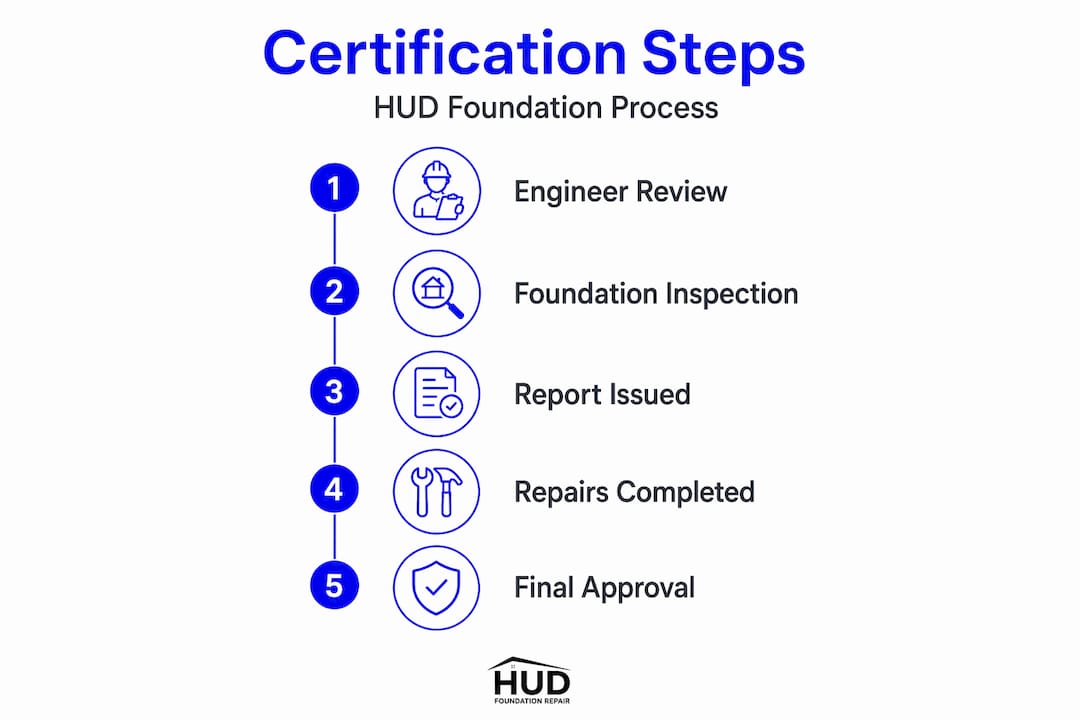
- Hire a licensed professional engineer with experience in HUD permanent foundation standards. This is not a task for a general home inspector. The engineer must be licensed in the state where the property is located.
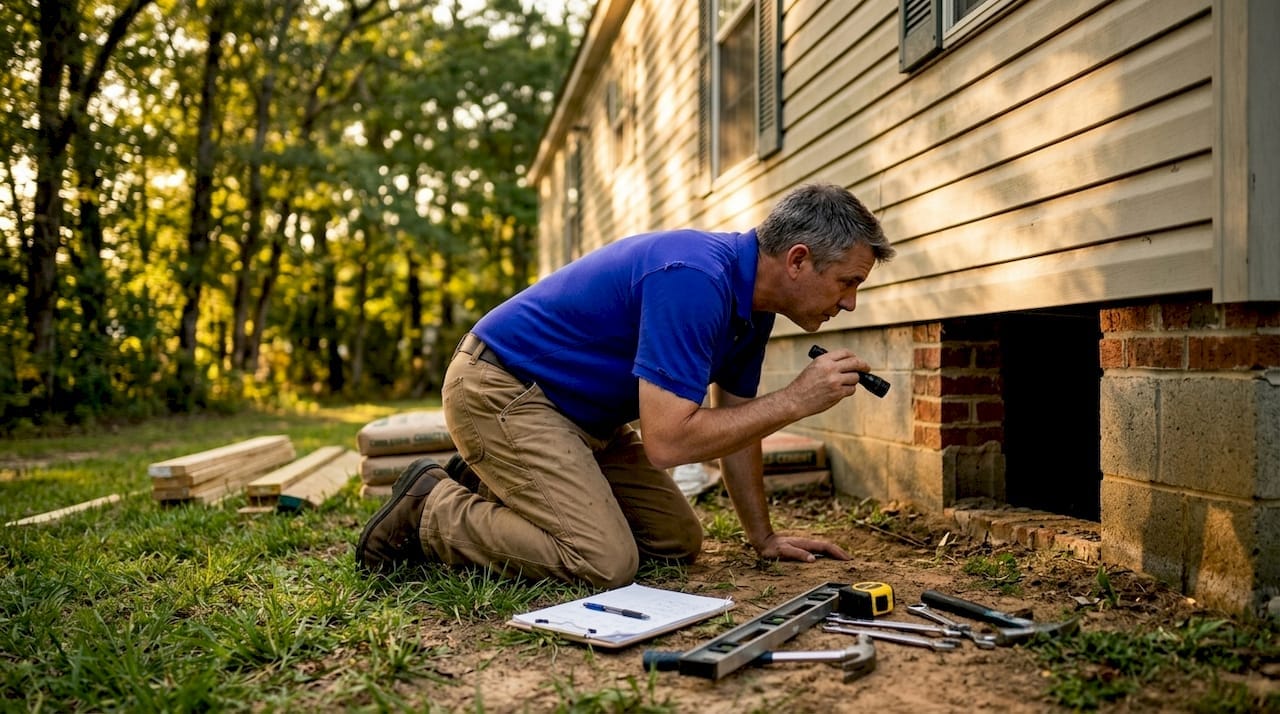
- Schedule the site inspection. The engineer visits the property to physically evaluate the foundation system, including footings, piers, tie-downs, anchoring, and site drainage.
- Review installation documentation. The engineer examines available records, including the original installation permit, data plate, and any prior engineering reports.
- Evaluate compliance against HUD standards. 24 CFR 3285 permanent foundation standards govern criteria for soil suitability, support design, and engineered anchoring systems. These are the benchmarks the engineer uses.
- Issue the certification letter. If the foundation meets all requirements, the engineer issues a signed, sealed letter confirming compliance. This document goes to the lender.
- Address deficiencies if found. If the foundation fails, the engineer documents what needs correction. Repairs must be completed and re-inspected before certification can be issued.
Common causes of rejection and how to address them:
| Rejection cause | Typical fix | Estimated timeline |
|---|---|---|
| Inadequate pier spacing | Add or reposition piers | 1 to 3 days |
| Missing or damaged tie-downs | Install compliant anchoring system | 2 to 5 days |
| Poor site drainage | Regrade soil, add drainage | 3 to 7 days |
| Deteriorated footings | Replace footings, re-inspect | 1 to 2 weeks |
| No documentation of original install | Obtain records or engineer’s affidavit | Varies |
We also recommend reviewing our resources on specialized inspections for manufactured homes and foundation problems revealed by inspectors to understand the full range of issues that surface in these evaluations.
Pro Tip: Start the certification process at least three to four weeks before your target closing date. If repairs are needed, that buffer prevents a scramble and keeps your timeline intact.
HUD scoring systems and inspection outcomes: What buyers and sellers need to know
Understanding standards is useful, but buyers and sellers also need to know how results are scored and what a passed or failed inspection actually means for a home sale.
HUD uses the NSPIRE (National Standards for the Physical Inspection of Real Estate) scoring system to convert observed deficiencies into a numerical score. The NSPIRE scoring system establishes that an overall score of 60 is the minimum passing threshold. Properties scoring below 60 require mandatory repairs before they can proceed through HUD-related financing.
Here is how defect severity maps to scoring impact:
| Defect severity level | Description | Score deduction range |
|---|---|---|
| Life-threatening | Immediate danger to occupants | 30 to 50 points |
| Severe | Significant structural or safety risk | 15 to 30 points |
| Moderate | Functional but non-compliant condition | 5 to 15 points |
| Low | Minor deficiency, cosmetic or maintenance | 1 to 5 points |
A property must achieve a minimum NSPIRE score of 60 to pass HUD inspection requirements. Scores below this threshold require documented repairs and re-inspection before any HUD-backed financing can proceed. Even a single life-threatening deficiency can drop a score below the passing threshold regardless of the property’s overall condition.
What does a “required repair” actually mean in practice? It means the lender cannot fund the loan until the repair is completed and documented. In some cases, the seller covers the repair cost. In others, the buyer and seller negotiate who pays. Either way, the deal cannot close until the property meets the minimum standard.
For commercial and multi-unit properties navigating similar evaluation frameworks, our overview of property condition assessments and NSPIRE provides useful context on how scoring systems affect larger transactions.
Key outcomes buyers and sellers should understand:
- Pass with no conditions: Certification issued, transaction proceeds normally.
- Pass with minor notes: Certification issued, but inspector flags items for future maintenance. No impact on closing.
- Conditional pass: Specific repairs required before certification is finalized. Closing delayed until repairs are verified.
- Fail: Significant deficiencies found. Repairs required, re-inspection scheduled, timeline extended.
Overlooked risks: Attachments, additions, and edge-case compliance surprises
Beyond the numbers and main foundation, savvy homebuyers and agents should also focus on sometimes-overlooked factors that commonly cause unexpected certification failures.
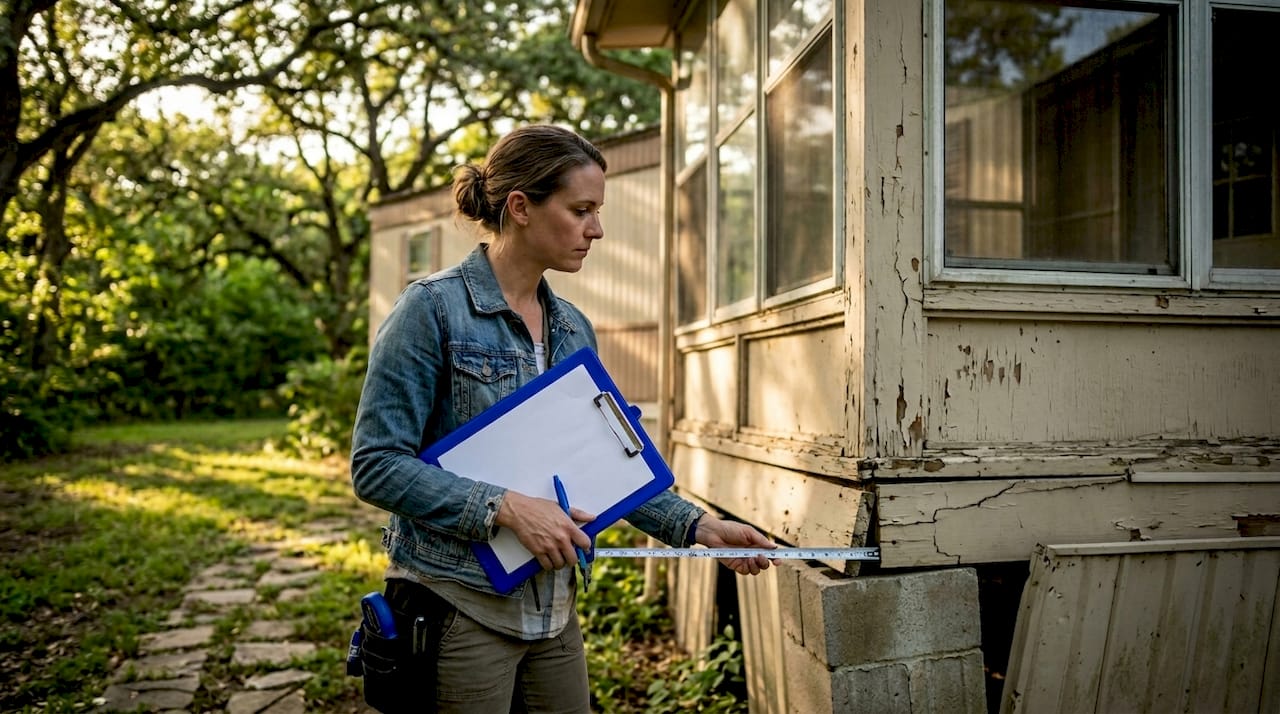
One of the most consistent surprises we see in the field involves additions that were built after the original installation. A deck, a porch, a utility room added onto the side of the home. These structures look harmless. But additions, decks, and porches that rely on the manufactured home for structural support or complicate site drainage can independently fail HUD certification. The original foundation might be perfectly compliant, and the home still fails because of what was added later.
Common edge-case issues that trigger unexpected failures:
- Unsupported room additions that transfer load back onto the manufactured home’s frame rather than independent footings
- Decks attached directly to the home without proper ledger connections or independent post footings
- Porches that alter drainage patterns around the foundation, creating water intrusion risk
- Skirting modifications that block ventilation or trap moisture under the home
- Utility connections (gas lines, electrical conduit) that were run in ways that violate clearance or anchoring requirements
- Non-permitted additions that have no documentation and cannot be verified for compliance
These issues are particularly common in older manufactured homes that have changed hands multiple times. Each owner may have added something without pulling permits or following HUD installation standards. By the time a buyer comes along with FHA financing, the cumulative effect of those modifications creates a compliance problem that nobody anticipated.
Our team performs engineer’s foundation evaluations that specifically account for these modifications, and we encourage buyers to review our guide on foundation issues every homebuyer should know before scheduling any certification inspection.
Pro Tip: If the home you are buying or selling has any additions, have an engineer review those structures before scheduling the HUD certification inspection. Catching a non-compliant deck two weeks before closing is far better than discovering it the day of the inspection.
Applying what you’ve learned: Preparing for a seamless inspection and transaction
To ensure all your effort leads to a successful transaction, let’s distill everything into a practical checklist and strategies to avoid rocky closings.
Preparation is the single biggest factor that separates smooth certifications from chaotic ones. Sellers who do the work upfront consistently see faster closings and fewer price renegotiations. Buyers who verify compliance before making an offer avoid inheriting someone else’s problem.
Here is a step-by-step checklist to prepare for HUD foundation certification:
- Gather all available documentation. Collect the original installation permit, data plate, HUD label numbers, any prior engineering reports, and records of additions or modifications.
- Walk the site yourself first. Look for visible drainage problems, damaged skirting, cracked piers, or anything unusual around the foundation perimeter.
- Identify all additions and modifications. List every structure attached to or built adjacent to the home after original installation. Note whether permits were pulled.
- Address obvious drainage issues proactively. If water pools near the foundation after rain, regrade the soil before the inspection. 24 CFR 3285 permanent foundation standards are clear that foundation stability and drainage issues can trigger repair conditions even when a separate certification has been obtained.
- Hire a qualified engineer early. Do not wait until you have a contract in hand. Engage an engineer as soon as you know FHA financing is involved.
- Disclose known issues upfront. Sellers who hide foundation or drainage problems face legal exposure and renegotiation risk. Transparency protects everyone.
- Schedule re-inspection immediately after repairs. Do not let repaired items sit. Get the engineer back on-site as quickly as possible to keep the timeline moving.
For additional guidance on what inspectors commonly find and how to address structural concerns, our resources on navigating common structural issues and causes and signs of foundation settlement are worth reviewing before your inspection date.
Pro Tip: Engage inspectors who have direct HUD certification experience, not just general foundation knowledge. The difference between a qualified specialist and a generalist can mean the difference between a clean certification and a report that raises more questions than it answers.
What most people miss about HUD foundation certification: Experience from the field
After laying out the requirements and process, we want to share something that does not appear in any regulation or checklist. The deals that fall apart over HUD certification rarely fail because of obvious, visible problems. They fail because of old repairs nobody documented, modifications a previous owner made without permits, or drainage issues that only become apparent when someone looks at the site with HUD standards in mind.
We have seen homes with brand-new skirting and freshly painted piers fail certification because the tie-down system was installed to a standard that was updated years ago. We have seen newer manufactured homes fail because a previous owner built a beautiful deck that happened to transfer load onto the home’s chassis. The home looked great. The paperwork was a problem.
Sellers who get ahead of this by ordering a certification before listing gain a real advantage. They know exactly what they have. They can price accordingly, make repairs on their own timeline, and present buyers with documentation that eliminates uncertainty. That transparency shortens negotiations and builds buyer confidence.
Agents who treat HUD certification as a formality to handle at the end of a transaction are setting their clients up for stress. The certification should be one of the first items on the checklist when FHA financing is involved, not one of the last. We have seen deals fall apart at the closing table because an agent assumed the general inspection was sufficient. It never is for these transactions.
The structural safety issues uncovered in manufactured homes often have a long history. Understanding that history requires a specialist who knows what to look for and how to document it properly.
Get expert help for HUD foundation certification and beyond
Equipped with in-depth knowledge, your next move should be securing the expertise to put your plan into action.
At Upchurch Inspection, we serve homebuyers, sellers, and real estate agents across the Mid-South with inspections built for real transactions. Our inspectors hold certifications that exceed state standards, and we understand the specific documentation and compliance requirements that FHA and HUD deals demand. Whether you need a full home inspection to evaluate all major systems, a focused pre-purchase home inspection before making an offer, or want to understand what a home inspection covers before booking, we are ready to help you move forward with confidence. Contact us today to schedule your inspection and protect your transaction.
Frequently asked questions
What documents are required for HUD foundation certification?
Certification requires an engineering inspection report, supporting photos, and proof of installation to HUD standards, including the data plate, HUD label numbers, and any available installation permits.
Can a regular home inspection substitute for a HUD foundation certification?
No. A standard inspection does not meet HUD’s permanent foundation requirements for manufactured or FHA-financed homes, which require a licensed engineer’s signed and sealed certification letter.
Who can provide a HUD foundation certification?
Only licensed professional engineers with HUD certification experience can issue valid reports. A general home inspector does not have the authority to certify permanent foundation compliance.
How long does the HUD foundation certification process take?
The process typically takes a few days if the foundation is compliant and documentation is available, but required repairs can extend the timeline by one to three weeks depending on the scope of work.
What happens if my property fails HUD foundation certification?
You will need to complete the recommended repairs and schedule a re-inspection before closing can proceed. Foundation stability or drainage issues can trigger repair conditions even on homes that have previously passed other types of inspections.