
TL;DR:
- An estate home inspection is a visual assessment of accessible systems, providing a detailed report for negotiation and planning. Understanding inspection scope, limitations, and report language empowers buyers and sellers to make informed decisions and leverage uninspected areas effectively. Proper interpretation of findings and boundaries transforms inspection results into a valuable asset in estate transaction negotiations.
Most people walk into an estate home inspection expecting a simple thumbs up or thumbs down. That misunderstanding costs buyers and sellers real money. An estate home inspection is a structured, standards-driven process with defined scope, documented limitations, and findings that require careful interpretation. Whether you’re purchasing a historic property in Memphis or selling a large home in northeast Arkansas, knowing exactly what the inspection covers, and what it doesn’t, gives you a measurable advantage at the negotiating table.
Table of Contents
- What is an estate home inspection?
- What’s included (and not included) in your estate inspection report
- Interpreting your report: Beyond the checklist
- Special focus: Plumbing and safety systems
- Key methodology insights for buyers and sellers
- Our take: Why understanding inspection boundaries is your best asset
- Need a trusted estate home inspection? Start here
- Frequently asked questions
Key Takeaways
| Point | Details |
|---|---|
| Inspections are visual only | Estate home inspections focus on what can be seen and do not cover hidden or inaccessible areas. |
| Report is not a warranty | Inspection reports provide a detailed snapshot of current conditions but do not guarantee future performance. |
| ‘Not inspected’ isn’t a red flag | Uninspected items mean no judgment could be made and should be viewed as negotiation tools rather than deal-breakers. |
| Specialists may be needed | General inspectors may recommend further evaluation by licensed experts for certain findings. |
| Know the boundaries | Understand what’s included and excluded so you can use the report wisely in estate negotiations. |
What is an estate home inspection?
With the importance of clarity established, let’s define exactly what an estate home inspection involves and why the standards behind it matter.
An estate home inspection is a limited visual examination of a property’s readily accessible systems and components. It is not a demolition survey or a code compliance audit. ASHI’s Standards of Practice defines the inspection as a visual examination of accessible systems, with inspectors providing a written report that describes conditions not functioning properly, items that are unsafe or near end-of-life, and recommendations for repair, replacement, or further evaluation. That written report is the deliverable. It is the document you use to negotiate, plan repairs, and make informed decisions.
Understanding the anatomy of a home inspection helps buyers and sellers set realistic expectations before the inspector ever arrives. The process follows a logical sequence: exterior, roof, foundation, structural components, HVAC, plumbing, electrical, and interior. Each system gets a visual assessment, not a destructive one.
| System evaluated | What the inspector assesses |
|---|---|
| Structural components | Foundation, framing, floors, walls, ceilings, roof structure |
| Roofing | Covering materials, flashings, drainage, penetrations |
| Electrical | Service entrance, panels, wiring, outlets, fixtures |
| HVAC | Heating and cooling equipment, distribution, controls |
| Plumbing | Supply lines, drain/waste/vent, water heater, fixtures |
| Interior | Doors, windows, floors, walls, ceilings, stairs |
“An inspection is not a prediction. It is a documented snapshot of observable conditions on a specific date, bounded by what is accessible and visible.”
A few important points every buyer and seller should keep in mind:
- Not every system is always inspected. If a component is inaccessible, blocked, or unsafe to evaluate, the inspector must document the reason for exclusion.
- The report describes conditions, not verdicts. Language like “deficient” or “near end-of-life” is informational, not a death sentence for the deal.
- Qualifications matter. Inspectors certified beyond minimum state standards bring more reliable findings to complex estate properties.
Pro Tip: Before hiring an inspector, ask specifically what certifications they hold and whether their standards of practice exceed your state’s minimum requirements. In the Mid-South, that distinction can make a significant difference on older or larger properties.
What’s included (and not included) in your estate inspection report
Now that you know what the standard procedure looks like, it’s important to understand exactly what is and isn’t covered in the written report you’ll receive.
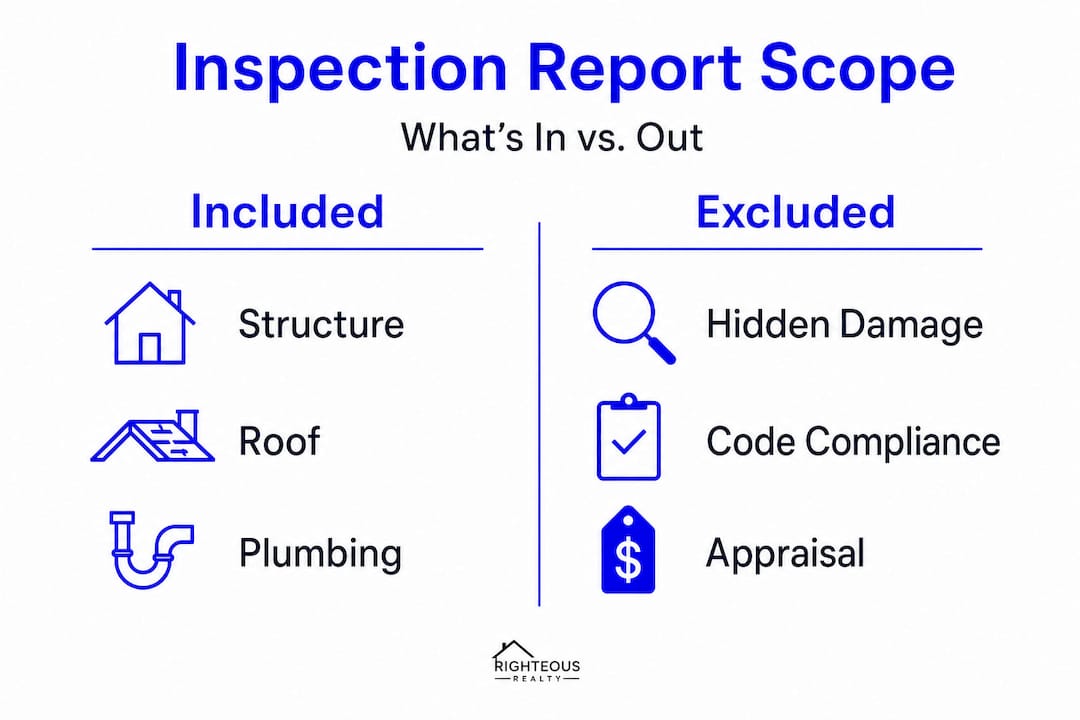
A general home inspection report is not a warranty, code compliance certification, or appraisal. It documents observable conditions as of the inspection date and is bounded by the Standards of Practice scope. This is a critical distinction, especially in estate transactions where buyers sometimes assume the report functions as a guarantee.

Here is a clear breakdown of what falls inside and outside the standard scope:
| Included in report | Excluded from report |
|---|---|
| Visible structural deficiencies | Concealed or inaccessible components |
| Observable safety hazards | Code compliance determinations |
| HVAC, plumbing, electrical condition | Future performance predictions |
| Water heater age and condition | Hazardous material testing (mold, asbestos, lead) |
| Roof surface condition | Underground utilities or septic systems |
| Visible moisture intrusion | Cosmetic conditions only |
Understanding why inspection reports look negative even on well-maintained homes helps buyers avoid panic. Inspectors are trained to document everything observable, so a thorough report on a solid home will still contain findings. That’s the job.
Here’s what the exclusions mean in practical terms for negotiation:
- Concealed systems cannot be evaluated. If the attic is inaccessible or the crawl space is blocked, those areas are excluded and documented. Buyers should treat these gaps as open questions, not clean bills of health.
- Code compliance is a separate process. An inspector may note that a condition appears inconsistent with modern safety standards, but they cannot formally cite code violations. That requires a code official.
- Cosmetic issues are typically not flagged. Chipped paint, worn carpet, and dated fixtures are not inspection concerns unless they indicate a deeper problem.
- Specialty systems require specialists. Pools, septic systems, wells, and elevators fall outside standard scope. Buyers should budget for separate evaluations.
Knowing which inspection findings are actual deal-breakers versus negotiable maintenance items is where buyers gain real leverage. A flagged item in the report is the starting point of a conversation, not the end of a transaction.
Interpreting your report: Beyond the checklist
Once you have your report in hand, the next challenge is figuring out which findings truly matter and what to do about them.
The most common mistake buyers make is treating every flagged item with equal urgency. A worn caulk joint around a tub is not equivalent to a failing foundation wall. The report uses specific language to signal severity, and learning to read that language accurately is a skill worth developing before you sit down at the negotiating table.
Comparing major standards of practice reveals that reporting language and defect thresholds can differ between inspectors, and that inspectors must avoid going beyond visual observation, including predicting future performance or determining hazardous materials presence. This matters because the same condition on two different properties may be described differently depending on the inspector’s training and the standards they follow.
Here’s how to read your report more effectively:
- “Deficient” or “significantly deficient” means the condition is not functioning as intended or poses a safety concern. These items warrant attention.
- “Recommend further evaluation” means the inspector observed something that exceeds their assessment ability. This is a referral, not an alarm.
- “Not inspected” means the item was present but could not be evaluated. This is a data gap, not a clean pass.
- “Near end-of-life” means a system or component is approaching the end of its expected service life. Plan for replacement, but it may not be urgent.
“A referral to a specialist is a scope-control mechanism, not a signal that the property is falling apart. Experienced buyers recognize this distinction and use it strategically.”
Pro Tip: When your report includes multiple “recommend further evaluation” notes, prioritize them by system. Structural and electrical referrals carry more financial weight than cosmetic or minor plumbing referrals. Address the high-stakes ones first.
Buyers who misinterpret inspection severity often either walk away from solid properties or fail to negotiate hard enough on genuinely serious findings. The report is a tool. Use it like one. And remember that fixing only the flagged report items isn’t always enough when underlying systemic issues are present.
Special focus: Plumbing and safety systems
A closer look at a critical part of any estate inspection: the plumbing, often the source of hidden risks and negotiation points.
Plumbing is one of the most misunderstood systems in any estate home inspection. It’s also one of the most consequential. For plumbing specifically, inspection scope centers on observable interior water supply, distribution, drain waste vent (DWV), water heating equipment, and related safety items, with further specialized evaluation recommended when findings warrant it.
Here is the step-by-step process we follow when evaluating plumbing in an estate home:
- Inspect the water supply entry point. We check the main shutoff valve, service line material, and visible supply piping for corrosion, leaks, or improper materials such as polybutylene or galvanized steel in older homes.
- Evaluate distribution lines throughout the home. We look for signs of active leaking, improper support, evidence of past repairs, and material concerns.
- Test fixtures and drains. Every accessible sink, tub, shower, and toilet is operated to check for drainage speed, leaks, and proper function.
- Assess the drain, waste, and vent system. We look for visible DWV piping, check for proper slope where accessible, and note any signs of blockage or improper venting.
- Inspect the water heater. Age, condition, proper installation, temperature and pressure relief valve function, and venting are all evaluated.
- Document safety concerns. Gas connections, water heater seismic strapping where applicable, and cross-connection hazards are noted.
Common plumbing issues we find in Mid-South estate homes include:
- Aging galvanized steel pipes with significant corrosion and reduced flow
- Polybutylene supply lines that are past their reliable service life
- Slow or partially blocked drains indicating DWV buildup
- Water heaters over 12 years old with no documented maintenance
- Improper venting on added bathrooms or remodeled spaces
- Evidence of past leaks under sinks or around toilet bases
Understanding what to know about water pipes in older estate homes is particularly important in the Mid-South, where properties built before 1990 may have multiple generations of pipe materials. We also strongly recommend sewer scoping for any estate purchase, because the sewer lateral falls outside standard visual inspection scope and failures there can cost thousands. For a full picture of common plumbing pitfalls in estate homes, the issues we see most often are entirely preventable with proper evaluation before closing.
Key methodology insights for buyers and sellers
To wrap up your understanding, let’s focus on lessons and negotiation strategies most buyers and sellers miss when interpreting estate inspection reports.
The Standards of Practice that govern home inspections exist to protect both clients and inspectors. But they also create boundaries that, if misunderstood, can lead to poor decisions. Aligning expectations to SOP boundaries means requiring a clear scope statement covering what was and was not inspected, insisting on documented reasoning for exclusions, and treating “not inspected” as a negotiating data gap rather than an automatic red flag or a guarantee of safety.
A common edge case in older or complex properties involves structural or safety concern phrasing. General inspectors document observed conditions and may recommend further evaluation such as structural engineering when issues exceed their assessment ability. Buyers often interpret a referral as meaning the property is in worse shape than it actually is, when in reality the referral is simply a scope-control mechanism.
Here’s what savvy buyers and sellers do with this information:
- Request a written scope statement upfront. Know exactly which systems were evaluated and which were excluded before you review findings.
- Ask for documented exclusion reasons. If the crawl space wasn’t inspected, you need to know why. That reason shapes your next step.
- Treat specialist referrals as next steps, not red flags. A referral to a structural engineer or licensed plumber is the inspector doing their job correctly.
- Use uninspected areas as negotiating leverage. If a system couldn’t be evaluated, that uncertainty has real value in price negotiations.
Pro Tip: Always ask your inspector to walk you through the report in person or by phone. Reading a report without context leads to misinterpretation. A five-minute conversation can clarify which findings are urgent and which are routine maintenance.
Understanding what inspectors are not allowed to move, test, or disassemble helps buyers recognize why certain areas appear as gaps. Reviewing real inspection report examples before your own inspection can also calibrate your expectations significantly.
Our take: Why understanding inspection boundaries is your best asset
Here’s our opinion on the smartest way to use your inspection findings in any Mid-South estate sale or purchase.
Conventional wisdom says a clean inspection report means a good property. We disagree. A truly useful inspection report is one that clearly defines what was evaluated, what wasn’t, and why. The boundaries of the report are as informative as the findings themselves.
In our experience inspecting estate homes across Tennessee, Arkansas, Mississippi, and Southeast Missouri, the most valuable moments in a transaction often come from the uninspected items. A blocked crawl space that couldn’t be evaluated. A detached garage that fell outside scope. A well or septic system that required a specialist. These gaps create legitimate uncertainty, and uncertainty has negotiating value when you know how to use it.
Buyers who understand this don’t panic when they see a long report. They prioritize findings by system and cost, identify the uninspected areas as open questions, and use both to negotiate a more accurate purchase price. Sellers who understand this prepare differently too. They address the predictable findings before listing and document the specialist evaluations they’ve already completed.
The real impact of an inspection on a transaction is rarely about a single dramatic finding. It’s about the cumulative picture of the property’s condition and the informed decisions that picture enables. That’s the standard we hold ourselves to at Upchurch Inspection, and it’s the standard every buyer and seller in the Mid-South deserves.
Need a trusted estate home inspection? Start here
If you’re preparing to buy or sell an estate home, here’s where to get expert guidance tailored to Mid-South real estate.
At Upchurch Inspection, we serve buyers and sellers across Tennessee, Arkansas, Mississippi, and Southeast Missouri with inspections that go well beyond a basic walkthrough. Our reports are detailed, clearly written, and designed to give you actionable information, not just a list of observations. Whether you’re new to the process or want to understand what a home inspection covers before you schedule, we have the resources to prepare you. When you’re ready to see exactly how the process unfolds from start to finish, our step-by-step guide to the home inspection process walks you through every phase. Contact Upchurch Inspection to schedule your estate home inspection and make your next real estate decision with confidence.
Frequently asked questions
Is an estate home inspection required to sell a property?
No, an estate home inspection is not legally required, but it is strongly recommended to protect both buyer and seller interests and to avoid surprises that can derail a closing.
Will the inspector check for mold, asbestos, or lead paint?
Standard estate home inspections do not test for mold, asbestos, or lead paint unless specifically requested, because inspectors are prohibited from reporting beyond visual observation under Standards of Practice.
What does ‘not inspected’ mean on my report?
“Not inspected” indicates that systems or components were not accessible or fell outside the inspection scope. Per ASHI Standards, the report must identify those items and explain why they were excluded.
Can a general inspection identify all necessary repairs?
No. A general inspection documents observable issues and may recommend specialist evaluation for certain findings. Inspectors document conditions and refer to specialists when findings exceed their assessment scope.
Is the inspection report a guarantee?
No. The report is a snapshot of observable conditions on the inspection date. A general home inspection report is not a warranty, code compliance certification, or appraisal, and it does not predict future performance.
Recommended
- When an Inspection Should Kill the Deal — And When It Shouldn’t – Upchurch Inspection
- Role of Inspections in Real Estate Transactions: Protecting Buyers and Sellers
- What Seasoned Buyers Do Differently After the Inspection – Upchurch Inspection
- 7 Essential Home Inspection Tips 2025 for Buyers and Sellers