

TL;DR:
- A warranty inspection evaluates a new home’s building defects near the end of the builder’s 12-month warranty period to ensure repairs are completed before coverage expires. It documents latent issues that develop during the first year, helping homeowners protect themselves financially and hold builders accountable. Proper timing around month 10 or 11 is crucial for effective claim submission and repair resolution within warranty limits.
A warranty inspection is a professional home evaluation performed near the end of a builder’s warranty period to identify construction defects the builder is legally obligated to repair. Most new construction homes carry a 12-month workmanship warranty, making this inspection one of the most financially consequential steps a new homeowner can take. Unlike a pre-purchase inspection, which informs your buying decision, a warranty inspection creates a documented punch list designed specifically for builder warranty submission. At Upchurch Inspection, we conduct these evaluations across the Mid-South with the same rigor we apply to full residential inspections, because the stakes are identical.
What does a warranty inspection cover?
A warranty inspection covers the same systems as a full residential inspection but filters findings through the lens of builder workmanship and warranty-eligible defects. The inspector is not evaluating whether you should buy the home. The inspector is building a case for what the builder must fix before your coverage window closes.
Systems examined during a typical warranty inspection include:
- Structural components: Foundation settlement, framing irregularities, and load-bearing wall concerns
- Roofing: Improper flashing, missing or lifted shingles, and inadequate attic ventilation
- Electrical systems: Ungrounded outlets, missing junction box covers, and panel labeling errors
- HVAC: Improper duct connections, refrigerant line issues, and thermostat calibration problems
- Plumbing: Slow drains, supply line connections, water heater installation, and fixture leaks
- Finishes: Drywall cracks from first-year settling, grout failures, and paint defects
- Windows and doors: Poor sealing, misalignment, and hardware that does not operate correctly
Professional warranty inspections typically document 30 to 80 items on a punch list, and in some cases, the list runs longer. That number surprises most homeowners who walked through the home at closing and noticed nothing obvious. First-year settling alone generates cracks, gaps, and alignment shifts that were not present on move-in day.
Pro Tip: Request that your inspector photograph every defect and include GPS-tagged images in the report. Builders respond faster to photo-documented punch lists than to written descriptions alone.
The warranty inspection process differs from a snagging inspection, which is conducted at handover before you take possession. A snagging inspection catches visible defects before you move in. A warranty inspection catches issues that develop during the first year of occupancy, including latent defects that only become apparent under normal use.
When should you schedule a warranty inspection?
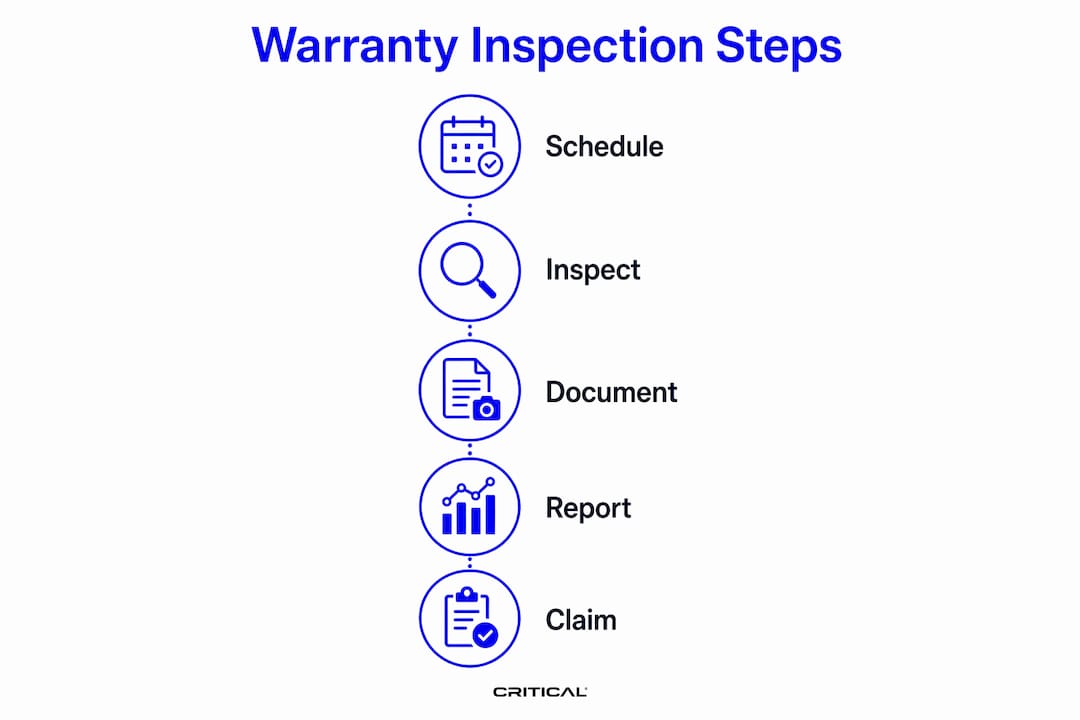
Timing is the single variable that determines whether your warranty inspection produces results or just produces a report you cannot act on. Inspections scheduled around the 10th or 11th month after closing offer the best balance of defect visibility and repair time.
Here is why the timing math matters:
- Schedule in month 10 or 11. By this point, the home has experienced a full seasonal cycle. Settling cracks are visible, HVAC performance issues have surfaced, and any moisture intrusion has had time to show itself.
- Allow 5 to 7 days for report delivery. A thorough inspection report with photos and itemized findings takes time to prepare. Rushing this step produces incomplete documentation.
- Submit the claim immediately. Once you receive the report, submit it to the builder’s warranty department in writing. Keep proof of delivery, whether that is a certified mail receipt or a timestamped email confirmation.
- Build in 30 to 60 days for repairs. Builders typically need 30 to 60 days to schedule trades and complete repairs. If you inspect at month 11.5, there is no realistic window for resolution before the warranty expires.
- Follow up in writing. Every communication with the builder after submission should be documented. Verbal agreements carry no weight in a warranty dispute.
Scheduling too early, say at month 6, means you miss defects that have not yet developed. Scheduling at month 12 or later means missing the warranty deadline entirely, which transfers full repair costs to you. The 10th month is the professional standard for a reason.
Pro Tip: Mark your warranty expiration date on your calendar the day you close. Set a reminder for month 9 to book your inspector. Availability fills up, and a rushed booking often means a less thorough inspection.

Why warranty inspections matter for new homeowners
The importance of warranty inspections comes down to one financial reality: after the warranty expires, every defect on that punch list becomes your expense. A typical inspection surfaces over 50 defects in a report that can run 30 or more pages. Even at modest repair costs per item, the aggregate value of those corrections easily exceeds the cost of the inspection by a significant margin.
The benefits extend beyond the immediate repair list:
- Builder accountability. A professional report with photos and itemized findings compels builders to respond. Verbal complaints are easy to dismiss. A 40-page documented report is not.
- Dispute resolution support. Report backing supports dispute resolution when builders delay or deny claims. Having a third-party professional document is far stronger than a homeowner’s personal account.
- Protection from latent defects. Some defects are not visible at move-in. Moisture intrusion behind walls, improper insulation installation, and HVAC duct leakage often only reveal themselves after months of use. A warranty inspection catches these before coverage ends.
- Peace of mind during early ownership. Knowing a qualified inspector has reviewed every major system gives you confidence that your home’s first year of issues are documented and addressed.
- Long-term home health. Defects caught and repaired under warranty do not compound. A small roof flashing issue fixed at month 11 does not become a mold remediation project at year three.
The regular inspection benefits for property owners are well established, and the warranty inspection is the highest-leverage version of that principle. You are using the builder’s obligation to fund repairs that would otherwise come out of your pocket.
Common misconceptions about warranty inspections
Several misunderstandings lead homeowners to skip this step or approach it incorrectly. Clearing them up before you schedule your inspection prevents costly mistakes.
The most common misconception is that a warranty inspection guarantees a perfect home. It does not. The inspection documents defects and creates a record for builder accountability. Whether the builder addresses every item depends on your warranty terms, your documentation, and your follow-through.
A second misconception is that warranty and pre-purchase inspections serve the same purpose. They do not. A pre-purchase inspection informs your decision to buy and your negotiating position. A warranty inspection is a post-purchase tool for extracting repairs from a builder under contractual obligation. The audience for each report is completely different.
Here is a quick reference for the distinctions that matter most:
| Inspection type | Timing | Primary purpose | Report audience |
|---|---|---|---|
| Pre-purchase inspection | Before closing | Inform buying decision | Buyer and real estate agent |
| Snagging inspection | At handover | Catch visible defects before move-in | Developer or builder |
| Warranty inspection | Months 10 to 11 | Document defects for warranty claims | Builder warranty department |
A third misconception involves latent versus visible defects. Visible defects are obvious at move-in: a door that does not close, a cracked tile, a missing outlet cover. Latent defects develop over time and are invisible at handover. Warranty inspections are specifically designed to surface latent defects before coverage ends.
Disputes over warranty claims often hinge on documentation submission timing. Homeowners who rely on verbal communication or informal emails without proof of delivery frequently lose these disputes. Treat your inspection report as legal evidence from the moment you receive it.
Key takeaways
A warranty inspection is the most cost-effective protection a new homeowner can use before builder coverage expires, and timing it correctly is as important as the inspection itself.
| Point | Details |
|---|---|
| Optimal timing | Schedule at month 10 or 11 to allow time for report delivery, claim submission, and repairs. |
| Scope of coverage | Inspections cover structural, roofing, electrical, HVAC, plumbing, finishes, windows, and doors. |
| Documentation discipline | Submit reports in writing with proof of delivery; treat every record as potential legal evidence. |
| Inspection type distinction | Warranty inspections differ from pre-purchase and snagging inspections in purpose and audience. |
| Financial protection | Defects caught under warranty are repaired at the builder’s expense, not yours. |
Why I think most new homeowners underestimate this inspection
After years of conducting property evaluations across the Mid-South, the pattern I see most often is not negligence. It is simply that new homeowners do not know the warranty inspection exists as a distinct service. They had a pre-purchase inspection, they moved in, and they assume the process is finished. By month 13, they are paying out of pocket for repairs a builder would have covered.
The homeowners who get the most from this process treat the inspection report as evidence, not just a checklist. They submit it certified mail. They follow up in writing. They keep a folder with every communication timestamped. That discipline is what separates a successful warranty claim from a frustrating dispute.
I also want to address the instinct to wait and see. Some buyers feel uncomfortable pushing back on a builder so soon after closing. That instinct costs money. Builders build warranty response into their business model. They expect these claims. A well-documented report from a qualified inspector is not adversarial. It is the process working exactly as designed.
The 11-month warranty inspection is, in my experience, the highest-return inspection a homeowner can schedule. The cost is modest. The potential repair value is substantial. And the window to act closes permanently at month 12.
— Holly
How Upchurch Inspection can protect your warranty investment
Upchurch Inspection conducts thorough warranty inspections for new homeowners across the Mid-South, producing detailed photo-documented reports built specifically for builder warranty submission. Our inspectors exceed state qualification standards and evaluate every major system, from structural components to HVAC and plumbing, with the precision your warranty claim requires. We also support clients through the submission process, helping you understand what to submit, how to document delivery, and what to expect from the builder’s response. If you want to understand the full value of professional inspections for your property or need help choosing the right inspection type for your situation, Upchurch Inspection is ready to guide you through every step.
FAQ
What is a warranty inspection for a new home?
A warranty inspection is a professional evaluation of a newly built home conducted near the end of the builder’s warranty period, typically around month 10 or 11, to identify construction defects the builder is obligated to repair before coverage expires.
How long does a builder’s warranty typically last?
Most new construction home warranties cover workmanship and materials for 12 months from closing, though some builders offer extended coverage for structural components. Always review your specific warranty documents for exact terms.
How many defects does a warranty inspection typically find?
A professional warranty inspection typically uncovers 30 to 80 defects, and some reports exceed 50 items and 30 pages of documentation. Most homeowners are surprised by how many issues develop during the first year of occupancy.
What happens if I miss the warranty inspection deadline?
Missing the warranty deadline means all repair costs transfer to you as the homeowner. Defects that would have been fixed at the builder’s expense become out-of-pocket expenses, often totaling thousands of dollars.
Is a warranty inspection the same as a pre-purchase inspection?
No. A pre-purchase inspection is conducted before closing to inform your buying decision, while a warranty inspection is a post-purchase tool designed to document defects for builder warranty claims. The purpose, timing, and report audience are entirely different.