
Every so often, usually near the end of an inspection or after a client has read through the report, someone will ask a version of the same question:
“So… does this mean the house is good?”
or
“If something breaks later, is that covered?”
Those questions aren’t unreasonable. Buying a home involves a lot of money, a lot of trust, and a lot of unknowns. It’s natural to want some kind of guarantee that everything will be okay once the keys change hands.
But home inspections don’t come with guarantees—and that isn’t because inspectors are avoiding responsibility. It’s because homes don’t work in a way that can be guaranteed, even by the most thorough inspection.
At Upchurch Inspection, we’re very deliberate about explaining this, because misunderstanding guarantees is one of the fastest ways for expectations to drift away from reality.
Homes Are Systems, Not Products
A guarantee makes sense when you’re buying something manufactured under controlled conditions. A new appliance. A phone. A piece of equipment with known tolerances and predictable use.
Homes are the opposite of that.
Every home is:
- Built at a different time
- Exposed to different soil, weather, and moisture conditions
- Maintained at different levels
- Modified by different owners over decades
Even two houses built side by side can age very differently depending on drainage, repairs, and how they’ve been lived in.
An inspection doesn’t reset that history. It documents where the home is right now.
A Real Example: The HVAC That “Worked Fine”
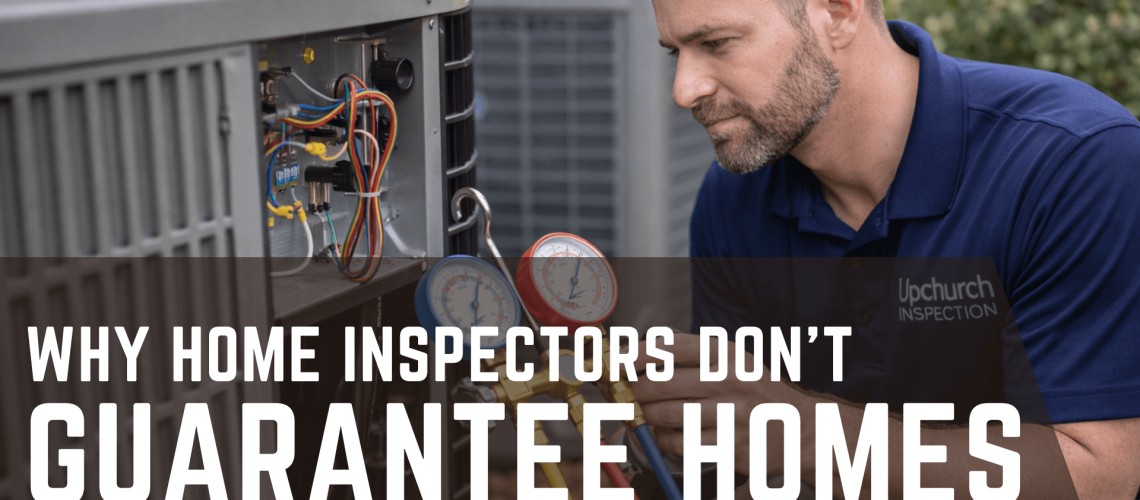
We’ve inspected countless homes where the heating and cooling system operated normally during the inspection. Proper temperature differential. No visible damage. No abnormal sounds. Everything looked and functioned as expected.
Then, months later, a blower motor fails or a coil develops a leak.
From the homeowner’s perspective, it feels like something was missed. But from an inspection standpoint, nothing was wrong at the time. Mechanical systems don’t always give warning signs before they fail. Some components operate until they don’t.
Guaranteeing that system would require predicting internal wear inside sealed equipment—something no visual inspection can do honestly.
Inspections Reduce Risk — They Don’t Eliminate It
One of the most important things an inspection does is reduce uncertainty. It narrows the range of unknowns. It identifies visible defects, safety concerns, and patterns that suggest where problems are more likely to occur.
What it cannot do is promise that nothing unexpected will ever happen.
For example, if an inspection identifies:
- An aging water heater nearing the end of its expected life
- Marginal drainage around the foundation
- Evidence of past moisture intrusion
Those findings are warnings, not warranties. They give buyers the chance to plan, budget, and decide how much risk they’re comfortable accepting.
A guarantee would imply that those risks disappear. They don’t.
Why Guarantees Can Create False Confidence
One of the dangers of inspection guarantees is that they encourage people to stop thinking critically.
When buyers believe a home is “covered,” they’re more likely to:
- Ignore early warning signs
- Delay maintenance
- Assume future problems are someone else’s responsibility
Homes don’t respond well to that mindset. Small issues become larger ones when they’re deferred, especially in regions like ours where moisture, soil movement, and seasonal weather shifts constantly stress structures.
Inspections work best when they promote awareness, not complacency.
Repairs After Inspection Change the Equation
Another reason guarantees don’t work is that homes often change hands in between inspection and ownership.
Sellers make repairs. Contractors get involved. Materials are replaced. Sometimes work is done well. Sometimes it’s rushed to meet deadlines.
Once those changes happen, the home is no longer in the condition it was when inspected. Guaranteeing future performance would require guaranteeing the quality of work performed by others after the inspection—which simply isn’t realistic or honest.
The Difference Between Accountability and Guarantees
Not offering a guarantee doesn’t mean inspectors aren’t accountable.
At Upchurch Inspection, accountability means:
- Performing a thorough, standards-based inspection
- Accurately documenting visible conditions
- Clearly explaining limitations and risks
- Communicating concerns in plain language
- Standing behind the accuracy of what was observed and reported
What it doesn’t mean is taking responsibility for how a complex structure behaves months or years later under changing conditions.
Those are two very different things.
Why Some Problems Appear “Out of Nowhere”
Homeowners are often surprised when something fails suddenly. In reality, many failures are the result of long-term wear that simply reaches its breaking point.
Electrical components overheat internally. Plumbing corrodes from the inside out. Roof materials degrade gradually until a storm pushes them past their limit.
An inspection may note age, condition, or marginal performance, but it can’t assign a calendar date to failure. Guarantees require certainty. Homes rarely offer it.
What Buyers Actually Need Instead of Guarantees
What buyers need isn’t a promise that nothing will go wrong. They need clarity.
They need to understand:
- Which systems are older or nearing replacement
- Where moisture or structural stress is most likely
- Which repairs are cosmetic versus consequential
- What ownership is likely to demand over time
That information allows buyers to make informed decisions and realistic plans. It also prevents the shock that comes from believing a house was ever “covered” to begin with.
How We Frame This With Our Clients
When we inspect a home, we’re not selling peace of mind through promises. We’re providing insight.
We explain what we saw, what it means, and where uncertainty still exists. We talk through scenarios. We answer questions. We help clients think through ownership—not just closing.
That approach may feel less comforting than a guarantee, but it’s far more useful once real life begins.
Why This Matters Long After Closing
The buyers who have the smoothest ownership experiences are almost always the ones who understood the inspection correctly.
They didn’t expect perfection.
They didn’t expect certainty.
They expected responsibility.
And because of that, when something eventually needed repair—as all homes do—it didn’t feel like a failure of the inspection. It felt like part of owning a home they understood from the start.
That understanding is what a good inspection is really meant to provide.