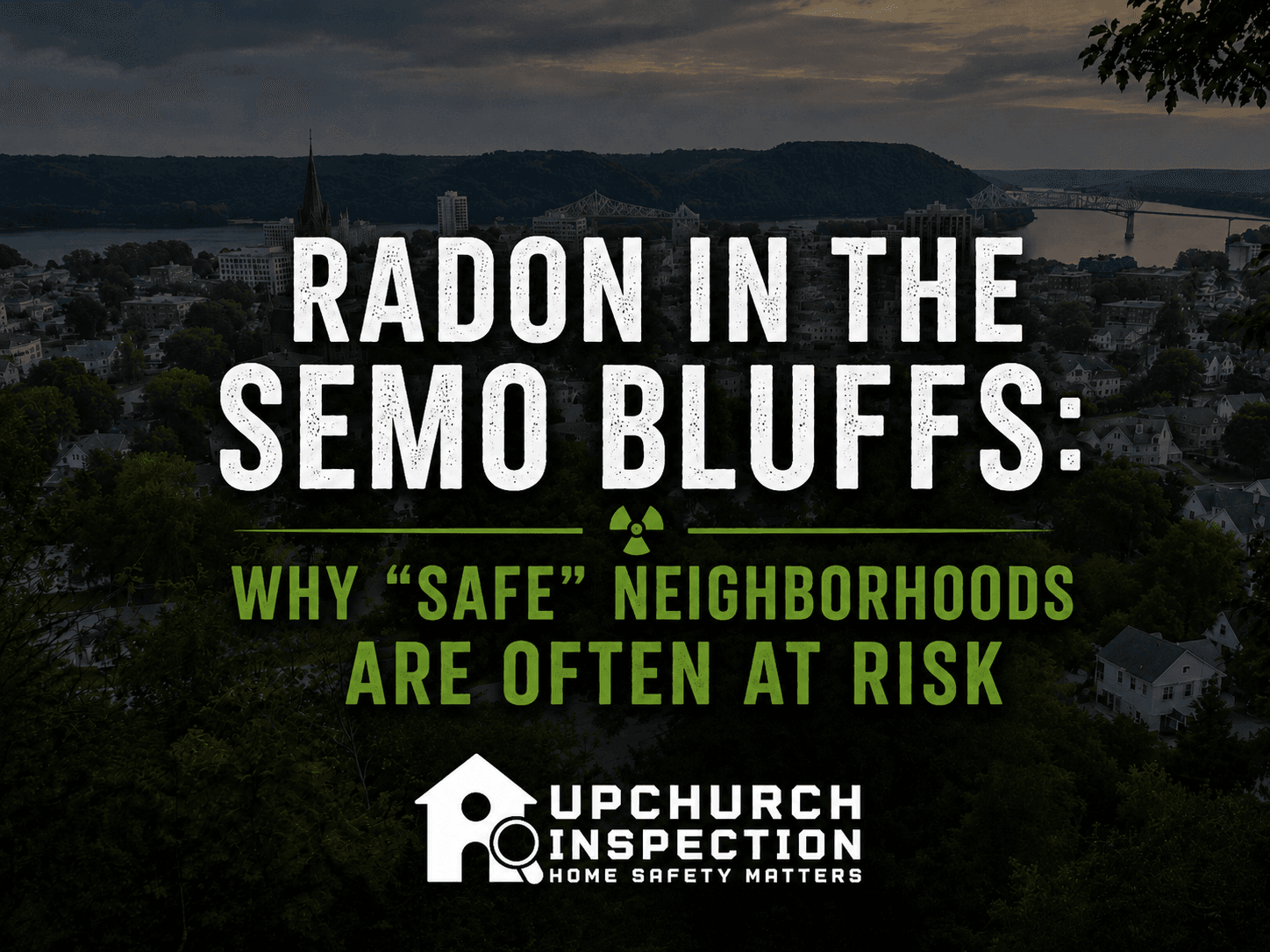
Radon risk in Southeast Missouri doesn’t follow traffic patterns or crime maps. It follows geology. Some of the quietest, most established neighborhoods sit on the most dangerous ground when it comes to radon gas — especially in the bluff areas of Cape County and around Jackson, Missouri.
Radon isn’t a maintenance issue. It’s a soil gas problem, and in SEMO, the soil is doing exactly what geology says it should.
Limestone Bluffs and Gas Pathways
The bluffs throughout this region are rich in limestone, fractured rock, and voids created over time by water movement. Those voids act as pathways, allowing radon gas to migrate upward from deeper soil layers and concentrate beneath homes.
Unlike flat delta soils, bluff geology doesn’t disperse gas evenly. It traps it in pockets. One house can test low while the neighbor tests high, even when construction styles are similar.
Why Basements Change Everything
Homes with basements are at increased risk because they sit deeper into the soil column where radon concentrations are higher. Basements also introduce more potential entry points:
- Cold joints at slab-to-wall connections
- Shrinkage cracks in foundation walls
- Utility penetrations below grade
Once radon enters the structure, pressure differences inside the home pull it upward and distribute it through the living space.
Stack Effect Makes It Worse
In multi-level homes, especially those with finished basements, the stack effect becomes a major driver of radon accumulation. Warm air rises and escapes through the upper portions of the house, creating negative pressure below. That pressure literally pulls soil gases into the building.
The tighter and more energy-efficient the home, the stronger this effect becomes.
Why “Nice” Areas Get Missed
I often hear, “This is a good neighborhood — radon shouldn’t be an issue here.” That assumption is exactly why elevated radon levels go undetected for years. Radon doesn’t care about finishes, schools, or curb appeal. It cares about rock, soil, and pressure.
In bluff-adjacent areas, visual condition offers no protection.
Testing Is the Only Way to Know
There is no reliable way to predict indoor radon levels without testing. Visual inspections don’t detect it. Seller disclosures often miss it. And neighboring test results don’t guarantee safety.
That’s why radon testing is especially important in Southeast Missouri homes with basements and lower-level living spaces.
To learn more about how we approach radon risk and environmental testing across the region, visit:
https://upchurchinspection.com/our-service-areas/home-inspections-in-southeast-missouri/
In the SEMO bluffs, the risk isn’t obvious — but it is very real.