Step-Downs Aren’t a Defect — Until They Are
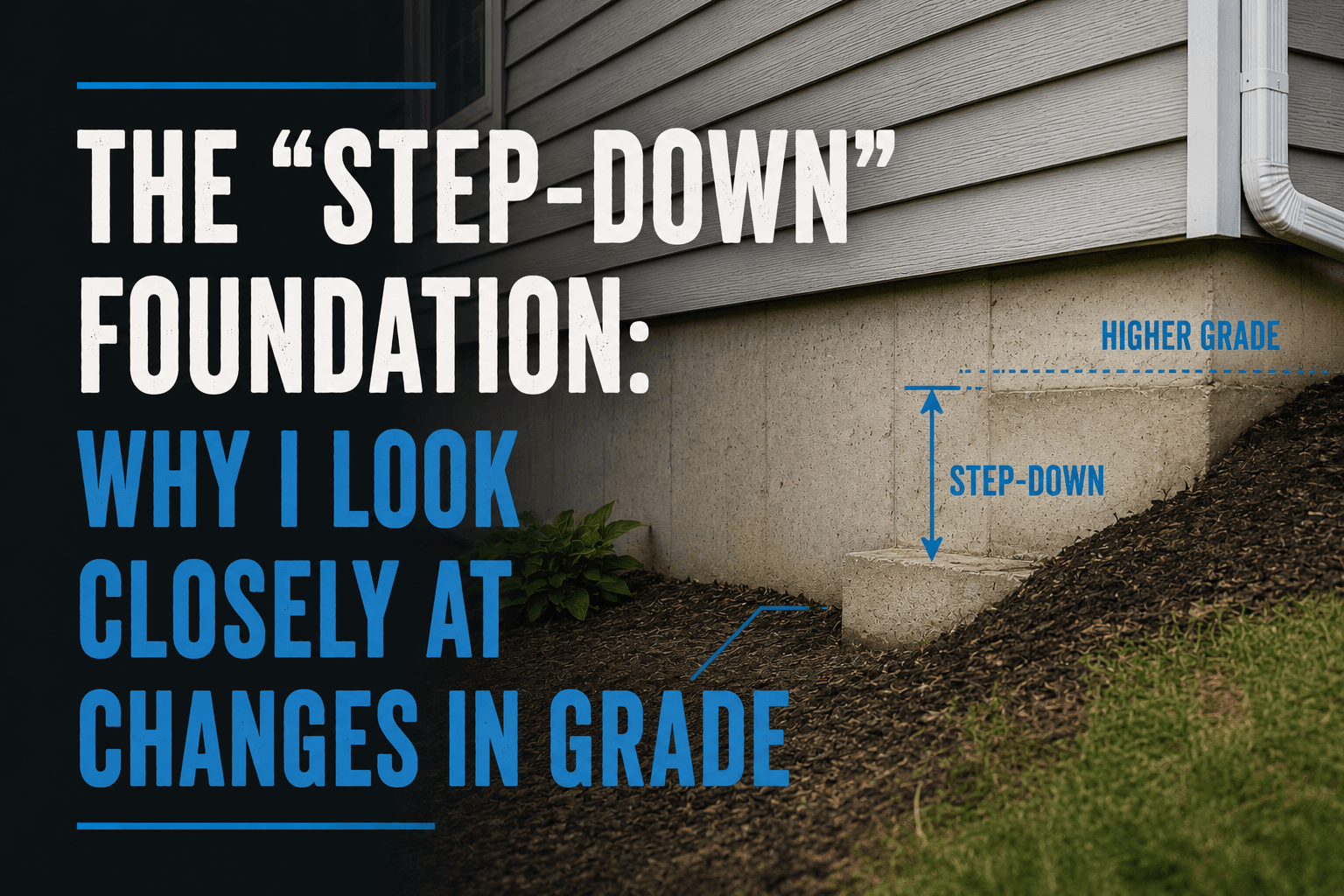
A step-down foundation isn’t unusual. Anytime a house is built on a slope, you’re going to see changes in elevation. The foundation follows the grade, stepping down in sections instead of cutting and filling the entire lot flat.
On paper, that’s efficient construction. In the field, it’s an area that earns extra attention from me every single time.
Where Step-Down Foundations Get Tricky
Every step is a transition point. Different soil pressures. Different moisture exposure. Different load paths. Those transitions are where movement shows up first.
I’m watching for:
- Vertical cracking at the step joint
- Differential settlement between sections
- Inconsistent floor elevations inside
- Gaps where foundation meets framing
If one section of the house stays dry and the lower section stays wet, the foundation isn’t moving uniformly. Over time, that imbalance shows up as cracking, sticking doors, or floor slope you can feel underfoot.
Water Always Finds the Step
Drainage is the silent partner in step-down issues. Water running along the foundation doesn’t stop politely at a step—it collects there.
I’ll often see erosion, washed-out soil, or splash-back staining right at the step transition. Downspouts that dump near those points accelerate the problem. Once soil support starts washing away, the lower section takes the hit.
On a home we inspected near Collierville, the step-down was directly below a valley discharge. The upper foundation looked fine. The lower section had measurable movement and fresh cracking because it was doing all the work.
Inside Clues I Don’t Ignore
Step-down problems don’t stay outside.
Inside, I’m paying attention to:
- Tile cracking that follows foundation lines
- Stair-step drywall cracks near transitions
- Uneven baseboards
- Doors that swing or latch differently between levels
These aren’t cosmetic when they align with a foundation step. They’re data points.
Why This Matters to Buyers
Step-down foundations can perform just fine for decades—if drainage, grading, and compaction were handled correctly. When they weren’t, the repair path is rarely simple.
Underpinning, drainage correction, or structural evaluation usually follows. None of those are surprises you want after closing.
That’s why I slow down at grade changes. The rest of the foundation may tell a calm story, but the step-down is where the truth usually shows up first.