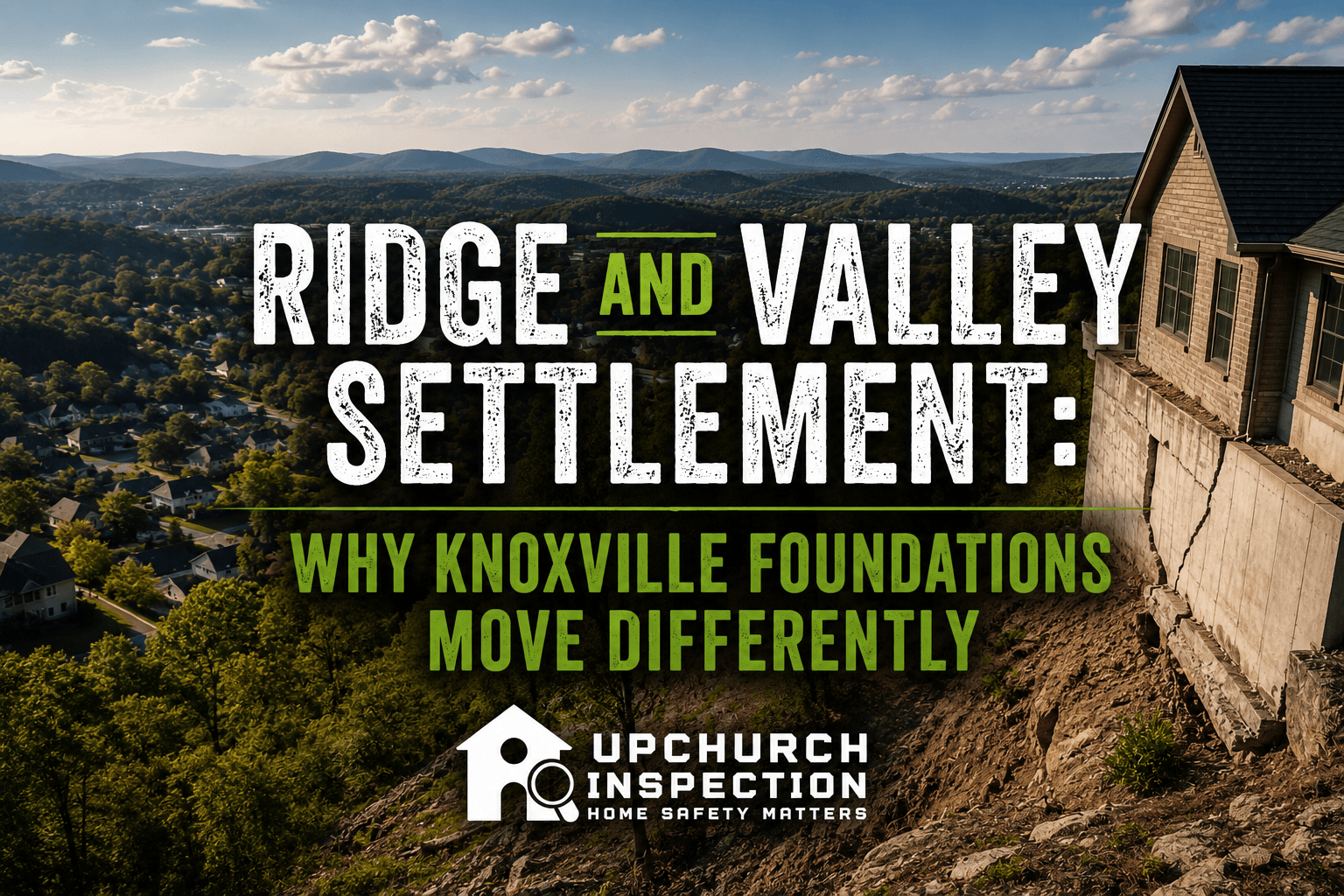
Knoxville houses don’t move like houses in Memphis. They don’t move like houses in Nashville either. East Tennessee sits in the Ridge-and-Valley province, and that terrain changes how soil loads behave, how water moves, and how foundations respond over time.
If you’ve ever wondered why one side of a Knoxville house looks fine while the other side keeps cracking, this is why.
Hillside Houses Aren’t Balanced Houses
A lot of Knoxville homes are built with one foot on a slope and the other on something flatter. From a framing standpoint, that’s fine. From a soil standpoint, it’s chaos.
The uphill side of the house is holding back soil. The downhill side is losing it. That creates unbalanced soil pressure, and foundations feel that imbalance year after year.
This isn’t dramatic failure. It’s slow, directional movement.
Lateral Earth Pressure Does the Pushing
Here’s a term that actually matters in East Tennessee: lateral earth pressure.
When soil becomes saturated on a slope, it doesn’t just get heavier — it pushes sideways. Retaining walls, basement walls, and foundation walls on the uphill side of a structure are constantly resisting that force.
Over time, that pressure shows up as:
- Horizontal cracking
- Bowing walls
- Stair-step cracking near corners
These cracks don’t usually mean the house is collapsing. They mean the house is doing work it was never designed to do indefinitely.
The Cumberland Plateau Makes It Worse
Knoxville sits near the edge of the Cumberland Plateau, and that influence matters. Plateau geology introduces layered soils, shale seams, and variable rock depths that change how water moves underground.
Some soil layers drain well. Others trap water. When rain hits, moisture doesn’t disperse evenly — it follows the path of least resistance.
That’s why foundation movement here often looks inconsistent instead of uniform.
Water Moves Sideways Before It Moves Down
In flatter parts of the country, water mostly moves vertically. In Knoxville, it moves laterally first. Rain hits a slope, infiltrates shallow soil, and travels sideways until it finds an exit point.
Sometimes that exit is:
- A foundation wall
- A basement corner
- A crawlspace
That’s why I see moisture intrusion on one side of a house while the opposite side stays dry.
Split-Level Homes Feel It First
Split-level and daylight-basement homes are common in Knoxville for a reason — they fit the terrain. Unfortunately, they also concentrate stress at transition points.
I pay close attention to:
- Floor transitions between levels
- Cracks near stairwells
- Separation where foundation types change
Those areas are where movement shows up earliest.
Retaining Walls Aren’t Optional Here
A retaining wall that’s leaning, cracked, or poorly drained isn’t a cosmetic issue in East Tennessee. It’s a structural warning sign.
I see a lot of walls built without:
- Proper drainage behind them
- Weep paths
- Adequate reinforcement
Once water builds up behind a wall, pressure spikes fast. Gravity takes care of the rest.
Crawlspaces on Slopes Are Moisture Traps
Crawlspaces on sloped lots tend to collect moisture at the uphill side. Even when vents are present, airflow doesn’t solve the problem if water keeps feeding in laterally.
Common findings include:
- Damp soil near uphill walls
- Mold growth concentrated on one side
- Insulation failure only in specific bays
That pattern tells me the issue isn’t ventilation. It’s site drainage and slope interaction.
Why Cracks Don’t Match From House to House
Buyers often ask, “Is this normal for Knoxville?” The honest answer is: movement is common, but it’s never identical.
Two houses on the same street can behave completely differently depending on:
- Lot orientation
- Cut vs. fill placement
- Subsurface drainage paths
That’s why comparing cracks to the neighbor’s house doesn’t tell you much.
Repairs That Miss the Point
I see a lot of cosmetic repairs here — epoxy cracks, patched block, fresh paint. Those fixes treat symptoms, not causes.
If lateral pressure and moisture aren’t addressed, cracks will return. Sometimes in the same place. Sometimes somewhere new.
Why East Tennessee Inspections Have to Be Terrain-Aware
Inspecting homes in Knoxville isn’t about assuming defects. It’s about understanding the ground the house is fighting against.
Foundations here don’t just support weight. They resist pressure from the side, from above, and from shifting moisture conditions.
For buyers evaluating homes across East Tennessee, recognizing ridge-and-valley behavior matters before you close.
https://upchurchinspection.com/our-service-areas/home-inspections-in-east-tennessee/
And for buyers relocating into the broader market around Knoxville, this terrain rewards inspectors who read the land — not just the walls.
In East Tennessee, the house doesn’t move because it’s weak.
It moves because the ground never stops pushing.