
The first time I really got how brutal East Tennessee humidity is on crawlspaces wasn’t from a textbook or a certification class. It was from reading a report our Knoxville inspector sent over after a summer inspection—one of those reports where every photo tells the same story from a different angle.
Damp soil. Sweating ductwork. Insulation hanging like wet cardboard. Wood framing that looked fine at first glance but felt spongy once you knew where to look.
That house wasn’t a fluke. It was normal for this region.
East Tennessee sits in the heart of the Tennessee Valley, and if you inspect enough homes here, you stop thinking of crawlspace moisture as an occasional defect. It’s a constant environmental pressure—one that every crawlspace is either resisting or surrendering to.
Why Crawlspaces Struggle Here More Than Other Regions
I’m based in Memphis, and we deal with humidity too—but East Tennessee is a different animal. The valley geography traps moisture. Warm air settles in. Rainfall is frequent. And unlike flatter areas, water doesn’t just soak in and sit—it moves, then evaporates, then condenses again.
Our Knoxville inspector has shown me crawlspaces where everything was technically “installed correctly” for a traditional vented crawlspace—vents open, vapor barrier present, no obvious leaks—and yet humidity readings were still high enough to support mold growth.
That’s when it clicks: the old-school vented crawlspace model just doesn’t work consistently in this environment.
The Vented Crawlspace Problem (Seen Up Close)
I’ve reviewed dozens of East Tennessee reports where the crawlspace vents were doing exactly what they were designed to do—pulling in outside air. The problem is that outside air in the Tennessee Valley is often wetter than the air inside the crawlspace.
So instead of drying things out, the vents introduce warm, moisture-laden air. That air hits cooler surfaces—ductwork, floor framing, subflooring—and condenses. Once condensation starts, the crawlspace becomes its own humidity generator.
Our inspector sent one report from a home not far from the river corridor where the homeowner complained about a musty smell inside. The crawlspace had vents every few feet. Plenty of airflow. But the relative humidity was hovering in the mid-80s.
Nothing was “broken.” The system itself was the problem.
What Encapsulation Actually Does (Beyond the Sales Pitch)
Crawlspace encapsulation gets marketed a lot, and frankly, some of the marketing is garbage. What matters isn’t the buzzword—it’s what changes physically in the crawlspace environment.
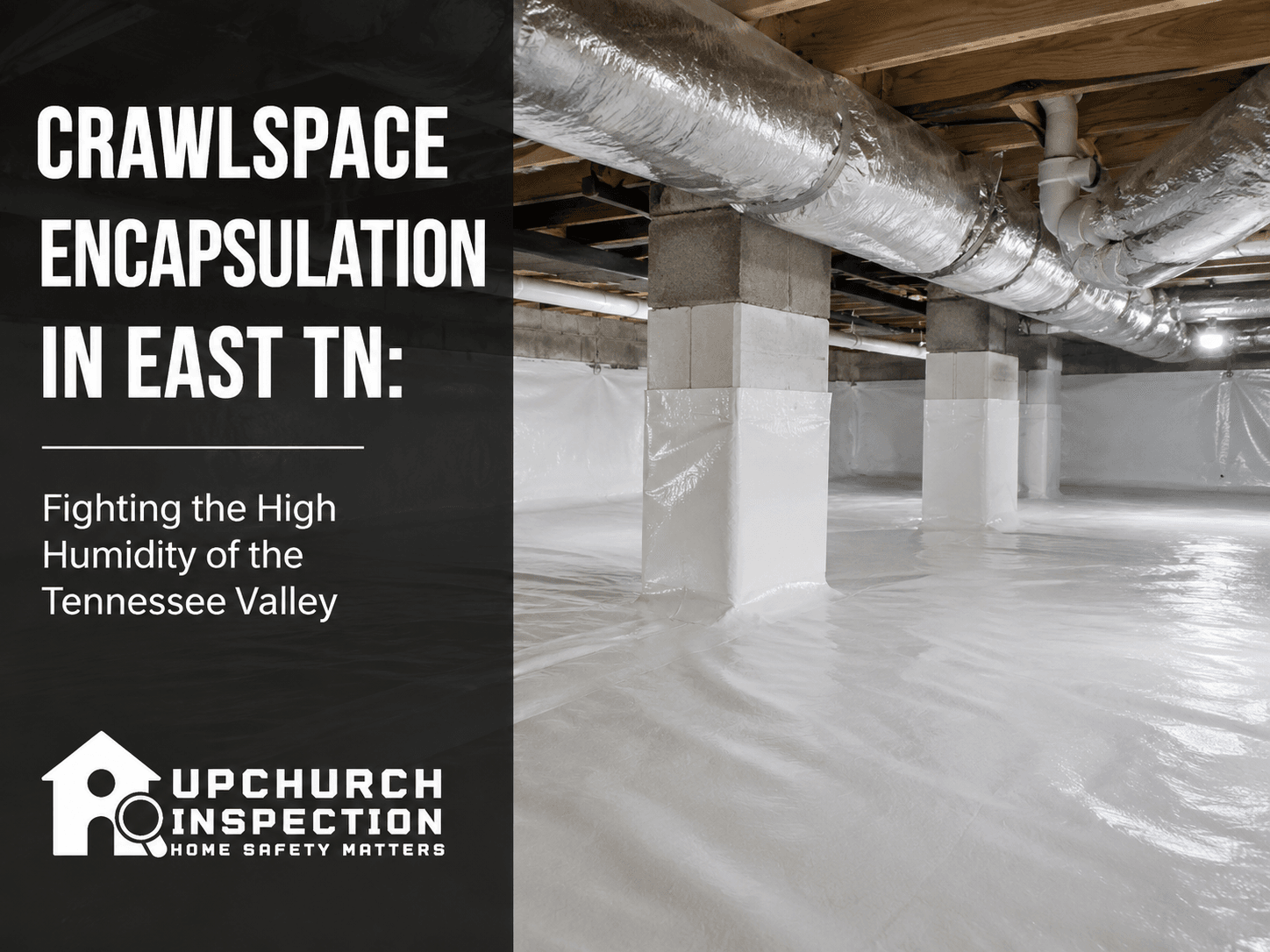
Encapsulation works when it does three things well:
- Cuts off ground moisture
- Stops humid outside air from entering
- Controls interior crawlspace air conditions
In East Tennessee, ground moisture alone is a big deal. Our inspector routinely finds exposed soil or thin, torn vapor barriers that do almost nothing. Moisture evaporates straight out of the ground and into the crawlspace air, day after day.
A properly installed, sealed vapor barrier doesn’t just “cover dirt.” It fundamentally changes the moisture source feeding the space.
Personal Example: The “Looks Fine” Crawlspace
One Knoxville report sticks with me. On paper, the crawlspace didn’t look awful. No standing water. No visible mold colonies. No collapsed insulation.
But our inspector took humidity readings and moisture meter readings on the floor joists. The wood moisture content was consistently elevated—not high enough to trigger panic, but high enough to support long-term decay.
That’s the dangerous zone. The one where nothing looks urgent, but everything is quietly trending in the wrong direction.
Encapsulation in cases like that isn’t about fixing damage. It’s about stopping damage that hasn’t fully shown itself yet.
Why East TN Crawlspaces Love Mold
Mold needs three things: moisture, organic material, and time. Crawlspaces in East Tennessee provide all three in abundance.
Wood framing is organic. Time is guaranteed. Moisture comes from everywhere—ground vapor, humid air, plumbing condensation, and temperature differentials.
Our inspector has documented mold growth in crawlspaces that homeowners never entered and never suspected. The only clue inside the home was air quality—persistent odors, allergy symptoms, or floors that felt clammy in summer.
Encapsulation doesn’t magically kill mold, but it removes the conditions mold depends on. When humidity stays controlled, growth slows or stops.
Ductwork: The Hidden Casualty
One thing I didn’t fully appreciate until I started reviewing East Tennessee reports was how hard crawlspace conditions are on HVAC systems.
Metal ductwork sweating in a humid crawlspace is common here. That condensation drips onto insulation, saturates it, and eventually leads to insulation falling off entirely. Once that happens, energy loss skyrockets—and moisture problems spread.
Our inspector sent photos of ducts with rust forming at seams, insulation hanging in strips, and condensation lines etched into the soil below. That’s not an HVAC defect—it’s an environmental one.
Encapsulation changes the air those ducts live in. When humidity drops, condensation stops. That alone can extend the life of mechanical systems.
Why “Just Add a Dehumidifier” Isn’t Enough
I see this mistake a lot. Someone adds a dehumidifier to a vented crawlspace and expects miracles.
Our Knoxville inspector has seen plenty of these setups. The unit runs constantly. Buckets fill up. Electricity bills go up. Humidity barely improves.
Why? Because the crawlspace is still open to the outside. The dehumidifier is fighting the entire Tennessee Valley, one cubic foot of air at a time.
Encapsulation works when the space becomes conditioned, not when it’s treated like a leaky basement.
Structural Implications Over Time
High humidity doesn’t just affect air quality. It affects wood performance.
In multiple East Tennessee inspections, our inspector has documented floor framing with early-stage decay—not catastrophic rot, but softened wood fibers, fungal staining, and fasteners beginning to corrode.
Those conditions don’t cause floors to collapse overnight. They cause floors to sag slowly, squeak more, and lose stiffness over years. Homeowners often blame age. The real culprit is moisture.
Encapsulation stabilizes moisture levels, which stabilizes wood behavior. That’s a structural benefit, not just a comfort upgrade.
Encapsulation Isn’t One-Size-Fits-All
One thing I’m careful about when reviewing these reports is not treating encapsulation as a checkbox solution. East Tennessee homes vary widely.
Some crawlspaces need drainage improvements first. Some need plumbing leaks corrected. Some have low clearances that complicate installation.
Our inspector documents those constraints carefully. Encapsulation works best when the crawlspace is addressed as a system—ground, air, drainage, and mechanicals all considered together.
A Regional Reality Check
I’ve reviewed crawlspace reports from all over the Mid-South. East Tennessee stands apart. The combination of valley humidity, frequent rain, and terrain-driven airflow makes crawlspaces here especially vulnerable.
Driving past landmarks like Ijams Nature Center, you can see how water, vegetation, and terrain dominate this region. That same environment doesn’t stop at the edge of a yard—it extends under the house.
Why We Treat This as an Inspection Priority
When I review inspection reports from our Knoxville inspector, crawlspace conditions often explain a long list of downstream issues—floor comfort complaints, HVAC inefficiency, air quality concerns, even unexplained health symptoms.
Encapsulation isn’t about upselling. It’s about acknowledging reality. In East Tennessee, unmanaged crawlspaces almost always become problem spaces given enough time.
The houses that perform best here are the ones that stop trying to ventilate humidity away—and start controlling it instead.
That’s not theory. That’s what the reports keep showing me, inspection after inspection.