
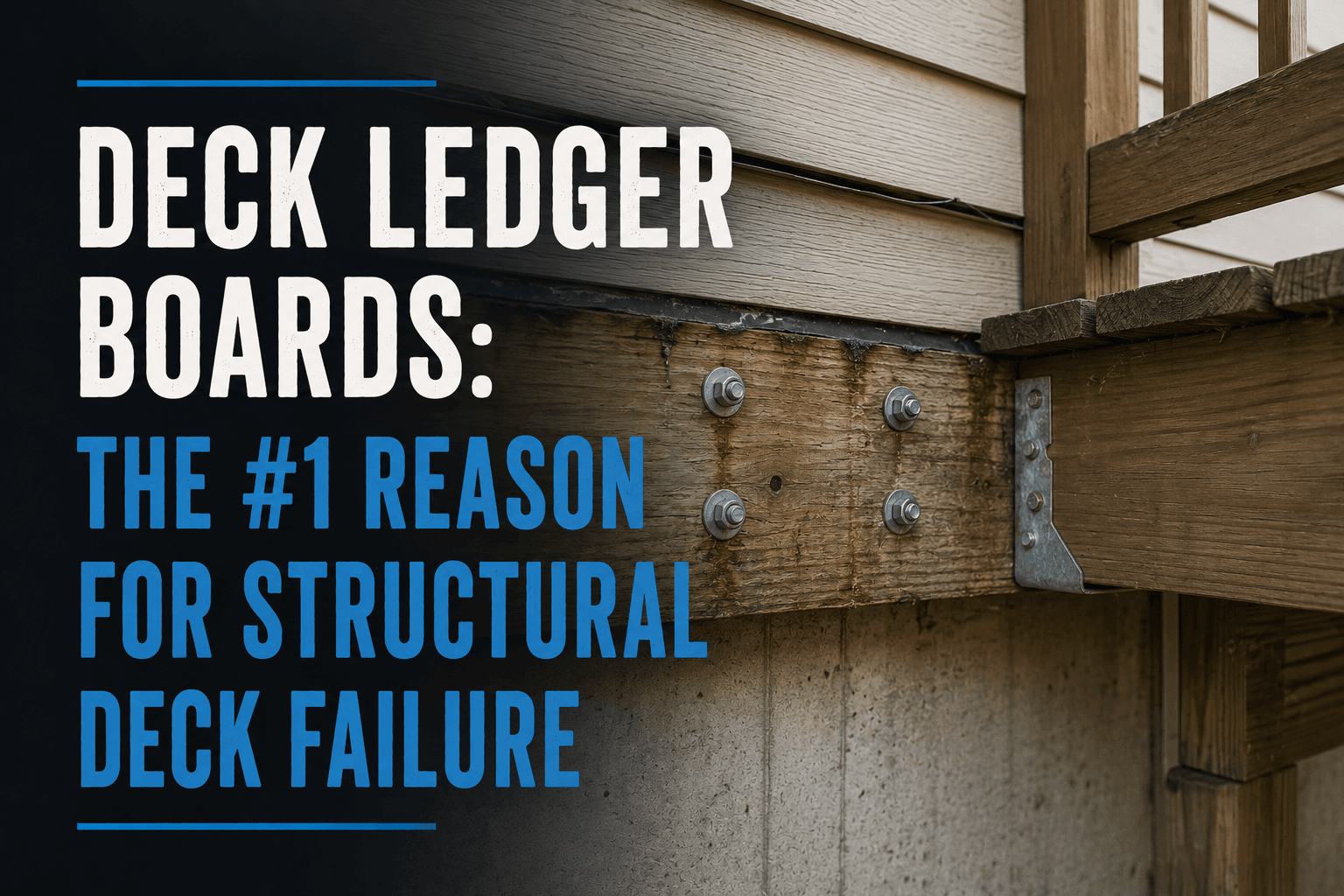
Decks don’t usually fail because the wood gets old.
They fail because the deck was never properly tied to the house in the first place.
And almost every time I see a serious deck problem, it leads back to one piece: the ledger board.
What the Ledger Board Does (And Why It Matters)
The ledger board is the connection point between the deck and the house. It carries a massive amount of load — people, furniture, grills, snow, movement.
If that connection fails, the deck doesn’t sag politely.
It drops.
That’s why ledger failures are responsible for some of the most violent deck collapses out there.
Where Things Go Wrong
Most ledger problems aren’t hidden. They’re just misunderstood.
The big ones I see:
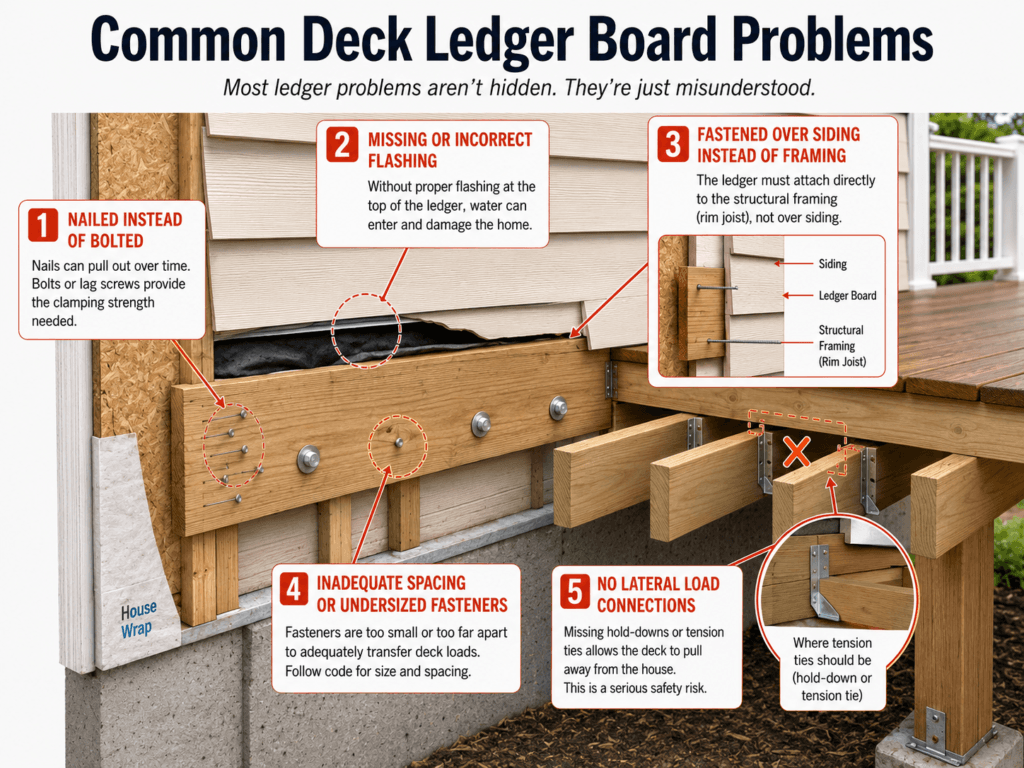
- Ledger boards nailed instead of bolted
- Missing or incorrect flashing
- Ledger fastened over siding instead of structural framing
- Inadequate spacing or size of fasteners
- No lateral load connections
A deck can look solid and still be hanging on by fasteners that were never meant to carry that load.
A Real Inspection Where the Deck Was Living on Luck
I inspected a home near Brownsville where the deck felt rock-solid underfoot. No bounce. No wobble.
Looked underneath and immediately saw the issue.
The ledger board was attached with nails only. No bolts. No washers. No flashing. The siding behind it was rotting, and the fasteners were already pulling.
That deck hadn’t failed yet — but it was absolutely on a timer.
Flashing Is Not Optional
If water can get between the ledger and the house, it will.
And once it does:
- The ledger stays wet
- The rim joist behind it rots
- Fasteners lose holding power
- The connection weakens silently
I’ve reviewed inspection photos from one of our inspectors in the Jonesboro area where the ledger looked intact — but the rim joist behind it was completely compromised. The deck was basically anchored to decay.
Bolts Matter. Spacing Matters.
Ledger boards need:
- Properly sized lag bolts or through-bolts
- Correct spacing based on load
- Solid attachment to framing — not brick veneer, not siding
Too few fasteners is bad. The wrong fasteners are worse.
And yes — nails don’t count.
Why “It’s Been Fine for Years” Isn’t Reassuring
This is the dangerous part.
Ledger failures often happen suddenly. No warning. No gradual sag.
The connection weakens over time until one day the load exceeds what’s left.
I’ve seen decks in West Tennessee that held up for decades — right up until they didn’t. Age doesn’t equal safety. It just means it hasn’t been tested yet.
What I Actually Check During an Inspection
When I evaluate a deck, I’m not just walking the surface.
I’m looking at:
- How the ledger is attached
- Fastener type and spacing
- Flashing presence and condition
- Signs of moisture damage
- Movement at the connection point
If I can’t see the ledger connection, that limitation gets documented. Hidden connections hide real risk.
Why Free-Standing Decks Are Often Safer
Interestingly, decks that don’t attach to the house avoid ledger issues entirely.
Free-standing decks transfer load to their own footings instead of relying on the home’s structure.
Ledger-attached decks can be perfectly safe — but only when done right.
What Buyers Should Understand
Deck repairs aren’t always cosmetic.
Fixing a ledger issue can involve:
- Removing deck boards
- Reflashing the connection
- Replacing rotted framing
- Rebuilding part of the deck
Catching the problem early is the difference between reinforcement and reconstruction.
The Inspector’s Bottom Line
Decks don’t fall because people overload them.
They fall because the ledger fails.
If that connection isn’t solid, properly flashed, and correctly fastened, the rest of the deck doesn’t matter.
That’s why I always start there — because gravity only needs one weak point.