
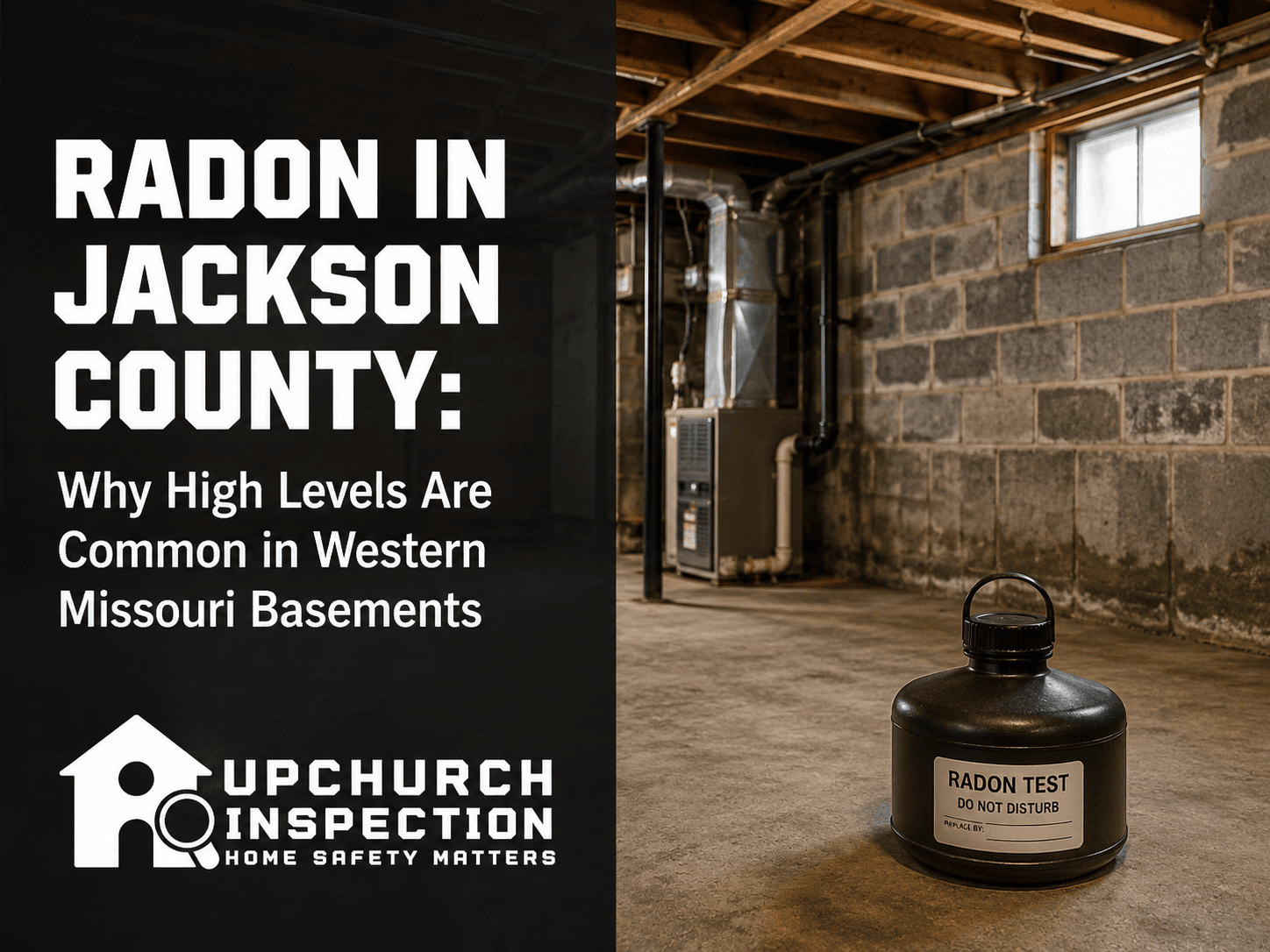
Radon Is a Regional Issue, Not a Random One
When I review reports from our Centerview, Missouri inspector working throughout Western Missouri, radon shows up far more often than many buyers expect. In Jackson County, elevated radon levels are not an anomaly—they’re a regional pattern tied directly to geology, soil composition, and how homes are built in this part of the state.
Homeowners are often surprised when a radon test comes back high, especially if the house looks solid, dry, and well maintained. But radon doesn’t care how new the roof is or how clean the basement looks. It follows the ground.
What Radon Actually Is—and Why It Ends Up Indoors
Radon is a naturally occurring radioactive gas released as uranium breaks down in soil and rock. It’s invisible, odorless, and tasteless. The only way to know it’s present is through testing.
In Western Missouri, radon is generated below the surface and moves upward through soil pores and rock fractures. When a home sits above that process, pressure differences between the interior of the house and the soil below can draw radon gas inside. Basements and crawlspaces become the primary entry points.
The issue isn’t whether radon exists underground—it does almost everywhere. The question is how easily it moves into the structure and whether it becomes concentrated indoors.
Western Missouri Geology Plays a Big Role
Jackson County sits over a mix of clay soils and limestone formations, and that combination matters. Limestone contains natural fissures and voids that allow soil gases to move laterally and vertically with relative ease. Clay soils, meanwhile, tend to trap moisture and seal the surface, forcing gases like radon to seek alternate pathways—often toward foundation openings.
Our inspector frequently sees this interaction play out in homes with basements. Radon migrates through cracks in basement slabs, control joints, sump pits, and utility penetrations. Even small openings can become effective entry points when pressure conditions are right.
This is why two houses on the same street can test very differently. Small differences in foundation design, sealing, and ventilation can dramatically affect indoor radon levels.
Basements vs. Slabs vs. Crawlspaces
In Jackson County, basement homes tend to show the highest radon readings, but slabs and crawlspaces are not immune.
Basements create a large surface area in direct contact with soil and rock. When interior air pressure drops—due to HVAC operation, bathroom fans, or stack effect in colder months—radon is pulled inward and accumulates.
Slab-on-grade homes can still test high, especially where slab cracks, plumbing penetrations, or expansion joints are present. Crawlspace homes may allow radon to build up beneath the structure and migrate upward into living spaces if the crawlspace is not properly sealed or ventilated.
Our inspector has documented elevated radon levels in all three foundation types across Western Missouri. The difference isn’t the presence of radon—it’s how effectively the home prevents it from entering and accumulating.
Seasonal Swings and Testing Timing
Radon levels are not static. In Western Missouri, seasonal changes can significantly affect test results. Levels often increase during colder months when homes are sealed tightly and the stack effect pulls soil gases upward. Summer storms can also influence readings by changing soil moisture and pressure conditions.
That’s why short-term testing during real estate transactions is only a snapshot. It provides valuable information, but it doesn’t represent a lifetime average. In several Jackson County inspections, our inspector noted borderline results that later tested higher during follow-up monitoring.
Understanding these fluctuations helps put results in context—especially when deciding on mitigation.
What We See During Radon-Related Inspections
When I review radon-related inspection reports from Jackson County, certain patterns repeat. Homes with open sump pits, unsealed slab penetrations, or unfinished basements tend to show higher readings. Finished basements don’t necessarily perform better; drywall and flooring don’t stop radon movement if the slab below is compromised.
We also see homes where prior mitigation systems were installed but not maintained. Fan failures, disconnected piping, or poorly routed discharge lines can reduce system effectiveness over time. A mitigation system is not a “set it and forget it” component—it requires verification and occasional maintenance.
Why High Radon Is So Often Missed
Radon is easy to ignore because it doesn’t create visible damage. There are no stains, no odors, and no immediate symptoms. That invisibility leads many homeowners to assume it isn’t an issue—until a test proves otherwise.
In Western Missouri, relying on assumptions is risky. Jackson County has a long track record of elevated radon readings across a wide range of neighborhoods, construction types, and home ages. New construction is not exempt, and neither are recently renovated homes.
The only reliable way to know is to test.
Mitigation Is Common—and Effective
The presence of radon doesn’t mean a home is defective. It means the home interacts with the ground in a predictable way. Mitigation systems are specifically designed to address that interaction by redirecting radon gas before it enters the living space.
In Jackson County, active sub-slab depressurization systems are common and generally effective when properly designed and installed. Our inspector often recommends verification testing after installation to confirm that levels have been reduced to acceptable ranges.
From an inspection standpoint, mitigation shifts the conversation from risk to management.
Putting Radon Findings in Perspective
When I review inspection reports that include radon testing, the most important factor is clarity. Elevated radon levels aren’t a judgment on the house—they’re information about how the structure interfaces with local geology.
In Western Missouri, and particularly in Jackson County, radon is part of the landscape. Understanding why levels are high, how they enter homes, and how they’re managed allows buyers and homeowners to make informed decisions without panic or guesswork.
Radon isn’t rare here. It’s regional. And that’s exactly why it deserves attention during the inspection process.