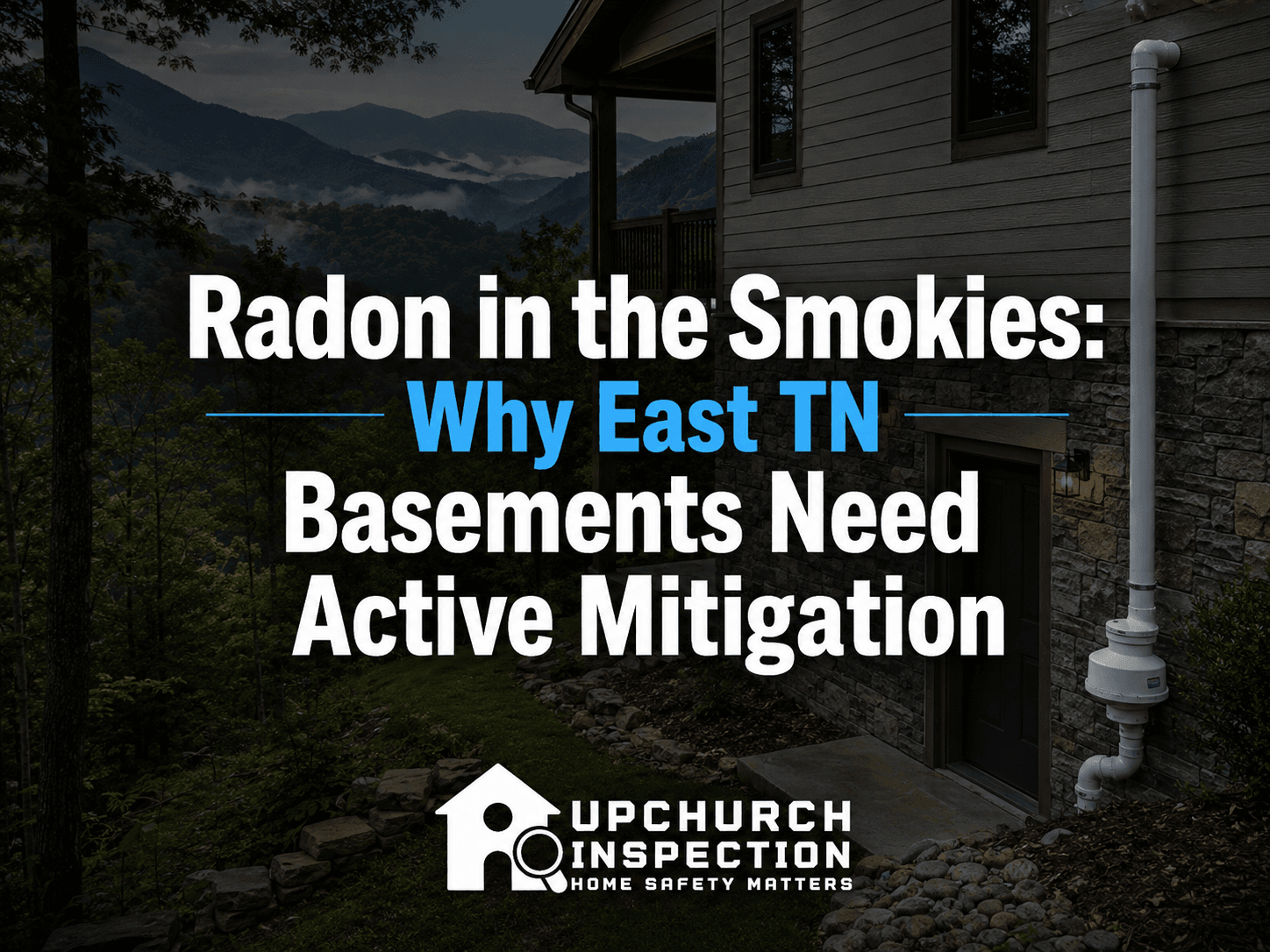
Radon in East Tennessee isn’t hypothetical. It’s not a “maybe.” It’s not something you wait to worry about after you move in. In this part of the state — Knoxville included — radon is baked into the geology, and basements are the easiest way for it to get inside your house.
If a home here has a basement and nobody tested for radon, that’s not an oversight. That’s a gamble.
East Tennessee Is a Radon Producer, Not a Fluke
The Smokies and surrounding ridges sit on uranium-bearing rock formations. That uranium decays naturally and releases radon gas. The gas doesn’t care about zip codes, views, or how nice the house looks. It moves through fractures, seams, and voids in the rock until it finds lower pressure.
Houses create lower pressure. Basements make it easy.
That’s why elevated radon levels in East Tennessee aren’t rare. They’re expected.
Basements Are Collection Chambers
A basement isn’t just extra space. It’s a big concrete box pushed down into radon-producing soil. Every crack, joint, and penetration becomes a potential entry point.
The usual suspects:
- Cold joints where the slab meets the wall
- Shrinkage cracks in poured concrete
- Utility penetrations below grade
- Sump pits that were never sealed
Once radon enters the basement, it doesn’t stay there. It mixes with indoor air and moves upward.
The Stack Effect Does the Heavy Lifting
Here’s the part most people don’t understand: your house pulls radon in.
Warm air rises and exits through the upper portions of the house. That creates negative pressure at the lowest levels. Nature fills that pressure difference with whatever is available — and in East Tennessee, that’s often radon-laden soil gas.
Multi-level homes amplify this effect. Finished basements make it worse by connecting living space directly to the lowest pressure zone in the structure.
“It’s a Walkout, So It’s Fine” Is Wrong
Walkout basements fool people. Because one wall is exposed, buyers assume radon can “escape.” That’s not how gas works.
Radon enters from the soil under and around the foundation, not just from one wall. Walkouts still have slabs, footings, and soil contact. I’ve tested plenty of walkout basements that came back elevated — sometimes very elevated.
Sunlight doesn’t neutralize geology.
New Construction Doesn’t Solve the Problem
I hear this one a lot: “It’s a newer house. Shouldn’t radon be lower?”
Sometimes it is. Sometimes it’s worse.
Tighter construction increases pressure differentials. Better air sealing means radon that enters is less likely to dilute naturally. If a passive radon system wasn’t installed correctly — or at all — new homes can test higher than older ones.
Energy efficiency and radon mitigation are not the same thing.
Passive Systems Aren’t Always Enough
Many East Tennessee homes rely on passive radon systems — a vent pipe that runs from below the slab up through the roof. Those systems help, but they’re not guarantees.
I’ve seen passive systems that:
- Weren’t sealed at the slab
- Had disconnected piping
- Terminated improperly in the attic
When radon levels come back elevated, active mitigation is usually the only reliable fix.
Active Mitigation Isn’t a Big Deal — Ignoring Radon Is
Here’s the good news: radon mitigation works. A properly installed active system reduces levels dramatically and predictably. This isn’t experimental science. It’s pressure control.
Fans create a lower-pressure zone beneath the slab than the house interior. Radon follows the path of least resistance — out of the building instead of into it.
The cost of mitigation is small compared to:
- Structural repairs
- Medical bills
- Or the value of the house itself
Testing After Closing Is Backwards
I’ll be blunt: testing for radon after you buy the house puts all the leverage on the wrong side of the table.
If radon is elevated before closing, it’s a negotiation item. After closing, it’s your problem.
I don’t care how competitive the market is. Skipping radon testing in East Tennessee is false economy.
Why East TN Buyers Get Burned More Often
A lot of buyers relocating into markets like Knoxville assume radon is a northern issue or a mountain issue farther east. By the time they learn otherwise, the deal is done.
Radon doesn’t show up in disclosures reliably. It doesn’t show up in photos. And it doesn’t announce itself until you test for it.
The Hard Truth
Radon is invisible. It’s odorless. And it’s the second leading cause of lung cancer in the U.S. Pretending it’s rare in East Tennessee doesn’t change the numbers.
Basements in this region don’t need hope. They need data.
For buyers evaluating homes across East Tennessee, radon testing isn’t optional — it’s baseline due diligence.
https://upchurchinspection.com/our-service-areas/home-inspections-in-east-tennessee/
You don’t have to be scared of radon.
You just have to stop ignoring it.