
Modern home inspections are built around concrete. Cracks in slabs. Spalling in poured walls. Vertical displacement you can measure with a level.
Midtown Memphis doesn’t play by those rules.
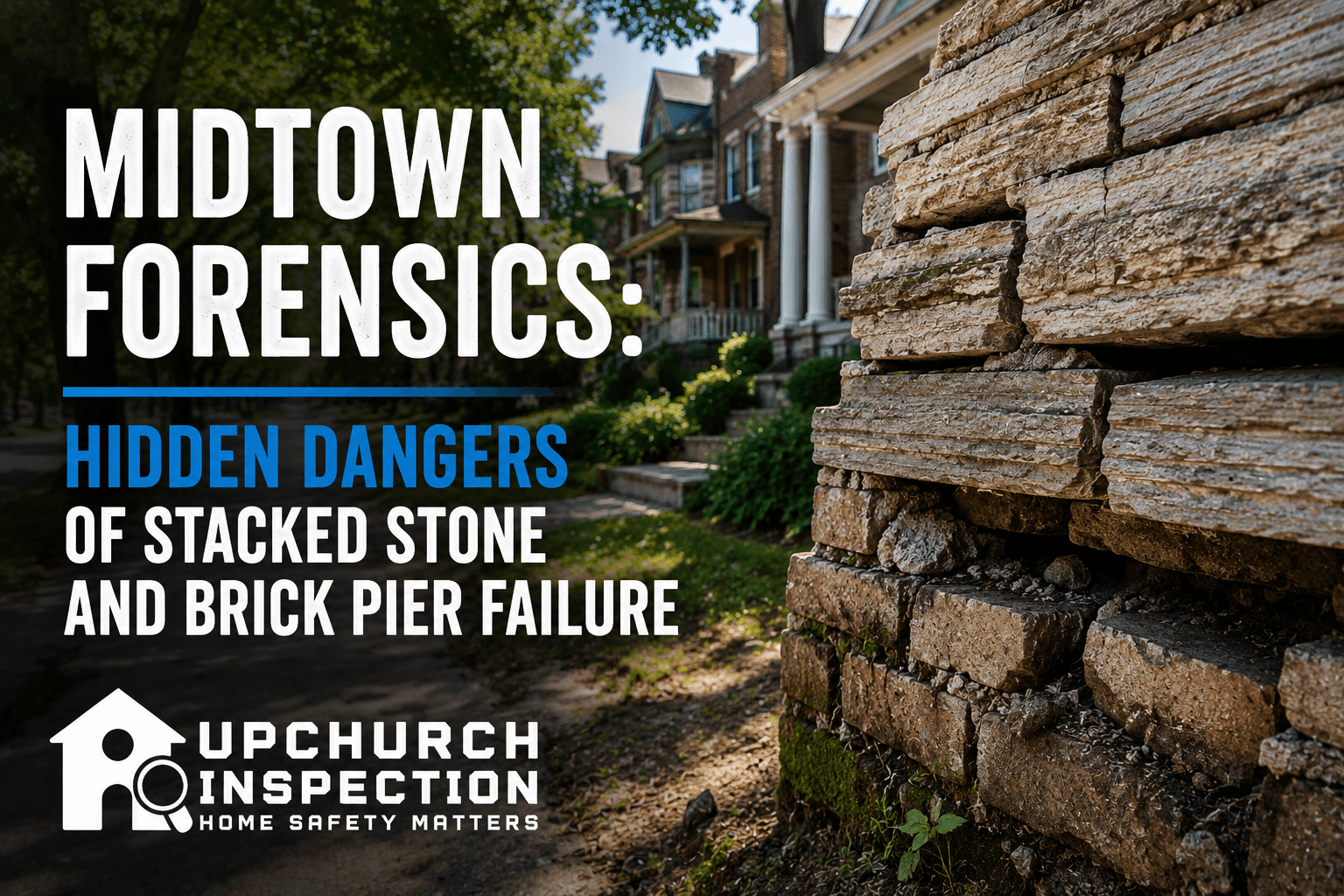
In neighborhoods like Central Gardens and Cooper-Young, many homes were built long before concrete became the default foundation material. What’s holding these houses up is often a patchwork of stacked stone, brick piers, and timber framing that has been “adjusted” for nearly a century. And those adjustments are where the real risk lives.
Why Midtown Foundations Are a Different Animal
Pre-1930s Construction Realities
Older Midtown homes were commonly built on:
- Rubble or stacked stone piers
- Brick piers laid without modern reinforcement
- Shallow footings bearing directly on native soil
These systems worked—until moisture, time, and repeated repairs took their toll.
Unlike concrete, stacked masonry doesn’t crack cleanly. It rots, erodes, leans, and compresses. Failure is gradual, uneven, and easy to hide.
The Real Enemy: Mortar Rot, Not the Stone
The stone or brick itself often survives. The weak link is the mortar.
In crawlspaces under Midtown homes, we regularly see:
- Mortar washed out from years of ground moisture
- Brick faces intact but no longer bonded
- Piers that look “solid” until they’re tapped or probed
Once mortar loses integrity, the pier stops acting as a column and starts acting like a stack of loose blocks.
That’s when movement begins.
Central Gardens: When “Historic Charm” Masks Structural Drift
In Central Gardens, many homes have been adjusted dozens of times since original construction.
Common findings include:
- Shims stacked above brick piers
- Wood blocks replacing failed masonry
- Piers leaning just enough to transfer load sideways
These fixes often worked temporarily. But temporary fixes repeated for decades create compound instability.
The structure above adapts. Floors slope. Doors are trimmed. Cracks are patched. The foundation keeps drifting.
Cooper-Young and the Shimming Cycle
In Cooper-Young, crawlspaces frequently tell the full story.
We often find:
- Fresh shims next to 80-year-old ones
- Piers that have been “squared up” multiple times
- Beams bearing on partial contact instead of full surface area
This creates point loads—concentrated stress that masonry was never designed to handle.
Eventually, the pier doesn’t fail dramatically. It leans, compresses, or slides.
Why Jacks and Beams Are Usually a Stopgap
Homeowners are often told:
“We’ll jack it up and add a beam.”
In Midtown homes, that’s rarely a permanent solution.
Why?
- Jacking corrects height, not soil or pier stability
- New beams still rely on old masonry unless piers are rebuilt
- Load redistribution can overstress adjacent piers
Without rebuilding or properly underpinning failing piers, jacking simply resets the clock.
Inspection Clues You Can’t Ignore
When inspecting older Midtown homes, we pay close attention to:
- Out-of-plumb piers
- Masonry separation at the base
- Shims exceeding reasonable thickness
- Differential sag across the same beam line
These aren’t cosmetic issues. They’re indicators of load path failure.
What Buyers Need to Ask Before Closing
If you’re buying in Central Gardens or Cooper-Young, the right question isn’t:
- “Has the house been leveled?”
It’s:
- “Why did it need leveling—and what failed underneath?”
A house that’s been adjusted once may be stable.
A house that’s been adjusted repeatedly is telling you something.
Final Thoughts
Midtown foundations don’t fail like modern ones. They age, adapt, and eventually lose structural integrity through small, cumulative losses.
Understanding stacked stone and brick pier behavior is critical when buying historic Memphis homes. This isn’t about fear—it’s about knowing what’s actually holding the house up.
Ensuring your West Tennessee investment is a safe one, requires the knowledge of a professional inspector. View our West Tennessee Service Area to see a full list of towns we serve.