
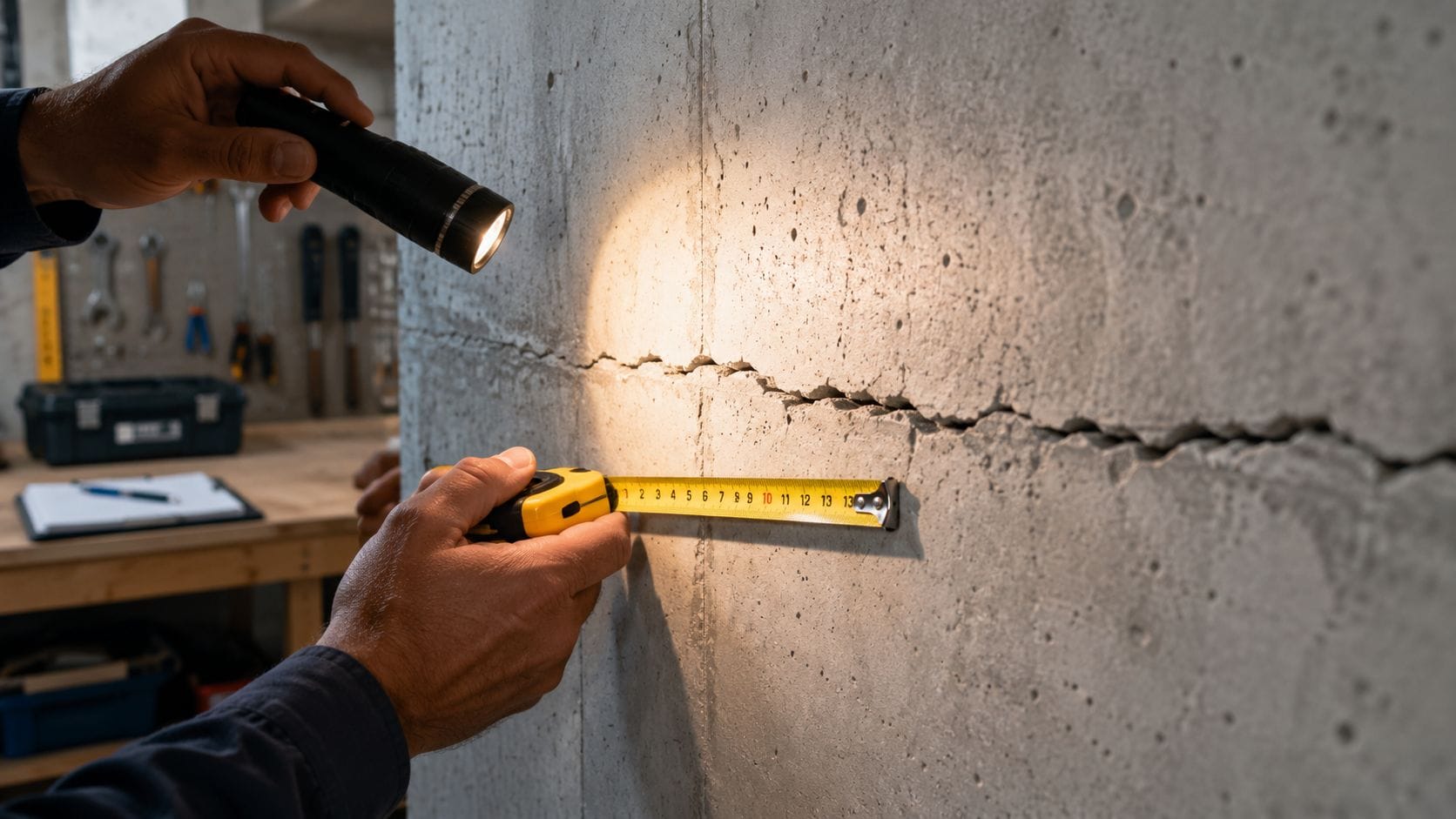
You're halfway down the basement stairs when you spot it, a horizontal line running across the block wall, maybe with a little dampness, maybe with a slight curve in the wall that you hadn't noticed before. That's the kind of finding that makes people stop and stare, because a horizontal crack in a basement wall doesn't feel like a small cosmetic issue. It feels like something that could turn into a real problem.
The good news is that you don't have to guess your way through it. A horizontal crack in basement wall serious enough to matter usually leaves clues you can evaluate before anyone starts talking about repairs. The key is to separate a crack that needs monitoring from one that points to lateral wall movement, bowing, or a load-related failure that needs prompt evaluation. ASHI's 2025 inspection guidance treats measurable movement and crack width as important thresholds, not just visual impressions, and that's the right mindset here, because the wall's movement matters as much as the line itself. cracked foundation warning signs is a useful companion read if you want another plain explanation of what foundation cracks can mean in the field.
In Southeast Missouri and Mid-Missouri, this comes up a lot in basements and crawlspaces where drainage, clay soils, and seasonal moisture swings keep pressure on foundation walls. That doesn't mean every crack is an emergency, and it definitely doesn't mean every wall needs replacement. It does mean you should look at the crack as a possible sign that the wall has been pushed past its comfortable range at that spot, then move methodically from observation to documentation to the right kind of help. For a quick sorting tool on which cracks tend to matter, Upchurch Inspection's page on cracks that matter vs cracks that don't fits this topic well.
Table of Contents
- Introduction What Finding a Horizontal Crack Really Means
- How Horizontal Cracks Form and Why They Matter More
- How to Tell If a Horizontal Crack Is Serious
- What You Can Safely Check and Monitor Right Now
- When to Call an Inspector or Structural Engineer in the Mid-South
- Common Repair Options and What Influences Cost and Choice
- Next Steps to Protect Your Home and Move Forward With Confidence
Introduction What Finding a Horizontal Crack Really Means
A homeowner in Cape Girardeau, Jackson, or Columbia usually spots the crack during a routine basement check, then starts looking harder at the wall, the floor line, and any damp spots nearby. That reaction makes sense. A horizontal crack draws attention because it does not look like the usual hairline shrinkage line people expect in concrete or block.
The question is what the crack is saying about the wall. In many cases, it points to lateral pressure from the outside. ASHI's 2025 guidance says a long horizontal crack at the second or third mortar joint, especially with step cracks and inward movement, points to structural trouble, and cracks over 1/8 inch wide with 1/2 inch or more of horizontal wall movement need to be addressed through ASHI's basement crack guidance. The crack line is the symptom, the bowing is the structural story.
Practical rule: if the wall is leaning inward, bulging, or changing over time, treat the crack as structural until someone qualified says otherwise.
A horizontal crack does not mean the basement is about to fail tomorrow. It also does not mean every wall needs a full rebuild. It does mean the cause is usually more serious than normal settling, and the next step should be an informed evaluation, not a surface patch. I've seen plenty of homeowners focus on the visible line and miss the bigger question, which is whether the wall is still moving.
In the Mid-South, drainage and clay soils often keep pressure on foundation walls, so this shows up often in basements and crawlspaces. That is why a calm, field-based check matters. Use the crack as a clue, then sort what you can safely watch from what needs a closer look. If you want a plain way to separate the two, Upchurch Inspection's guide on cracks that matter vs cracks that don't is a useful place to start.
For buyers, sellers, and investors, the next move is simple. Document the crack, note whether it is widening or tied to bowing, and get the right level of review before making repair or negotiation decisions. For a quick caution on what foundation cracks can mean, cracked foundation warning signs is a useful companion read.
How Horizontal Cracks Form and Why They Matter More
Horizontal cracks form when the wall is being pushed from the outside hard enough that its tensile capacity gives way. In plain English, the soil and water outside the foundation are loading the wall sideways, and the wall bends until it cracks. That is why a horizontal crack is treated differently from a vertical crack, which more often comes from shrinkage or normal movement.
A basement wall is supposed to act like a retaining wall. When wet soil, clay expansion, or freeze-thaw pressure build up outside, the wall starts to bow inward, and the crack often appears where the bending stress is greatest, usually near the middle height of the wall. Guidance on bowing basement walls notes that a horizontal crack at or near mid-wall height is one of the clearest visual signs of active bowing, and that cracks wider than 1/8 inch or cracks that keep widening should be evaluated promptly through guidance on bowing basement walls.
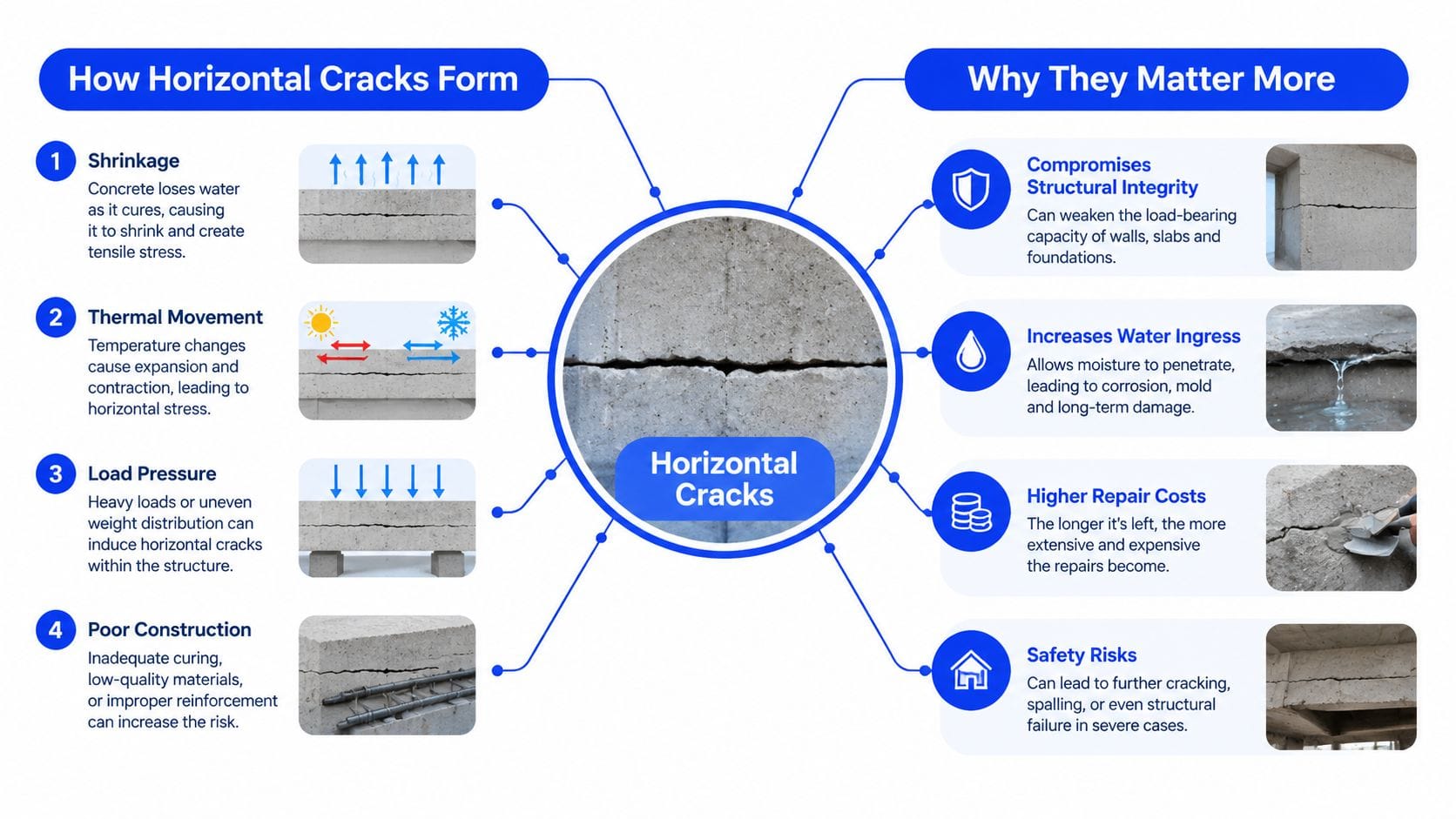
What the crack is really showing
The crack is not just a water path. It is evidence that the wall has already been stressed beyond what it was designed to carry in that location. A block wall can show that stress along mortar joints, while a poured wall may show it across a single horizontal plane. Either way, the concern is the same, the wall is being loaded laterally and is starting to deform.
Horizontal cracking is a load problem first, a moisture problem second.
That distinction matters in the Mid-South. In places around Farmington, Perryville, Sedalia, and Jefferson City, drainage patterns and soil moisture can change fast after heavy weather, so the wall may see repeated sideways pressure instead of one isolated event. When that pressure keeps building, sealing the crack alone won't solve the cause. The crack may stop leaking for a while, but the wall can still keep moving.
The practical takeaway is simple. Horizontal cracks matter more because they point to structural loading, not just cosmetic change. Once you understand that, you can stop asking, “How do I hide the line?” and start asking, “Is the wall moving, and why?”
How to Tell If a Horizontal Crack Is Serious
A homeowner usually starts asking the right question after the crack stops looking random. Issue is whether the wall is still holding its line or whether lateral pressure is already changing its shape.
Severity comes down to width, movement, and wall behavior. Horizontal cracks that are wider, growing, or paired with inward movement deserve more attention than a thin line that has stayed unchanged. In the Mid-South, that matters because wet soil, poor grading, and drainage that sends water back toward the foundation can keep loading the wall after a storm has passed.
What I look for in the field is not just the crack itself, but whether the wall is bowing inward, whether the crack is widening, and whether there are step cracks, water staining, or a damp seam nearby. A horizontal crack at the second or third mortar joint, especially with inward movement, is much more concerning than a crack with no visible deformation. A crack near mid-wall height also deserves extra attention because that's where bowing often shows up first. ASHI's guidance on basement cracks and leaks and the discussion in independent 2026 structural guidance both point in the same direction, once a wall starts moving, sealing the surface does not fix the load on the wall.
Severity Signals for Horizontal Basement Wall Cracks
| Observation | What It Suggests | Next Action |
|---|---|---|
| Hairline horizontal crack with no visible bowing | Structural stress may be present, but movement may be early | Document it and arrange evaluation |
| Crack wider than 1/8 inch | Heightened concern, especially if the line is active | Prompt professional review |
| Crack with inward wall movement or bowing | Lateral pressure is actively deforming the wall | Prioritize inspection and likely engineering input |
| Horizontal crack plus step cracks | Structural trouble is more likely than simple shrinkage | Escalate quickly |
| Crack that is widening or leaking | The condition may be changing, not stable | Photograph, measure, and seek evaluation soon |
| More than 2 inches of inward deflection | Substantial displacement, possible loss of structural integrity | Engineer-level assessment is warranted |
For a buyer, seller, or investor, the question is less about the crack label and more about whether the wall is in a stable condition. A modest DIY estimate can help separate a quick look from a fuller review, and the DIY foundation check costs page is useful for understanding that difference. If you want context on how settlement fits into the picture, see what is foundation settlement, since settlement and lateral wall movement are different problems. One can be localized. The other can point directly to structural loading.
What You Can Safely Check and Monitor Right Now
Start inside the basement with a plain visual scan. Look at the crack's direction, where it sits on the wall, and whether the wall surface looks straight or curved. A simple straightedge, level, or even a long board can help you notice bowing without prying on anything or trying to force a diagnosis.
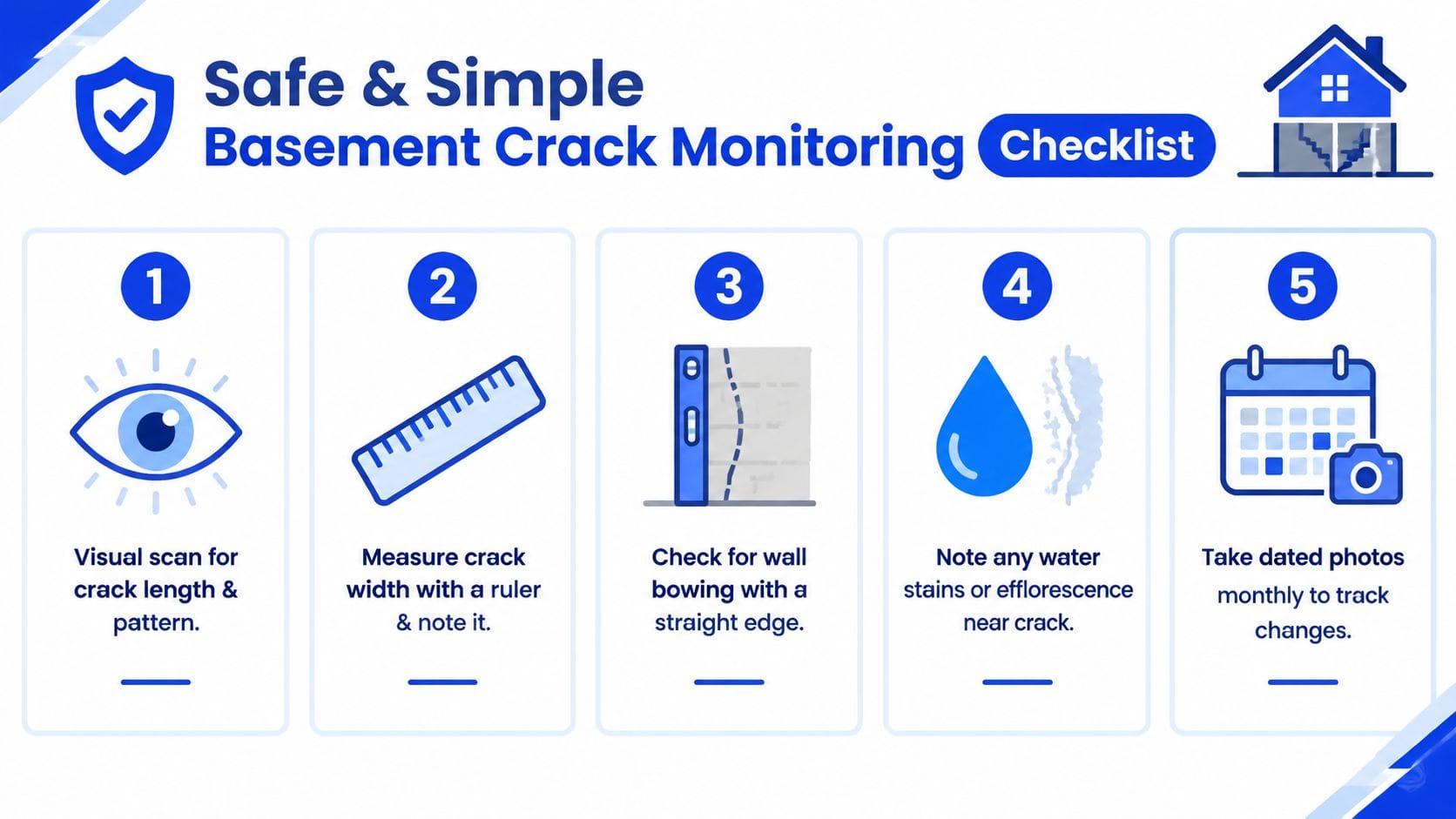
Safe checks that tell you something useful
- Measure the crack width: Use a ruler and write down the measurement so you can compare it later.
- Photograph the wall: Take close photos and wider shots that show the whole wall section.
- Mark the ends: A small pencil mark at each crack end helps you see whether it lengthens.
- Note moisture signs: Water stains, white mineral deposits, or damp block faces matter.
- Check the exterior drainage: Look at gutters, downspouts, grading, and any pooling water near the foundation.
Those checks are safe because they don't alter the wall or hide the evidence. They also give an inspector or engineer better information if the condition changes later. In Missouri, where clay-heavy soils can hold water and freeze-thaw cycles can make wet soil harder to manage, drainage problems can keep pressure on the wall long after a storm passes. That's why a downspout that dumps near the foundation or a yard that slopes toward the house is not a minor detail.
What you shouldn't do is just seal a structural crack and call it fixed. Surface patching can help with water intrusion, but it does not remove the outside pressure that caused the wall to move. It can also make it harder to track crack growth later. I'd also avoid excavating outside the wall unless someone has already told you that's part of the right corrective plan.
If the crack is active, treat drainage as a priority, but treat the wall itself as a separate issue.
For sellers and investors, dated photos and a simple notebook entry with width, location, and moisture notes are worth keeping. For buyers, those notes help you ask sharper questions during the inspection period instead of waiting for a seller disclosure to tell the full story. The goal here is not to fix the foundation yourself. The goal is to gather clean, honest observations.
When to Call an Inspector or Structural Engineer in the Mid-South
A horizontal crack often shows up in a basement that already has a story. Maybe the wall has started to bow, maybe the floor is damp after a storm, or maybe the crack was found during a home purchase and nobody knows how long it has been there. That is the point where a clear, field-based look matters.
A home inspector is usually the first call when you need condition documentation and a broader read on the house. An inspector can record crack direction, width, wall movement, moisture staining, grading problems, and nearby issues without pretending to give the final structural word. That kind of report helps buyers, sellers, and investors decide what needs attention now and what can be watched.
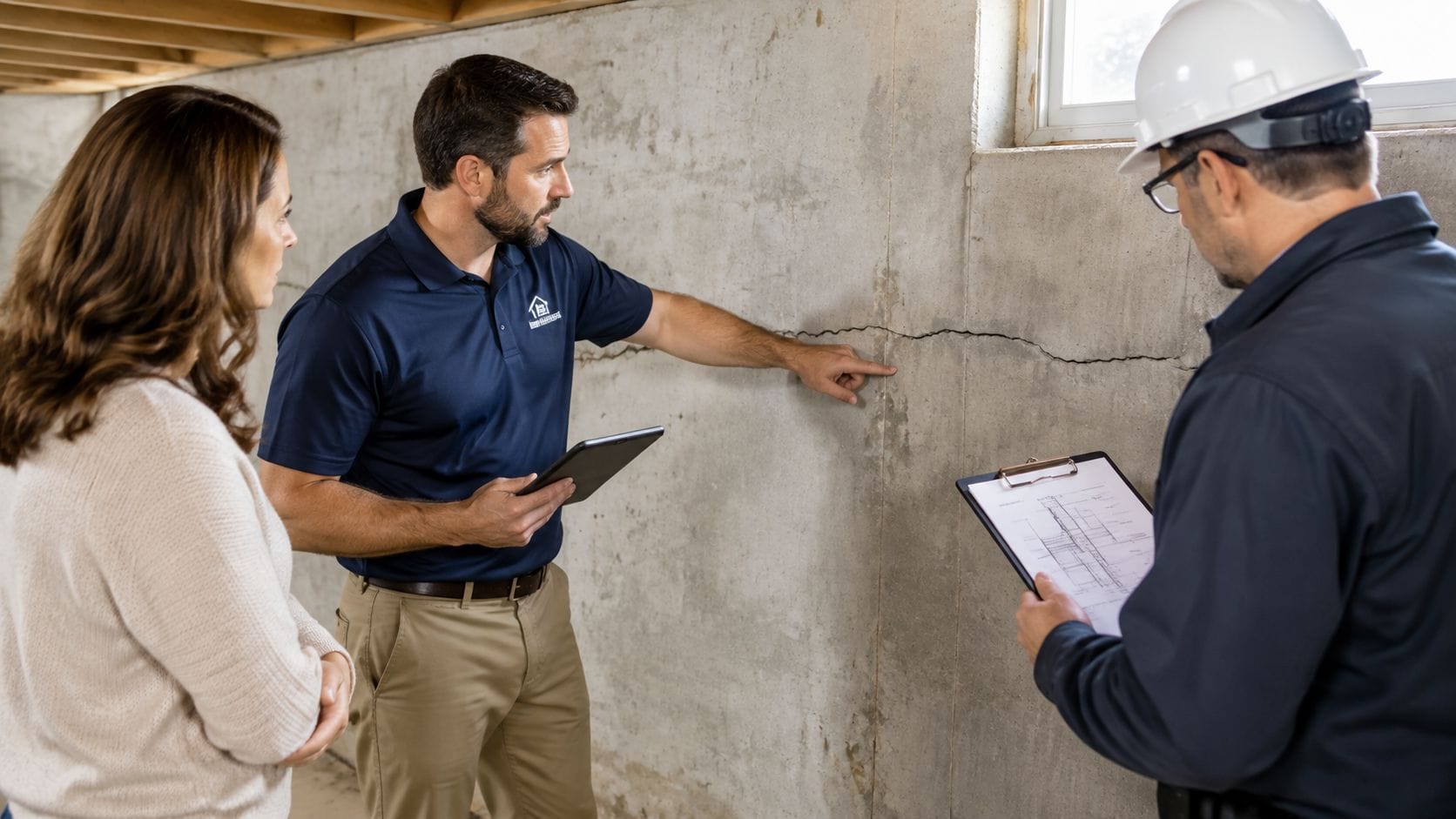
Who should look at it first
- Home inspector: Best for documenting the crack, wall condition, drainage, and related concerns in a sale or maintenance setting.
- Structural engineer: Best when the wall is bowed, the movement can be measured, or the repair plan needs independent analysis.
- Contractor: Useful after the cause is understood, especially when you need a scoped repair proposal.
A horizontal crack is not something to brush off if it shows active movement or measurable inward deflection. Guidance on horizontal crack severity thresholds treats that pattern as a sign of structural stress, and a wall with significant inward movement can lose enough integrity that stabilization in place is no longer the simple answer. In those cases, engineer-level evaluation matters because someone needs to measure the wall, judge the movement, and sort out whether drainage correction, reinforcement, or replacement fits the condition.
In the Mid-South, including places like Cape Girardeau, Jackson, Sikeston, Poplar Bluff, Farmington, Perryville, Columbia, Jefferson City, Fulton, Boonville, and Sedalia, the soil and drainage setup often decides how serious the crack becomes. Clay-heavy ground holds water, and wet soil keeps pushing on the wall long after the weather clears.
A licensed structural engineer guide is useful for understanding why an engineer's role is different from a contractor's role when the wall needs independent review. The question changes from “what repair should be done” to “what is the wall doing, what caused it, and what fix fits the condition.”
Upchurch Inspection's engineer's evaluation guidance fits here too, because it helps sort out when an inspection report is enough and when a structural opinion is the better next step. I use that line any time a buyer is under contract, a seller is preparing disclosures, or an investor is comparing older homes with basement movement.
Common Repair Options and What Influences Cost and Choice
The right repair depends on the cause, not just the crack. If water is building up outside the wall, drainage and grading need attention because they reduce the pressure that keeps loading the foundation. If the wall is already bowed, reinforcement may be needed to stabilize the movement. If the wall has lost too much integrity, replacement may come up in the conversation.
Drainage corrections are usually part of the long-term fix because they address the soil moisture driving lateral pressure. That includes downspout extensions, gutter maintenance, and grading that moves water away from the house. In a place with clay soil and seasonal freeze-thaw cycles, that outside water management matters because saturated soil gets heavier and keeps pushing.
Repair choices compared by job, not by hype
- Drainage and grading correction: Best when the wall needs less outside pressure, and it also supports other structural repairs.
- Carbon fiber straps or similar reinforcement: Better for walls with limited inward movement where the goal is to stop further bowing.
- Wall anchors or braces: Used when the wall needs active counter-pressure and more correction force.
- Full wall replacement: Considered when the wall has severe displacement or has lost too much structural integrity to stabilize safely.
Homeowners sometimes get led astray by a crack-sealing pitch. Surface sealants can help with leakage, but they don't answer the structural question. A horizontal crack is still a sign of stress even if the face of the wall looks cleaner afterward. The better repair discussion is about wall performance, not just appearance.
Ask every contractor the same thing, what is causing the wall movement, and how will this repair change that condition over time?
That question helps buyers and investors compare proposals more intelligently. It also keeps the conversation focused on the actual failure mechanism, which is the only way to know whether the repair is stabilization, correction, or replacement. A repair that fits the load condition is worth more than a prettier crack line.
Next Steps to Protect Your Home and Move Forward With Confidence
If you own the home, start with photos, measurements, and drainage fixes, then schedule an inspection if the crack is wide, active, or paired with inward movement. If you're buying, use the finding to negotiate for documentation, further evaluation, or repair credit instead of treating it like a generic basement blemish. If you're selling, disclose it plainly and gather clear records so the next conversation is about facts, not surprises.
For investors and property managers, a horizontal crack should move up the priority list because it can affect habitability, financing, and long-term maintenance planning. The practical approach is simple, document the wall, correct the water management problems you can safely correct, and get the right specialist involved when the wall itself shows movement. A measured response is usually better than panic, and it's certainly better than cosmetic patching that hides the evidence.
If you're seeing a horizontal crack in a basement wall and you want a clear, field-based read on what it means, Upchurch Inspection can document the condition, note related moisture and movement signs, and help you decide whether an engineer's review makes sense. Visit Upchurch Inspection to set up an inspection that gives you the facts you need before you commit to repairs, negotiations, or a sale.