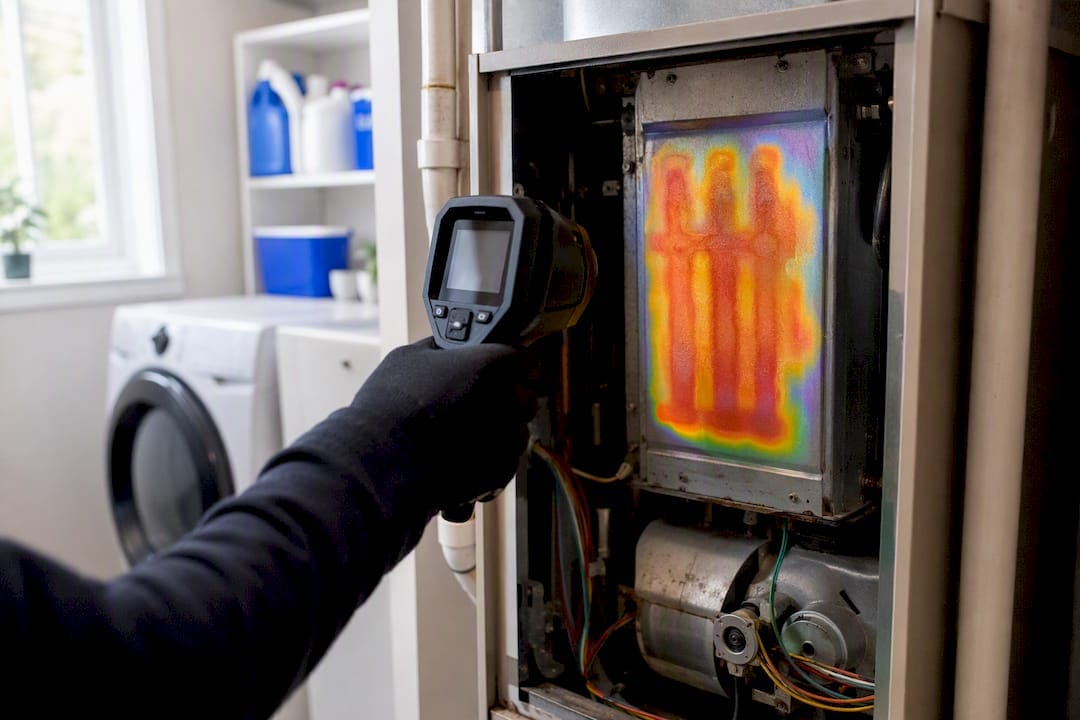
If you suspect a cracked heat exchanger, shut the furnace off now and don’t turn it back on until a qualified HVAC technician confirms it’s safe. This isn’t a “monitor it for a while” situation. Heat exchanger cracks let combustion gases, including carbon monoxide, mix with the air your system pushes into your living space.
Here’s the immediate checklist:
- Shut off the furnace (thermostat off, or kill power at the switch/breaker if you’re not sure the thermostat will stop it)
- If a CO alarm is sounding, get everyone outside immediately and call 911 or your local fire department
- Ventilate the house if it’s safe to do so, opening windows and doors on your way out
- Call a licensed HVAC technician for a combustion safety inspection before running the furnace again
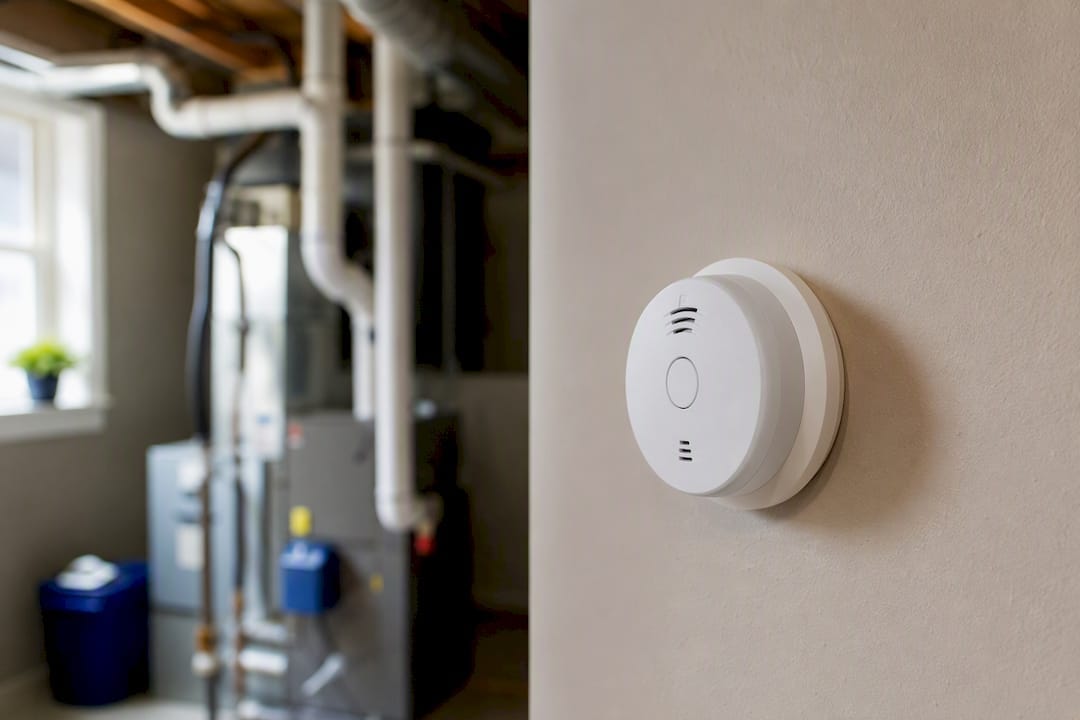
A working carbon monoxide alarm is the single cheapest insurance policy against a cracked heat exchanger. Don’t wait on symptoms. Wait on the alarm, and act the second it goes off.
Key Takeaways
A cracked heat exchanger is a carbon monoxide safety issue first and a repair decision second, and no confirmed crack should be run again without a technician’s documented sign-off.
| Point | Details |
|---|---|
| Shut down immediately | Turn off the furnace and evacuate if a CO alarm sounds, no exceptions. |
| Airflow is the top cause | Dirty filters and blocked vents drive most premature exchanger cracking, per manufacturer guidance. |
| Demand real diagnostics | Ask for combustion analyzer numbers, not just a visual opinion, since second opinions confirm only about 1 in 10 suspected cracks. |
| Replacement beats repair | Welding or patching a cracked exchanger is rarely recommended since fatigue usually extends beyond the visible crack. |
| Get an independent check | Upchurchinspection’s combustion testing and thermal imaging give documented evidence before you commit to a repair or replacement. |
Table of Contents
- What Heat Exchanger Cracks Actually Compromise
- Why Heat Exchangers Crack in the First Place
- Warning Signs of Heat Exchanger Damage
- The Real Danger: Carbon Monoxide and What Follows
- Can a Cracked Heat Exchanger Be Repaired?
- What to Do Right Now If You Suspect a Crack
- How Inspectors Separate Real Cracks From Cosmetic Noise
- Sources
What Heat Exchanger Cracks Actually Compromise
A furnace heat exchanger is a sealed metal chamber, usually stainless steel or aluminized steel, that lets heat pass from burning gas into the air circulating through your ducts, without ever letting the two mix directly. Combustion gases stay on one side, walled off, while a blower pushes house air across the outside of that metal to warm it. That wall is the entire safety design.
Most units use a clamshell or serpentine tube shape with multiple welded seams and tight bends, which are common sites for metal fatigue. Picture a cross-section: burner flame on one side of a thin metal wall, return air on the other. A crack anywhere along that wall creates a direct path for flue gas, including CO, straight into your supply air.
The exchanger isn’t a performance part. It’s a containment vessel. Once it’s breached, you don’t have a furnace problem anymore. You have an air-quality problem.
Why Heat Exchangers Crack in the First Place
Restricted airflow is the cause we find most often in the field, and it lines up with what manufacturers report too. A dirty filter, closed supply registers, or blocked return grilles force the exchanger to run hotter than it’s designed for, and that repeated overheating leads to the kind of premature cracking Trane documents in its own troubleshooting guidance. A handful of other causes also show up regularly:
- Oversized furnaces that short-cycle, heating the space quickly then shutting off before the exchanger reaches stable temperature, stressing the metal with constant expansion and contraction
- Corrosion from condensate, especially in high-efficiency units where acidic condensation can eat through metal if drainage isn’t managed correctly
- Simple age and metal fatigue, since even a well-maintained exchanger has a service life and thinner metal cracks faster under thermal stress
- Poor original installation, including undersized ductwork that restricts airflow from day one
Prevention tracks directly to these causes: change filters on schedule, keep registers open, make sure your furnace was sized correctly for the space (not just upsized “to be safe”), and if you run a high-efficiency condensing furnace, confirm the condensate line and PVC venting are working as designed.
Pro Tip: During a walkthrough, we’ll often run a thermal camera across the return and supply plenums. Uneven heat signatures across the exchanger surface, or a supply register that reads noticeably cooler than its neighbors, points to airflow restriction long before a crack ever shows up on a visual check.
Warning Signs of Heat Exchanger Damage
Some signs show up in the house, some in the furnace itself. A triggered CO alarm is the loudest and most urgent one there is, but headaches or flu-like symptoms that ease up once you leave the house are a pattern worth taking seriously, especially if more than one person in the home notices it. An unusual metallic or formaldehyde-like smell when the furnace kicks on is another cue.
On the equipment side, watch for:
- A yellow or flickering flame instead of steady blue
- Soot or black streaking around the burner compartment or vent
- Visible rust or corrosion on the exchanger housing
- Water or condensate pooling somewhere it shouldn’t be
- Short cycling or repeated flame rollout trips (the furnace shutting down and relighting on its own)
CO alarms and flame rollout trips are immediately actionable; shut the system down. Soot, corrosion, and odd smells need a technician with a combustion analyzer to confirm what’s actually happening, since only a minority of suspected cracks are confirmed on second inspection in one long-running service provider’s experience. That number alone tells you visual suspicion and a confirmed crack aren’t the same thing.
The Real Danger: Carbon Monoxide and What Follows
Carbon monoxide has no color and no smell, which is exactly what makes it dangerous. The CDC’s guidance on CO exposure is blunt about this: you cannot detect it with your senses, only with a working alarm. Low-level leakage from a cracked exchanger can cause chronic symptoms that get blamed on the flu or stress for months. Acute exposure from a larger breach can be life-threatening in a matter of hours.
There’s a secondary layer too. A cracked exchanger often runs less efficiently, producing more soot and more incomplete combustion, which in turn generates even more CO than a clean burn would. In rare, extreme cases, deteriorating metal near a burner can raise fire risk as well.
Manufacturer guidance from Lennox on cracked heat exchangers is consistent with what we see on inspections: treat any confirmed crack as a shutdown event, not a maintenance item. A technician diagnosing this properly will run combustion analysis at the flue, test CO levels at supply registers, and do a visual inspection of accessible exchanger surfaces before making a call.
Can a Cracked Heat Exchanger Be Repaired?
Welding or patching a cracked exchanger is rarely the right move, and most reputable technicians won’t do it. The metal fatigue that caused one crack is usually present throughout the assembly, so a patch job just relocates the failure point. Replacement of the exchanger, or in many cases the whole furnace, is the standard recommendation.
Here’s how the decision usually breaks down:
- Furnace under 10 years old and still under warranty: an exchanger swap is often covered under parts warranty, with labor typically running several hundred to over a thousand dollars depending on accessibility and unit type
- Furnace 10 to 15 years old: replacing just the exchanger can cost close to what a new furnace would, since labor to disassemble the unit is substantial either way, so full replacement is usually the better value
- Furnace over 15 years old: full replacement is almost always the right call, since you’re also getting improved efficiency and a fresh warranty period
Before signing off on any of this, ask your technician a few direct questions:
- What were the actual combustion analyzer numbers, not just “it failed”
- Can they show you the crack, either in place with a camera or on the removed part
- Would they document findings in writing for warranty or insurance purposes
- Is a second opinion reasonable given the cost involved
A technician confident in the diagnosis should have no problem showing you the evidence.
What to Do Right Now If You Suspect a Crack
- Shut the furnace off completely
- If a CO alarm is active, evacuate immediately and call emergency services
- Ventilate the house once it’s safe to re-enter
- If there’s no active alarm but you’ve noticed symptoms or odd furnace behavior, schedule a qualified HVAC inspection before running the system again
When the technician arrives, be specific. Tell them exactly what you observed, when it started, whether your CO detector has ever registered a reading (even a low one), and whether the furnace has been short-cycling or tripping on flame rollout. Vague descriptions lead to vague diagnoses.
Before they leave, ask for:
- Printed or photographed combustion analyzer readings
- Flue and supply-register CO numbers
- Photos of the crack, or the removed exchanger itself if it’s replaced
- A written estimate that separates labor from parts
That paperwork matters later, whether you’re filing a warranty claim, disputing a bill, or just want a record for the next buyer if you sell the house.
How Inspectors Separate Real Cracks From Cosmetic Noise
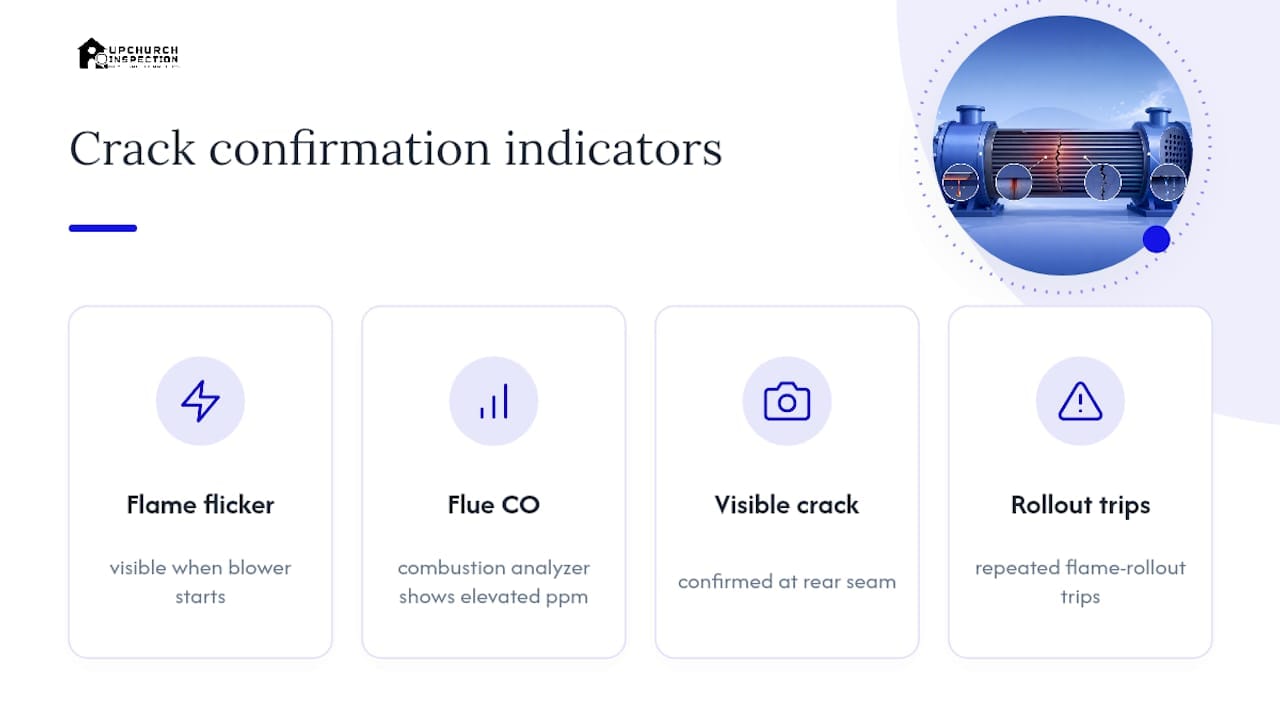
On-site, we’re looking for specific, repeatable evidence, not just a rust spot that looks alarming in a flashlight beam. Flame disturbance when the blower kicks on is one of the clearest tells: if the flame visibly moves or flickers as air pressure changes around the exchanger, that’s a strong sign of a breach. Combustion analyzer readings showing elevated flue CO back that up with numbers instead of guesswork. Repeated flame rollout trips are another hard indicator.
What doesn’t automatically mean condemnation: surface rust on the exterior housing, or a minor seal gap around a panel that isn’t a through-wall crack in the exchanger itself. We’ve seen homeowners panic over corrosion that’s cosmetic and stable, and we’ve also seen technicians use a quick flashlight glance to justify a full furnace replacement quote. Both extremes are wrong.
A proper report should use specific language, something like “confirmed crack visible at the rear seam, flue CO reading of [X] ppm, flame disturbance observed at blower startup,” not just “heat exchanger appears compromised.”
Pro Tip: If a written report just says “recommend replacement” with no numbers behind it, ask for the combustion analyzer printout before you approve anything. A real finding has data attached to it.
A Field Note on What Actually Goes Wrong
The mistake we see most often isn’t ignoring a real crack. It’s homeowners accepting a diagnosis with no data behind it, or assuming a scary-looking rust patch means the whole unit is done. A second opinion, especially when the recommendation is full replacement, is almost always worth the trip charge. In the Mid-South, our humid summers and heavy seasonal furnace use mean corrosion moves faster than in drier climates, so an annual pre-season check earns its keep here more than in most regions.
How Upchurchinspection Confirms What You’re Really Dealing With
A furnace tech has an obvious incentive to sell you a new unit. An independent inspection doesn’t carry that conflict. Upchurchinspection runs combustion testing and thermal imaging as part of its HVAC evaluations, giving you documented numbers, not just a verbal opinion, before you spend money on a repair or a full system swap. That documentation matters even more if you’re weighing a warranty claim or negotiating with a seller during a real estate transaction.
If you’re buying, selling, or managing a property anywhere across Tennessee, Arkansas, Mississippi, Missouri, or Kentucky and want a heat exchanger evaluated as part of a broader HVAC and safety check, review the benefits of scheduling a regular property inspection and request a combustion analysis alongside your standard inspection. For preventive corrosion protection on exposed metal HVAC components, especially in commercial or industrial settings, protective coating guidance from our partners is also worth a look.