Home inspections are one of the most important parts of a real estate transaction, but they are also one of the most misunderstood. I have seen buyers panic over normal maintenance items, sellers get defensive over legitimate safety concerns, and agents get caught in the middle because everyone came into the inspection with a different idea of what the report was supposed to do.
A home inspection is not supposed to make a house look perfect, and it is not supposed to destroy a deal. The purpose is much simpler and much more useful: to document visible conditions, identify material defects, explain risk, and give the client a clearer understanding of what they are buying or selling. Once people understand that, the inspection becomes less emotional and more practical.
At Upchurch Inspection, we inspect homes across Memphis, West Tennessee, and surrounding areas where many properties have a mix of age, moisture exposure, foundation movement, older repairs, additions, and deferred maintenance. In this region, inspection findings are rarely just about whether something is “good” or “bad.” They are about context. A cracked driveway, a patched roof, a damp crawlspace, or an aging HVAC system may mean very different things depending on the age of the home, the construction type, drainage conditions, and the pattern of related findings.
That is why inspection myths are not harmless. They can cause buyers to walk away from a good house for the wrong reason, ignore serious issues because the house “looks fine,” or pressure sellers into treating every finding like an emergency. The better approach is to understand what an inspection can tell you, what it cannot tell you, and how to use the information wisely.
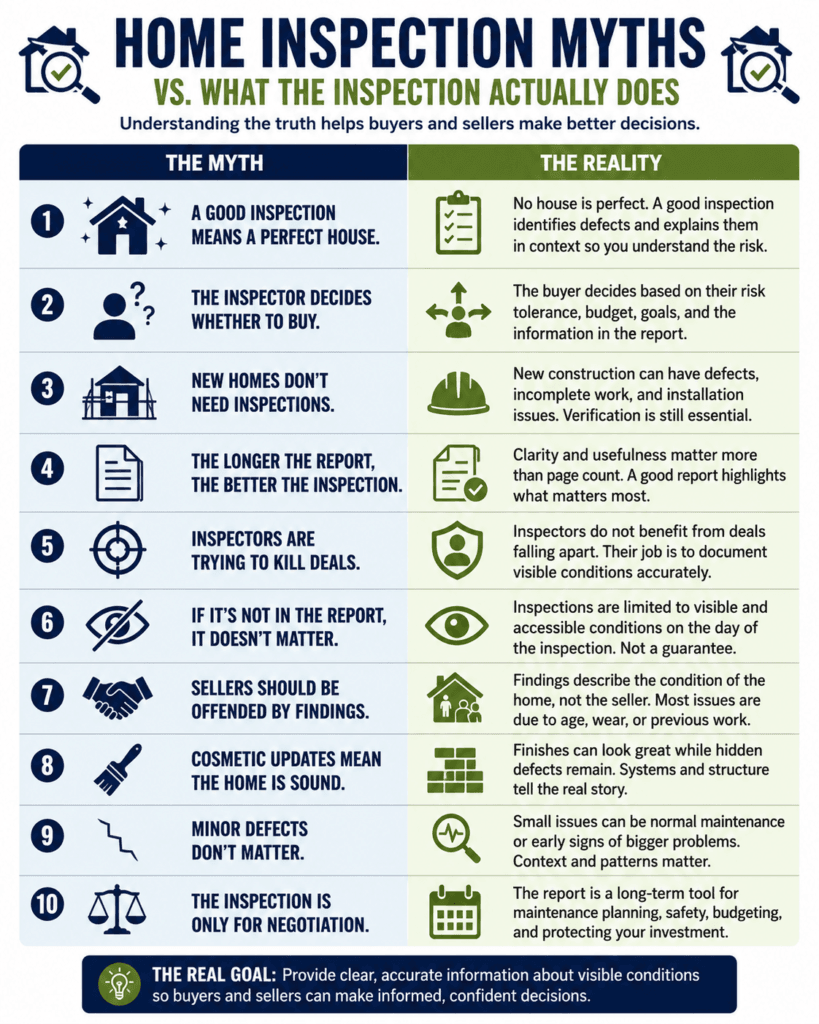
Myth #1: “A Good Inspection Means a Perfect House”
No house is perfect. That includes older homes, renovated homes, investor flips, luxury homes, and brand-new construction. Every property has some combination of aging, wear, incomplete work, installation defects, maintenance needs, or safety improvements that should be addressed.
One of the most common expectation problems I see is when buyers believe a “good inspection” means the report should come back clean. That is not realistic. A good inspection does not mean the house has no defects. It means the findings are documented clearly, explained accurately, and placed in proper context.
For example, in Memphis and West Tennessee homes, we often see common patterns such as poor drainage around the foundation, roof-edge deterioration, damaged soffit or fascia, loose exterior trim, missing GFCI protection, older HVAC equipment, crawlspace moisture conditions, and amateur repair work. Some of these items may be routine maintenance. Others may point to deeper risk. The value of the inspection is not simply listing defects. The value is helping the client understand which findings matter most.
A house can have a long report and still be a reasonable purchase. A house can also have a short report and still contain one or two serious issues. The number of findings alone does not tell the whole story.
Internal link suggestion: Link this section to your sample reports page with wording like:
“Reviewing a sample inspection report can help buyers understand how findings are documented and prioritized.”
Myth #2: “The Inspector Decides Whether You Should Buy the House”
Home inspectors do not make purchase decisions. We do not decide whether a buyer should close, renegotiate, walk away, or accept the property as-is. That decision belongs to the buyer, often with input from their agent, lender, contractor, insurance provider, or attorney when needed.
The inspector’s job is to observe and report visible and accessible conditions. That includes identifying defects, explaining safety concerns, noting systems that may need further evaluation, and helping the client understand potential risk. But the inspection is not a pass/fail test.
This myth causes problems because it puts the inspector in the wrong role. If a buyer asks, “Would you buy this house?” they are usually asking for certainty that no inspector can honestly provide. Different buyers have different budgets, risk tolerance, repair ability, financing terms, and long-term plans. A real estate investor may be comfortable with repairs that would overwhelm a first-time buyer. A buyer planning a full renovation may view the report differently than someone who needs the house move-in ready.
The better question is not, “Did the house pass?” The better question is, “What are the major concerns, what needs attention soon, what needs specialist evaluation, and what appears to be normal maintenance for a home of this age?”
That is where the inspection becomes useful.
Myth #3: “New Homes Don’t Need Inspections”
New construction can give buyers a false sense of security. The house is new, the finishes are fresh, and everything looks clean. But a new home can still have defects, incomplete work, improper installation, missing components, drainage problems, roof issues, electrical defects, HVAC concerns, plumbing leaks, or safety items that were simply missed during construction.
A new house has not had years of use, but that does not mean every system was installed correctly. In fact, new construction often has its own category of problems because multiple trades are working quickly, schedules are tight, and the final product may be reviewed more for completion than performance.
I have seen new and newer homes with attic ventilation concerns, disconnected ducts, loose fixtures, missing insulation, grading problems, improperly installed flashing, unsafe electrical conditions, and roof details that should have been corrected before closing. These are not “old house” issues. They are workmanship and verification issues.
The inspection of a new home is not about distrusting the builder. It is about having another set of trained eyes review the visible systems before the buyer inherits the responsibility. A municipal code inspection and a private home inspection are not the same thing. They serve different purposes and are often performed under different conditions.
For buyers, the practical point is simple: new does not automatically mean correct.
Internal link suggestion: Link this section to your new construction or 11-month warranty inspection page if you have one. If not, link to your residential home inspection service page.
Myth #4: “The Longer the Report, the Better the Inspection”
Report length does not equal report quality. A long report may be thorough, but it can also be bloated with repetitive comments, generic disclaimers, minor maintenance notes, and low-priority observations that make it harder for the client to identify what really matters.
A good inspection report should be clear, organized, photo-supported, and useful. It should help the client separate significant concerns from ordinary maintenance. It should identify safety issues, system defects, moisture concerns, structural indicators, roof problems, electrical hazards, plumbing leaks, and major components that may need evaluation or replacement.
The best reports are not just long. They are readable.
This matters because buyers and sellers often react to the size of a report instead of the substance of the report. A 70-page report does not necessarily mean the house is falling apart. Many reports include photos, descriptions, standards language, maintenance items, informational notes, and limitations. The real question is not, “How many pages is the report?” The real question is, “What are the material findings?”
For example, ten minor items such as loose door hardware, missing caulk, a dirty filter, and typical exterior wear are not the same as one active roof leak, a damaged electrical panel, significant crawlspace moisture, or a failed sewer line. A useful report helps the client see that difference.
Internal link suggestion: Link here to your “500 Memphis and West Tennessee Home Inspections” field analysis, because that page shows the difference between isolated minor defects and recurring regional patterns.
Myth #5: “Inspectors Are Trying to Kill Deals”
This is one of the most damaging myths in real estate. A competent inspector is not there to kill a deal, save a deal, help the seller, help the agent, or steer the buyer toward a particular decision. The inspector’s responsibility is to the condition of the property and the client who hired them.
Most inspectors do not benefit when a deal falls apart. In fact, inspectors who exaggerate findings or create unnecessary fear usually damage their own reputation over time. Good inspectors are careful with language because they understand that the report may influence negotiations, repair requests, insurance decisions, and buyer confidence.
That does not mean the inspector should soften legitimate concerns to keep everyone comfortable. If a roof is at the end of its service life, the report should say so. If there are unsafe electrical conditions, the report should document them. If a crawlspace has moisture problems, fungal-like growth, damaged insulation, or visible wood deterioration, those conditions should not be minimized.
The goal is not fear. The goal is accuracy.
This is especially important in older homes and investor-renovated properties. A fresh coat of paint and new flooring can hide the fact that major systems still need attention. I have inspected houses where the visible finishes looked market-ready, but the attic, crawlspace, electrical panel, roof, or drainage conditions told a different story. That is not “killing the deal.” That is doing the job.
Myth #6: “If It’s Not in the Report, It Doesn’t Matter”
A home inspection is a visual, non-invasive inspection of visible and accessible components at a specific point in time. It is not a guarantee that every defect has been discovered. It is not technically exhaustive. It is not destructive testing. It is not a prediction that nothing will fail after closing.
Some issues are concealed behind walls, under flooring, below grade, inside equipment, or hidden by stored belongings, insulation, finishes, furniture, or limited access. Some issues develop after the inspection. Some require specialized evaluation, such as sewer scoping, mold testing, termite inspection, structural engineering, HVAC diagnostics, chimney evaluation, or invasive moisture investigation.
This is why limitations matter. A good inspector should explain when something could not be fully evaluated and when further evaluation may be appropriate. That is not an excuse. It is part of honest reporting.
For example, if a crawlspace access is blocked, the inspector cannot report the same level of detail as they could if the crawlspace were fully accessible. If utilities are off, some systems cannot be operated. If a roof is too steep, wet, fragile, or unsafe to walk, the inspection method may be limited to the eaves, ladder, drone, or binoculars. Those limitations affect what can reasonably be observed.
The absence of a finding is not the same thing as a warranty. It means the issue was not observed under the conditions present at the time of inspection.
Myth #7: “Sellers Should Be Offended by Inspection Findings”
Sellers often take inspection findings personally, especially if they have lived in the home for years and believe they maintained it well. That reaction is understandable, but it is not helpful. An inspection report is not a moral judgment on the seller. It is a condition report on the property.
Many inspection findings are simply the result of age, normal wear, changing standards, older construction methods, weather exposure, or repairs performed by previous owners. In Memphis and the surrounding region, it is common to inspect homes that have gone through decades of roof repairs, HVAC replacements, plumbing changes, electrical upgrades, foundation movement, drainage modifications, and renovations by different people at different times.
The seller may have no idea that a defect exists. A homeowner can live in a house for years without knowing that an attic has poor ventilation, a crawlspace has moisture staining, a deck ledger was improperly attached, or a receptacle lacks proper GFCI protection.
Sellers are better served by viewing the inspection as information, not an attack. Some findings may be negotiable. Some may be minor. Some may need correction. Some may simply help everyone understand the property more clearly before closing.
Internal link suggestion: Link this section to a pre-listing inspection page if you have one, or to your general residential inspection page with language like:
“A pre-listing inspection can help sellers identify issues before buyers discover them during the transaction.”
Myth #8: “Cosmetic Updates Mean the Home Was Properly Maintained”
This myth hurts buyers more than almost any other. A home can look beautiful and still have serious concerns. New paint, flooring, countertops, fixtures, and appliances do not tell you whether the roof is properly flashed, the electrical panel is safe, the crawlspace is dry, the HVAC system is performing well, or the drainage is moving water away from the foundation.
Cosmetic updates are easy to see. System defects are often not.
This is especially relevant with flipped houses and older homes that have been renovated for resale. Some renovations are excellent. Others focus heavily on appearance while leaving major systems untouched or only partially repaired. The house may photograph well, show well, and still have defects that matter after closing.
Examples we commonly watch for include fresh interior finishes below older roof coverings, new flooring above uneven subfloors, recently painted walls near prior moisture staining, new bathroom finishes with poor ventilation, upgraded kitchens with older electrical limitations, and exterior improvements that do not address grading or drainage.
The inspection helps buyers look past presentation and evaluate the actual condition of the property.
Myth #9: “Minor Defects Don’t Matter”
Minor defects do not always require major concern, but they should not automatically be ignored. Some small findings are isolated maintenance items. Others are early indicators of a larger pattern.
A single loose outlet cover is usually minor. Multiple missing covers, open junction boxes, double-tapped breakers, unprotected wiring, and amateur electrical repairs suggest a broader electrical safety concern. A small area of peeling paint may be routine exterior maintenance. Peeling paint combined with soft trim, open joints, roof-edge staining, and gutter problems may indicate a water-management issue.
This is where pattern recognition matters. One defect may not tell the story. Several related defects often do.
In our region, drainage and moisture patterns are especially important. Heavy rain, humidity, clay soil, crawlspaces, and older exterior assemblies can create conditions where small maintenance issues become expensive if ignored. Missing caulk, poor grading, clogged gutters, short downspouts, deteriorated fascia, and damaged crawlspace vapor barriers may not sound dramatic by themselves, but together they can create real risk.
The point is not to overreact to every small item. The point is to understand whether a small item is isolated or part of a larger condition.
Myth #10: “The Inspection Is Only for Negotiation”
Many buyers think of the inspection mainly as a negotiation tool. It can certainly affect negotiations, but that is not its only purpose. A good inspection also becomes a maintenance guide, safety review, repair planning document, and baseline record of the home’s condition at the time of purchase.
After closing, the report can help the buyer prioritize repairs. It can help them decide what to address immediately, what to monitor, what to budget for, and what to have evaluated by specialists. In some cases, the inspection report may be more useful after the transaction than during the negotiation period.
For sellers, an inspection can also provide value by identifying issues before listing, reducing surprises, and helping them decide whether to make repairs, disclose conditions, or price the home accordingly.
When people view the inspection only as a negotiation weapon, they miss the long-term value of the information.
What Buyers and Sellers Should Understand Instead
A home inspection is not about perfection. It is about informed decision-making. The buyer deserves to know what visible conditions exist. The seller benefits when expectations are realistic. Agents benefit when everyone understands the difference between major defects, safety concerns, deferred maintenance, and normal aging.
The best inspection conversations are not driven by panic. They are driven by prioritization.
A practical inspection report should help answer questions such as:
Which issues are safety concerns?
Which issues may affect habitability, financing, or insurance?
Which systems appear near the end of their service life?
Which findings need specialist evaluation?
Which items are normal maintenance?
Which concerns may become more expensive if ignored?
Which limitations affected the inspection?
That is a much better framework than asking whether the house “passed” or “failed.”
Final Thought
Home inspections work best when buyers and sellers understand what the inspection is actually designed to do. It is not a guarantee, a code inspection, an appraisal, a repair list, or a pass/fail test. It is a professional evaluation of visible and accessible conditions, written to help the client make a more informed decision.
When inspection myths take over, people tend to overreact to minor issues, underreact to major ones, or misunderstand the inspector’s role entirely. But when the process is understood correctly, the inspection becomes one of the most valuable tools in the transaction.
The goal is not to scare buyers. It is not to protect sellers from uncomfortable findings. It is not to make the house look better or worse than it really is.
The goal is to tell the truth about the condition of the property, explain the risk clearly, and help people make decisions with their eyes open.