
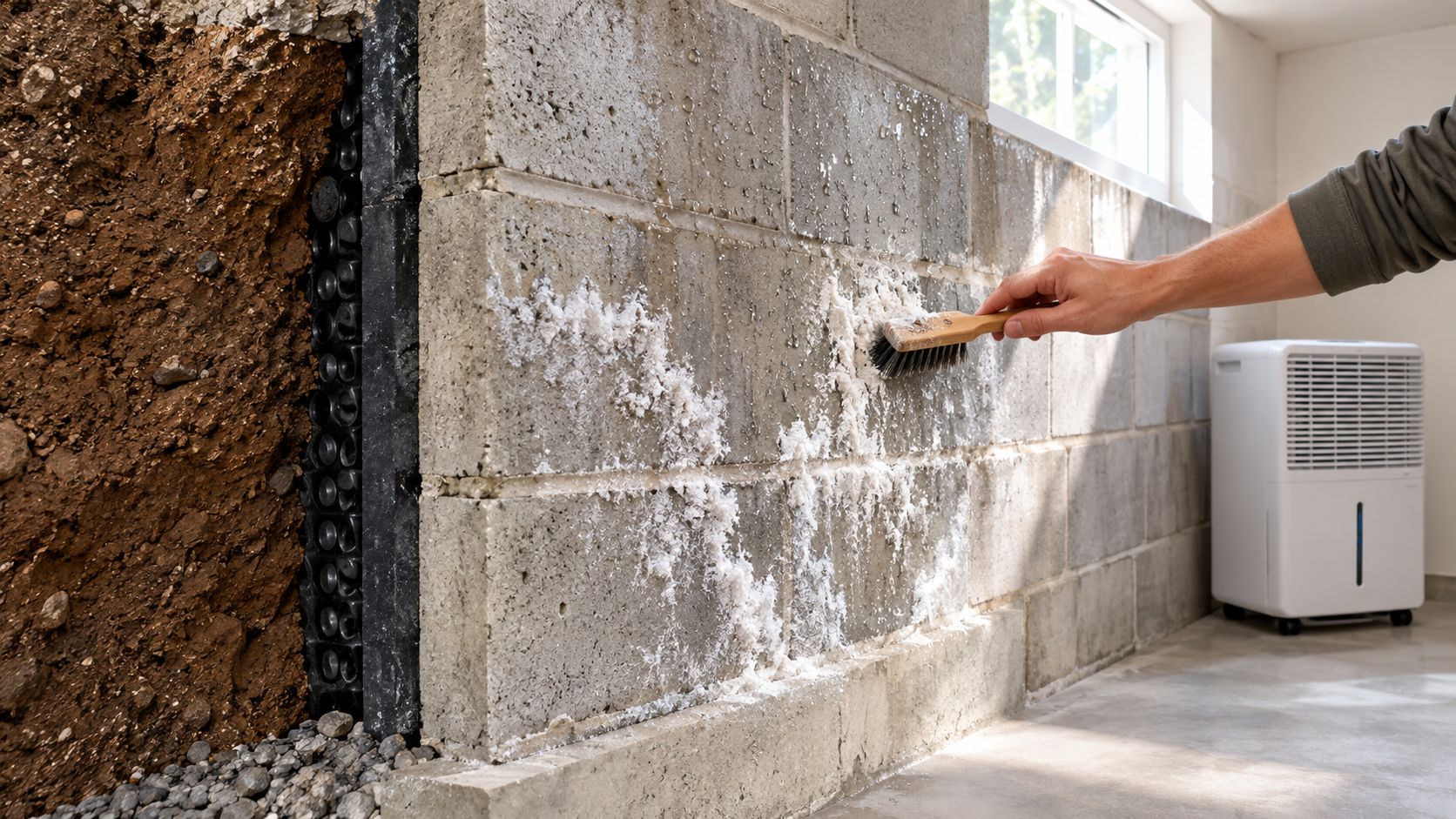
You walk downstairs after a stretch of rain and notice a chalky white bloom along the concrete wall. At first, it looks like dust, dried paint, or something left behind by an old leak. Across Missouri, from Cape Girardeau and Jackson to Columbia and Jefferson City, that residue often has a more useful name: efflorescence.
The powder itself usually isn't the structural problem. It's a visible record of moisture moving through masonry, and the pattern can help show whether you're dealing with storm-driven seepage, capillary wicking, or humidity condensing on a cool wall. That distinction matters because brushing the wall clean won't solve a drainage problem, while running a dehumidifier won't repair a foundation crack.
Table of Contents
- What That White Powder on Your Basement Wall Actually Is
- Why Missouri Basements Are Especially Prone to It
- How to Tell Efflorescence from Mold and from Active Leaks
- Cleaning It Yourself Versus Calling in a Professional
- Stopping It from Coming Back
- When It Makes Sense to Schedule a Professional Inspection
- Putting It All Together Your Next Steps
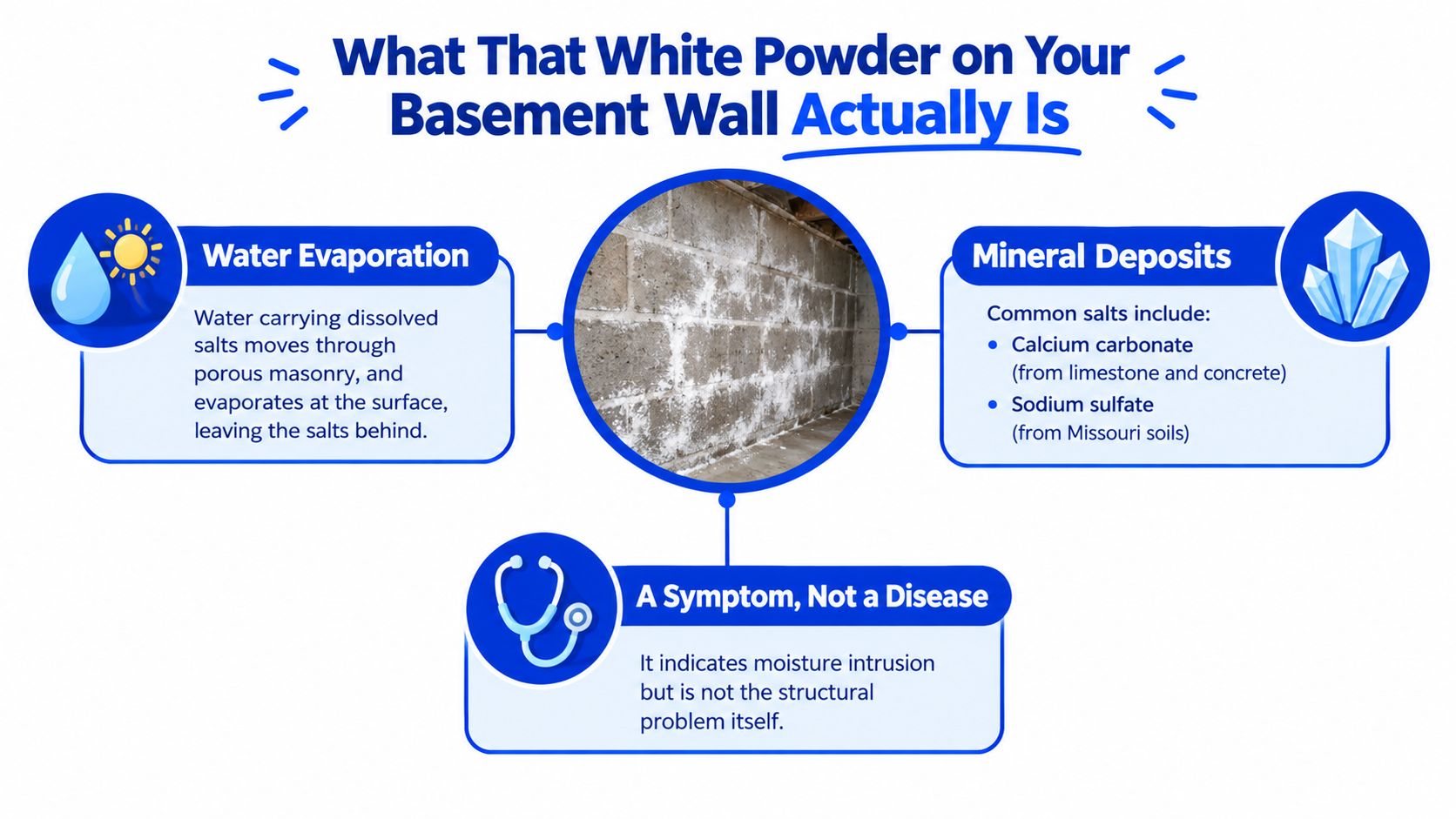
What That White Powder on Your Basement Wall Actually Is
After a wet week in St. Louis or Kansas City, a homeowner may find a chalky white film on a poured-concrete or concrete-block wall. It can look like failed paint or dried dust. In many cases, it is efflorescence, mineral salt left behind when moisture moves through masonry and evaporates at the basement surface.
Concrete and mortar contain soluble minerals. Water traveling through soil, pores, joints, or small openings can dissolve some of that material. As the moisture reaches the interior side of the wall and dries, the minerals crystallize into a powdery or crust-like deposit. Missouri basement moisture guidance from Upchurch Inspection describes this moisture-related process.
The exact salts may include compounds associated with cement and masonry, including calcium hydroxide, sodium sulfate, and potassium salts. Identifying the compound is rarely the first practical step. The important finding is that water has found a route through or along the wall.
What the residue tells you
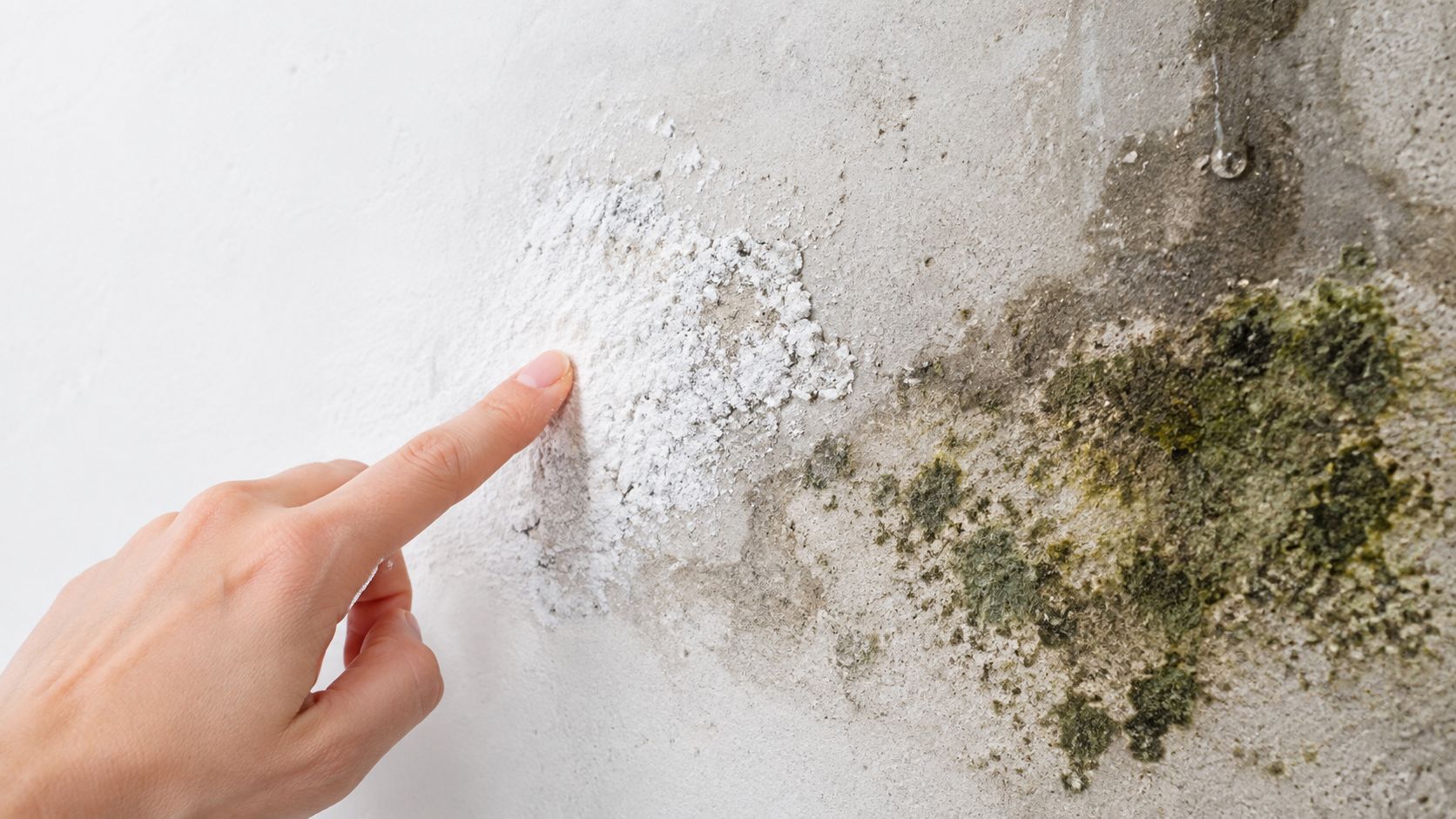
Efflorescence is generally mineral, not organic. Mold can still be present nearby on wood, drywall, insulation, or settled dust, especially where moisture remains. The white deposit itself does not establish that mold is growing.
It also does not prove the foundation is failing. The moisture source could be storm seepage, capillary wicking through porous masonry, interior humidity condensing on a cool wall, a plumbing condition, roof runoff, poor grading, or a crack. Check where the residue appears, whether it feels damp, and whether it returns after rain or during humid weather. Those clues help match the repair to the cause.
Dry brushing may improve the appearance, but it does not close the moisture route. If the deposit returns, the wall is still receiving or carrying moisture, as explained in technical efflorescence guidance from InterNACHI.
Practical rule: Treat recurring efflorescence as a moisture clue, not as a housekeeping problem.
Why Missouri Basements Are Especially Prone to It
Missouri basement walls often sit against soil that holds water tightly, particularly where clay-rich ground surrounds the foundation. When that soil becomes saturated, water can remain against the wall and find openings, pores, joints, or the footing connection.
Regional conditions work together rather than acting alone. Heavy rain can overwhelm settled grading, humid summer air can condense on cool basement walls, and freeze-thaw cycles can make existing masonry openings more troublesome. In Southeast Missouri and Mid-Missouri, these conditions help explain why efflorescence may appear after storms, during wet-dry swings, or in a basement that has no obvious stream of water.
A Missouri-focused explanation of basement leaks connects moisture problems with saturated soil, clay movement, roof runoff, grading, foundation openings, and plumbing conditions. That combination is why two homes with identical-looking white deposits may need completely different repairs.
The main moisture routes
Storm seepage usually follows rainfall or snowmelt. Water may collect beside the wall because the soil slopes toward the house, a downspout discharges too close to the foundation, or an exterior drainage path isn't working properly.
Capillary wicking can move moisture upward through porous concrete block, mortar, or the footing. This pattern may look less dramatic than a leak, but it can leave a persistent band of residue near the lower wall.
Interior humidity behaves differently. Warm, damp basement air meets a cool masonry surface, and condensation forms. A finished basement with weak dehumidification can develop moisture symptoms even when groundwater isn't entering through a crack.
| Factor | Missouri context | How it drives efflorescence |
|---|---|---|
| Clay-rich soil | Soil can hold water against foundation walls and change volume as moisture changes | Sustained moisture contact gives water more opportunity to move through masonry |
| Storm runoff | Rainwater can collect near walls when grading has settled or discharge is poorly directed | Water pressure and seepage carry dissolved minerals toward the basement surface |
| Freeze-thaw exposure | Seasonal temperature changes affect existing cracks and masonry openings | Small paths can admit more moisture during wet conditions |
| Interior humidity | Cool basement walls meet humid indoor air | Condensation can leave moisture on the surface without a groundwater leak |
The regional pattern isn't a diagnosis by itself. A wall in Farmington, Perryville, Poplar Bluff, Columbia, or Sedalia still needs observation of the actual site, including grading, gutters, plumbing, wall material, and interior air conditions.
How to Tell Efflorescence from Mold and from Active Leaks
A white, gritty film on a Missouri basement wall is usually efflorescence, but appearance alone cannot identify the moisture source. Efflorescence feels dry and powdery. Mold may look fuzzy, smeared, or slimy and often comes with a musty odor. An active leak usually leaves a damp surface, darkened edge, or visible trail from a crack, joint, or floor-wall connection.
The timing and location provide better clues. Residue that increases after a storm points toward runoff, grading, gutters, or seepage through the foundation. A dry wall in a damp-feeling room points more toward interior humidity and condensation. Deposits concentrated near the lower wall may reflect capillary wicking through porous masonry.
Use a plastic-sheet test
Tape a clear plastic sheet tightly over a cleaned section of wall and leave it for 24–48 hours. This simple check can help separate room-side condensation from moisture moving through the masonry.
- Moisture on the room side suggests condensation from indoor air.
- Moisture beneath the sheet, against the wall suggests moisture traveling through the wall.
- No visible moisture does not prove the wall is dry. The test may not have included a storm, a humid period, or another condition that drives the problem.
A moisture meter can add context, although readings vary with the wall material and instrument. A reading above 15% is commonly treated as a warning in basement moisture discussions, not as a standalone diagnosis.
Use a hygrometer to track indoor humidity, then compare that reading with recent weather, wall temperature, and the deposit location. Musty odors or visible organic growth warrant closer attention because moisture problems contribute to mold growth in homes.
Signs the issue needs more than cleaning
Residue that returns quickly, staining above the floor line after heavy rain, rust on nearby metal, or a persistent odor suggests the moisture path remains active. Bowing block, significant cracking, and standing water raise the concern beyond a surface deposit.
Surface cleaning cannot correct storm seepage, capillary wicking, or interior humidity. The same principle applies to exterior growth. Cultivate House Detailing siding tips reinforce that removing visible growth and controlling the wet conditions behind it are separate tasks. મેચ
Cleaning It Yourself Versus Calling in a Professional
DIY cleaning makes sense when the wall is dry, the deposit is limited, and your goal is appearance. Begin with a stiff, dry brush and a vacuum suitable for the area. Avoid spreading the powder through the basement, and don't start with aggressive chemical treatment when a simple dry removal may be enough.
For stubborn deposits, a mild masonry-safe wash may help. If an acid-based cleaner is used, technical guidance recommends wetting the masonry first, limiting the application to small areas of about 4 square feet, waiting roughly 5 minutes, and scrubbing with a stiff brush before rinsing carefully. The same guidance emphasizes that source control must follow cleaning, or salts commonly return.
Wear eye protection and gloves, protect nearby finishes, and provide ventilation. Don't use a pressure washer indoors, and don't paint over a wall that remains damp. A sealer may be compatible with one masonry surface and unsuitable for another, so read the product instructions and consider the wall's condition before applying it.
What each approach can and cannot solve
| Factor | DIY cleaning | Professional remediation |
|---|---|---|
| Main purpose | Removes visible surface residue | Identifies and controls the moisture path |
| Suitable condition | Limited deposits on a dry, accessible wall | Recurring residue, damp readings, bubbling paint, or active seepage |
| Typical work | Brushing, vacuuming, cautious masonry washing | Moisture mapping, drainage evaluation, crack repair, and waterproofing assessment |
| Main limitation | Doesn't correct groundwater, drainage, or pressure | Requires diagnosis, planning, and contractor coordination |
| Safety concern | Chemical exposure and hidden dampness | Specialized equipment and more invasive repair work |
A professional may check footing-drain performance, hydrostatic pressure, capillary movement, plumbing sources, or cracks that need injection repair. Interior drainage systems and exterior waterproofing address different conditions, so a contractor should explain what evidence supports the proposed scope.
The right decision follows the diagnosis. Clean efflorescence, but fix water. If readings remain high, paint bubbles, or staining returns, stop treating the wall as a cosmetic project and bring in an appropriately qualified inspector or moisture-remediation contractor.
Stopping It from Coming Back
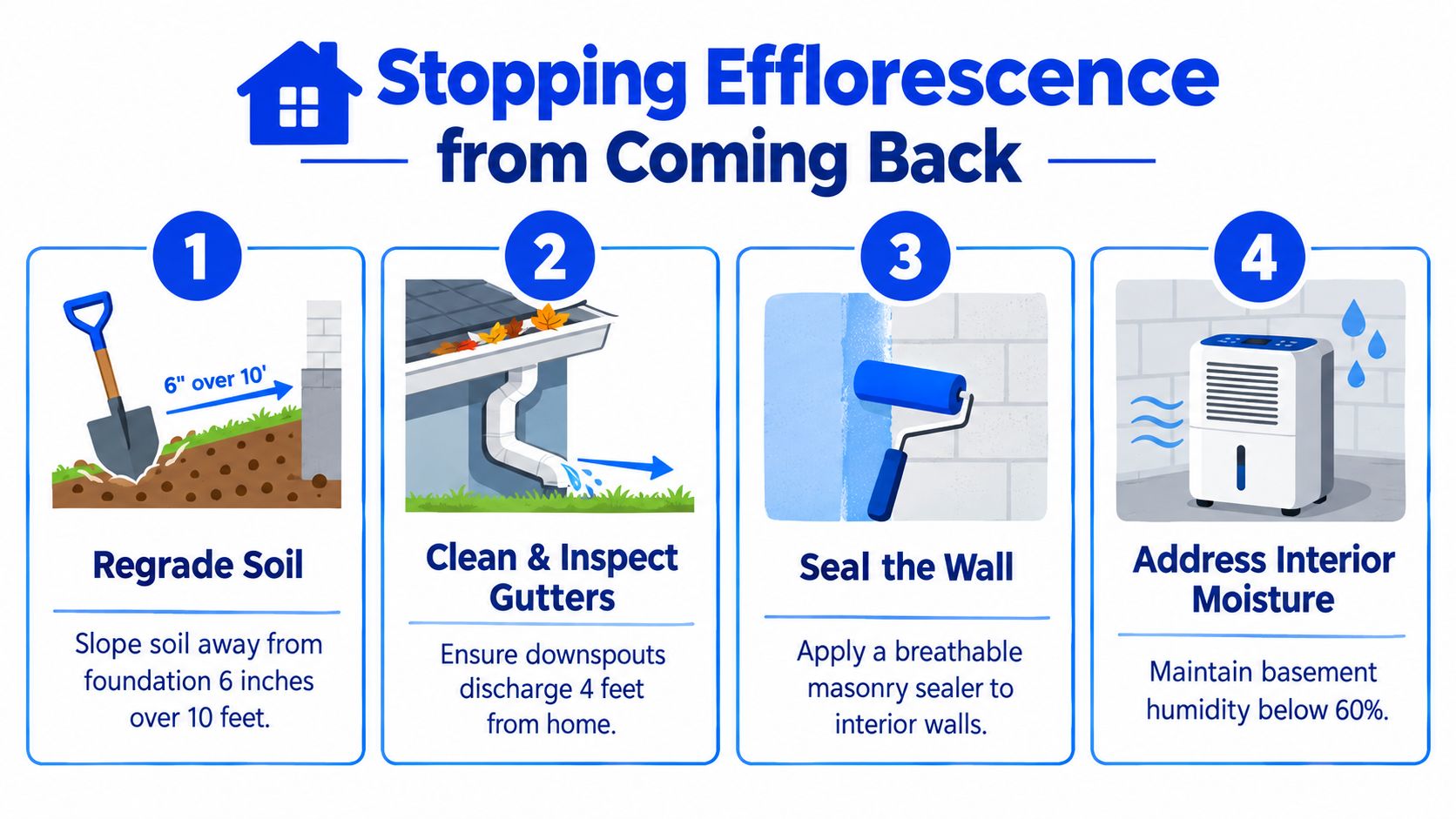
The most sensible order starts outside and moves inward. Homeowners often spend money on interior coatings before addressing roof runoff or soil that slopes toward the foundation. That reverses the usual priority.
Begin with the ground around the house. A commonly used drainage target is a slope of 6 inches over the first 10 feet away from the foundation, as described in Missouri-oriented basement moisture guidance. Clay-heavy soil can settle, wash, or shift over time, so check the slope rather than assuming it still works because it did when the house was built.
Next, inspect gutters and downspouts. Extend downspouts at least 5 feet from the house and confirm that discharge isn't washing back toward the foundation. Downspout extensions, splash control, and repaired grading can resolve water entry caused by roof runoff, but they won't correct a failed footing drain or a foundation crack by themselves.
Move from simple maintenance to targeted repairs
- Check drainage performance: Older Missouri homes may have incomplete, clogged, or difficult-to-access footing drainage. A drainage specialist may need to evaluate it when exterior corrections don't change the moisture pattern.
- Repair the actual crack: Hydraulic cement or an appropriate injection system may suit some cracks, but the repair depends on crack location, movement, width, and whether water is active.
- Use interior sealers carefully: A breathable masonry sealer can help with light recurring residue on a suitable wall. It isn't a replacement for exterior drainage or structural evaluation.
- Control indoor humidity: A basement-rated dehumidifier can support the repair plan. A commonly used target is 50% relative humidity, while the provided prevention guidance also describes keeping basement humidity below 60%. These targets address interior air, not water entering through the wall.
In flood-prone areas near the Missouri and Meramec rivers, a sump pump with a battery backup may be a practical resilience measure for a finished basement. That equipment still needs inspection, testing, and a discharge route that doesn't return water to the foundation.
Before approving an interior drainage system, verify that grading, gutters, and downspouts aren't sending avoidable water to the wall.
When It Makes Sense to Schedule a Professional Inspection
Observation is reasonable when the residue is light, isolated, and clearly tied to a temporary condition. Schedule help when it persists after a dry period, returns after cleaning, or appears with a musty odor, visible mold, standing water, unexplained humidity, or staining at the floor-wall joint.
The wall itself provides important escalation signals. Bowed block, widening cracks, or water entering through a crack should not be handled as a simple cleaning project. A structural concern may require a foundation specialist or engineer, while a moisture source may call for an inspector, waterproofing contractor, plumber, or HVAC professional depending on the findings.
Match the professional to the question
A general home inspection can document visible conditions and recommend further evaluation. A specialty moisture or foundation inspection is more focused on tracing water movement, measuring wall moisture, assessing drainage, and distinguishing a maintenance issue from a more involved repair.
A diagnostic visit may include:
- Moisture readings across multiple wall areas
- Thermal imaging where hidden temperature or moisture differences are suspected
- Review of sump equipment and accessible drainage components
- Examination of grading and downspout discharge
- Documentation of cracks, staining, wall movement, and affected finishes
Upchurch Inspection can provide a written report with photos, moisture readings, and prioritized recommendations as part of a property evaluation. Homeowners comparing inspection types can also review guidance on choosing the right specialized inspection before scheduling.
Consider booking before finishing a basement, before listing a home, or after a major storm exposes a problem that wasn't visible during dry weather. For commercial properties and multifamily buildings, documentation can help facility managers separate recurring maintenance from a larger building-envelope or foundation concern.
Putting It All Together Your Next Steps
Efflorescence is a symptom, not a disease. The visible salt tells you moisture has moved through or onto the masonry, but the correct repair depends on where that moisture came from.
Use a simple decision path:
- Remove the loose residue carefully. Dry-brush and vacuum the surface so you can observe fresh changes.
- Run the plastic-sheet test. Leave the sheet in place for 24–48 hours and note whether moisture forms on the room side or wall side, using the method described in the earlier diagnostic guidance.
- Inspect the exterior. Look at grading, gutters, downspouts, foundation openings, and areas where water collects.
- Track the condition. Record wall locations, recent storms, visible staining, odors, and moisture readings.
Light, seasonal residue on an otherwise dry wall may point toward grading maintenance and interior humidity control. Dampness that follows rain suggests drainage, runoff, or footing-related investigation. Visible water combined with meaningful cracking calls for professional waterproofing and foundation evaluation rather than repeated surface cleaning.

Document what changes
A small cleaning and observation project may fit into a weekend. Drainage repairs, crack injection, interior systems, or exterior waterproofing can require a broader scope and coordination with qualified contractors. Don't approve a large repair solely because a wall looks unpleasant. Ask what moisture source the work addresses and how the contractor confirmed it.
Keep photographs, dates, test results, inspection reports, and repair records. That documentation can help during resale, insurance conversations, contractor bidding, and future maintenance, especially when the basement serves as finished living space or part of a commercial property.
A professional inspection is most valuable when several causes overlap. An assessment that maps moisture, considers Missouri soil and drainage conditions, and separates cosmetic residue from active intrusion can replace guesswork with a prioritized action list.
Upchurch Inspection offers property inspections and moisture-focused evaluations that can document basement conditions with photos, moisture readings, and practical recommendations. If efflorescence on basement walls in your Missouri home keeps returning, visit Upchurch Inspection to schedule an evaluation and identify the next repair step.