
TL;DR:
- A water heater expansion tank absorbs increased water volume in closed systems to prevent pressure buildup.
- Inspection indicators include PRVs, discharged TPR valves, and recent water heater replacements without tanks.
A water heater expansion tank is a small, air-bladder vessel installed on the cold-water supply line that absorbs the extra volume created when water heats up, preventing pressure spikes that would otherwise stress pipes, fittings, and the temperature-pressure relief (TPR) valve. For property buyers, sellers, and agents, the short answer is this: if the domestic water supply is a closed system, the property likely needs one, and its absence or failure is a reportable condition.
Three immediate inspection flags tell you to look closer:
- A PRV (pressure-reducing valve) or backflow preventer on the incoming service line, indicating a closed system
- A TPR valve that shows signs of weeping or discharge, often a symptom of thermal expansion pressure rather than a faulty valve
- A recently replaced water heater with no expansion tank installed alongside it
Table of Contents
- How a water heater expansion tank actually works
- When an expansion tank is required or recommended
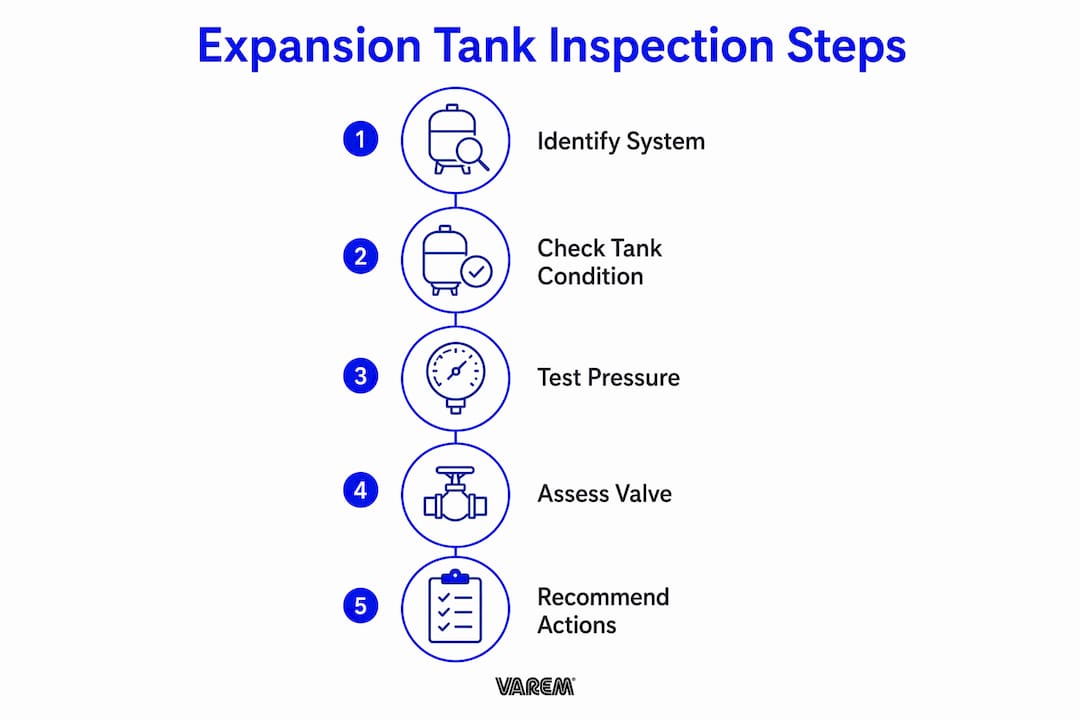
- Field checklist for inspecting an expansion tank
- Common failure modes and urgency levels
- Sizing, replacement costs, and expected lifespan
- How to phrase expansion tank findings in an inspection report
- Code baseline and the AHJ wildcard
- Key Takeaways
- What we actually see in the field
- Schedule an inspection before the water heater becomes a negotiation problem
- Useful sources
How a water heater expansion tank actually works
When a water heater fires, cold water at roughly 50°F heats to 120°F or higher. Water expands as it heats, but in a closed plumbing system that expansion has nowhere to go. The expansion tank solves this with an internal rubber bladder pre-charged with air. As heated water pushes into the tank, the bladder compresses, absorbing the added volume and keeping system pressure stable.
Typical residential tanks are small, commonly about 2 gallons, though the correct size depends on water heater volume and static supply pressure.
Without a functioning tank, that pressure has only one release point: the TPR valve. Repeated TPR discharge is not a sign the valve is defective. It is a sign the system has no other way to manage thermal expansion. Water heaters operating above 150 psi are classified as boilers under IAPMO standards, which underscores why controlling expansion pressure matters well before that threshold.
When an expansion tank is required or recommended
The primary field indicator is the presence of a pressure-reducing valve or backflow preventer on the incoming service. Either device creates a closed system by blocking pressure from dissipating back into the main. Newer residential developments built from the 1990s onward commonly include these devices, so the expectation of an expansion tank is reasonable on most properties from that era forward.
Key indicators to document:
- PRV on incoming service — most common closed-system indicator; typically found near the meter or where the main enters the structure
- Backflow preventer or meter check valve — same functional result as a PRV; look at the meter box and main shutoff area
- Utility-installed check device — some municipal utilities install check valves at the meter without homeowner knowledge
- Local/AHJ mandate — many jurisdictions require expansion tanks on all new water heater installations regardless of open or closed system terminology
The 2024 IPC Section 607.3 establishes thermal expansion control as a code requirement on closed systems. The IRC has required it on closed systems since the 2006 edition. Local amendments often go further.
Pro Tip: When you cannot definitively confirm the service configuration, assume closed and recommend an expansion tank. A conservative call here costs the client a few hundred dollars if unnecessary; the alternative can cost thousands in water damage or a failed water heater.
Field checklist for inspecting an expansion tank
Inspectors can perform several non-invasive checks without opening the system or operating pressure-relief devices.
- Confirm presence and location. The tank should be on the cold-water supply line, downstream of any PRV or backflow device, and within a few feet of the water heater.
- Check orientation and support. Vertical mounting is standard. Horizontal tanks are acceptable only with proper strapping or a bracket; an unsupported horizontal tank stresses the threaded fitting over time and can become a leak point.
- Inspect for visible corrosion, leaks, and bulging. Corrosion at the tank body or fittings, active moisture, or a visibly deformed tank body are all reportable conditions.
- Knock test. Tap the tank with a knuckle. A hollow sound from top to bottom suggests the bladder holds air. A solid or heavy sound throughout indicates the tank may be waterlogged.
- Schrader valve check. The valve cap on the tank’s air stem should be present. A brief press of the Schrader core (do not force discharge) that releases air suggests the bladder is intact; water at the Schrader port indicates bladder failure.
- Locate and note the PRV/backflow device. Document its presence and condition; this is what confirms the closed-system designation.
- Check the isolation valve. The tank should have a shutoff valve so it can be serviced without draining the system.
- Observe the TPR valve. Mineral deposits, weeping, or a discharge pipe that shows staining are red flags. Note them and link them to the expansion tank condition in the report.
- Safety reminder. Never operate the TPR valve during an inspection. Do not open sealed system components. Pressure measurement and pre-charge verification require a licensed plumber.
Common failure modes and urgency levels
| Condition | Likely Cause | Urgency |
|---|---|---|
| Solid sound on knock test; water at Schrader port | Waterlogged tank, bladder failure | Repair — replace tank; repeated TPR discharge will follow |
| Active leak at tank body or fitting connection | Corrosion or fitting failure | Safety concern — refer to licensed plumber promptly |
| TPR valve weeping intermittently | Thermal expansion not being absorbed | Repair — evaluate tank before replacing valve |
| Unsupported horizontal tank, no active leak | Pipe strain on threaded fitting | Monitor/Repair — recommend strapping or bracket |
| Tank approaching or past 8-year service life, no current leaks | Age-related wear | Monitor — recommend plumber evaluation at next service |
A leaking TPR valve is frequently the symptom, not the root cause. Replacing the valve without addressing the expansion tank is a common and costly mistake. Document both in the report and recommend evaluation of the full thermal expansion system.
Sizing, replacement costs, and expected lifespan
Sizing a thermal expansion tank correctly requires three inputs: water heater storage volume, static supply pressure, and the temperature rise. A 2-gallon tank is typical for 40–50 gallon water heaters at moderate supply pressure. Larger heaters or systems with higher static pressure often need a 5-gallon tank.
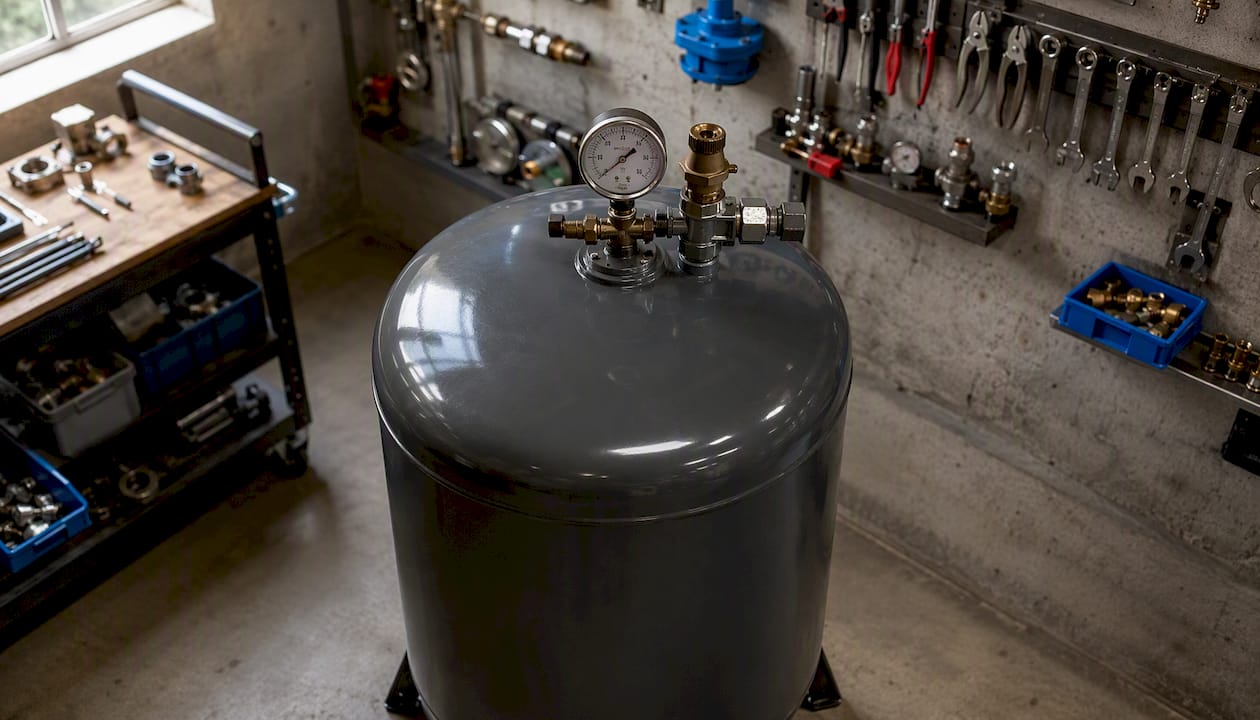
The pre-charge requirement is where most DIY installations fail. The tank’s air bladder must be set to match the measured static supply pressure before installation. A tank pre-charged at the factory, often at 40 psi, will be ineffective on a system with higher static pressure such as 70 psi. This is not something an inspector can verify non-invasively; it requires a plumber with a pressure gauge.
| Factor | Typical Range |
|---|---|
| Installed cost (labor + tank) | $250–$400 |
| Expected service life | 5–8 years |
| Common residential tank size | 2 gallons for 40–50 gallon heaters, larger for bigger/heavier-use systems |
| Life-shortening factors | Corrosion, poor support, high mineral content, absorbed air |
Always refer sizing, pre-charge adjustment, and permit verification to a licensed plumber. In Tennessee and across the Mid-South, permit requirements for water heater work vary by municipality.
How to phrase expansion tank findings in an inspection report
Clear report language protects the inspector and gives buyers, sellers, and agents a defensible basis for negotiation or repair decisions. Here is how to categorize and word common findings:
Safety concern (immediate referral):
- “Active leak observed at expansion tank fitting. Recommend evaluation and repair by a licensed plumber prior to closing.”
- “TPR valve shows evidence of repeated discharge. Expansion tank appears waterlogged. Recommend licensed plumber evaluate thermal expansion system.”
Repair (recommend correction):
- “Expansion tank is waterlogged based on knock test and Schrader valve check. Recommend replacement by a licensed plumber.”
- “Expansion tank is mounted horizontally without support strapping. Recommend securing with a bracket to prevent fitting stress and potential leak.”
Monitor (note for future attention):
- “Expansion tank is functioning at time of inspection but is approaching the typical 5–8 year service life. Recommend periodic evaluation by a licensed plumber.”
- “No expansion tank observed. A PRV is present on the incoming service, indicating a closed system. Recommend confirming local AHJ requirements and installing an appropriately sized tank.”
For guidance on reading inspection report findings, buyers and agents should review how urgency labels translate into negotiation or repair timelines.
Code baseline and the AHJ wildcard
Model codes set the floor, not the ceiling. The 2024 IPC Section 607.3 requires thermal expansion control on closed systems, with tanks installed downstream of the check valve or PRV and sized per manufacturer instructions. The IRC has carried similar language since 2006.
- Local amendments routinely expand this. Many municipalities and utilities require expansion tanks on all new water heater installations, regardless of whether the system is technically open or closed, to eliminate configuration ambiguity.
- Utility check valves are invisible. Some utilities install check devices at the meter without notifying the homeowner, effectively creating a closed system the owner does not know about.
- Permit requirements vary. In Tennessee, Arkansas, Mississippi, Missouri, and Kentucky, the AHJ for a given municipality may have adopted a different code edition or added local amendments. Never assume the model code is the final word.
Add this phrase to reports when the configuration is unclear: “Confirm local AHJ or utility requirements prior to water heater replacement or permit application.”
Key Takeaways
A closed system without a functioning expansion tank puts the TPR valve, water heater, and connected piping under chronic pressure stress that shortens service life and raises the risk of an active leak or sudden failure.
| Point | Details |
|---|---|
| Closed system indicator | A PRV or backflow preventer on the incoming service confirms a closed system and requires an expansion tank. |
| TPR valve weeping | Intermittent TPR discharge usually signals a failed or missing expansion tank, not a defective valve. |
| Sizing and pre-charge | A 2-gallon tank suits most 40–50 gallon heaters; pre-charge must match static supply pressure or the tank is ineffective. |
| Replacement cost and life | Installed cost typically ranges from $250 to $400, and service life is usually 5–8 years, varying by use and water quality. |
| Upchurchinspection’s role | Upchurchinspection documents expansion tank condition, flags closed-system indicators, and recommends licensed plumber referrals in every applicable inspection report. |
What we actually see in the field
The expansion tank is one of those items that gets skipped during a quick water heater swap. A plumber replaces the heater, the tank is old or missing, and nobody flags it because the TPR valve has not started weeping yet. By the time a buyer’s inspector shows up six months later, the valve is dripping and the buyer thinks the whole water heater needs replacement. We see this pattern regularly in Memphis and West Tennessee, particularly in homes built in the 1990s and early 2000s where PRVs were installed as standard but expansion tanks were not always added alongside them.
Our stance is conservative: if we see a PRV and no expansion tank, that goes in the report as a repair item with a plumber referral, not a monitor. If the tank is present but sounds solid on the knock test, we call it out and recommend replacement. We do not operate the TPR valve, we do not measure pre-charge, and we do not open sealed system components. What we do is document what is visible and give buyers, sellers, and agents a clear picture of the condition and the next step.
Schedule an inspection before the water heater becomes a negotiation problem
Upchurchinspection provides thorough plumbing system evaluations as part of every residential and commercial inspection across Tennessee, Arkansas, Mississippi, Missouri, and Kentucky. We document expansion tank condition, identify closed-system indicators, and give you report language that holds up in a transaction. If you are buying, selling, or managing a property and want a clear picture of the water heater and plumbing system before it becomes a negotiating issue, schedule your inspection with Upchurchinspection today.
Useful sources
The following references support the code citations, sizing guidance, and inspection practices covered in this article. Bring these to a licensed plumber or your local AHJ when seeking clarification on local requirements.
- IPC 2024 Section 607.3 — Thermal Expansion Control (ICC/IPC) — Model code text; primary authority for closed-system expansion tank requirements. Model code.
- IAPMO — 2018 UPC Section 608.3, Expansion Tanks — Uniform Plumbing Code guidance on expansion tank placement and T&P valve requirements. Model code.
- Bradford White — What is a thermal expansion tank? — Manufacturer explanation of function and typical sizing. Manufacturer guidance.
- Watts — Thermal expansion in potable water heating systems — Industry explanation of closed-system indicators and TPR valve symptoms. Trade commentary.
- InterNACHI — Water Heater Expansion Tanks — Inspector-focused guidance on knock tests and Schrader valve checks. Practitioner guidance.
- Jaspector — IRC 2018 water heater expansion tank rules — IRC code analysis including pre-charge and sizing requirements. Code commentary.
- How to Look at a House — When were expansion tanks first required? — Historical code adoption timeline for IRC and state codes. Trade commentary.