TL;DR:
- Scheduling commercial inspections early helps prevent costly surprises by identifying structural and safety issues before capital commitment. Using standardized protocols like ComSOP ensures report reliability, clarity, and supports better negotiations, compliance, and asset management. Regular inspections tailored to property risk protect investments, maintain compliance, and improve financing and resale prospects over time.
Scheduling commercial inspections is defined as the deliberate, standards-based practice of arranging professional property evaluations to document condition, identify risk, and protect asset value before and during ownership. For business owners and commercial property investors, this practice is not optional due diligence. It is the foundation of sound risk management. The CCPIA’s ComSOP sets the internationally accepted standard for these evaluations as of 2026, covering scope, reporting, inclusions, exclusions, and ethics across nine core sections. Understanding why schedule commercial inspections matters starts with knowing what is actually at stake: deferred maintenance, code compliance exposure, and capital reserve surprises that can erode an investment fast.
Why schedule commercial inspections before you commit capital
The clearest reason to schedule a commercial inspection early is financial protection. Early inspections prevent losses from investing in properties with hidden or severe deficiencies that would not surface until after closing or lease execution. A structural crack in a load-bearing wall, a failing rooftop HVAC unit, or an outdated electrical panel can each represent six-figure repair obligations. Catching these conditions before you commit capital gives you the choice to walk away, renegotiate, or budget accurately.

Commercial inspections also serve a compliance function that residential inspections do not. Building code requirements, fire suppression systems, ADA accessibility standards, and environmental conditions all fall within the scope of a thorough commercial evaluation. Missing a compliance deficiency at acquisition means inheriting the liability. That liability does not disappear because the previous owner failed to disclose it.
Regular inspections help avoid unexpected repairs, maintain compliance, and preserve or increase property value over time. That is not a generic claim. A property with documented inspection history and a maintained capital reserve schedule commands stronger financing terms and higher buyer confidence at resale.
What do commercial inspections actually cover?
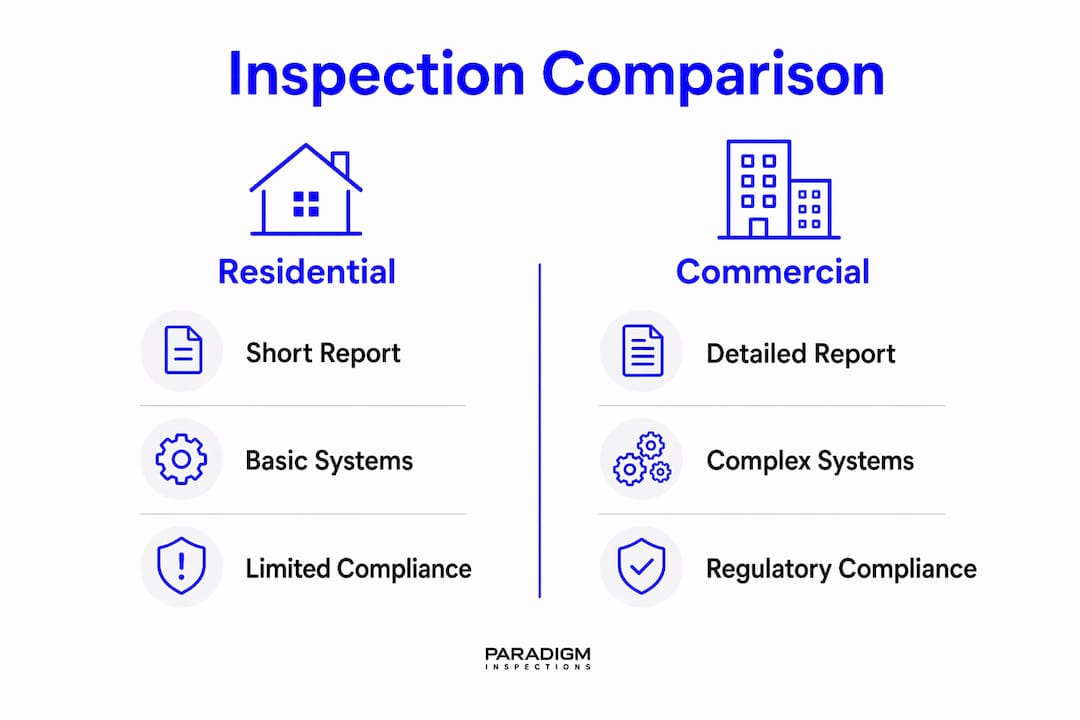
Commercial inspections differ substantially from residential inspections in scale, complexity, and systems involved. A residential inspector works through a home in two to four hours. A commercial inspector may spend a full day or more on a single building, and the resulting report often runs 50–150 pages with detailed photographs, system condition narratives, and capital reserve tables.
The scope of a commercial inspection under ComSOP covers nine core areas:
- Structural systems: Foundation, framing, load-bearing walls, and roof structure
- Roofing: Membrane condition, drainage, penetrations, and flashing
- Plumbing systems: Supply lines, drain lines, water heaters, and fixtures
- Electrical systems: Service entrance, panels, branch circuits, and grounding
- HVAC systems: Rooftop units, split systems, boilers, and ventilation
- Interior components: Ceilings, floors, walls, doors, and windows
- Site conditions: Parking lots, drainage, retaining walls, and exterior lighting
- Life safety systems: Fire suppression, alarms, emergency egress, and signage
- Specialty systems: Elevators, generators, and commercial kitchen equipment where applicable
The table below shows how commercial inspection scope compares to a standard residential inspection:
| Component | Residential Inspection | Commercial Inspection |
|---|---|---|
| Report length | 20–40 pages | 50–150+ pages |
| Systems covered | Basic home systems | All building systems plus site |
| Capital reserve table | Rarely included | Standard in thorough reports |
| Life safety review | Limited | Fire suppression, egress, alarms |
| Specialty equipment | Not applicable | Elevators, generators, kitchen systems |
Capital reserve tables included in commercial reports provide forward-looking replacement costs for major systems. That forward-looking data is what separates a useful commercial report from a basic checklist. Investors use it to model cash flow, plan capital expenditures, and avoid being blindsided by a $180,000 roof replacement two years after acquisition.
Key reasons proactive scheduling protects your investment
Waiting until a problem is visible is the most expensive approach to commercial property management. Proactive scheduling of inspections creates a documented baseline of property condition that protects you in multiple ways.
- Identifies structural and safety issues early. A failing parapet wall or deteriorating fire suppression system does not announce itself. Regular inspections catch these conditions while repair costs are still manageable.
- Supports negotiation leverage. A pre-purchase inspection report gives buyers documented evidence to negotiate price reductions, seller credits, or repair obligations before closing. Without it, you are negotiating blind.
- Reduces liability exposure. Documented inspection records demonstrate due diligence. If a tenant or employee is injured due to a building condition, an inspection history showing proactive monitoring significantly changes the liability picture.
- Maintains lender and insurer confidence. Many commercial lenders and insurers require current inspection documentation as a condition of financing or coverage. Gaps in inspection history can trigger policy exclusions or loan covenant violations.
- Preserves long-term asset value. Deferred maintenance compounds. A $3,000 HVAC repair ignored for two seasons can become a $25,000 unit replacement. The domino effect of deferred maintenance across multiple systems is one of the fastest ways to erode net operating income.
Pro Tip: Schedule your commercial inspection before the due diligence period expires, not at the end of it. You need time to review findings, consult specialists if needed, and renegotiate. Inspections ordered on the last day of due diligence leave no room to act on what they reveal.
How ComSOP standards improve report reliability
Choosing the right inspection framework is as important as scheduling the inspection itself. ComSOP-style inspections focus on observable condition documentation, while ASTM E2018 emphasizes financial risk and capital planning through a Property Condition Assessment format. Each serves a different decision-making purpose, and choosing the wrong one can misalign the report with what your stakeholders actually need.
The table below clarifies when each standard applies:
| Standard | Primary Focus | Best Used For |
|---|---|---|
| CCPIA ComSOP | Observable condition, systems documentation | General commercial inspections, due diligence |
| ASTM E2018 (PCA) | Financial risk, capital reserve forecasting | Lender-required assessments, institutional acquisitions |
Standardized inspection boundaries reduce disputes from unclear methodology and exclusions, which are costly for commercial owners and investors. When a report clearly defines what was inspected, what was excluded, and why, there is far less room for disagreement after the fact. That clarity protects the inspector, the buyer, the seller, and the lender simultaneously.
Using ComSOP also builds stakeholder trust. Lenders, attorneys, and boards reviewing a report produced under a recognized standard can evaluate findings with confidence. A report produced without a defined methodology leaves every finding open to challenge. For investors in the Mid-South market, where commercial transactions often involve multiple stakeholders and tight timelines, that defensibility matters.
Pro Tip: Ask your inspector which standard they are working under before the inspection begins. If they cannot name one, that is a red flag about the quality and defensibility of the report you will receive.
How often should you schedule commercial inspections?
Inspection frequency depends on building age, type, and use. Newer buildings may require inspections every 2–3 years, while older or high-risk properties warrant annual evaluations or more. High-risk occupancies like restaurants, manufacturing facilities, and medical offices justify tighter schedules because their systems operate under greater stress and their compliance requirements are more demanding.
Practical scheduling guidance by property type:
- Office buildings (under 20 years old): Every 2–3 years, with annual HVAC and roof checks
- Retail and restaurant spaces: Annually, given heavy system use and health code exposure
- Industrial and manufacturing: Annually or semi-annually, focusing on structural loads, ventilation, and electrical capacity
- Older buildings (30+ years): Annual full inspections, with targeted follow-ups after severe weather events
- Multi-tenant properties: Annual inspections plus re-inspections after significant tenant turnover or build-outs
Coordinate inspection timing with your preventive maintenance schedule. An inspection conducted just before a major HVAC service contract renewal gives you current condition data to inform that contract. Timing inspections before lease renewals also gives landlords and tenants documented condition baselines that prevent disputes at lease end.
Providing detailed information when scheduling, such as property size, age, condition, address, and any known concerns, helps the inspector prepare the right scope and allocate sufficient time. A 40,000-square-foot warehouse and a 4,000-square-foot retail strip require very different preparation. Clear booking details prevent scope gaps and scheduling delays.
Key takeaways
Scheduling commercial inspections under accepted standards like ComSOP is the most direct way to protect capital, manage risk, and maintain asset value across the life of a commercial property.
| Point | Details |
|---|---|
| Schedule early in due diligence | Early inspections prevent financial losses from hidden deficiencies before capital is committed. |
| Use the right inspection standard | ComSOP suits general condition documentation; ASTM E2018 suits lender-required capital assessments. |
| Match frequency to property risk | High-risk properties like restaurants and factories need annual inspections; newer offices can extend to 2–3 years. |
| Detailed booking information matters | Providing property size, age, and known issues upfront improves scope accuracy and scheduling efficiency. |
| Reports should include capital reserve tables | Forward-looking replacement cost data separates a useful commercial report from a basic checklist. |
What investors get wrong about commercial inspections
Most investors I talk with treat the commercial inspection as a box to check, not a tool to use. They schedule it late, skim the report, and move on. That approach consistently costs more than the inspection itself.
The complexity gap between residential and commercial properties is real. Business owners often underestimate the risk embedded in commercial buildings compared to residential, which makes professional inspections indispensable for informed decisions. A 1990s office building in Memphis or Germantown may look fine on the surface and carry $400,000 in deferred HVAC, roof, and electrical work that only shows up in a thorough inspection report. I have seen investors walk into that situation more than once.
The other mistake is treating all inspections as equivalent. An inspector who works primarily on residential properties and occasionally takes commercial assignments is not the same as one who specializes in commercial work and operates under ComSOP. The scope, documentation standards, and system knowledge required are fundamentally different. Choosing a qualified commercial inspector is not about price. It is about whether the report you receive will actually hold up when you need it to.
My honest advice: schedule the inspection before you need it, not after something breaks. The investors who build regular inspection schedules into their property management calendar spend less over time and negotiate better at every transaction.
— Holly
Schedule your commercial inspection with Upchurchinspection
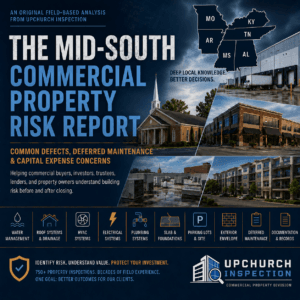
Upchurchinspection serves commercial property owners and investors across the Mid-South with thorough evaluations that go well beyond a basic checklist. We work under accepted standards including CCPIA’s ComSOP, producing detailed reports that cover structural systems, HVAC, electrical, plumbing, life safety, and site conditions. Our inspectors hold qualifications that exceed state standards, and every report includes the documentation detail you need to make informed decisions, negotiate with confidence, and plan capital expenditures accurately. Whether you are acquiring a property, managing an existing portfolio, or preparing for a lease renewal, regular commercial inspections are the most direct way to protect your investment. Contact Upchurchinspection to schedule your commercial inspection services today.
FAQ
What does a commercial inspection cover?
A commercial inspection covers structural systems, roofing, plumbing, electrical, HVAC, interior components, site conditions, life safety systems, and specialty equipment. Reports under CCPIA’s ComSOP often run 50–150 pages with photographs and capital reserve tables.
How is a commercial inspection different from a residential inspection?
Commercial inspections are larger in scope, more complex in systems reviewed, and produce significantly more detailed documentation than residential inspections. A residential-style checklist is insufficient for evaluating a commercial property’s risk and condition.
How often should commercial properties be inspected?
Inspection frequency depends on building age, type, and occupancy risk. Newer buildings may need inspections every 2–3 years, while older buildings and high-risk uses like restaurants or factories warrant annual evaluations.
What is ComSOP and why does it matter?
ComSOP is CCPIA’s internationally accepted standard for commercial property inspections, defining scope, reporting practices, inclusions, exclusions, and ethics across nine core sections. Reports produced under ComSOP are more defensible and reduce disputes between buyers, sellers, and lenders.
What information do i need to schedule a commercial inspection?
Provide the property address, square footage, building age, known conditions or concerns, and any ancillary inspection needs such as environmental or specialty system reviews. Clear scheduling details allow the inspector to prepare the right scope and allocate sufficient time.