
TL;DR:
- A pre-purchase inspection is an independent evaluation of a property’s visible condition performed before buying to identify potential issues. It provides critical leverage for negotiations, repairs, or withdrawal, especially when conducted prior to contract exchange. Different types of inspections serve varied purposes, with limitations that buyers must understand to make informed decisions.
Before you sign anything, before you wire a single dollar, you need to know exactly what you’re buying. A pre-purchase inspection, known in the industry as a building inspection or home inspection, is the independent evaluation that stands between you and a costly mistake. Many buyers treat it as a formality. It isn’t. The inspection is the only moment in the transaction when a qualified professional physically examines the property on your behalf and documents their findings. Understanding what this process covers, when it occurs, and its limits will make you a significantly more confident buyer or investor.
Table of Contents
- Key takeaways
- What is a pre-purchase inspection and what does it cover
- Timing and role within the home buying process
- Types of inspections and how they differ
- Limitations and common misconceptions
- How to conduct a pre-purchase inspection effectively
- My perspective on getting inspections right
- How Upchurch Inspection supports your next purchase
- FAQ
Key takeaways
| Point | Details |
|---|---|
| Know the definition | A pre-purchase inspection is an independent assessment of a property’s visible condition completed before purchase commitment. |
| Timing determines leverage | Inspections done before contract exchange give buyers the most power to negotiate, adjust offers, or withdraw. |
| Not all inspections are equal | Standard home inspections, pre-inspections, and Property Condition Assessments serve different audiences and purposes. |
| Reports have real limits | Inspectors can only evaluate what is visible and accessible; hidden defects behind walls are not covered. |
| Attend and ask questions | Buyers who attend the inspection and engage the inspector directly get far more value from the report. |
What is a pre-purchase inspection, and what does it cover
A pre-purchase inspection is an independent assessment of a property’s physical condition, completed before a buyer commits to the purchase. The inspector is hired to evaluate what is present and visible on the day of the inspection, without any obligation to the seller. That independence is the entire point. Their job is to tell you what they see, accurately and without softening the findings to protect a deal.
According to guidance from the NSW Government on pre-purchase inspections, a standard building inspection covers major visible issues including rising damp, structural cracks, safety hazards, and faulty roofing. In the American context, the scope is similarly broad. A typical home inspection covers:
- Structural components: foundation, framing, load-bearing walls
- Roofing: shingles, flashing, gutters, and visible drainage
- Plumbing: supply lines, fixtures, water heater condition, and visible waste lines
- Electrical: service panel, wiring condition, outlets, and safety compliance
- HVAC systems: heating and cooling equipment, ductwork, and filter conditioning
- Interiors: floors, ceilings, walls, windows, and doors
- Exterior: grading, siding, walkways, and decks
Beyond these systems, some inspections also include health-related evaluations for mold, radon, asbestos, and lead paint. These are typically add-on services, not automatically included, so you need to ask about them specifically when booking.
Pro Tip: Request that mold and radon testing be added to your inspection when you schedule it, not after. Many inspectors need extra equipment or subcontractors, and adding these services at the last minute can delay your report.
The pre-purchase inspection, at its core, means this: it is a risk-disclosure tool. The report does not determine the property’s market value. It documents the condition. That distinction matters when you interpret the findings.
Timing and role within the home buying process
Most buyers schedule a home inspection after their offer is accepted but before closing. The inspection typically happens during a negotiated contingency period, usually 7 to 14 days after contract execution. What you do with the report during that window shapes the rest of the transaction.
The inspection report as a contingency works in three practical ways:
- Request repairs: You can ask the seller to fix specific items identified in the report before closing. This works best for safety issues or major system failures.
- Negotiate a price reduction: Instead of repairs, you can request a credit or price adjustment to cover the cost of addressing deficiencies yourself after closing.
- Withdraw from the purchase: If findings reveal problems significant enough to change your assessment of the property’s value or risk, you can walk away without penalty, provided your contract includes an inspection contingency.
Experienced buyers and investors often pursue a pre-inspection, which is the same scope as a standard home inspection but done before making a formal offer. An early pre-inspection lets you factor known issues into your offer price from the start. In competitive markets, this can strengthen your offer because you signal that you will not renegotiate after the fact.
Regional practices vary. In some markets, sellers conduct their own pre-listing inspections to disclose issues upfront and accelerate offers. In others, buyers are expected to conduct their own due diligence exclusively. Understanding the norms in your market helps you time this step correctly. Your real estate agent and your inspector should both be able to advise you on local expectations. You can also review how inspections affect transactions to understand the broader strategic picture.
Types of inspections and how they differ
Not all inspection types serve the same purpose, and confusing them is one of the more expensive mistakes buyers make. Here is how the three most common types break down.
| Inspection Type | Scope | Primary Users | Key Deliverable |
|---|---|---|---|
| Standard home inspection | Visible systems and components | Homebuyers | Written condition report |
| Pre-inspection | Same as standard, done before offer | Competitive-market buyers | Condition report used for offer pricing |
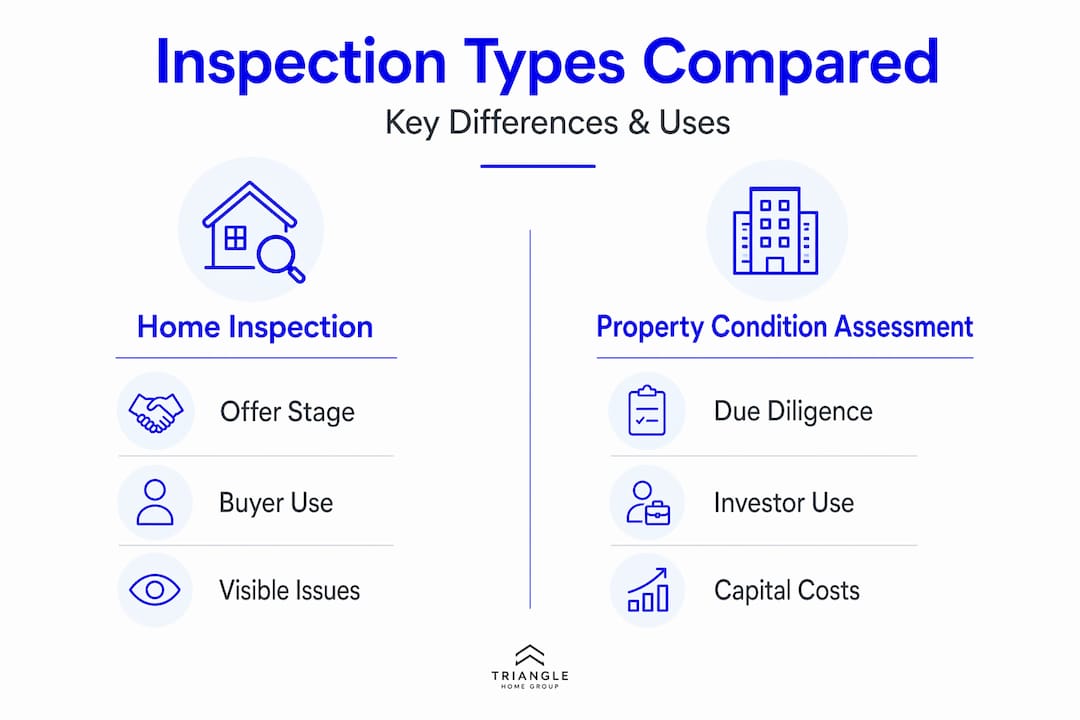
| Property Condition Assessment (PCA) | Detailed evaluation with capital cost projections | Investors, lenders, commercial buyers | Investment-grade analysis and multi-year cost forecasts |
The standard home inspection and the pre-inspection are functionally identical in scope. The difference is timing and intent. A pre-inspection happens before an offer, giving the buyer knowledge to price correctly from the start. A standard inspection happens after an offer, during the contingency period.
The Property Condition Assessment, or PCA, is a different category entirely. Governed by ASTM E2018-24 standards, a PCA provides capital cost projections spanning multiple years, identifies deferred maintenance, and evaluates regulatory compliance. Investors purchasing multifamily or commercial properties need a PCA, not a home inspection. Using a standard home inspection for an apartment complex is like using a general practitioner to diagnose a complex cardiac condition. The scope simply does not match the need.
Pro Tip: If you are buying a duplex, triplex, or any income-producing property, ask your inspector whether they conduct PCAs. A standard checklist will not capture the deferred maintenance or capital reserve needs that determine whether the investment actually pencils out.
Mixing up these inspection types leads to under-budgeting, missed compliance issues, and misaligned expectations. The pre-purchase inspection checklist for a fourplex looks very different from the one for a single-family home.
Limitations and common misconceptions
The biggest misconception buyers carry into a purchase is that a clean inspection report means the property is problem-free. It does not. It means the inspector found no significant issues in the visible and accessible areas on the day of their visit.
Building reports reveal faults only in what inspectors can physically see and reach. The following are examples of what a standard inspection cannot assess:
- Conditions behind finished walls, ceilings, or under concrete slabs
- Underground plumbing and buried utilities
- Roofing areas that are inaccessible or unsafe to walk on
- Electrical systems are concealed inside walls
- Issues that only manifest under specific weather or load conditions
Every credible inspection report includes a limitations section. Most buyers skip it. That section tells you exactly what the inspector could not evaluate and often flags where specialist follow-up is warranted. Ignoring it is like reading only the test results your doctor ordered and skipping the notes about what was not tested.
A home inspection report is a snapshot of visible conditions on one specific day. It is not a warranty, and it is not an exhaustive audit of every system in the building. Treat it as a starting point for further questions, not a final verdict.
Waiving the inspection contingency to make an offer more competitive is a real risk that experienced investors understand clearly. You lose not just the information, but also the legal leverage to renegotiate or exit the contract without financial penalty. In hot markets, some buyers feel pressured to waive. If you do, at minimum, commission a pre-inspection before submitting your offer so you are not flying blind.
How to conduct a pre-purchase inspection effectively
If you want to get the most from this process, you need to treat it as active participation rather than a service you order and wait for. Here is how to approach it with the right preparation:
- Commission the inspector yourself. Never rely on an inspector recommended exclusively by the seller or the listing agent. You need an inspector whose obligation runs entirely to you, not to the closing of the transaction.
- Prepare your property access list. If you are the seller or have access arrangements in place, confirm that all areas are accessible before inspection day, including the attic, crawl space, electrical panel, and mechanical rooms.
- Attend the inspection in person. Buyers who attend the inspection understand the property’s systems at a level that reading a report alone cannot deliver. Walk with the inspector. Ask questions as they examine each system.
- Read the full report, including limitations. Do not skip to the defects list. The limitations section tells you where specialist evaluations may be needed.
- Ask your inspector to clarify repair timelines. Inspection reports often include estimated repair urgency and sometimes cost ranges, which directly inform how you negotiate.
- Use the report strategically in negotiations. Prioritize safety issues and major system failures in your repair requests. Minor cosmetic items rarely move sellers and can make your requests look less credible.
Pro Tip: Ask your inspector which items they would address immediately and which are acceptable to monitor. That distinction gives you a practical framework for prioritizing your repair request list.
A well-prepared buyer can turn a thorough inspection into thousands of dollars in negotiated concessions or, at minimum, a realistic picture of what ownership will cost. For more detailed preparation guidance, the buyer’s preparation guide at Upchurch Inspection walks through this process step by step.
My perspective on getting inspections right
I have seen buyers treat the inspection as a box to check rather than a tool to use. That approach costs them money, sometimes serious money, within the first year of ownership.
What I have learned from working on and reviewing property evaluations across the Mid-South is this: most buyers focus on the defect count in the report. They read the list length and assume that a longer report means a worse property. That framing is almost always wrong. Inspection reports naturally skew toward documentation of flaws. That is the inspector’s job. A 47-item report on a well-maintained property and a 12-item report on a property with one catastrophic foundation problem are not comparable by count.
What matters is the severity and cost implication of the findings, not the volume. Investors especially need to internalize this. A property with 30 minor deferred maintenance items may be a better investment than one with 5 items if one of those 5 is a failed HVAC system serving multiple units.
My advice: read every section of the report, understand the inspector’s scope limitations, and then commission specialist evaluations for anything they flagged as outside their purview. The inspection is the map. What you do with that map determines your outcome.
— Holly
How Upchurch Inspection supports your next purchase
At Upchurch Inspection, we conduct full home inspections and investor-grade property condition assessments across the Mid-South, covering both residential and commercial properties. Our inspectors exceed state licensing standards, and our reports go beyond checklists. We document what we find, flag what we cannot access, and give you the context to act on the findings with confidence. Whether you are a first-time homebuyer evaluating a single-family property or an investor analyzing a multifamily acquisition, we build our reports to inform real decisions. A pre-purchase home inspection from Upchurch Inspection is the clearest picture of a property you will get before you own it.
FAQ
What is a pre-purchase inspection?
A pre-purchase inspection is an independent assessment of a property’s visible condition, completed before a buyer finalizes the purchase. It covers major systems including structure, roofing, plumbing, electrical, and HVAC, and is used to inform negotiation or withdrawal decisions.
Do I need a pre-purchase inspection for a new-construction home?
Yes. New construction homes can still have defects in workmanship, insulation, electrical wiring, and grading. An independent inspection before closing protects your interests regardless of the builder’s quality assurance claims.
What is the difference between a pre-inspection and a standard home inspection?
Both cover the same scope, but a pre-inspection happens before you submit an offer, while a standard home inspection occurs during the contract contingency period. The pre-inspection allows buyers to price offers accurately from the start.
What does a Property Condition Assessment cover that a home inspection does not?
A PCA includes multi-year capital cost projections, deferred maintenance analysis, and regulatory compliance considerations, making it the appropriate tool for investors purchasing commercial or multifamily properties rather than owner-occupied homes.
Can I skip the inspection to make my offer more competitive?
Waiving the inspection contingency removes your legal right to renegotiate or exit the contract based on findings. If market pressure requires it, commission a pre-inspection before submitting your offer so you understand the property’s condition before committing.