TL;DR:
- New homes often conceal defects that can cost thousands of dollars to repair if not properly inspected during construction. Conducting phased inspections at pre-pour, pre-drywall, and final stages helps identify issues early before they become costly or hidden permanently. Understanding the differences between code and home inspections, and scheduling each phase appropriately, protects your investment and ensures long-term quality in your new home.
New homes look finished and flawless at closing, but that polished appearance can hide serious defects that cost thousands to fix after you move in. Multiple phase inspections are the standard approach for new construction, covering the foundation, framing, and final walkthrough at distinct stages rather than a single visit like you’d schedule on a resale home. If you’re buying new construction in Tennessee, Arkansas, Mississippi, or Southeast Missouri, understanding how these phases work and why each one matters is one of the most important steps you can take before you sign at closing.
Table of Contents
- Why new construction homes still need inspections
- The three critical phases of new construction inspection
- Code inspections vs. home inspections: Understanding the difference
- Common issues found, and why timing matters
- A seasoned inspector’s take: What most people get wrong about new construction
- How Upchurch Inspection can help you safeguard your new home investment
- Frequently asked questions
Key Takeaways
| Point | Details |
|---|---|
| Multi-phase protection | Three-phase inspections catch hidden defects new homes can hide at each construction milestone. |
| Beyond code compliance | Home inspections uncover quality and functional issues that may be overlooked by city code checks alone. |
| Timing is crucial | Inspections must be timed before finishes conceal problems—especially at the pre-drywall stage. |
| Common new home defects | Missing insulation, poor wiring, foundation cracks and HVAC errors are frequent even in new builds. |
| Inspector experience matters | Choose inspectors with clear standards and phase expertise for the most reliable results on your investment. |
Why new construction homes still need inspections
The most common mistake buyers make is assuming a new home equals a problem-free home. Builders operate under real pressure: deadlines are tight, crews rotate, and high-volume construction communities can stretch quality control thin. That combination creates conditions where defects are not just possible but genuinely common.
Consider what happens when a home goes through its first summer and winter. HVAC systems run under full load for the first time. Soil settles beneath the foundation. Moisture infiltrates poorly sealed joints. These are the moments when defects surface after systems have been stressed and exposed to environmental pressure. You won’t see these issues during a builder walkthrough, and the builder’s representative has no incentive to volunteer them.
Here are some realities that often surprise first-time new construction buyers:
- Fast-paced builds move quickly through critical stages, leaving little time for quality checks between phases.
- Subcontractors work independently, meaning the framing crew, the electricians, and the plumbers may never coordinate directly on problem areas.
- Builder warranties sound reassuring but have limits. They often exclude cosmetic items, systems wear, and issues that surface outside narrow time windows.
- Move-in day enthusiasm can override due diligence. Buyers get caught up in the excitement and skip third-party verification.
Pro Tip: Schedule an 11-month warranty inspection before your builder’s warranty expires. Many structural and mechanical issues don’t show up until the home has been occupied for several months.
“A new home is not a guarantee of quality. It’s an invitation to verify quality before the opportunity to fix problems at no cost disappears.”
Sewer line defects are a clear example of this principle. Newly installed sewer lines in new subdivisions are sometimes poorly graded, back-pitched, or damaged by heavy equipment during site work. These issues rarely show up on a builder’s checklist, but they are costly to repair once landscaping and driveways are in place. A professional inspector looks specifically for these conditions at the right stage of construction.
The three critical phases of new construction inspection
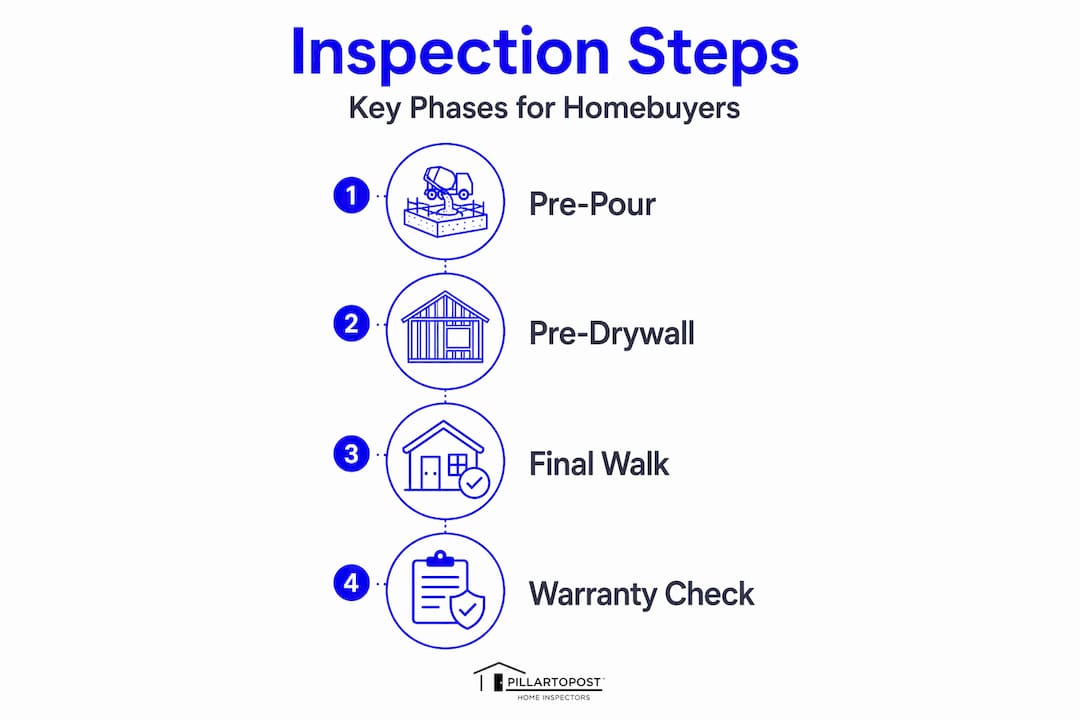
New construction inspections are structured around three distinct phases, each timed to catch specific types of defects before they become impossible to access or expensive to repair. Skipping any phase is not a minor shortcut; it’s a decision to leave potential problems permanently hidden.
Here’s how each phase is structured:
Pre-pour foundation inspection. This happens before the concrete is poured for the slab or foundation walls. The inspector evaluates site preparation, form placement, and steel reinforcement layout. Once concrete is poured, there is no cost-effective way to verify what’s underneath.
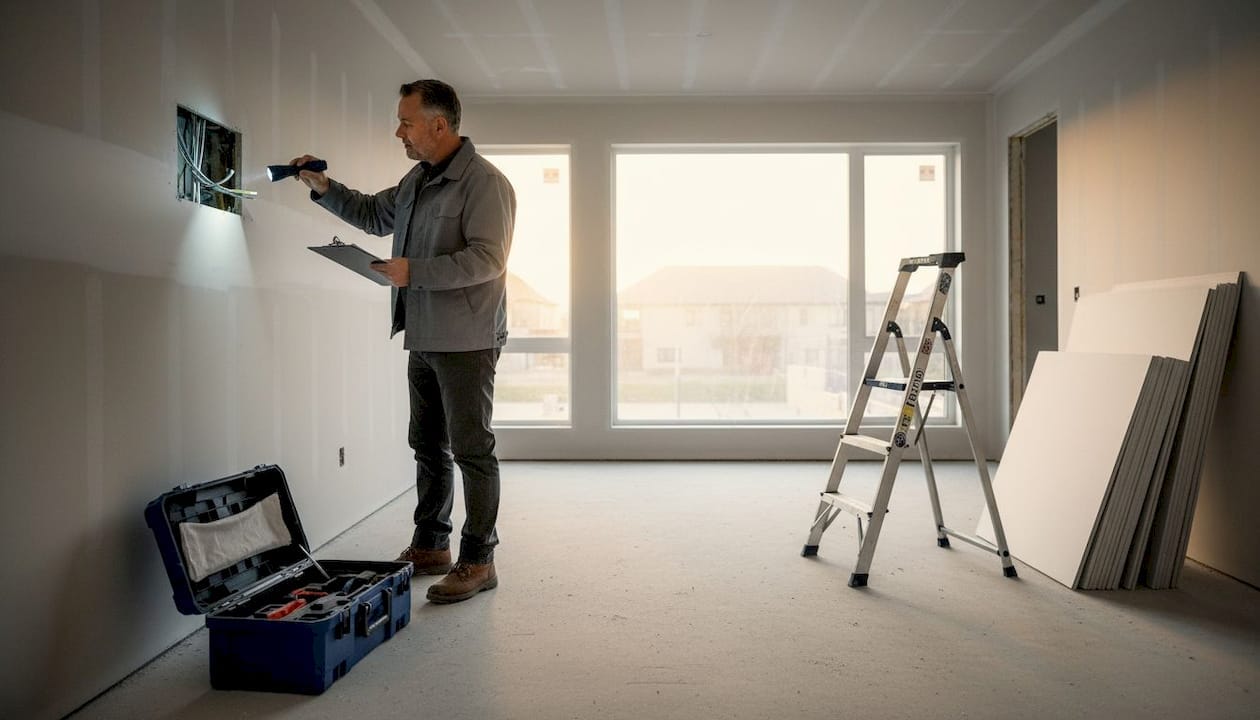
Pre-drywall framing and rough-in inspection. This is the most critical phase of the entire process. The inspector examines structural framing, electrical wiring, plumbing supply and drain lines, HVAC ductwork runs, and moisture barrier installation before insulation and drywall close everything off. A misplaced wire, an improperly supported pipe, or a gap in the moisture barrier can generate serious damage over years of occupancy. Once drywall goes up, you would need to cut it open to access any of these systems.
Final pre-closing inspection. After the home is substantially complete, the inspector evaluates all installed systems under normal operating conditions: electrical panels and outlets, HVAC performance, plumbing pressure and drainage, windows and doors, grading and drainage around the exterior, and the overall condition of finished surfaces. This phase also confirms that any items flagged in earlier phases were actually corrected.
| Phase | Timing | Primary focus | Risk if skipped |
|---|---|---|---|
| Pre-pour | Before foundation pour | Site prep, forms, rebar | Structural foundation defects hidden permanently |
| Pre-drywall | Before insulation/drywall | Framing, wiring, plumbing, HVAC, moisture barriers | Concealed system defects with no access |
| Final | Before closing | All systems, finishes, drainage | Performance issues accepted without remedy |
Pro Tip: Coordinate directly with your builder to notify you when each phase milestone is approaching. Builders are not required to contact your inspector, so the scheduling responsibility falls on you.
Foundation and drywall issues that appear after closing are often traceable to problems that were visible and fixable before the pour or before drywall installation. Catching them at the right stage costs very little. Repairing them after the fact can mean cracked walls, uneven floors, and five-figure repair bills.
Small findings that signal larger problems show up frequently in new construction. A slightly bowed stud may indicate improper lumber drying. A screw popping through drywall at move-in can suggest truss movement. These aren’t cosmetic nuisances; they are early indicators of structural or moisture conditions that get worse over time.
Code inspections vs. home inspections: Understanding the difference
A lot of new construction buyers assume that if the home passed its municipal code inspections, a third-party home inspection would be redundant. This is one of the most costly misconceptions we encounter in our work.
Code inspections and home inspections serve entirely different functions. Municipal code inspectors are government employees enforcing minimum legal safety standards at specific construction milestones. They are checking that the work meets the floor, not the ceiling, of acceptable quality. They are not evaluating workmanship quality, installation precision, or long-term system performance.
A private home inspector hired by the buyer works from a different mandate. They assess:
- Installation quality, not just minimum compliance
- Workmanship, including fit, finish, and proper fastening
- System performance, such as whether HVAC airflow is balanced and adequate for the home’s square footage
- Moisture conditions, including potential water intrusion points that meet code on paper but will leak under real weather conditions
- Drainage and grading, which affects foundation performance over years
- Integration between systems, where the work of two different subcontractors may each pass code separately but create a combined problem
| Inspection type | Performed by | Legal authority | Focus |
|---|---|---|---|
| Code inspection | Municipal official | Enforcement | Minimum safety compliance |
| Home inspection | Certified private inspector | Advisory | Workmanship, quality, performance |
Inspection scope and limitations matter here too. A private inspector cannot enforce code corrections or compel a builder to act. What they can do is document observable conditions in detail and give you the information you need to negotiate repairs before closing. That documentation has real leverage.
Choosing the right type of inspection for each situation also matters. Some new construction situations call for specialized evaluations beyond the standard phase inspection scope, particularly for homes with complex HVAC systems, custom structural elements, or sites with known drainage challenges.
Pro Tip: Always ask your inspector whether their process follows recognized professional standards. Inspection reports tied to clearly defined scope and methodology carry more weight in builder negotiations than a general narrative report with no stated standards.
“Municipal code inspectors and private home inspectors are not doing the same job. One confirms legality, the other confirms quality. You need both.”
Common issues found, and why timing matters
Understanding what inspectors actually find on new construction sites puts the value of phase inspections into sharp focus. These are not rare or exceptional cases. They come up on a regular basis across new construction communities throughout the Mid-South.
Pre-pour and foundation phase finds:
- Inadequate soil compaction before slab placement
- Rebar positioned incorrectly or missing entirely in specified zones
- Poor site drainage that will direct surface water toward the foundation
Pre-drywall phase finds:
- Missing or improperly installed moisture barriers in exterior wall cavities
- HVAC ductwork with unsealed joints that will leak conditioned air into wall cavities
- Wiring runs that violate clearance requirements or lack proper stapling support
- Plumbing drain lines with incorrect slope, which causes slow drains and eventual blockages
- Gaps in floor insulation that create thermal bypasses and high utility bills
Final phase finds:
- HVAC systems that are improperly sized or poorly balanced between zones
- Windows and doors that don’t seal or operate correctly
- Grading around the foundation that directs rainwater toward the home rather than away
- Incomplete attic insulation that was installed but not spread correctly
Defects found post-occupancy after environmental exposure and system stress represent a particularly important category. Many issues in new construction only become apparent once the home goes through a full weather cycle. This is exactly why an 11-month warranty inspection is valuable. It gives you one last look before the builder’s warranty closes.
Here’s the straightforward reality of timing:
- A defect found before foundation pour: corrected at no cost to you, minimal disruption.
- A defect found at pre-drywall: corrected before walls close, moderate effort, no lasting trace.
- A defect found at final walkthrough: corrected as a punch-list item, still builder’s responsibility.
- A defect found after closing: now your problem, your money, and your repair timeline.
Sewer line issues found after landscaping is complete are a textbook example of timing costs. The same repair that might have been a quick adjustment before the yard was graded becomes a significant excavation job once everything is finished. Timing is not just a scheduling convenience; it is a financial decision.
A seasoned inspector’s take: What most people get wrong about new construction
We want to be direct about something that most generic inspection guides won’t tell you.
A lot of buyers approach new construction inspections as a formality, something to check off the list so they can say they did due diligence. They schedule a single inspection at the end of the build, flip through a multi-page report they don’t fully understand, and assume everything is fine because the home looks new and clean. That approach leaves real money on the table and real risk in the walls.
Here’s what we observe from working on new construction projects across Tennessee, Arkansas, Mississippi, and Southeast Missouri: builder quality varies dramatically, even within the same subdivision. One crew does excellent framing work; the next cuts corners on moisture barriers. One electrical subcontractor is meticulous; another leaves open junction boxes in the attic. There is no uniformity, and there is no substitute for eyes on each phase.
We also see this pattern: buyers who skip the pre-drywall inspection because they “trust the builder” end up calling us twelve to eighteen months after closing when problems appear. By that point, the builder’s warranty may cover some items but rarely covers the investigative cost of finding out what went wrong or the collateral damage from delayed discovery.
Issues that look small but signal bigger problems are especially easy to overlook in a new home context. When everything is freshly painted and gleaming, a minor crack or a slightly stiff door reads as settling. Sometimes it is. But experienced inspectors know the difference between cosmetic settling and the early signature of a structural condition.
One more thing worth saying directly: inspection report quality varies considerably across the industry. A thick report with many photos doesn’t automatically mean a thorough inspection. What matters is whether the inspector’s process follows recognized professional standards, whether their scope is clearly stated, and whether their findings are documented with enough specificity to drive builder action. Page count is not quality.
How Upchurch Inspection can help you safeguard your new home investment
If you’re purchasing new construction anywhere in the Mid-South, Upchurch Inspection provides multi-phase inspection services timed precisely to the pre-pour, pre-drywall, and final stages of your build. We go well beyond a basic walkthrough, delivering detailed reports that clearly explain conditions across every major system in plain language you can actually act on. Our inspectors hold certifications that exceed state minimums, and we work closely with buyers, agents, and builders to ensure findings are addressed before they become permanent.
We also offer specialized inspection services including 11-month warranty evaluations, mold testing, sewer line inspections, and HVAC performance audits for new construction. If your builder is moving fast, that HVAC audit is especially worth your attention. Contact Upchurch Inspection today to schedule your phase inspections and protect your investment at every stage of the build.
Frequently asked questions
When should I schedule each phase of new construction inspection?
Phase inspections should be scheduled before the foundation pour, before drywall and insulation are installed, and again just before your closing date when all systems are fully installed and operational.
Is a new construction home inspection the same as a code inspection?
No. Code inspections are performed by municipal officials to verify minimum safety compliance, while a private home inspector hired by the buyer assesses workmanship quality, system performance, and issues that exceed or fall outside code scope.
What types of defects are usually found during new construction inspections?
Common findings include foundation preparation problems, post-stress defects in plumbing and HVAC, missing or improperly installed insulation and moisture barriers, and grading conditions that direct water toward the home.
Should I get a final inspection if my home passed all prior code checks?
Yes. Pre-drywall defects in electrical, plumbing, and HVAC may not be visible to code inspectors and only become apparent through performance testing after systems are fully operational. A final inspection also verifies that prior punch-list items were actually corrected.