
TL;DR:
- Improper inspection frameworks for multifamily properties can lead to costly surprises and deferred maintenance risks.
- Using standards like ASTM E2018 and HUD’s NSPIRE ensures comprehensive assessments that inform investment and negotiation strategies.
Buying or managing a multifamily property without the right inspection framework is one of the most expensive mistakes an investor can make. A standard home inspection simply was not designed for apartment buildings, mixed-use complexes, or portfolios with shared systems. Experienced investors and property managers in the Mid-South know that relying on the wrong standard exposes you to deferred maintenance surprises, costly capital expenditures, and missed negotiation leverage before closing. This guide walks through the inspection frameworks, standards, and practical strategies that protect your investment from the moment you start due diligence.
Table of Contents
- What makes multifamily inspections different?
- Frameworks and standards: What defines a robust multifamily inspection?
- What investors and managers should demand: Key focus areas
- Best practices: Inspection methodology, unit sampling, and risk reduction
- Why most multifamily inspections fall short—and what savvy investors do differently
- Connect with trusted multifamily inspection experts
- Frequently asked questions
Key Takeaways
| Point | Details |
|---|---|
| Residential vs. multifamily standards | Standard residential inspections miss critical risks in multifamily properties, especially shared systems and common areas. |
| Follow recognized frameworks | ASTM E2018 and HUD NSPIRE/UPCS provide reliable inspection and benchmarking standards for investments. |
| Investor-focused inspection essentials | Insist on findings tied to capex, deferred maintenance, and unit-level differences for actionable reports. |
| Comprehensive methodology matters | Full or targeted unit inspections and expert inspectors minimize surprises and reduce financial risk. |
| Benchmark with big data | Referencing HUD and NAHRO scoring data reveals frequent risk areas even for non-regulated properties. |
What makes multifamily inspections different?
The gap between a residential home inspection and a proper multifamily inspection is wider than most buyers expect. Standard residential inspections are scoped for simple, single-family transactions. They were built for consumers, not for investors managing capex across dozens of units or protecting lender-required due diligence on a $3 million acquisition.
The ASHI Standard of Practice applies only to one- to four-family dwellings, which means it excludes common areas, shared mechanical systems, site infrastructure, and larger-scale building systems. If you apply that standard to a 24-unit apartment complex, you are operating with an inspection scope that was never designed for the property type.
Here is what that gap looks like in practice:
- Common areas and corridors are excluded from residential inspection scopes but represent major liability and maintenance cost centers in multifamily buildings.
- Shared HVAC, plumbing stacks, and electrical panels may serve multiple units. A single failure point can cascade across the property in a domino effect, triggering simultaneous repair needs and tenant complaints.
- Site infrastructure including parking lots, exterior lighting, drainage, and retaining structures is typically outside residential inspection scope but directly impacts property value and operating costs.
- Life-safety systems such as fire suppression, emergency egress, and carbon monoxide detection require different expertise than a standard home walkthrough covers.
Relying on a consumer-grade residential inspection for a multifamily acquisition is not a cost-saving measure. It is a risk-creation decision that can cost far more than a proper inspection ever would.
Investors evaluating multi-unit deferred maintenance patterns need an inspector who understands how maintenance issues cluster across units and compound over time. Similarly, properties with commercial components require attention to mixed-use risks that standard residential inspections never touch. For a broader orientation on what professional property assessments involve, the commercial inspection guide provides a solid foundation.
Understanding the scope limitations of residential inspections is the first step. Understanding what frameworks replace them is what separates informed investors from those who get surprised at closing.
Frameworks and standards: What defines a robust multifamily inspection?
Two major frameworks govern professional multifamily inspections: ASTM E2018 and HUD’s NSPIRE/UPCS standards. Knowing how they work and when to apply them gives you a credible basis for due diligence that lenders, partners, and attorneys will respect.
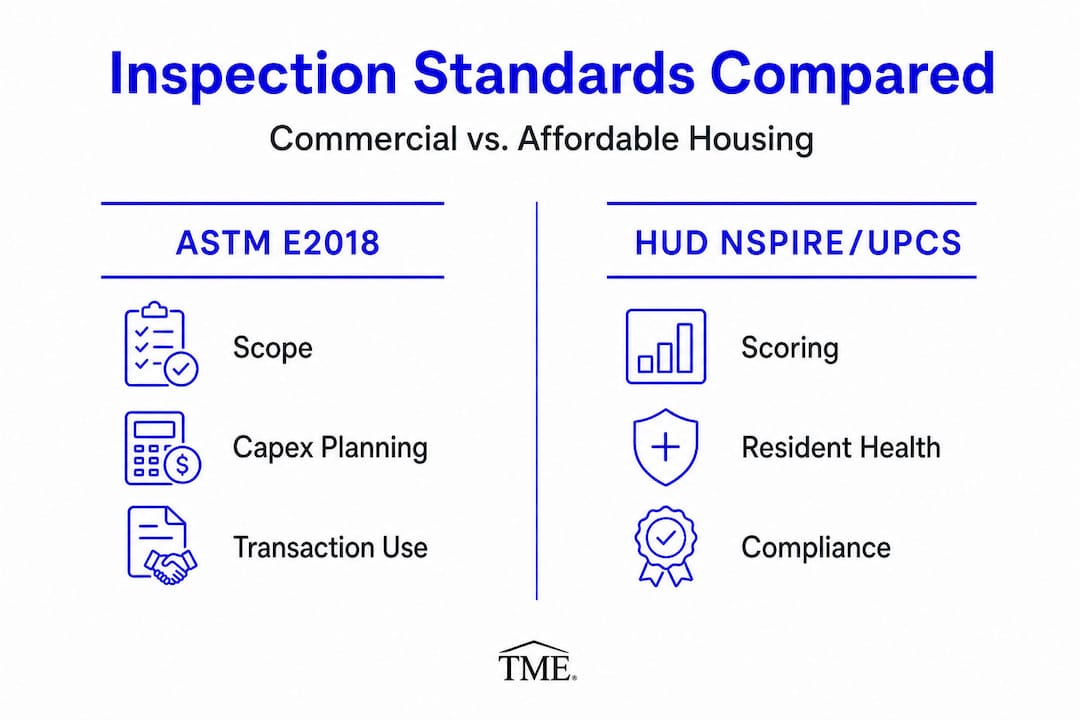
ASTM E2018 is the gold standard for transactional property condition assessments, defining the multifamily property inspection process for investors and lenders. It governs Property Condition Assessments (PCAs) and establishes what must be visually reviewed, what systems must be evaluated, and how findings should be documented and reported. ASTM E2018 includes scope for building structure and envelope, mechanical systems, electrical, plumbing, roofing, site improvements, and common areas. Critically, it requires inspectors to estimate the remaining useful life (RUL) of major systems and identify deferred maintenance with cost implications. This is the framework most commercial lenders require before approving financing.
HUD’s NSPIRE and UPCS standards take a different but complementary approach. These standards are used for scoring multifamily portfolios, and NAHRO’s data shows tens of thousands of recent results that can be used to benchmark risks and deficiencies across portfolios. Even if your property is not government-assisted housing, NSPIRE scoring data tells you what deficiency categories are most commonly found at what frequency. That benchmarking is genuinely useful for risk planning and investor reporting.
Here is how the three major frameworks compare:
| Feature | ASTM E2018 | ASHI SOP | HUD NSPIRE/UPCS |
|---|---|---|---|
| Property scope | All commercial and multifamily | 1 to 4 family residential only | HUD-assisted multifamily properties |
| Common areas | Included | Excluded | Included |
| RUL estimates | Required | Not required | Scoring-based assessment |
| Deferred maintenance | Documented with cost estimates | Not required | Identified by deficiency type |
| Mechanical systems | Full review across all systems | Limited to accessible areas | Inspected per scoring protocol |
| Life-safety systems | Included | Limited | Required |
| Best use | Investor/lender due diligence | Consumer home purchase | Regulatory compliance and benchmarking |
For properties that require specialized inspections beyond standard scope, including environmental screening or structural assessments, layering those onto an ASTM E2018-compliant PCA is standard practice on larger acquisitions. When it comes to HVAC, which is consistently one of the most significant capex categories in multifamily properties, a detailed HVAC inspection walkthrough illustrates exactly what a professional mechanical review should cover. A thorough understanding of multifamily HVAC requirements reinforces why this system category demands dedicated attention beyond what a checklist covers.
What investors and managers should demand: Key focus areas
Knowing the frameworks is important. Knowing exactly what to demand from an inspection report is what makes the difference when you are sitting across the table from a seller.
Investor-focused inspections prioritize remaining useful life, deferred maintenance, and code compliance, tying findings directly into capex planning and negotiation strategy. An inspection report that simply lists observations without quantifying cost implications is not adequate for investment-grade decisions.
The key building systems and focus areas that must appear in any credible multifamily inspection report include:
- Roofing systems: Age, condition, remaining service life, evidence of ponding water or prior repairs, and flashing integrity at penetrations.
- Structural components: Foundation walls, framing, visible deflection, and moisture intrusion evidence in crawl spaces or basements.
- Mechanical systems (HVAC): Unit-by-unit condition where applicable, shared system capacity, filter status, ductwork integrity, and service history. This is where the domino effect risk is highest. One aging shared chiller or boiler serving all units creates portfolio-wide exposure.
- Electrical systems: Panel age and capacity, breaker condition, grounding and bonding in common areas, and code compliance in older buildings, particularly those built before 1980 where aluminum wiring and Federal Pacific panels were common.
- Plumbing: Supply line material and age, drain line condition, water heater age and condition, and evidence of prior leaks or active moisture issues.
- Fire and life-safety systems: Sprinkler systems, fire extinguisher placement, emergency lighting, smoke and CO detector placement, and egress compliance.
- Site and grounds: Parking surfaces, drainage grading, exterior lighting, retaining walls, and ADA compliance items.
| Inspection area | Common deficiency | Capex impact |
|---|---|---|
| Roofing | End-of-life membrane or shingles | $8,000 to $40,000+ per building |
| HVAC (unit level) | Aging refrigerant equipment | $3,000 to $6,000 per unit |
| Electrical panels | Undersized or outdated service | $2,500 to $10,000 per building |
| Plumbing supply lines | Galvanized or polybutylene pipe | $5,000 to $25,000+ depending on scope |
| Foundation | Settlement or moisture intrusion | Highly variable, $10,000 to $100,000+ |
| Life-safety | Missing or expired suppression systems | $5,000 to $50,000 depending on code |
Understanding deferred maintenance patterns in older building stock helps set realistic expectations about what categories carry the most risk. The anatomy of a thorough inspection also reinforces why methodical, system-by-system documentation matters for building a reliable picture of total investment needs.

Pro Tip: Request that your inspection report include cost-range estimates for each deficiency, not just observations. An estimate does not need to be a contractor bid. It just needs to be specific enough to inform your capex model before closing.
Reviewing HVAC system reliability benchmarks before your inspection gives you a working framework for evaluating what the inspector finds against realistic service life expectations for your market.
Best practices: Inspection methodology, unit sampling, and risk reduction
How an inspection is executed matters just as much as what standards it follows. The biggest operational risk in multifamily due diligence is sampling too few units and walking away with a false sense of confidence.
Sampling fewer units can materially understate risks because problems tend to cluster. A plumbing issue affecting one building corner often affects all units stacked above and below that same drain line. Inspecting only the units the seller makes available can leave the worst-condition units completely hidden from your report.
Here is a structured approach we recommend for executing a multifamily inspection that reduces your exposure to missed risks:
- Start with scope planning. Define which systems and areas require inspection and match that scope to either ASTM E2018 or an equivalent commercial-grade standard before scheduling.
- Request access to all units. Make full unit access a condition of your contract. If the seller resists, treat that resistance as a red flag. Vacant units and units belonging to month-to-month tenants tend to reveal the most about actual property condition.
- Prioritize mechanical rooms and common areas. These areas carry the highest concentration of shared system risk and are often where deferred maintenance accumulates without tenant-generated complaints to flag it.
- Conduct unit-by-unit documentation. Use consistent notation for each unit inspected, noting HVAC condition, plumbing fixtures, moisture evidence, and appliance age. This creates a baseline for forecasting replacement cycles.
- Engage specialists where needed. Structural, environmental, and electrical issues sometimes require discipline-specific experts beyond a generalist inspector. Know when to bring in additional assessments.
- Map findings to your capex model. An inspection report is only as useful as what you do with it. Every finding with a cost implication should feed directly into your investment model and inform your negotiation position.
Pro Tip: Always include vacant and hard-to-schedule units in your inspection scope. These are frequently the units with the most deferred maintenance, and they represent your first capex exposure after closing if conditions go undetected.
Reviewing systemic multifamily risks specific to apartment complexes gives investors a practical lens on where issues are most likely to surface and what systemic patterns repeat across aging stock in the Mid-South market.
Why most multifamily inspections fall short—and what savvy investors do differently
Here is an uncomfortable observation: most multifamily inspections are still treated as a checkbox exercise rather than a genuine due diligence tool. We see it regularly in this market. An investor schedules a walkthrough of a few representative units, gets a report describing surface conditions, and interprets the absence of red flags as confirmation that the property is in reasonable shape.
That approach protects no one. A checklist inspection on a 30-unit building is essentially a guess with documentation attached.
The investors who consistently avoid costly post-closing surprises do something fundamentally different. They treat the inspection as a data collection exercise, not a pass/fail test. They want to know the age and condition of every major system, the realistic remaining service life of roofing and mechanical equipment, and a credible range of what repairs and replacements are likely to cost in the next three to five years. That information shapes the offer price, the financing structure, and the property management plan from day one.
One underutilized strategy is benchmarking your findings against HUD NSPIRE and UPCS data, even if your property has no government assistance component. These scoring systems have generated large datasets on deficiency frequency and severity across multifamily properties nationally. Knowing that a certain percentage of properties of a similar age consistently fail on a specific system category gives you a realistic baseline for evaluating what the inspector found, and for anticipating what they may have missed.
The other critical mistake we see is over-reliance on seller disclosures. Disclosures reflect what the seller knows and chooses to share. They are not a substitute for independent inspection findings. Properties with documented deferred maintenance patterns rarely advertise that fact in a seller disclosure document.
Steps that experienced investors follow to protect their capital:
- Require ASTM E2018-compliant scope for all transactions above a certain dollar threshold.
- Insist on access to every unit before finalizing inspection scope.
- Demand RUL estimates and cost ranges for all material findings.
- Use NSPIRE benchmarking data to calibrate risk expectations before the inspection.
- Build capex reserves based on inspector-estimated system timelines, not seller-provided maintenance records.
The investors who treat inspection findings as negotiation data consistently close at better prices and manage fewer post-closing surprises. That is not coincidence. It is the direct result of investing in the right inspection process upfront.
Connect with trusted multifamily inspection experts
At Upchurch Inspection, we work directly with investors and property managers across the Mid-South who need more than a basic walkthrough. Our commercial-grade inspections are structured to address the full scope of major systems, common areas, deferred maintenance, and life-safety concerns that matter for investment decisions. Whether you are evaluating a four-unit rental or a larger apartment complex, we apply inspection standards that give you actionable data, not just a list of observations. Explore our specialized inspection options to understand how we structure commercial and multifamily work. If you are newer to the process, our overview of what to expect from inspections is a useful starting point. And if deferred maintenance is your primary concern, our investor guide to deferred maintenance provides region-specific context for what we see most in the Mid-South market.
Frequently asked questions
What is typically included in a multifamily property inspection?
A multifamily inspection covers major systems including structure, roofing, plumbing, electrical, HVAC, common areas, life safety, and deferred maintenance, with the ASTM E2018 baseline guiding the visual review of primary building systems and components.
How does a multifamily inspection support investment decisions?
It identifies capital needs, risk exposures, and negotiation leverage by quantifying deferred maintenance and estimating system life cycles, since inspections estimating remaining useful life and deferred maintenance directly inform capex modeling and valuation.
Do I need to inspect every unit in a large property?
Inspecting all units is ideal because guidance is to inspect every unit if feasible; if that is not possible, sampling should include all vacant and hard-to-access units to reduce the chance of missing clustered issues.
Is a standard home inspection sufficient for multifamily buildings?
No. The ASHI SOP applies only to one- to four-family dwellings and excludes common areas and large-scale shared systems, making it inadequate for investment-grade multifamily due diligence.
How can HUD’s NSPIRE scoring benefit non-HUD multifamily owners?
NAHRO’s NSPIRE dataset provides benchmarks on common deficiencies and scoring trends that help all property owners identify portfolio-wide risks, even when no government assistance is involved.
Recommended
- Inspecting Cape’s Rental Market: The Investor’s Guide to Multi-Unit Deferred Maintenance – Upchurch Inspection
- Commercial Property Inspection Guide: Confident Investments in 2026
- Shelby County Multi-Family Risks: Identifying Systemic Risks in Apartment Complexes – Upchurch Inspection
- Investor Renovations vs. Owner Renovations: Key Differences Buyers Should Understand – Upchurch Inspection