
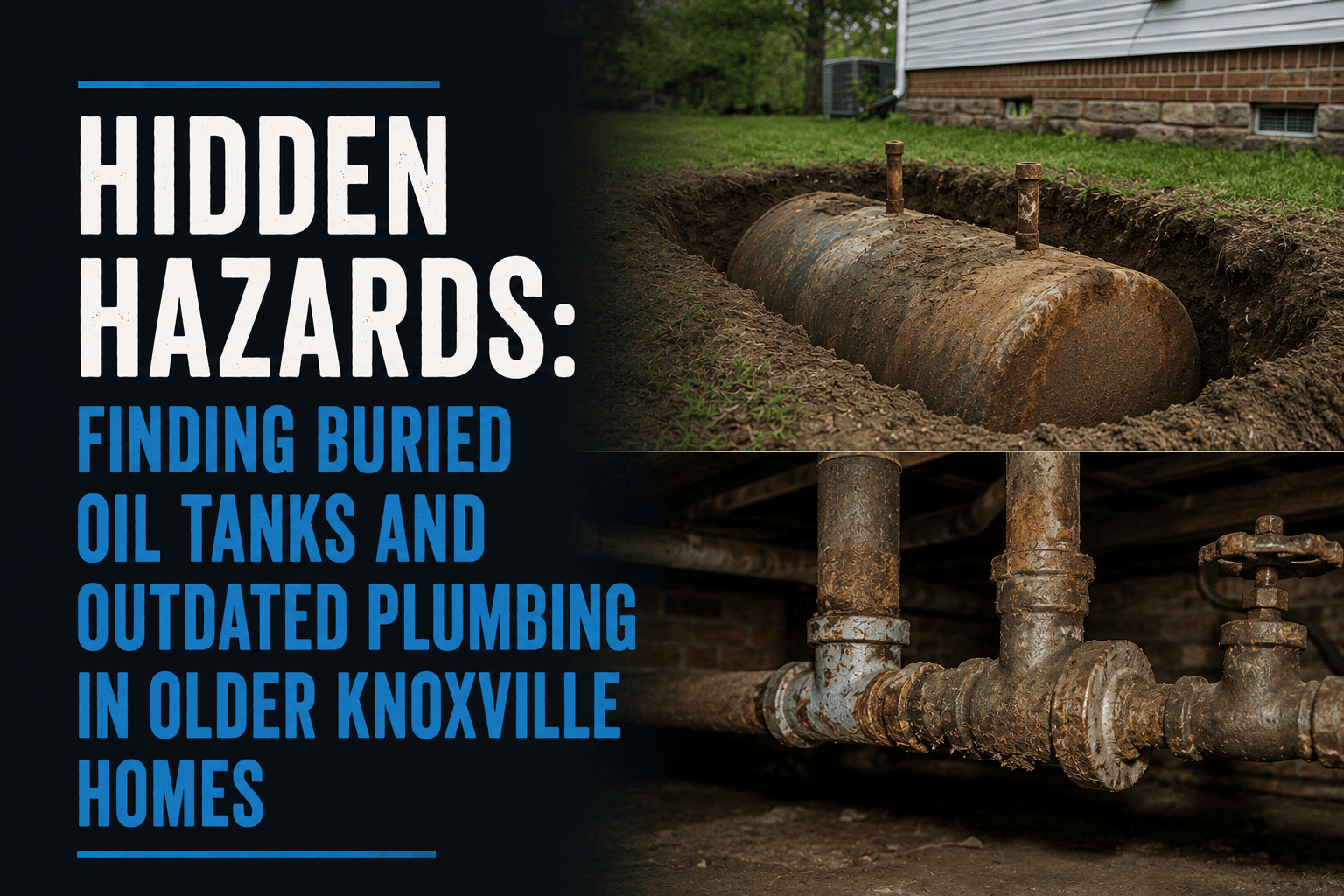
There’s a specific kind of pause that happens when I’m reviewing certain Knoxville inspection reports. It’s not the “that’s bad” pause. It’s the “okay, slow down, this one matters” pause.
Those almost always involve older homes. And more often than not, they involve two things buyers rarely think about until they’re staring straight at them in black and white:
buried oil tanks and old plumbing systems that never quite retired.
If you’ve spent any time around older Knoxville neighborhoods—especially near elevated areas like Sharp’s Ridge Memorial Park—you’re surrounded by houses that were built for a completely different energy and infrastructure reality than the one we live in now. That doesn’t make them bad houses. It just means they come with ghosts.
And those ghosts are usually underground.
The “What Do You Mean There’s a Tank?” Moment
I’ve lost count of how many buyers thought oil heat was something from old movies until our Knoxville inspector pointed out the signs.
Here’s the thing: a lot of homes built before the 1960s in East Tennessee originally used fuel oil for heating. Gas wasn’t everywhere. Electric heat wasn’t practical yet. Oil was common.
When those systems were converted—usually to gas or electric—the tanks didn’t always leave with them.
They were:
- Left in place and abandoned
- Buried and forgotten
- Cut off but never properly decommissioned
And decades later, nobody remembers they’re there.
Until they become your problem.
How Buried Oil Tanks Actually Get Found
This isn’t Hollywood. We’re not stumbling across giant metal drums every week. Most buried tanks get discovered in much more mundane ways.
Our Knoxville inspector has flagged them because:
- There’s a suspicious fill pipe near the foundation
- Old oil lines enter the crawlspace wall
- Ground depressions exist where nothing should be sinking
- Sellers mention “there used to be oil heat, I think”
One report that sticks with me involved a home where the yard had a subtle low spot—nothing dramatic. The buyer thought it was settling soil. Turns out it was a corroded tank collapsing inward.
That’s not cosmetic. That’s environmental.
Why Buried Oil Tanks Are a Big Deal (Even If They’re Empty)
An abandoned oil tank isn’t just an old metal container. It’s a potential liability.
Even “empty” tanks often aren’t empty. Residual oil, sludge, and corrosion products remain. Over time, tanks rust. Seams fail. Contents leak into surrounding soil.
And once oil contaminates soil, things escalate quickly.
Our inspector doesn’t test soil—that’s outside a home inspection—but when signs point to a buried tank, the recommendation is never casual. Because remediation is not cheap, and responsibility usually lands with the current property owner.
I’ve reviewed reports where buyers were blindsided by removal estimates after closing. Five figures. Sometimes more.
That’s a hard way to learn about a heating system you never planned to use.
“But the House Has Gas Now” Doesn’t Mean You’re Clear
This is where people get tripped up.
Just because the home has modern HVAC doesn’t mean the past is gone.
Our Knoxville inspector has documented homes with:
- Gas furnaces installed in the 1980s
- Oil tanks buried since the 1940s
- No records of removal or abandonment
- Sellers who genuinely didn’t know
Nobody’s lying. They just didn’t know what to look for.
That’s why inspection context matters.
Outdated Plumbing: The Other Hidden System
If buried oil tanks are the headline risk, outdated plumbing is the slow-burn story that quietly causes damage for years before anyone realizes it.
Older Knoxville homes often have plumbing systems that are a timeline, not a system.
You’ll see:
- Galvanized steel supply lines
- Copper added in phases
- PVC patched in later
- Cast iron drains still doing heavy lifting
Nothing wrong with upgrades. The problem is partial upgrades.
Galvanized Pipes: The Quiet Flow Killers
Galvanized supply lines are still present in a surprising number of Knoxville homes. And they rarely fail catastrophically.
They fail by:
- Corroding from the inside
- Restricting water flow
- Creating pressure imbalance
- Trapping sediment
Our inspector has documented cases where water pressure at one fixture was fine and terrible at another—same house, same system. The issue wasn’t the fixtures. It was pipe diameter reduced by decades of corrosion.
Buyers often assume it’s a “city pressure” issue. It’s not.
It’s internal rust doing what rust does.
Mixed Plumbing Materials = Mixed Expectations
One of my personal red flags in these reports is when I see three or four pipe materials tied together.
It usually means:
- Repairs were reactive
- Sections were replaced only when they failed
- No full-system planning ever happened
Our Knoxville inspector has shown me plumbing systems where copper transitions to galvanized with dielectric fittings that weren’t doing their job, accelerating corrosion instead of preventing it.
From the outside, the plumbing “works.” From the inside, it’s aging unevenly—and unpredictably.
Cast Iron Drains: Still Working… Until They’re Not
Cast iron drain lines are common in older Knoxville homes, especially in basements and crawlspaces.
Here’s the thing about cast iron: it gives you very little warning.
It corrodes from the inside. Scaling builds up. The pipe thins. Eventually, the bottom of the pipe becomes a trough instead of a tube.
Our inspector has scoped or visually documented cast iron drains that looked fine externally but were nearly shot internally. No leaks yet. No backups yet.
That “yet” is doing a lot of work.
Why Plumbing Leaks Hide Better in Older Homes
Older homes weren’t built with modern moisture barriers, engineered lumber, or drywall systems. When plumbing leaks occur, water spreads differently.
It soaks into:
- Plaster
- Old subflooring
- Masonry
- Wood framing without treatment
And it does so quietly.
I’ve reviewed reports where moisture readings were elevated near kitchens or bathrooms, but no visible damage existed yet. That’s the danger zone. The one where repairs are still manageable—if you catch them.
Crawlspaces Tell the Truth
If you want to know how plumbing has been behaving, crawlspaces don’t lie.
Our Knoxville inspector spends a lot of time under older homes because that’s where:
- Old supply lines run
- Drain connections exist
- Evidence of past leaks shows up
Rust flakes. Staining. Temporary patches. Improvised supports. These are all breadcrumbs.
One report showed a “repaired” drain line held together with a rubber coupling that was never meant to be permanent. It worked. Until it didn’t.
Why These Issues Get Missed in Walkthroughs
Buyers don’t crawl. Sellers don’t highlight buried tanks. And outdated plumbing doesn’t show itself unless someone goes looking.
That’s why I get frustrated when people treat inspections like formalities.
These aren’t cosmetic defects. They’re legacy systems with financial consequences.
The Knoxville Context Matters
East Tennessee homes age differently. Soil moisture. Humidity. Freeze-thaw cycles. All of it affects underground and in-wall systems more aggressively than people expect.
A house near ridge lines, older infrastructure corridors, or long-established neighborhoods has simply lived more life underground.
Ignoring that doesn’t make it go away.
The Wes Take
I love older Knoxville homes. They’ve got soul. They’ve got history. They’ve got craftsmanship you don’t see anymore.
But history comes with baggage.
Buried oil tanks and outdated plumbing don’t show up in listing photos. They don’t creak when you walk by. They don’t wave red flags at open houses.
They sit quietly, doing their thing, until someone finally asks the right questions.
That’s what good inspections do. They don’t scare people. They inform them.
And when our Knoxville inspector sends me reports that dig into these hidden systems—literally and figuratively—I know buyers are getting something far more valuable than reassurance.
They’re getting the full story.