There are certain inspection photos I can recognize instantly, even before I read the address. Dark, round sewer camera frame. Hairy-looking obstructions creeping in from the edges. Water backing up just enough to blur the image.
When our Knoxville inspector sends me those photos, nine times out of ten the report says the same thing somewhere near the top:
Old North Knoxville.
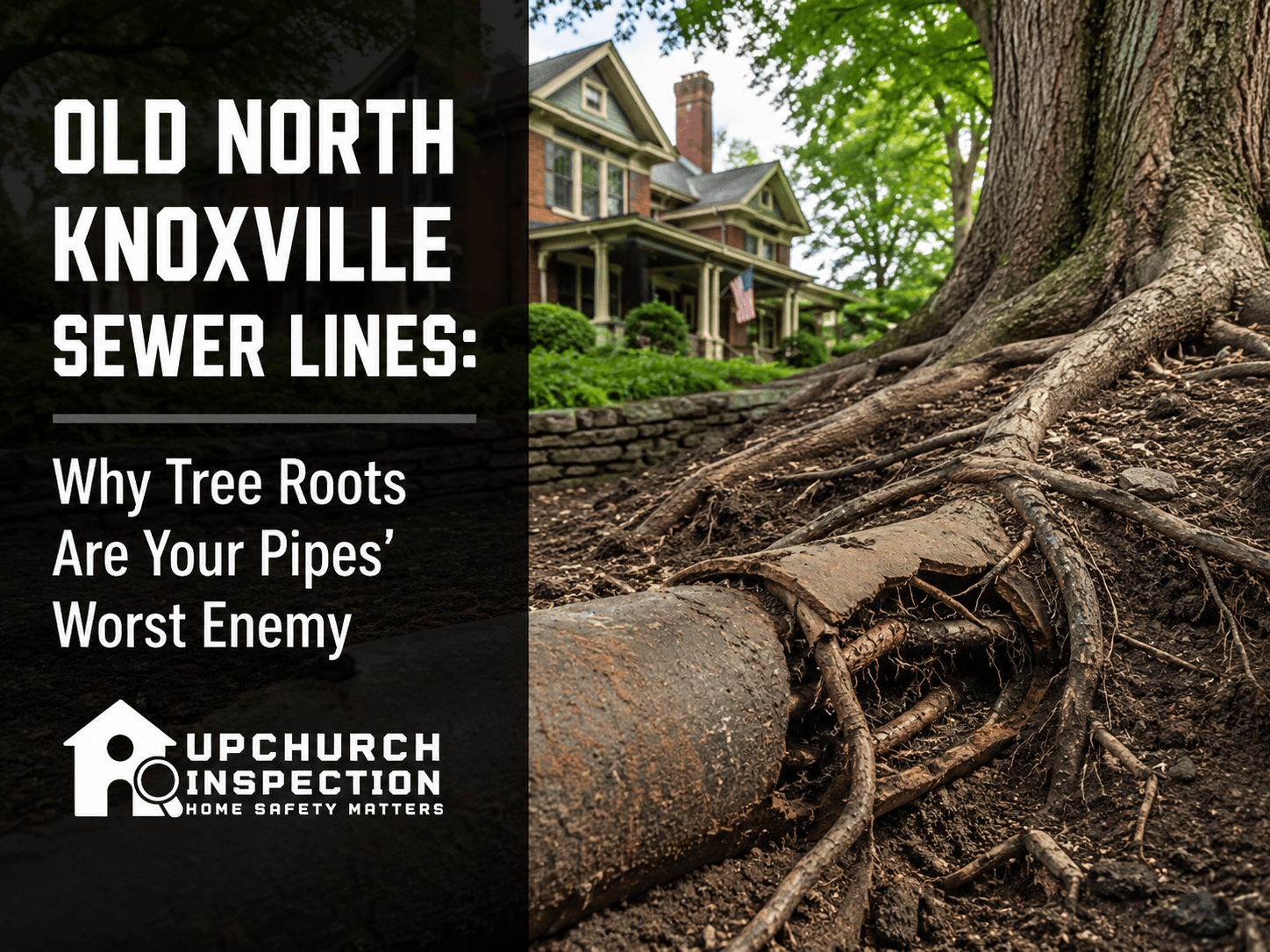
If you inspect enough homes in Old North Knoxville, you stop asking if tree roots are in the sewer line and start asking how bad they are.
This isn’t bad luck. It’s math, age, and biology all working together.
Old Neighborhoods Have Old Pipes — That’s Not an Insult
Old North Knoxville is one of those neighborhoods people fall in love with immediately. Mature trees. Walkable streets. Houses with character instead of vinyl sameness. I get it. I like these houses too.
But most of these homes were built long before anyone thought about PVC sewer lines, glued joints, or root-resistant materials. Original sewer laterals here are commonly:
- Clay tile
- Cast iron
- Early concrete
- Mixed materials from partial replacements
Those materials worked fine when they were new. The problem is that roots don’t age out of the equation—pipes do.
Why Tree Roots Love Sewer Lines (More Than Your Yard)
Tree roots don’t go hunting for pipes because they’re bored. They’re looking for water and nutrients. And an old sewer line is basically a subscription service for both.
Here’s what our Knoxville inspector sees over and over:
- Tiny cracks at clay pipe joints
- Separated sections from soil movement
- Corroded cast iron thinning from the inside
- Old repairs that created uneven transitions
Once even the smallest gap forms, roots move in. Not aggressively at first—just exploratory. Then they thicken. Then they multiply. Eventually, they don’t just intrude… they occupy.
I’ve reviewed sewer scope footage where roots filled 30–40% of the pipe diameter. The homeowner had no idea. Toilets flushed fine. Drains “mostly” worked. That’s the dangerous phase—when failure hasn’t announced itself yet.
The “It Drains Fine” Trap
One of my least favorite sentences in real estate is:
“We’ve never had a problem with it.”
Of course you haven’t. Sewer lines don’t fail like water heaters. They fail slowly, quietly, and then all at once.
Our inspector scoped one Old North Knoxville home where the line was functioning—technically. Waste was squeezing past root masses like water through reeds. But the slope had changed just enough that solids were starting to hang up.
That line wasn’t broken. It was counting down.
The next heavy rain, the next big family dinner, or the next toilet paper-heavy guest visit would’ve been the moment it stopped cooperating.
Clay Pipes + East Tennessee Soil = Movement
East Tennessee soil expands, contracts, shifts, and drains unevenly depending on season and rainfall. That movement matters underground just as much as it does at foundations.
Clay sewer pipes don’t flex. They crack. Joints separate. Sections drop.
Our inspector frequently notes offsets in Old North Knoxville sewer lines—where one pipe section has sunk slightly below the next. Roots love those offsets. They create ledges where debris catches and moisture lingers.
Once that happens, root growth accelerates. It’s not theoretical. We see it constantly.
Cast Iron Isn’t Immortal Either
Some Old North Knoxville homes have cast iron sewer lines, and people hear “cast iron” and relax. Big mistake.
Cast iron corrodes from the inside out. You don’t see it until the wall thickness is gone. By the time the camera shows heavy scaling or channeling, the pipe is already compromised.
Our inspector has scoped cast iron lines where the bottom of the pipe was essentially gone—waste flowing through a rusted trough. From the yard? Nothing looked wrong.
That’s why sewer scopes matter here. You cannot infer underground condition from above-ground calm.
Trees Aren’t the Enemy — Proximity Is
I don’t blame the trees. Old North Knoxville has some gorgeous ones. But when massive root systems exist within a few feet of aging sewer lines, physics wins.
Our inspector often notes sewer lines running directly beneath mature trees that were planted long before the current owner ever moved in. The roots didn’t “cause” the problem—the pipe invited them.
And cutting the tree doesn’t fix the pipe. I’ve seen reports where trees were removed years earlier and roots were still actively growing inside the line. Once the pathway exists, it stays active.
Partial Repairs Create New Problems
One of the most common—and frustrating—findings I see in Old North Knoxville sewer reports is partial replacement.
Someone replaced the section near the house. Or the section near the street. Or just the collapsed portion.
Now you have:
- PVC tied into clay
- Clay tied into cast iron
- Different pipe diameters
- Uneven slopes
Those transition points become the new failure zones. Roots target them. Debris collects there. Offsets form faster.
Our inspector documents these mixed-material lines carefully because they’re not inherently wrong—but they are higher risk.
Why Sewer Scoping Is Non-Negotiable Here
In some markets, sewer scopes are “nice to have.” In Old North Knoxville, I consider them baseline due diligence.
I’ve reviewed too many reports where:
- The home inspection looked clean
- The basement was dry
- Plumbing fixtures worked fine
- And the sewer line was one clog away from excavation
That’s not drama. That’s pattern recognition.
Sewer line replacement isn’t a $500 repair. It’s often invasive, disruptive, and expensive—especially in established neighborhoods with mature landscaping and limited access.
Knowing before you close matters.
What Our Inspector Looks For on the Camera
When I review sewer scope reports from Old North Knoxville, I’m not just looking for the word “roots.” I’m looking for:
- Root density and location
- Pipe material and age indicators
- Offsets and bellies
- Evidence of prior cutting or jetting
- Structural integrity of the pipe wall
A few wispy roots near the street aren’t the same as a root mass under the slab. Context matters.
The Rain Factor Nobody Talks About
Heavy rains in East Tennessee don’t just affect basements and crawlspaces. They affect sewer lines too.
When soil becomes saturated, it shifts. Pipes move. Joints open wider. Roots exploit the opportunity.
Our inspector has documented sewer lines that looked borderline in dry conditions and actively obstructed after prolonged rain. That’s why timing matters—and why a single clean scope doesn’t guarantee long-term performance if the line is already compromised.
Why Old North Is Especially Vulnerable
Old North Knoxville combines all the risk factors:
- Older pipe materials
- Mature trees
- Shifting soils
- Partial repairs over decades
- Limited cleanout access
None of that makes it a bad place to buy a home. It just means buyers need better information than they think.
The Wes Bottom Line
I love Old North Knoxville homes. I really do. But if you buy one without scoping the sewer, you’re gambling with blinders on.
Tree roots aren’t a hypothetical problem here. They’re a known one. They don’t care how charming the house is, how well the seller maintained it, or how many times “it’s never backed up.”
When our Knoxville inspector sends me a sewer scope from Old North, I don’t skim it. I study it. Because underground failures don’t give warning labels—they give invoices.
If you want to enjoy the trees in Old North Knoxville, make sure they’re not enjoying your sewer line more than you are.